



 sales@resultfirst.com
 +1-888-512-1890
SEO for Personal Injury Lawyers: How to Win High-Value Local Cases

Personal injury SEO is a blood sport. If your agency is bragging about “traffic growth” while your intake team is sitting on their hands, you’re being sold a bill of goods. In this niche, traffic is cheap; signed cases are expensive. We aren’t just trying to rank; we are fighting to control the three-second window when someone’s life just got upended and they need a shark, not a blogger.
As high-stakes YMYL searches raise the bar for trust and authority, firms increasingly need a Law Firm SEO service provider that ensures their expertise, credibility, and local relevance are unmistakable to Google at the exact moment case decisions are made.
Most firms hit a ceiling because they’re playing by standard SEO rules in a YMYL (Your Money or Your Life) environment that demands a much higher trust threshold. This isn’t about volume; it’s about Search Equity. It’s about building a digital footprint so authoritative that Google has no choice but to put you in the Map Pack when a high-value case is on the line.
Why SEO for Personal Injury Lawyers Is a High-Stakes Search Category
SEO for personal injury lawyers sits within one of the most sensitive search environments on the web. These searches often follow accidents, medical trauma, or financial stress, which means search engines apply higher standards before surfacing results. Visibility is not based on relevance alone. It depends on confidence that the firm being shown is legitimate, experienced, and appropriate for a high-impact legal decision.
Because of this, personal injury SEO behaves differently from most legal or service-based niches. Thin content, weak trust signals, or inconsistent local data may still rank elsewhere, but they struggle to sustain visibility here. Firms that understand this elevated bar are better positioned to compete for high-value cases without relying on short-term tactics.
Why Does SEO for Personal Injury Lawyers Matter for Case Acquisition
SEO matters for personal injury lawyers because search is where most high-value cases begin. People rarely discover injury attorneys through casual browsing or brand awareness alone. They search when something has already gone wrong and they need help quickly.
At that moment, visibility determines opportunity. Firms that are not present, not trusted, or not locally relevant are excluded from consideration altogether. SEO for injury lawyers is therefore not a marketing add-on. It is a case acquisition system. When executed correctly, it aligns local visibility with urgency, credibility, and intent resolution. When executed poorly, it creates activity without outcomes.
Read More: Why SEO Matters for Personal Injury Law Firms
How Local Intent Shapes Case Quality in Personal Injury SEO
Let’s be honest: Local intent isn’t a “predictor” of quality—it’s the filter that keeps you in business. If you’re a firm in Philly and you’re ranking for “truck accident lawyer” in Pittsburgh, you aren’t winning; you’re wasting your crawl budget.
High-value injury cases are won in the “Map Pack” trenches. When urgency hits, users don’t scroll past the first three results to read your 2,000-word blog post on the history of tort law. They look for proximity and Review Velocity. If you don’t have a recent, local trail of trust, you’re invisible to the people who matter most. In 2026, local SEO for lawyers is a fulfillment game. If you can’t prove you’re a local authority, Google will quietly bury your firm in favor of a competitor who’s actually active in the community.
Why Personal Injury Searches are Urgency-Driven
Most injury searches occur shortly after an incident or during an active dispute with insurers. The user’s priority is speed and reassurance, not research. This compresses the decision-making window and amplifies the importance of clear, local signals.
How Proximity and Availability Influence Attorney Selection
Proximity signals accessibility, while availability signals readiness. Firms that communicate both clearly outperform competitors with stronger brands but weaker local alignment. Search engines reward this alignment because it improves user outcomes.
Local SEO for Personal Injury Lawyers as a Competitive Advantage
Local SEO is not a subset of personal injury SEO. It is the competitive battleground. High-value cases are won market by market, not nationally. Firms that dominate locally often do so without ranking broadly across generic terms.
Local SEO for personal injury lawyers focuses on being visible where the firm can realistically serve clients and where intent converts into consultations. This includes map visibility, localized practice pages, local authority signals, and consistent engagement from nearby users. Firms that invest here build defensible visibility that competitors struggle to displace.
Google Business Profile as the Primary Conversion Layer
Stop obsessing over your homepage for a second. In the injury game, your Google Business Profile (GBP) is your actual storefront. For someone sitting in an ER or on the side of a highway, your website is a secondary thought. They’re looking at the Map Pack. If your review recency is stale or your ‘open now’ status is a lie, you’re invisible. Period. This isn’t ‘local SEO’—it’s fulfillment. If your GBP isn’t optimized for instant trust, you’re just spending money to help your competitors look better by comparison.
Search engines also rely on Business Profiles as high-confidence data sources because they provide structured, verifiable information tied to real-world behavior. For personal injury lawyers, this makes the profile a primary conversion surface rather than a supporting asset.
How Google Evaluates Injury Law Profiles Differently
Personal injury profiles are assessed with greater caution. Categories, review patterns, engagement signals, and accuracy all influence whether a firm is considered safe to recommend. Incomplete or inconsistent profiles are often suppressed quietly rather than penalized directly.
Category Selection for Personal Injury Practices
Categories determine eligibility. Selecting a precise primary category that reflects the firm’s core injury focus is essential. Broad or mismatched categories introduce ambiguity and weaken relevance.
Location Signals that Influence Map-Pack Visibility
Accurate addresses, consistent contact details, and correctly defined service areas reinforce local relevance. Even small inconsistencies can reduce map-pack exposure over time in competitive markets.
Authority Signals That Matter in SEO for Personal Injury Law Firms
Authority in personal injury SEO is built through focus and reinforcement, not volume. Search engines evaluate whether a firm demonstrates sustained expertise in injury law across its digital footprint.
Why Topical Authority Outweighs Content Volume
Publishing large amounts of generic legal content often dilutes relevance. Firms that concentrate on injury-related topics send clearer signals of specialization and competence.
Firm Identity, Expertise, and Credibility Reinforcement
Clear branding, attorney profiles, consistent practice focus, and reputable external mentions all reinforce authority. SEO for personal injury law firms works best when digital signals mirror real-world expertise rather than attempting to appear comprehensive across unrelated areas.
SEO for Personal Injury Law Firms vs Individual Attorneys
Search engines distinguish between firm-level entities and individual attorney entities. Understanding this difference is important for supporting both firm visibility and attorney credibility.
Firm-level SEO focuses on practice authority, local presence, and brand trust. Attorney-level visibility supports expertise and personal credibility, especially for name-based searches. Strategies differ in emphasis but should remain aligned. Confusion between the two often weakens both.
SEO for pi attorney should reinforce the firm’s authority rather than compete with it, ensuring that searches resolve to the most appropriate entity for the user’s intent.
Practice Area Pages That Attract High-Value Injury Cases
Most legal content is a total waste of crawl budget. If your practice area page reads like a Wikipedia entry on “Medical Malpractice,” you’ve already lost. High-value leads for lawyers aren’t looking for a history lesson; they are looking for a win. Your practice pages need to be “Decision Assets,” not informational blog posts.
One-intent-per-page Structure for Injury SEO
Stop trying to look “comprehensive” and start looking specialized. If you’re trying to rank for “Motorcycle Accidents” on a page that also talks about “Dog Bites,” Google’s backend won’t trust you for either. One intent, one page. Anything else just confuses the search engine and dilutes your topical authority.
Localizing Injury Pages Without Duplication
Don’t just swap out the city name in the H1 and call it “localized.” That’s “thin content” and a fast track to a rankings plateau. Your pages need to reflect the jurisdictional reality—mention local courthouses, specific regional accident stats, or local hospital recovery zones. Search engines reward uniqueness that aligns with real, boots-on-the-ground operational differences.
Trust Elements that Reduce Hesitation Before Contact
In a high-stakes search, users are scanning for “Expertise” and “Empathy,” not sales fluff. Avoid overly aggressive “Law-Marketing” speak—it reeks of desperation and undermines trust. A “ResultFirst” page uses clear process maps and realistic settlement expectations to lower the user’s blood pressure. If your page doesn’t make them feel “safe” within the first ten seconds, they’re hitting the ‘back’ button.
Local SEO Signals That Influence Injury Lawyer Rankings
Local SEO signals function as a validation system rather than isolated ranking factors. They help search engines confirm that a firm genuinely operates within a specific market.
NAP Consistency and Local Validation
Consistent name, address, and phone data across platforms reinforces legitimacy. Fragmentation quietly erodes trust over time.
Local links, Citations, and Community Authority
Mentions from reputable local organizations, legal associations, and community involvement reinforce prominence and relevance.
Behavioral Signals from Local Users
Calls, directions, and engagement from nearby users confirm that the firm is serving its market effectively.
Reviews as Trust and Conversion Multipliers
Reviews influence both algorithmic visibility and human choice, especially in personal injury law where emotional stakes are high.
Why Review Recency Matters more than Star Ratings
A steady flow of recent reviews signals ongoing activity and reliability. High ratings without recency often feel outdated.
How Review Responses Affect Credibility Signals
Thoughtful responses demonstrate accountability and attentiveness. Search engines analyze response behavior as a proxy for operational engagement.
Research from BrightLocal consistently shows that review quality and recency strongly influence local selection decisions in trust-sensitive industries.
Content Strategy for SEO for PI Lawyers
Content in personal injury SEO is not about broad education. It is about demonstrating competence and relevance.
Effective strategies focus on injury-specific explanations, local context, and clear process communication. Fewer, stronger pages often outperform frequent publishing schedules. SEO for injury lawyers benefits when content reinforces authority rather than expands into unrelated topics.
Technical SEO Foundations for Personal Injury Websites
Technical health isn’t about “perfection”; it’s about removing the friction between a victim’s crisis and your intake team. If your site is slow or confusing, you are effectively hanging up the phone on a lead before they even call.
Mobile Performance During High-Urgency Searches
Most high-value injury searches happen on a smartphone, often at the scene of an accident or in a hospital waiting room. If your page takes more than three seconds to load, you’re invisible. This isn’t just about “user experience”—it’s about availability. If your site introduces friction during a moment of peak urgency, that lead is going to your competitor.
Internal Linking as an Equity Funnel
Internal linking isn’t just for navigation; it’s about funneling search equity. Your “Car Accident” page should be the strongest node in your site’s backend. If you aren’t linking from your high-authority blog posts back to your core decision assets, you’re wasting your site’s power and confusing Google’s crawlers about what you actually do.
Avoiding the “Thin Content” trap
Shallow, 300-word legal pages are a liability. Consolidation is almost always better than expansion. If a page doesn’t offer enough depth to prove your expertise to a skeptical user (and a Google manual rater), it shouldn’t exist. Delete or merge thin pages to build a dense authority footprint that actually sustains visibility.
Learn More: Technical SEO for Lawyers
Link Acquisition Without Risk Exposure
In legal SEO, a single high-quality link from a local Bar Association or a regional news outlet is worth more than a thousand $50 guest posts.
Links that Reinforce Legal Credibility
Focus on earned equity. Editorial mentions, reputable legal directories, and local community sponsorships aren’t just links—they are digital affidavits of your firm’s legitimacy. These signals tell Google that you are a real-world entity with local prominence, which is the only way to survive a YMYL algorithm update.
Tactics that Quietly Damage Trust
Stop buying spam. Low-quality directories and aggressive link schemes leave a “lead gen” footprint that screams “untrustworthy” to Google. In the injury niche, “cheap” links are the most expensive mistake you can make. They don’t just fail to move the needle; they put your entire digital asset at risk of silent suppression.
Measuring SEO Success by Case Quality, Not Traffic
SEO success for personal injury lawyers should be measured by outcomes, not activity.
Metrics that Indicate High-Value Case Acquisition
- Calls from local organic and map results
- Consultation requests tied to injury pages
- Branded search growth within service areas
Why Rankings Alone Mislead Injury Firms
Rankings indicate visibility, not value. Case quality and consistency matter more than position changes.
The difference between activity and actual case-driving performance becomes clear when these principles are applied correctly. Here’s what that looks like in practice.
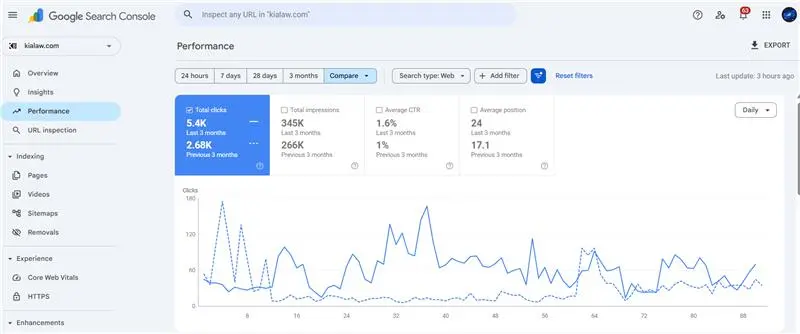
Growth Case Study: Kia Law
Kia Law, a growing legal services firm, partnered with ResultFirst to improve its visibility in competitive local search results and attract more qualified legal inquiries. Alongside organic growth, the strategy also focused on strengthening AI search presence and brand authority through mentions and citations.
Strategy Implemented
ResultFirst executed a focused local SEO approach that included:
- Google Business Profile optimization
- Local keyword targeting
- Citation building
- Reputation management
- On-page SEO improvements
Results (3-Month Growth)
Clicks: 2,675 → 5,396 (~101% increase)
Impressions: 266,261 → 345,307 (~29% growth)
Outcome: Improved local visibility, stronger brand presence across search and AI-driven platforms, increased citations and mentions, and a significant rise in high-intent organic traffic.
Looking to achieve similar results for your business? Get in touch with ResultFirst to build a data-driven SEO strategy tailored to your growth goals.
Scaling SEO for Multi-Location Personal Injury Firms
Multi-location firms face additional complexity.
Normalizing Performance Across Markets
Each market has different competition and demand. Normalization prevents misinterpretation of results.
Governance Challenges in Large Injury Practices
Central oversight with local flexibility allows firms to scale without losing authority signals.
The Plateau: Why Your Strategy is Stagnating
Plateaus occur when firms stop reinforcing trust signals. Review velocity slows, content becomes outdated, and competitors increase local investment. SEO for pi attorneys is a competitive system. Standing still often leads to gradual decline.
Explore More:
- SEO for Divorce Attorneys to Increase Consultations.
- SEO for Family Law Firms
- SEO for Criminal Lawyers
- SEO for Employment Law Attorneys
- SEO for Bankruptcy Law Firms
Conclusion
SEO for Personal Injury Lawyers is a precision system, not a volume play. Firms that align local visibility with trust, urgency, and legal credibility are more likely to attract consistent high-value cases than those chasing rankings alone.
As a performance-driven law SEO agency, ResultFirst approaches SEO for personal injury lawyers by focusing on local dominance, authority reinforcement, and measurable case outcomes rather than surface-level metrics.
For firms seeking sustained growth in competitive injury markets, ResultFirst builds SEO strategies that connect search visibility with real legal impact, helping personal injury practices compete effectively where it matters most.
FAQ’s:
WHAT TO READ NEXT
READY TO BUILD PREDICTABLE ORGANIC GROWTH?
We are the only TOP SEO services agency providing Real Results in a Real Performance model. We help growth hungry companies outperform their competition and achieve 300%+ growth in their digital marketing initiatives.
- San Jose, CA, 95120

- +1-888-512-1890

- sales@resultfirst.com

0K+
KEYWORDS RANKED
0M+
REVENUE GENERATED
0 Years
SOLVING COMPLEX SEO
0+
TEAM MEMBERS