



 sales@resultfirst.com
 +1-888-512-1890
BigCommerce SEO Guide: Strategy, Techniques, and Ranking Tips for 2026

BigCommerce powers more than 60,000 online stores in the United States and is the platform most commonly chosen by mid-market and enterprise ecommerce brands that need scalable infrastructure without a full custom development investment. Its SEO foundation is stronger out of the box than most platforms at its price point: automatic sitemaps, editable robots.txt, built-in 301 redirects, CDN-delivered assets, and SSL included on every store.
Platform capability and SEO outcomes are not the same thing. A store on BigCommerce still requires a deliberate, platform-specific SEO strategy to rank for the keywords US buyers use to find products in your category, attract qualified traffic from those rankings, and convert visitors into revenue.
This guide covers the full BigCommerce SEO strategy for US ecommerce brands in 2026. It starts with what the platform does well and where it creates challenges, moves through keyword strategy, technical optimization, and structured data implementation using BigCommerce’s native tools, and covers the AI Overview and LLM visibility layer that now sits above organic results for a significant share of product-related queries in the US. It also addresses the niche market approach that consistently outperforms broad category targeting for stores that have not yet built significant domain authority. For a broader ecommerce SEO context, see our ecommerce SEO guide.
Why BigCommerce Is Well-Suited for SEO
BigCommerce includes technical SEO capabilities that most competing platforms charge for separately or require plugin installation to access.
Automatic XML Sitemaps
BigCommerce generates and maintains XML sitemaps for product, category, and content pages without manual configuration. When pages are added or removed, the sitemap updates automatically. Submitting this to Google Search Console ensures new and updated pages are discovered promptly rather than waiting for Google’s crawl schedule to reach them naturally.
Editable Robots.txt
Store owners have direct access to edit the robots.txt file through the BigCommerce admin panel. This is not available on Shopify without a code workaround and requires developer access on most competing platforms. For US ecommerce brands managing large catalogs, robots.txt control matters for directing Google away from filter and sort parameter URLs that generate crawl waste and toward the product and category pages that generate revenue.
Built-in 301 Redirects
When a product or category URL changes, BigCommerce automatically creates a 301 redirect from the old URL to the new one. On platforms without this feature, URL changes create 404 errors that destroy accumulated ranking signals. The automatic redirect preserves link equity and search visibility through catalog changes that happen regularly on active ecommerce sites.
CDN-Delivered Assets
BigCommerce serves images and static files through a content delivery network by default. For US stores, this reduces page load time for visitors regardless of their location relative to the origin server.
Structured Data for Products
BigCommerce includes Product schema on product pages as part of the platform default. The default implementation covers core fields, but extended schema including ratings, availability, and price ranges requires additional configuration through Stencil templates or Script Manager. See the structured data section of this guide for the specific implementation steps.
SSL Included
HTTPS is active on every BigCommerce store. Google confirmed HTTPS as a ranking signal and it remains a baseline requirement for any page competing in organic search.
BigCommerce SEO Limitations and How US Stores Work Around Them
A complete BigCommerce SEO strategy requires understanding where the platform creates friction. Knowing these limitations before building a program prevents technical debt that surfaces months later when rankings are already affected.
Limited blogging functionality. BigCommerce has a native blog, but it lacks the content management depth of WordPress. There are no native blog categories, limited tag structure, and no plugin ecosystem for content-specific SEO tools like Yoast or RankMath. For US ecommerce brands where content marketing drives a meaningful share of organic traffic, this is a real gap. The most effective workaround is a headless content setup: BigCommerce powers the store while a WordPress installation on a subdomain (blog.yourstore.com) or subdirectory (yourstore.com/blog/) handles content. This preserves full editorial capability without migrating off BigCommerce for the storefront. The subdirectory setup passes more link authority to the store domain than the subdomain approach.
Duplicate content from product filters and sorting. BigCommerce generates separate URLs for filtered and sorted views of category pages. Without configuration, this creates hundreds of near-duplicate URLs that compete with each other and consume crawl budget that should go to primary category and product pages. Fix: configure robots.txt to disallow crawling of filter and sort parameter URLs, and add canonical tags on paginated collection pages pointing to the base category URL. This directs Google’s crawl budget toward the pages that generate organic revenue.
URL customization constraints. BigCommerce URLs follow a fixed structure. Product URLs always include /products/ in the path. Category and sub-category structures have limited nesting options. For most US ecommerce stores, this is not a meaningful ranking disadvantage. For brands with specific URL architecture requirements, the constraint exists and cannot be fully resolved within the platform.
No native staging environment. BigCommerce does not include a built-in staging environment for testing SEO changes before deploying them live. Testing a robots.txt update, a structured data change, or a theme modification on a live store carries risk. BigCommerce’s developer sandbox addresses this for stores with developer resources, but it requires additional setup that small US ecommerce teams may not have capacity to manage.
App dependency for advanced capabilities. BigCommerce’s core platform covers SEO fundamentals. More granular structured data management at scale, advanced redirect handling for catalogs with thousands of SKU changes, and custom analytics beyond the built-in reporting layer all typically require paid third-party apps from the BigCommerce app marketplace. For US brands planning a comprehensive SEO program, the total cost of platform plus required apps is a relevant budgeting input.
BigCommerce SEO vs. Shopify and WooCommerce: How the Platforms Compare
US ecommerce brands evaluating platforms or reconsidering their current setup ask a specific question: which platform provides the best starting position for organic growth? The answer depends on catalog size, available technical resources, and the type of SEO work the team will be doing.
BigCommerce vs. Shopify for SEO
BigCommerce provides direct robots.txt editing that Shopify restricts to theme-level code access. BigCommerce’s URL structure for categories and products is more flexible than Shopify’s rigid /collections/ and /products/ path architecture. Shopify generates a documented duplicate content issue between /products/ and /collections/ URL paths, where the same product page is accessible at two different URLs. Resolving this requires careful canonical tag management that BigCommerce’s structure avoids by design.
For US brands planning active technical SEO work on large catalogs, BigCommerce’s accessible technical controls are a practical advantage. For brands that prioritize a larger third-party app ecosystem and a more accessible admin interface for non-technical teams, Shopify remains a capable platform for SEO when managed with attention to its known structural issues. For US brands already on Shopify and not planning a migration, the priority is resolving the duplicate content issue rather than switching platforms.
For a full comparison across leading platforms, see the ResultFirst Best Ecommerce Platforms for SEO Guide.
BigCommerce vs. WooCommerce for SEO
WooCommerce on WordPress provides more structural SEO flexibility than either BigCommerce or Shopify because WordPress is an open, extensible platform. Complete URL control, native blogging with the full WordPress plugin ecosystem, and unlimited technical customization make WooCommerce the highest-ceiling option for SEO teams with developer resources available.
The practical difference: WooCommerce requires active management of plugins, hosting configuration, database performance, and security patching. These are ongoing costs in time and money. BigCommerce’s managed infrastructure removes this overhead while providing SEO-ready technical defaults that WooCommerce requires intentional setup to achieve. For US brands that want strong SEO capability without a dedicated developer, BigCommerce occupies a practical middle position between Shopify’s simplicity and WooCommerce’s flexibility.
1- Conduct Intent-Driven Keyword Research
Keyword research is no longer about collecting large keyword lists. It starts with understanding how and why customers search.
Begin by identifying:
- Informational intent (research, comparisons, guides)
- Commercial intent (evaluating products or categories)
- Transactional intent (ready-to-buy searches)
In BigCommerce:
- Category pages should target broader commercial terms
- Product pages should focus on specific, high-intent keywords
- Blog and guide content should support early-stage discovery
Use tools like Google Keyword Planner, Ahrefs, Moz, or KeywordTool.io to validate ideas, but always analyze the SERP. Look at shopping grids, filters, FAQs, and page types that rank to understand what Google expects for that query.
Semantic keyword research also matters. Related terms and supporting phrases help search engines better understand topical relevance and user intent.
2- Focus on On-page SEO
On-page SEO helps search engines and users clearly understand each page’s purpose.
Maintain Clean and Descriptive URLs
Your URLs should be readable, descriptive, and consistent.
For example:/womens-running-shoes/ is clearer than /product123/
In BigCommerce:
- Use clear category and product names
- Avoid unnecessary parameters or numbers
- Maintain consistent URL structures
Clean URLs support crawlability and user trust.
Optimize Headings and Page Titles
Headings and titles guide both users and search engines.
BigCommerce automatically generates headings based on product or category names, but you should:
- Ensure titles are descriptive and intent-aligned
- Include relevant keywords naturally
- Avoid keyword stuffing
Well-structured headings improve readability and reinforce topical relevance.
Write Effective Meta Descriptions
Meta descriptions do not directly influence rankings, but they strongly impact click-through rates.
Use them to:
- Clearly describe the page value
- Highlight differentiators like pricing, shipping, or selection
- Encourage clicks from competitive SERPs
BigCommerce allows you to customize meta descriptions for products and categories, which should not be overlooked.
3. Optimize Images for SEO and UX
Images are essential for eCommerce, but they must be optimized correctly.
Best practices include:
- Using descriptive file names
- Writing meaningful alt text for accessibility and image search
- Compressing images to reduce load times
For example, rename images before uploading rather than using default file names. Optimized images support both search visibility and conversion performance.
4. Use Structured Data to Enhance SERP Visibility
Structured data in Schema.org JSON-LD format tells Google and AI systems what type of content a page contains, what the product details are, and what signals of authority the page carries. For BigCommerce stores, structured data affects standard SERP appearance, Google Shopping rich results, AI Overview citations, and product recommendations in ChatGPT and Perplexity responses.
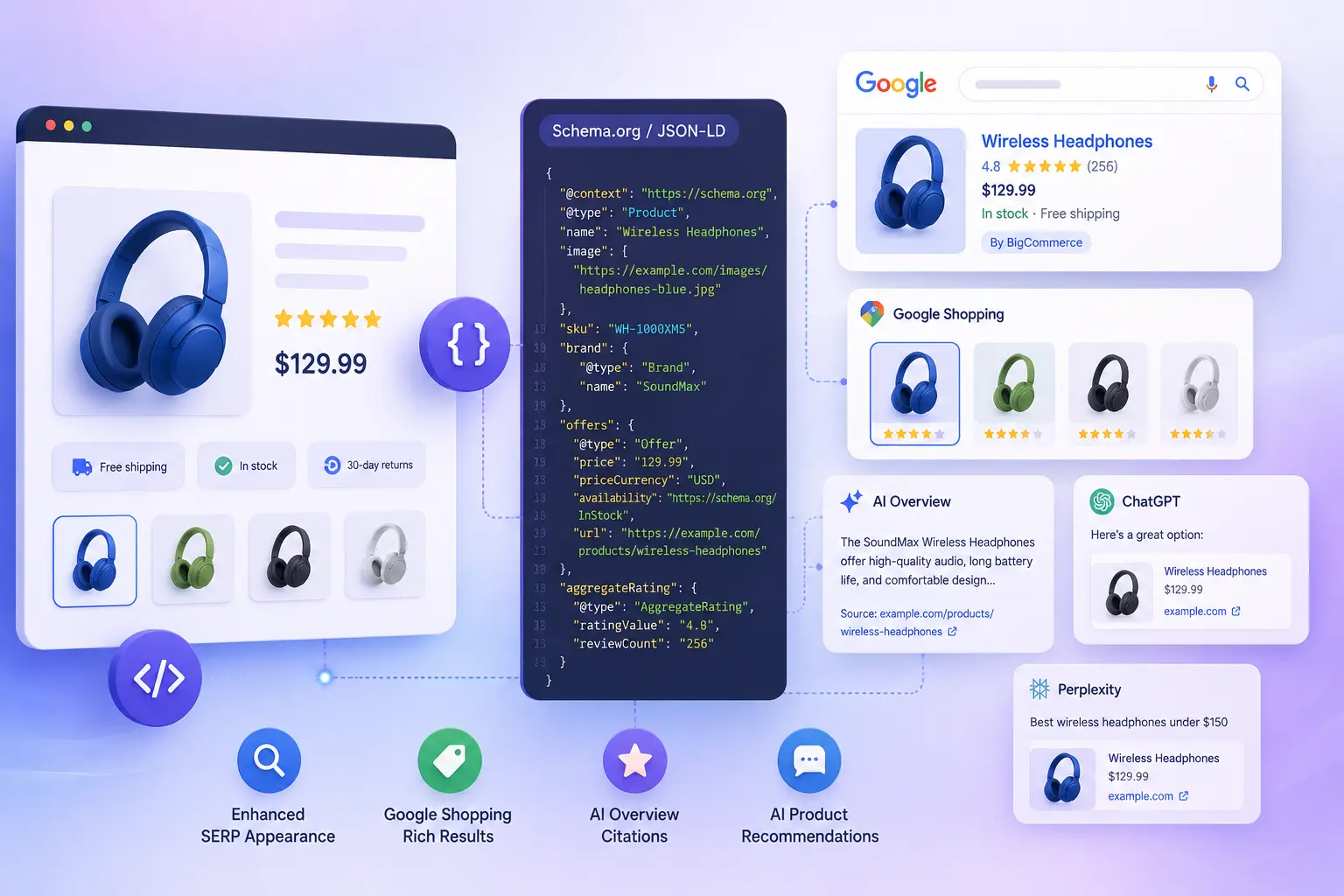
BigCommerce supports structured data implementation through three methods:
Method 1: Stencil Theme Templates
BigCommerce’s Stencil framework uses Handlebars templating to generate structured data dynamically from your product catalog. Product schema, breadcrumb schema, and review schema can be injected directly into product and category page templates to output dynamically populated JSON-LD for every page in the catalog without manual editing. This is the most scalable method for stores with hundreds or thousands of SKUs because it generates accurate, catalog-consistent schema for every product page automatically.
Method 2: Script Manager
BigCommerce’s Script Manager allows custom scripts to be added across specific page types without modifying theme code directly. For stores using a third-party theme or stores without developer access to the Stencil file structure, Script Manager provides a way to inject structured data scripts across all product pages, all category pages, or the homepage. No theme editing is required.
Method 3: Manual JSON-LD in Custom HTML Fields
For individual high-priority pages such as the homepage, key landing pages, and select category pages, structured data can be added directly to the page’s custom HTML field in the BigCommerce page editor. This approach is practical for a small number of pages but does not scale to catalog-level implementation.
Schema types to implement on every US BigCommerce store:
Product schema with these fields populated: name, description, brand, SKU, price, currency, availability, image URL, and aggregate rating. The availability field (in-stock, out-of-stock, pre-order) is frequently missing from default BigCommerce product schema and is a required field for Google Shopping rich result eligibility.
BreadcrumbList schema on all product and category pages. BigCommerce includes this in its default Stencil themes. Verify it is present and valid using Google’s Rich Results Test at search.google.com/test/rich-results.
Organization schema on the homepage: include organization name, logo URL, contact information, and social profile URLs. This supports entity recognition that AI search systems use to verify brand legitimacy when deciding whether to cite your store in product recommendations.
FAQPage schema on any page with question-and-answer content. Google no longer shows FAQ rich results for commercial content in standard search snippets as of August 2023, but FAQPage schema is actively used by Google’s AI Overview selection process and by Bing Copilot, Perplexity, and ChatGPT for citation matching.
Product description length for AI citation eligibility: Research on AI Overview citation patterns shows that product descriptions written as complete information paragraphs of 134 to 167 words are significantly more likely to appear in AI-generated product recommendations than pages that use only bullet lists or fragmented specifications. Write each product description to answer four questions: what is it, what does it do, who is it for, and what makes it different from the alternatives.
5. Improve Site Speed and Core Web Vitals
Google evaluates page experience using real user data collected through the Chrome browser via the Chrome User Experience Report (CrUX). These field measurements determine the page experience score that affects rankings. A site can pass a lab test in PageSpeed Insights while still failing field data if real mobile users experience slower connections or processing constraints on their devices.
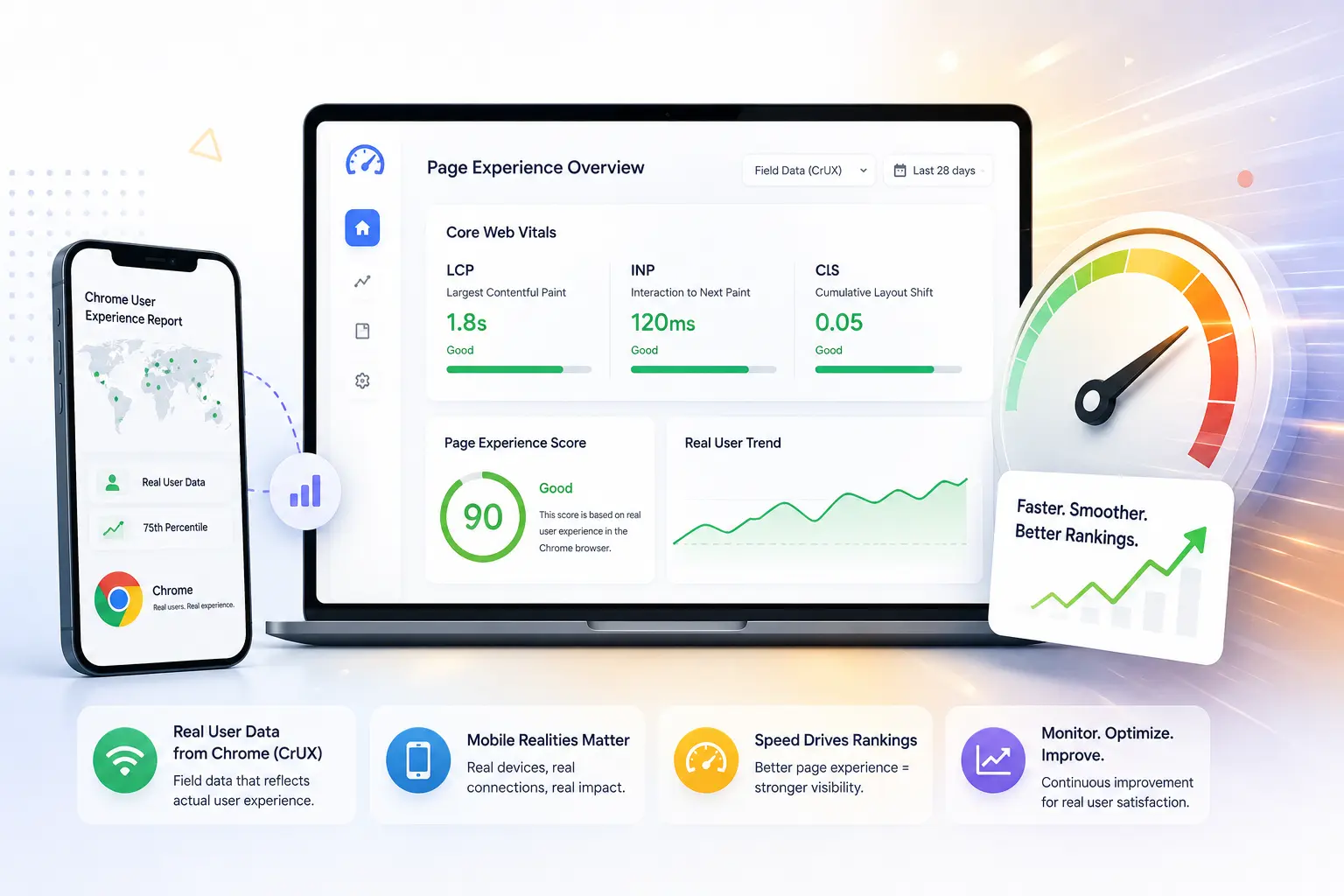
The three Core Web Vitals and their thresholds:
LCP (Largest Contentful Paint): Measures how long the main content element takes to appear on screen. Target: under 2.5 seconds. Poor: over 4 seconds. On BigCommerce, the most common LCP cause is unoptimized product and category hero images. BigCommerce’s CDN serves these efficiently, but oversized source images sent through the CDN still slow LCP. Use BigCommerce’s built-in image optimization settings, serve images in WebP format where possible, and preload the LCP image with a link rel=”preload” tag in the Stencil theme head template.
INP (Interaction to Next Paint): Replaced FID as a Core Web Vital in March 2024. INP measures how fast the page responds to every user interaction throughout a full session, not just the first one. Target: under 200 milliseconds. Poor: over 500 milliseconds. Poor INP on BigCommerce stores is most commonly caused by third-party scripts loaded through Script Manager (live chat, A/B testing tools, remarketing pixels, review app widgets) that run on page initialization and block the main thread. Defer these scripts until after the first user interaction rather than loading them on page load.
CLS (Cumulative Layout Shift): Measures visual stability during page load. Target: under 0.1. Poor: over 0.25. The most common BigCommerce CLS cause is product images without defined width and height attributes in the Stencil template, causing the browser to recalculate layout when images load. Add explicit width and height to image elements in the theme, and reserve space for any dynamically loaded content such as review widgets and promotional banners.
Check your store’s Core Web Vitals field data in Google Search Console under Experience, then Core Web Vitals. Field data reflects what real US users experience on your store, which is the data Google uses for ranking decisions, not the lab simulation scores from PageSpeed Insights.
6. Submit and Maintain an XML Sitemap

An XML sitemap helps search engines discover, crawl, and prioritize important pages on your BigCommerce store. While a sitemap does not improve rankings on its own, it plays a critical role in ensuring that product, category, and content pages are indexed efficiently.
BigCommerce automatically generates an XML sitemap, which typically includes products, categories, brand pages, and content pages. This makes submission and maintenance straightforward.
To use your sitemap effectively:
- Submit the sitemap URL in Google Search Console
- Ensure only index-worthy pages are included
- Exclude duplicate, filtered, or low-value URLs where possible
- Monitor sitemap status and indexing coverage regularly
Sitemaps are especially important for stores with:
- Large or frequently changing product catalogs
- New pages that need faster discovery
- Seasonal product launches or updates
In a mobile-first and crawl-budget–aware search environment, a clean and well-maintained sitemap helps search engines focus on the pages that actually matter for visibility and revenue.
7. Optimize Category and Faceted Navigation SEO
Category pages are critical for BigCommerce SEO, but filters can create duplicate URLs.
Best practices include:
- Controlling indexation of filtered URLs
- Using canonical tags to consolidate signals
- Preventing crawl budget waste
- Internally linking to priority categories
This ensures search engines focus on valuable pages rather than filtered variations.
Related Post: SEO Tactics To Optimize Ecommerce Category Pages
8. Manage Product Variants Strategically
Product variants can unintentionally create duplicate content.
Use a parent-child approach:
- Index the main product page
- Use canonical tags for variants that do not require separate indexing
- Only index variants when they serve distinct search intent
This approach protects rankings while supporting large catalogs.
9. Secure Your BigCommerce Store
Security is both a ranking requirement and a trust signal.
BigCommerce includes SSL by default, but you should ensure:
- HTTPS is enforced sitewide
- No mixed content issues exist
- Checkout and payment flows remain secure
Secure sites improve user confidence and conversion rates.
10. Measure SEO Performance Effectively
SEO success should be measured by outcomes, not just rankings.
Use:
- Google Search Console for indexing, performance, and enhancements
- GA4 for traffic, engagement, and ecommerce events
- SEO platforms to track visibility trends and competition
Track how organic traffic contributes to revenue, not just sessions.
11. Align SEO with Conversion Optimization
SEO without conversions is incomplete.
Optimize product and category pages by:
-
Displaying reviews and trust signals
-
Using clear calls to action
-
Improving mobile usability
-
Reducing checkout friction
SEO should support business growth, not vanity metrics.
12. Build Strategic Internal Linking
Internal linking helps search engines understand site structure, topical relevance, and page importance.
For BigCommerce stores, internal linking should connect:
- Category pages to subcategories
- Category pages to top-selling products
- Blog content to relevant product or category pages
- Related products within product pages
Best practices include:
- Use descriptive anchor text
- Link to high-value commercial pages
- Avoid excessive linking that confuses users
- Ensure priority pages receive the most internal links
A strong internal linking strategy improves crawlability and distributes authority across important pages.
BigCommerce Niche Market SEO Strategy
US ecommerce stores with focused, specialized product catalogs have a structural advantage in organic search that most do not apply deliberately. Broad-catalog retailers with established domain authority compete across thousands of product categories but distribute their topical authority thinly across all of them. A niche BigCommerce store that builds specific, deep content around a defined product area can outrank larger stores for the exact queries that matter most to its buyers.
Research on AI Overview citation patterns shows that 47% of AI Overview citations come from pages ranking outside the top 5 in standard organic search. This means a niche BigCommerce store with well-structured product content can appear in AI-generated answers alongside retailers with significantly higher domain authority, provided the content addresses the specific query more precisely than higher-authority competitors.
How to apply niche SEO on BigCommerce:
- Build topical depth, not breadth. A niche store selling specialty outdoor lighting should own every search query in that product category: product-specific queries, buying guide queries, installation queries, and comparison queries. A store spreading its content effort across general lighting and outdoor living will not achieve the topical authority in either category that a focused approach delivers.
- Target long-tail product queries with specific buyer intent. Niche markets have lower search volume per keyword but higher purchase intent per visitor. A US buyer searching “12-volt outdoor pathway lights for rock gardens” is significantly closer to purchasing than one searching “outdoor lights.” BigCommerce’s product page structure supports highly specific title tags and meta descriptions that match these exact queries without requiring custom URL architecture.
- Use category pages as the topical authority hub. On BigCommerce, category pages that contain a structured editorial introduction of 200 to 300 words describing the category, key buying considerations, and product selection guidance outperform product-grid-only category pages for competitive niche terms. These introductions give Google text content to evaluate against the query and give AI systems a citation-eligible passage to extract.
- Build content around the specific questions your niche buyers ask. BigCommerce’s native blog, even with its limitations, handles a focused content program targeting 10 to 20 high-intent informational queries per quarter. A niche outdoor lighting store publishing guides on wiring low-voltage pathway lights or selecting wattage for specific outdoor settings builds the topical cluster that makes its product pages rank for commercial queries in the same category.
BigCommerce SEO for Google AI Overviews and LLM Platforms
Google AI Overviews appear for approximately 48% of Google searches in the United States. On mobile devices, the AI Overview occupies the entire above-fold area of the search results page, pushing all organic listings below the fold. A BigCommerce store that earns AI Overview citations gains product visibility above every organic result on the page. A store absent from AI Overview results competes for clicks in a reduced space below competitor products and AI-generated answers.
The conversion data attached to AI-cited visits is significant: visitors arriving from AI-cited sources convert at 14.2% compared to 2.8% for standard organic traffic. This difference reflects the nature of AI recommendation: the user has already been pointed to a specific product or store before clicking through, so they arrive with context that standard organic visitors do not have.
How BigCommerce stores earn AI Overview citations:
- Write product content as complete information units. Google’s AI systems extract answers from self-contained passages, not from pages that distribute information across multiple tabs, accordions, and separate collapsible sections. A product page where the description covers what the product is, what it does, who it suits, key specifications, and what distinguishes it from alternatives, all within a single coherent paragraph section, is more citable than a page with the same information fragmented across multiple interactive elements.
- Keep product data current. Research shows a sharp drop in AI citation frequency for content older than three months on competitive product queries. For BigCommerce stores, this means product descriptions, pricing, and availability should reflect the current catalog state rather than being set during initial product import and left unchanged through multiple catalog cycles.
- Verify AI crawler access in your robots.txt. BigCommerce gives direct access to edit robots.txt. Confirm that these user agents are not blocked: GPTBot (OpenAI/ChatGPT), ClaudeBot (Anthropic/Claude), PerplexityBot (Perplexity), Bingbot (Bing Copilot), CCBot (Common Crawl). Blocking any of these prevents your store from being cited in those platforms regardless of your Google rankings.
- Implement llms.txt for your BigCommerce store. BigCommerce’s own research recommends implementing an llms.txt file: a plain-text, machine-readable document that tells AI systems what your store sells, which pages represent your primary catalog, and which URLs to prioritize for product discovery. Place this file at yourstore.com/llms.txt and include your primary product categories, your brand description, and your highest-priority product and category page URLs. This is a 2026-specific implementation step that most US BigCommerce stores have not yet completed, which means the competitive gap is still open for stores that move on it now.
- Optimize for branded product queries in AI platforms. When a US buyer asks ChatGPT “what are the best [product category] for [use case],” AI systems pull from pages that address that specific buyer intent with product recommendations, comparisons, and structured answers. BigCommerce stores that publish product comparison guides and category-level buying guides generate the content that AI systems cite for these queries. See our guide to AI search optimization tools for a breakdown of current approaches.
Off-Page SEO and Link Building for BigCommerce Stores
Domain authority remains a ranking factor for competitive product categories. For US BigCommerce stores competing in categories where keyword difficulty scores exceed 30, on-page and technical optimization creates the ranking foundation but off-page authority determines which stores reach the top 3. Building this off-page layer requires acquisition approaches specific to ecommerce, not the generic outreach tactics more commonly discussed in B2B content contexts.
Link acquisition approaches specific to BigCommerce stores:
- Product review coverage from relevant publications. Reach out to US-based publications, YouTube product reviewers, and niche-specific industry bloggers to feature your products. Editorial product mentions from authoritative domains build link equity and brand entity signals that AI search systems use to verify brand legitimacy when deciding whether to cite your store in product recommendations.
- Supplier and manufacturer referral pages. US brands selling products from recognizable manufacturers can typically request a listing on the manufacturer’s “where to buy” or “authorized retailer” page. These links are high-authority, directly relevant to your product category, and frequently overlooked as a link acquisition source. The barrier to entry is low for stores with an existing supplier relationship.
- Buying guide placements in category publications. Publications in most product verticals maintain buying guides that link to specific US retailers. Identify the existing buying guides ranking for your target category keywords, determine which publications maintain them, and reach out to editorial teams to be considered for inclusion. Placements in active buying guides generate referral traffic alongside the link equity benefit.
- Original research and product data. BigCommerce stores that publish original research relevant to their product category — such as performance comparisons, pricing analysis across suppliers, or survey data from customers — generate inbound links from industry publications covering the category. One well-researched data piece in a focused niche produces more high-authority links than months of standard outreach volume.
- Unlinked brand mention conversion. Set up alerts for your brand and product names using Google Alerts. When your brand is mentioned in a publication without a link to your store, a brief, direct email to the editorial contact requesting the link addition converts a meaningful percentage of mentions. These are the most efficient link conversions available because the editorial decision to feature you has already been made.
BigCommerce SEO Checklist: What to Audit Before and After Launch
Use this checklist to audit a new BigCommerce store before launch or an existing store showing declining organic traffic.
Technical Foundation
- XML sitemap submitted to Google Search Console and confirmed as updating automatically when products are added or removed
- robots.txt configured to disallow crawling of filter and sort parameter URLs
- Canonical tags present on all paginated collection pages pointing to the base category page
- All 301 redirects in place for URL changes since site launch, with no redirect chains longer than one hop
- HTTPS active and confirmed across all store URLs, including checkout and account pages
- No broken internal links flagged in the Search Console Crawl report under Pages
- GPTBot, ClaudeBot, PerplexityBot, Bingbot, and CCBot are not blocked in robots.txt
- llms.txt file present at yourstore.com/llms.txt listing primary categories and key product URLs
On-Page Optimization
- Every product page has a unique title tag under 60 characters with the primary keyword in the first 50 characters
- Every product page has a unique meta description under 155 characters
- H1 is present on every page and matches the page’s primary keyword intent
- Product descriptions are written as complete, self-contained paragraphs of 134 to 167 words covering what the product is, what it does, who it is for, and what distinguishes it
- Category pages include a 200 to 300 word editorial introduction above the product grid
- All image alt attributes describe the specific product, not generic labels or file names
Structured Data
- Product schema present on all product pages with name, price, availability, image, and aggregate rating fields populated
- Availability field specifically confirmed as present (required for Google Shopping rich result eligibility)
- BreadcrumbList schema verified on product and category pages via Google’s Rich Results Test at search.google.com/test/rich-results
- FAQPage schema added to pages containing question-and-answer content
- Organization schema on the homepage with logo, contact information, and social profile URLs
Performance
- Core Web Vitals at Good status in Google Search Console field data: LCP under 2.5 seconds, INP under 200 milliseconds, CLS under 0.1
- Product images served in WebP format, sized for mobile viewports
- Third-party scripts in Script Manager configured to defer until after first user interaction
- No render-blocking JavaScript in the Stencil theme head template
Content
- Category pages contain editorial introductions targeting informational queries in the product category
- Blog or content section publishing at minimum one piece per month addressing a high-intent question in the primary product category
- FAQ content structured with question-phrased headings and 40 to 60 word direct-answer paragraphs
- Product data updated on a regular cycle to maintain AI citation eligibility (content older than three months shows reduced AI citation frequency on competitive queries)
Conclusion
BigCommerce provides a technically capable foundation for US ecommerce SEO. The stores that rank consistently in the top 3 for competitive product keywords are not using a different platform. They are running a more complete program: technical configuration that removes crawl waste, structured data that earns product visibility in both standard SERP results and AI-generated answers, content that builds topical authority in their specific product category, and off-page signals that give Google the authority evidence to rank them above less established competitors.
The gap between a technically sound BigCommerce store and one that consistently drives organic revenue is almost always a content and authority gap, not a platform gap.
For brands looking to implement these strategies effectively, working with a reliable provider of ecommerce SEO services can simplify execution and improve outcomes. At ResultFirst, we help BigCommerce stores turn SEO best practices into measurable performance through structured, data-driven strategies. With the right approach and the right partner, ResultFirst helps retailers strengthen visibility, attract qualified traffic, and drive sustainable revenue growth.
FAQs:
WHAT TO READ NEXT
READY TO BUILD PREDICTABLE ORGANIC GROWTH?
We are the only TOP SEO services agency providing Real Results in a Real Performance model. We help growth hungry companies outperform their competition and achieve 300%+ growth in their digital marketing initiatives.
- San Jose, CA, 95120

- +1-888-512-1890

- sales@resultfirst.com

300K+
KEYWORDS RANKED
546M+
REVENUE GENERATED
18 Years
SOLVING COMPLEX SEO
150+
TEAM MEMBERS