



 sales@resultfirst.com
 +1-888-512-1890
Best Content Strategy for an eCommerce Brand to Drive Organic Traffic

Most eCommerce brands treat content as an afterthought. They launch a blog, publish a few posts, and wonder why nothing ranks. The problem is not the content. It is the absence of a strategy behind it. 23.6% of eCommerce orders trace directly back to organic search traffic. That is nearly one in four sales generated without a single dollar spent on ads. The brands capturing that revenue are not lucky. They are strategic. They research what buyers search for. They create content that answers it. They built an authority search engine rewards.
This guide covers every element of a strategy built to drive organic traffic from audience research and keyword targeting to content formats, UGC, and performance tracking, so your brand earns the rankings your competitors are currently holding.
Why Organic Traffic Is the Most Valuable Asset an eCommerce Brand Can Build
Paid ads rent your audience. Content owns it. Content marketing leaders achieve 6 times higher conversion rates than brands that do not prioritize content. That gap alone should settle the debate.
Here is what makes organic traffic different from every other channel:
- It does not stop when your budget runs out
- It builds compounding authority over time
- It attracts buyers who are already in research mode
- It reduces your cost per acquisition with every passing month
There is a clear impact of SEO on revenue, 23.6% of eCommerce orders come from organic search traffic. Think about what that means. Nearly one in four orders your store processes can trace back to a piece of content that ranked in search results. That is not a side channel. That is a core revenue driver.
87% of consumers say product descriptions are the most important factor when deciding to make a purchase online.
The content on your pages, every word, is doing sales work. The question is whether it is doing it well.
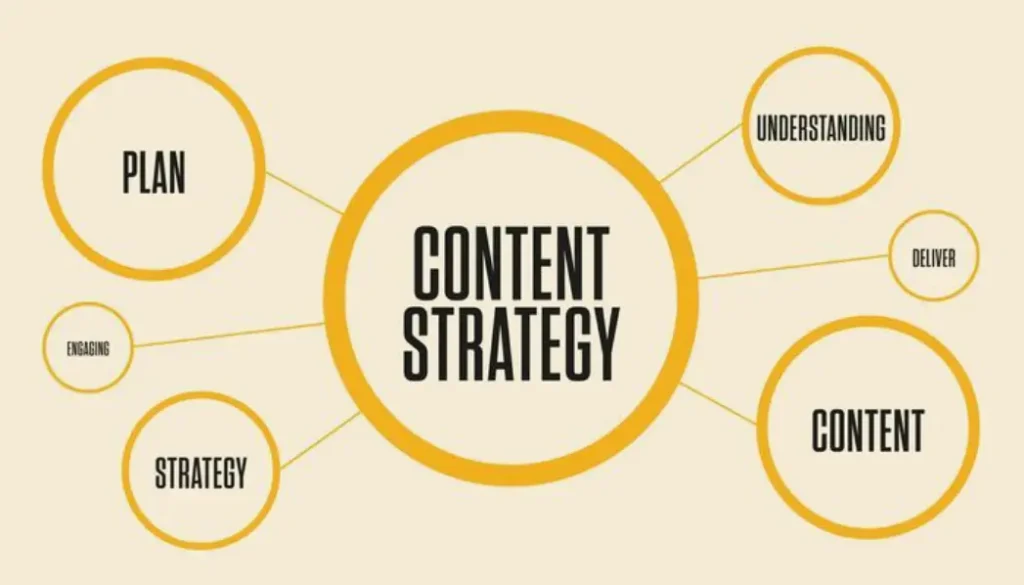
Source: Yandex
1. Start Here: Know Exactly Who You Are Writing For
Before you write a single word or plan a single keyword, know your buyer. This is not about creating a generic persona document. It is about understanding the real questions real people ask before they buy from a store like yours.
Build a Picture From Real Data
Pull your Google Analytics data and look for patterns:
- Which pages hold attention the longest
- Which search queries bring visitors who actually convert
- Which product categories attract repeat buyers
The patterns must be mapped against the three demographic viz target groups: age ranges, locations, and device types. Mobile commerce is growing at a rapid rate and is projected to reach $4 trillion in 2025, which requires businesses to create websites that include mobile-friendly design and rapid loading times as mandatory features.
Map the Buying Journey
Your buyer does not go straight from “never heard of you” to “purchase confirmed.” They move through stages:
- Awareness: they have a problem and are searching for answers
- Consideration: they are comparing options and reading reviews
- Decision: they are ready to buy and looking for a reason to choose you
Each stage needs different content. A first-time visitor wants education. A buyer comparing options wants comparison content. A buyer ready to purchase wants trust signals and clear product information.
Build content for each stage. Most brands only build for the decision stage and then wonder why their traffic does not convert.
2. Competitive Analysis: Find the Gaps Your Competitors Left Open
You do not need to outspend competitors. You need to outthink them.
A proper competitive analysis gives you a map of where the organic traffic is going right now. It also shows
What to Look For
Run the top three to five competitors through a tool like Ahrefs or SEMrush. Look at:
- Which keywords are driving their highest-traffic pages
- Which topics do they cover poorly or miss entirely
- Where their content quality drops, and yours can be stronger
- Which blog posts earn them backlinks from other sites
The Gap Is Your Opportunity
Once you identify topics your competitors cover weakly, those become your priority targets. Write more thoroughly on those topics. Answer the follow-up questions they ignore. Use real data and examples where they use vague generalizations.
Search engines evaluate websites based on their content depth and overall usefulness to users. Your content achieves ranking when it provides superior value to readers compared to all other content available on the first search results page.
3. Keyword Research That Actually Drives Revenue
Most eCommerce brands target keywords that are either too competitive or too vague. Both waste time and budget.
The sweet spot is keywords with clear purchase intent, search terms that signal someone is close to buying.
How to Find Revenue-Driving Keywords
- Begin with your product categories and enumerate all the problems that those products address.
- Find long-tail variations with less competition using SEMrush or Ahrefs.
- Filter out terms containing best, buy, review, vs, or [specific use case]
Build Topic Clusters Around Pillar Pages
A topic cluster groups related content around one central pillar page. The pillar page covers a broad topic comprehensively. Cluster pages are in-depth about particular sub-topics and connect to the pillar.
In case a skincare products store is involved, the pillar page may be the Complete Guide to Building a Skincare Routine. Cluster pages could include:
- How to layer serums correctly
- Morning vs evening skincare routine, what changes
This structure tells search engines your site has genuine authority on the topic. It also guides visitors deeper into your content ecosystem.
Learn More: How to Do Keyword Research for An ecommerce Website?
4. The Content Calendar: How Consistency Beats Creativity Every Time
A great piece of content published once and forgotten does not build organic traffic. A consistent flow of useful content does.
A content calendar is not just an editorial schedule. It is a strategic tool that keeps your team aligned, your publishing consistent, and your SEO momentum building.
What Your Content Calendar Should Include
- Title and target keyword for each piece
- Content type: blog post, product guide, comparison page, video script
- Target audience stage: awareness, consideration, or decision
- Publishing date and assigned writer
- Status tracker: draft, in review, published
- Distribution plan: where each piece gets promoted after publishing
How Often Should You Publish
More is not always better. One well-researched piece per week beats five thin posts that do not rank. For most eCommerce brands just starting content marketing:
- Two to four blog posts per month is a sustainable starting point
- Revise and refresh old material once a quarter.
- Add new product guides and comparison pages as your catalog grows.
5. What Content Types Actually Drive Organic Traffic for eCommerce
Not all content formats work the same way when it comes to search results. Here’s our list of the most consistent content footprints that generate organic traffic for E-commerce brands.
- Blog Posts and How-To Guides
These form the backbone of any eCommerce content strategy. A buyer searching “how to clean suede shoes” is telling you exactly what they need. If you sell shoe care products, that query is a door into your store.
You should create blog content that provides solutions to particular issues that your products are designed to solve. Use the exact language your buyers use when they search.
- Product Comparison Pages
“Product A vs Product B” searches are extremely high-intent. Buyers typing these terms are close to a decision. They want help making it. A well-structured comparison page, honest, detailed, specific, captures that traffic and often converts it.
- Category and Collection Guides
“Best running shoes for flat feet” or “top home espresso machines under $500” are buying guides that rank well and drive direct revenue. They pull buyers at the decision stage directly into your product catalog.
- Video Content
Product demos, unboxing videos, and tutorials work on YouTube and social platforms, and YouTube videos often rank in Google search results too. Video content is a traffic multiplier. It earns attention on multiple platforms from one production effort.
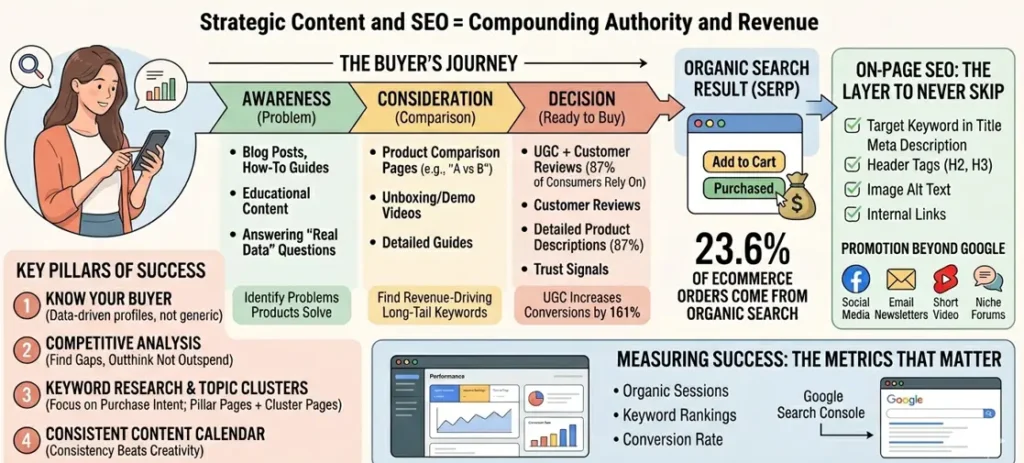
Source: Buyer Journey
6. User-Generated Content: The Trust Engine Your Brand Cannot Afford to Ignore
No matter how good your copy is, a real customer’s words carry more weight.
92% of consumers trust peer recommendations over brand messages. That trust gap is enormous. The brands closing it are the ones actively building systems to capture and display user-generated content.
Why UGC Directly Impacts Organic Traffic
UGC increases conversions by 161% when included on eCommerce product pages. More time on site. More pages visited. Lower bounce rates. Search engines view these signals as quality indicators and give the respective web pages enhanced ranking.
How to Get More UGC Without Begging for It
- Email follow-up 3-5 days after delivery with a request for a photo or review.
- Give a review in exchange for a small discount on the next order or offer loyalty points.
- Organize a monthly social media competition where the customers are requested to tell you how they use your product.
- Display the finest customer images on product pages with their approval.
7. On-Page SEO: The Layer Most eCommerce Brands Skip
Great content with weak on-page SEO is like a great product in an unmarked box. Search engines cannot surface what they cannot understand.
Every piece of content you publish needs:
- A clear target keyword in the title and first paragraph
- A meta description that reads like a genuine invitation to click
- Image alt text that describes what the image actually shows
- Internal links pointing to relevant product pages and related content
- A URL structure that is short and descriptive
Read More: On-Page SEO Guide for E-commerce Websites
Product Descriptions Deserve More Attention Than They Get
83% of online buyers use Google Search to check product reviews. Your product pages are content too. Write descriptions that explain how the product solves a problem, not just what it is. Include the specific terms buyers search for. Add real reviews prominently. Make every product page a landing page worth ranking.
8. Promoting Content: Getting Your Content Seen Beyond Google
Publishing content and hoping Google finds it is a passive strategy. An active distribution plan accelerates results.
Where to Distribute Your Content
- Share every new blog post across your brand’s social media channels with a short hook that drives clicks.
- Include your best content in email newsletters. Your existing subscribers are your most engaged audience.
- Reuse blog content in the form of short-form video on Instagram Reels and TikTok.
- Post useful content in the relevant online groups – Reddit, Facebook groups, niche forums where your buyers are already found.
- Contact complementary brands to become content partners or guests.
9. Tracking What Works: The Metrics That Actually Matter
Publishing content without measuring it is spending without a budget. You need clear signals that tell you what is working and what needs fixing.
Key Metrics to Track Monthly
- Organic sessions: Is your search traffic growing month over month?
- Keyword rankings: Are your target pages moving up in search results?
- Time on page: Are readers actually consuming your content or bouncing immediately?
- Conversion rate from organic traffic: Are organic visitors buying?
- Backlinks earned: Are other sites citing your content as a reference?
You can use Google Search Console to find out which search terms lead to which website pages. Google Analytics enables you to monitor the actions of visitors who arrive at your site. The two tools together provide a comprehensive view of your content’s performance throughout its entire life cycle.
Mistakes That Kill eCommerce Content Strategies Before They Scale
Most content strategies fail for predictable reasons. Knowing them in advance saves months of wasted effort.
- Publishing content with no target keyword. Good writing with no search purpose earns no traffic.
- Writing for the brand instead of the buyer. Your story matters less than solving their problem.
- Stopping too early. Content marketing compounds over six to twelve months. Brands that quit after eight weeks never see results.
- Skipping internal links. Every new piece of content should link to relevant product pages and related articles. Internal links pass authority and guide buyers toward purchase..
The Brands Winning Organic Search Are Playing a Long Game and Starting Now
Content strategy is not a quarter-to-quarter project. It is an infrastructure investment. Every piece of content you publish today can drive traffic in six months. Every keyword you rank for today compounds with every piece you add tomorrow.
The brands that understand this are building assets. The ones waiting for a better time are watching competitors claim the rankings they cannot recover easily.
Your buyers are searching right now. They are typing questions into Google that your products can answer. The only question is whether your content shows up to answer them or your competitor does.
Start with one clear audience. Pick five problems your products solve. Write one piece of content for each. Build from there.
Create a content strategy that actually earns organic traffic, not just publishes content.
At ResultFirst, our ecommerce SEO services are designed around real search demand and buyer intent. We help brands build scalable content strategies, improve rankings, and turn organic traffic into consistent revenue. If you want traffic that compounds and converts, this is where it starts.
WHAT TO READ NEXT
READY TO BUILD PREDICTABLE ORGANIC GROWTH?
We are the only TOP SEO services agency providing Real Results in a Real Performance model. We help growth hungry companies outperform their competition and achieve 300%+ growth in their digital marketing initiatives.
- San Jose, CA, 95120

- +1-888-512-1890

- sales@resultfirst.com

300K+
KEYWORDS RANKED
546M+
REVENUE GENERATED
18 Years
SOLVING COMPLEX SEO
150+
TEAM MEMBERS