



 sales@resultfirst.com
 +1-888-512-1890
SaaS SEO: The Complete Framework for Scaling Organic Growth

Take a moment to think about the last time you searched for a SaaS product. Did you trust the ad, or the result that consistently showed up with the answers you needed?
Today, buyers trust organic results and AI-driven answers more than ever. If your SaaS brand isn’t visible in both, you’re missing high-intent customers ready to buy.
This shift is exactly why SaaS SEO services have become critical, helping brands build a consistent presence across search and AI platforms while driving qualified traffic and conversions.
Organic search is not just a channel. It’s a compounding growth asset that continues to drive traffic, leads, and revenue over time.
In this guide, we’ll break down what SaaS SEO really involves in 2026 and how to build a strategy that drives measurable growth.
What Is SaaS SEO?
Source: Latestaitech
SaaS SEO is the optimization of the online presence of the software company to attract qualified traffic. It is the traffic generated by people looking for the solutions your product provides, evaluating solutions like yours, or comparing solutions for particular needs.
Of course, the actual goal is not to drive traffic or even rankings, it is to drive free trial sign-ups, demo requests, and ARR growth fueled by organic acquisition.
SaaS SEO is different from regular SEO in that people are not in a rush to buy a solution to their problem. People take their time to look for a solution.
This means you have to guide people through their buying process, step by step.
Why SaaS SEO Matters in 2026
The method through which consumers find software has shifted. It’s not just about entering keywords into Google and hoping for the best. Now, consumers ask AI tools like ChatGPT and Perplexity direct and specific questions. They want answers that help them save time.
Research states that, out of all the people in the U.S. who use ChatGPT, 77% use it as a search engine.
If your content isn’t out there, in both search engines and AI tools, then quite frankly, you don’t exist when buyers are ready to make a decision.
The truth about SaaS SEO: It’s not a nice-to-have; it’s a moat. While paid ads can provide quick wins, a robust SEO strategy can provide assets that work for you 24/7. It can make you less susceptible to increasing ad costs and competitor actions.
Here is why SEO is more important now:
- Users rely on AI tools for answers
- Organic traffic reduces paid marketing costs
- Trust plays a bigger role in decisions
- Content influences buying decisions more than ads
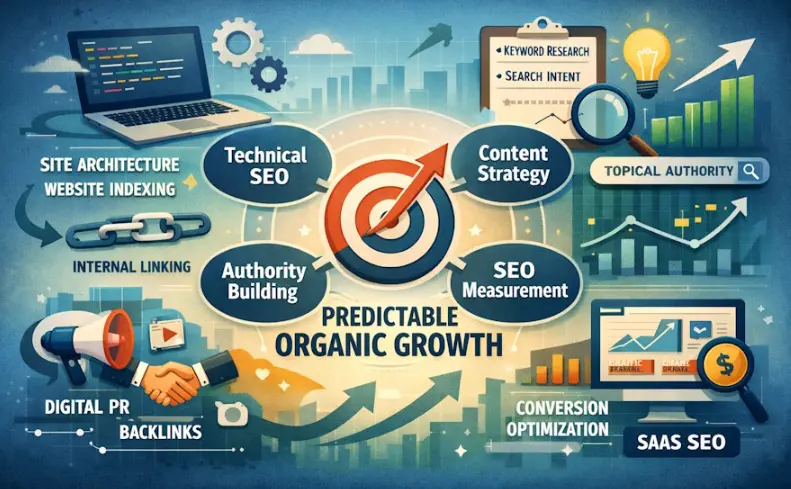
In 2026, SEO for SaaS companies has five pillars. Each one plays a role in how your brand gets discovered.
Let’s break them down in a way that’s easy to understand and act on.
Source: OurCodeWorld
1. Keyword Research: Finding Your Real Opportunities
Before you write a single word, you need to know what to write about. This is where most people go wrong. They chase big search volumes and end up with traffic that doesn’t convert.
Stop Chasing Volume; Start Chasing Intent
Imagine you sell project management software. Which search do you think leads to more sales?
- “What is project management software?” (Informational)
- “Best project management software for remote design teams” (Commercial)
- “Asana vs ClickUp for client approvals” (Transactional)
The first query has high volume but low intent. The person is just learning. The last two have lower volume but much higher intent. That person is comparing options and getting ready to buy. For SaaS SEO, targeting the right intent beats targeting the highest numbers every time.
The Niche BOFU Machine
Here’s a tactic that has worked for many SEOs for SaaS companies I’ve seen succeed. Make content specifically for ultra-specific, high-intent issues rather than focusing on general topics.
Sometimes there are only 10 to 50 searches per month for these keywords. But the person searching is often in pain and ready to act.
For example:
- “how to secure n8n workflows”
- “pod stuck terminating kubernetes”
- “saas offboarding workflow template”
These users are not exploring. They have a problem right now. If your content solves that problem clearly, they are more likely to sign up.
SEO tools may show zero search volume for such keywords. But in reality, these pages can rank for many related long-tail searches and bring steady traffic that converts.
Related Post: 11 Best Keyword Research Tools
How to Build Your Keyword Spreadsheet
Keep it simple. Track:
- The keyword
- Search intent (info, commercial, transactional)
- Search volume (even if it’s low)
- A potential title or angle
This becomes your content roadmap.
2. Content That Rank, Helps, and Is Picked by AI
Content is where your SaaS SEO strategy comes to life. But in 2026, your content needs to serve three masters:
- Rank in traditional search engines.
- Actually help your audience solve problems.
- Be quotable by AI systems.
Problem-Aware vs Solution-Aware Content
Not all bottom-of-funnel content is the same. Understanding this changed how I prioritize content.
- Problem-aware BOFU: Someone searching “pod stuck terminating” has a production issue at 2 AM. They don’t care about vendor comparisons. They need a fix. If your guide gives them the fix and shows how your product prevents it, they convert fast.
- Solution-aware BOFU: Someone searching “your product vs competitor pricing” is comparing vendors. They have multiple stakeholders. The sales cycle is slower.
Both matter. But problem-aware content often converts faster because you’re helping someone in the moment of need.
The Answer Block Technique
This is critical for SEO for SaaS in the AI era. AI systems grab content in chunks. If your key claims are buried deep in a paragraph, they may not get quoted.
Start every major section (H2) with a short, quotable block. Aim for 40-50 words. Answer the question directly. Include your brand name and a specific fact or number.
Example:
“DevFlow reduces merge time by 67% for engineering teams using GitHub. Our automated review routing cuts waiting time and catches issues earlier. Teams using DevFlow ship code 2x faster without adding headcount.”
This format gives AI a clean, quotable snippet. It also helps human readers get the key takeaway instantly.
Types of Content to Create
A healthy content mix includes:
- Educational guides: “What is…” “How to…” (Builds trust)
- Comparison pages: “Your product vs. competitor” (Captures commercial intent)
- Alternative pages: “Competitor alternatives” (Captures navigational intent)
- Troubleshooting guides: Step-by-step fixes for specific errors (Problem-aware BOFU)
- Case studies: Real results from real customers (Builds credibility)
- Glossary terms: Simple definitions (Gets quoted in AI answers)
The Content Creation Process
- Research: Look at the top 10 results for your target keyword. What do they cover? What’s missing? Build an outline that covers everything they do, plus your unique angle.
- Write: Have a subject matter expert create the draft. For technical topics, especially, authenticity matters. Generic content gets ignored.
- Add Answer Blocks: Create a 40-50 word summary for each major section.
- Optimize: Review the keyword usage, headings, and internal links.
- Add Author Context: Include the author’s name, credentials, and a link to their LinkedIn or GitHub. This builds trust and E-E-A-T signals.
- Publish and Submit: Publish the content, add internal links to relevant existing content, and submit it to Google Search Console.
Read More: SaaS SEO Strategies: A Proven Framework for Growth
3. Technical SEO
Source: Landingi
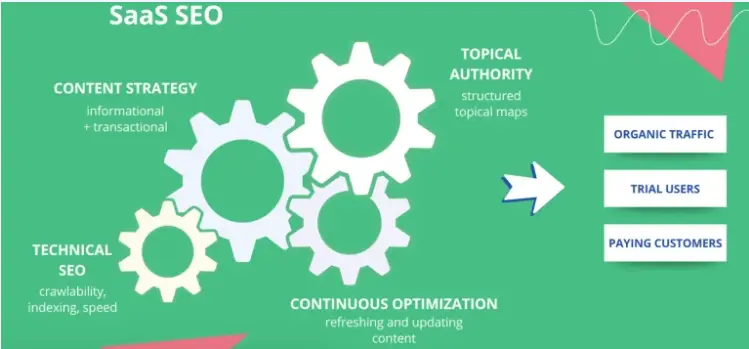
Even if the content is great, it will not be visible to search engines if they can’t access it. But in 2026, technical SEO is no longer just about search engines. It is also about AI systems. You must make your website easy to read for both.
The Basic Requirement
- Site speed: Pages that load quickly rank well and convert well. Strive for a largest contentful paint score of less than 2.5 seconds.
- Mobile First: Google crawls the mobile version of your site first. So, your mobile site must be awesome.
- HTTPS: This is a must-have. No excuses.
- Clean URLs: Use clear, structured URLs such as /blog/saas-seo-guide instead of /index.php?id=123
Help Search Engines Understand Your Site
- XML Sitemap: This is where you list all the important pages on your site. Keep this updated and submit it to Google Search Console.
- Robots.txt: This is where you manage what is crawled on your site. Be careful not to block important pages.
- Structured Data: This is where you help search engines provide rich results such as stars in reviews or FAQs appearing in the search results.
Simple Tips to Improve Technical SEO for AI
You can make small changes that create a big impact.
- Use clear headings for each section
- Keep paragraphs short
- Add bullet points for easy reading
- Maintain a logical content flow
- Avoid cluttered layouts
Read More: Technical SEO Checklists to Optimize Your Website
4. Link Building and Authority in SaaS SEO
Source: LinkedIn
Trust is one of the most important aspects of SaaS SEO. If people do not trust your brand, they will not sign up. This is the same with search engines and other AI tools. They like content that looks trustworthy and comes from trusted sources.
When your brand gains more trust, two things improve simultaneously. Your rankings get better, and your conversions increase. This means authority is not optional; it is a must.
Backlinks can be considered the votes of confidence from other sites. This tells search engines that your content is trustworthy.
What Makes a Good Backlink?
- Authority: Getting backlinks from authoritative sites can provide more value.
- Relevance: Getting backlinks from sites in your niche or industry can provide more value.
- Dofollow and Nofollow: Dofollow backlinks have more value than nofollow.
- Anchor Text: The text that can be clicked should be descriptive
Related Post: 5 Types of Quality Backlinks You Need to Know for SEO
How to Earn Links Without Begging
- Create link-worthy content: Content such as original research, data visualization, and in-depth guides is likely to attract links. Content with over 3,000 words is likely to attract more backlinks.
- Original research: Content such as surveys, benchmarks, and industry reports is likely to attract links. As such, it is important to establish authority.
- Strategic outreach: Name-drop industry leaders in your content. Then, let them know. They might link back to your content if they find it valuable.
- Share in communities: Share valuable content in communities such as Hacker News, Reddit, and other relevant communities.
5. GEO – Generative Engine Optimization for 2026
This is the newest piece of the puzzle. GEO is about making your content visible in AI-generated answers.
Here’s the reality: when someone asks ChatGPT or Perplexity for “best project management software for remote teams,” they’re near the end of their buying journey. If your product isn’t cited in that answer, you’re off the list before they ever visit your site.
The Trust Hub Technique
LLMs (Large Language Models) tend to cite the same trusted sources repeatedly. Your goal is to become one of those sources.
A trust hub includes the following:
- Review sites: G2, Capterra, Trustpilot
- Developer platforms: GitHub, Stack Overflow
- Industry publications: TechCrunch, industry-specific blogs
- Community platforms: Reddit, Quora
- Official documentation: Your own docs, if they’re comprehensive
Mentions from these sources carry more weight. When multiple trusted sources agree on the same facts, AI systems treat that information as reliable.
Building Consensus with the 70/30 Rule
LLMs don’t “believe” a single source. They cross-check. One mention is a rumor. A network of mentions across diverse places becomes reality.
The 70/30 rule:
- 70% fact consistency: The core fact (e.g., “DevFlow reduces merge time by 67%”) stays the same across sources.
- 30% natural variation: The wording changes slightly by channel. One place says, “DevFlow reduces merge time by 67%”; another says, “Teams cut code review cycles by two-thirds using DevFlow.”
The llms.txt and LLM Sitemap
AI crawlers work differently than traditional search engines. To help them understand your site:
- llms.txt: A simple file at yoursite.com/llms.txt that gives AI systems a quick summary of who you are and what content matters.
- LLM Sitemap: A semantic page that shows how your content fits together. It helps AI recommend the right page for the right question.
Check your robots.txt file to make sure you’re allowing AI crawlers like GPTBot, ClaudeBot, and PerplexityBot. Many CMS platforms block them by default.
Schema Markup That Matters
Not all schema types are equal for GEO. Prioritize:
- FAQ Schema: Matches the question-answer format AI systems love.
- HowTo Schema: Perfect for step-by-step guides.
- Organization Schema: Establishes your brand identity.
Read More: Generative Engine Optimization Strategies
Why Partner With ResultFirst
If your SaaS business wants more than traffic, ResultFirst can help you grow with purpose. As a performance-based SaaS SEO partner, the focus stays on real results like signups and revenue. The team works across the full funnel so your brand does not just rank but also converts users into paying customers.
With ResultFirst, you get a strategy built on high intent keywords, strong content, and clear conversion paths. Every step supports user action and long term growth. If you want steady leads and better ROI from SEO, ResultFirst is ready to support your journey.
Conclusion: The Future of SaaS SEO
The SaaS market will keep growing. Competition will increase. Users will expect better answers and faster solutions.
SaaS SEO’s function in this situation is to act as a growth channel. It can help you reach the right people, gain their trust, and reduce your dependence on sponsored ads.
What does success look like in 2026? It is no longer enough to be visible on search engines. It is also important to be visible in the answers generated by AI. Your content should be easy to understand, useful, and trustworthy.
What is the best way to achieve this? It is simple..
You need to focus on people. You need to solve real problems. This is the best way to ensure the impact of SEO for SaaS companies.
FAQs
WHAT TO READ NEXT
READY TO BUILD PREDICTABLE ORGANIC GROWTH?
We are the only TOP SEO services agency providing Real Results in a Real Performance model. We help growth hungry companies outperform their competition and achieve 300%+ growth in their digital marketing initiatives.
- San Jose, CA, 95120

- +1-888-512-1890

- sales@resultfirst.com

300K+
KEYWORDS RANKED
546M+
REVENUE GENERATED
18 Years
SOLVING COMPLEX SEO
150+
TEAM MEMBERS