



 sales@resultfirst.com
 +1-888-512-1890
Google’s “Things To Know” SERP Feature: What It Is & How It Works

Google is no longer just answering questions. Now, the popular search engine anticipates the users’ needs and provides information about what they need to know next. It marks a significant shift in search engine methodology, moving from reactive results to predictive and context-aware experiences.
A key part of this evolution is “Things to know,” a feature introduced by Google in September 2021 that breaks down topics into digestible insights and guides users through layered information instead of offering a static answer. This AI-driven change isn’t just helping users but also impacting your website’s future prospects.
Simply user-centric content ranks on Google. It means your content should address user intent, explore subtopics integrated into them, and provide answers to related questions.
So, a proper understanding of how Google Things to Know function works is important to stay visible in the new era of search. –
What Is The Google’s “Things to Know” SERP Feature?
“Things to Know” is a Google’s SERP feature that provides concise information directly related to your query. This function appears on both mobile and desktop search result pages.
Things to Know appears in SERP results for queries related to multiple topics. Users can find important details, relevant concepts, and common questions using this functionality. It saves users time as they don’t need to visit a particular web page.
The “Things to Know” SERP functionality differs from featured snippets, PAA (people also ask) or Knowledge Panels. Let’s try to learn about the distinctions through this tabular presentation:
| Feature | Purpose | Position | Source | Interaction |
| Things to Know | Breaks user query into related subtopics | Generally, in the top of SERP results | Multiple site pages | Expandable and topic-driven |
| Featured Snippets | Provides a direct answer to your query | Above the organic results | Single web page | Static and easy-to-read |
| People Also Ask | Related follow-up questions | Mid- SERP results | Various web pages | Click-to-expand |
| Knowledge Panel | Factual data about entities | Right side or top of the mobile search results | Google knowledge graph | Minimal and information-centric |
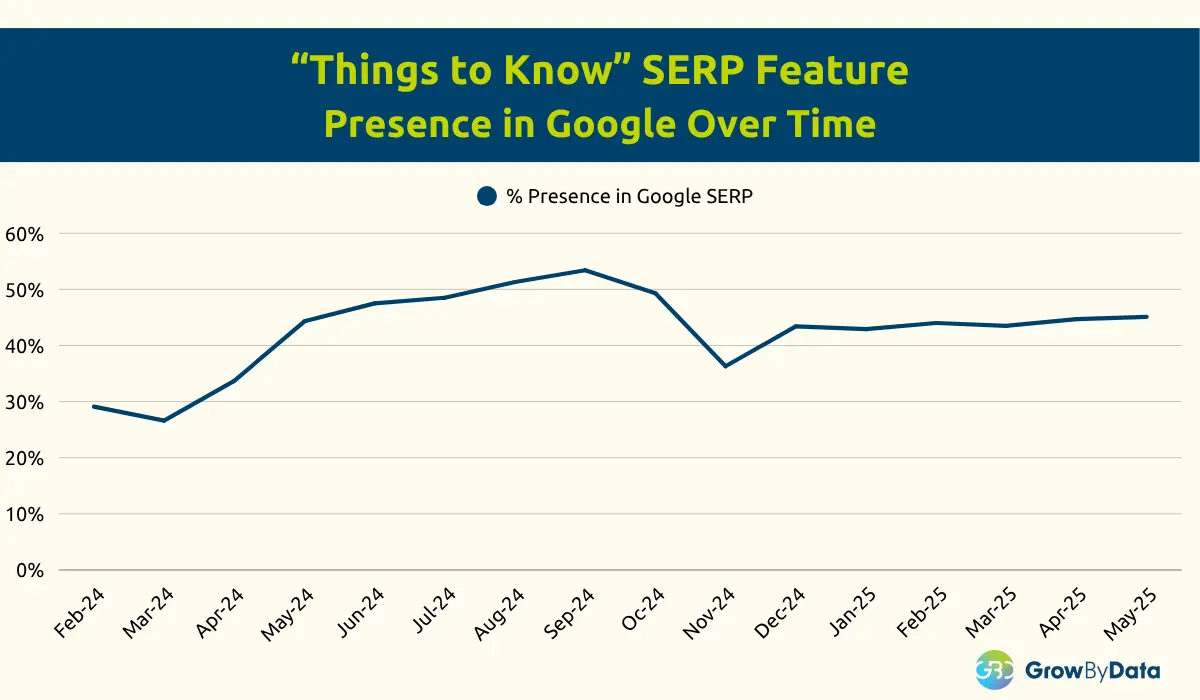
Source: Grow By Data
Why did Google Introduce The “ Things to Know” Function?
Google’s mission has always been to organize the world’s information and make it universally accessible and useful. The ‘google things to know’ feature is a direct step forward to achieving that mission in a more intuitive and user-centric way. This section was introduced to cater to the evolving nature of search behavior.
Let’s explore the prime reasons behind the introduction of this feature:
- Support Exploratory Search Behavior: Things to Know anticipates follow-up questions and provides structured or branching pathways to explore the depth of the topic.
- Making Search More Intent-Aware: This function allows surfacing information to align with different stages of the user’s journey, ranging from basic understanding to advanced insights.
- Reduces Search Friction: Things to Know provides a roadmap upfront. So you don’t need to focus on multiple and separate queries.
- Fosters AI-Powered Future: Things to Know is a stepping stone in offering dynamic and context-rich search experiences. It’s a push toward AI-enhanced search like MUM and search generative experience.
How Google Things To Know Feature Works Behind The Scene
As we’ve mentioned in the introductory part of the article, Google Things to Know is more than just a new layout in SERP. It’s a sophisticated function powered by advanced AI models designed to deliver great understanding in a single search.
Let’s break down this process and how it works:-
Topic Segmentation: From One Query To Many Paths
At the core of Google, the Things to Know function is a feature of topic segmentation. So, instead of treating the query as a standalone request, Google dissects it into multiple meaningful subtopics. For example, a Google search like “ how to start a podcast ” might trigger subtopics such as:-
- Best equipment for podcasting
- Choosing a podcast format
- How to host and distribute
- Tips for growing an audience
The subtopics mentioned above are intelligently derived from analyzing how people explore these themes across the web. This includes user behavior patterns, follow-up queries and content structures.
Dynamic And Expandable SERP Experience
Each subtopic within “ Things to Know” appears as an expandable module. When you click, these sections reveal more information and links to relevant site pages, videos, or tutorials. Plus, you get to experience:
- Reduces frictions that keep users engaged within one seamless experience
- Transforms search from a linear question-answer interaction to a multi-directional exploration journey.
It encourages a deep on-page process and topic discovery, which helps both users and content publishers.
AI and MUM: The Technology Powering It
The backbone of “ Things to Know” Lies in Google’s advanced AI systems. This is particularly liable for MUM (Multitask Unified Model). MUM is an AI model more powerful than Google BERT (Bidirectional Encoders Representations From Transformers) as:
- MUM can understand information across formats (text, images or videos) and languages. It allows Google to group and prioritize genuinely useful subtopics.
- MUM also considers the context, intent, and nuance of the content. It enables smart connections between different topics that are not immediately obvious.
Also Read: What is BERT Update and How Does It Affect Your Search?
Why Google’s Things To Know Feature Matters For SEO And Content
The introduction of Things to Know signals a paradigm shift in how Google evaluates, ranks, and presents content. It’s no longer about targeting high-volume keywords and aiming for Position #1.
The scenario is different, so you need to focus on contextual relevance, topic depth, and semantic structure.
Here’s what SEO professionals and content strategists need to understand:-
- Prioritize content as per the deep intent of search queries. So, provide web content addressing the user’s intent, not just surface-level queries.
- Keep your content piece in proper structure, modular and segmented by subtopics.
- Make your content contextual, as Google Things to Know often surfaces secondary pages, niche content, and even newer websites.
- Now, just posting thin content or surface-level blogs won’t work. You need to provide a comprehensive vision that anticipates content-related questions as well.
How to Optimize Your Web Content For Google’s “ Things to Know” SERP Feature
The advent of Google Things to Know marks a new room where your content can be discovered and featured in SERP results. SEOs struggle to position the content for high visibility in this evolving search environment.
So, they’re experimenting with the new trends and looking to embrace a user-first and intent-rich approach. But, for the adoption of such methodologies, SEOs need to follow a certain set of steps:
# Strategy 1-Provide answers to multiple related questions within a single web page:
Gone are the days when content writers created dozens of fragmented articles targeting single long-tail keywords. So, SEOs should focus on building comprehensive and organized web pages.
They ( SEOs) need to:
- Track primary and secondary questions users ask about your topic. You can use tools like People Also Ask, Google Search Console queries, and forums like Reddit or Quora.
# Strategy 2: Focus on Formatting and Subheadings Distribution: –
As we’ve highlighted in the first-fold content, Google always focuses on content structure to break your web page into digestible and scannable segments. So, you need to:
- Use descriptive H2s and H3s that show real search intent.
- Keep paragraphs short. Content writers can use bullet points, numbered lists, and callouts.
- Implement schema markup carefully.
# Strategy 3: Cover Broad Topics Through Specific And Actionable Angles:
High ranking is not just broad. It’s comprehensively actionable. Google wants to surface results that help you take the next step and not just consume information passively. Thus, you need to:-
- Neglect generic fluff. Instead of creating a blog on “ Why Podcasts Are Popular”, you can go with the topic “ How to choose a podcast format that attracts listeners.”
- Go deep into sub-niches or use-cases-driven content that directly allows users to do something (e.g., tutorials, comparisons or decision guides)
Final Words:
Google’s “ Things to Know” function is remodelling the search experience. It guides users through layered, intent-driven journeys rather than providing quick answers. Things to Know functionality uses AI and topic segmentation to surface rich and contextually relevant content.
This evolution signals webmasters and content creators to move beyond keyword-first strategies and adopt a more user-centric or topic-driven approach. So, those who create content that informs, anticipates, and guides will gain deep visibility and a strong SERP presence.
Want to win the SEO game in the age of smart search? Partner with the ResultFirst team, team where strategy meets performance.
WHAT TO READ NEXT
READY TO BUILD PREDICTABLE ORGANIC GROWTH?
We are the only TOP SEO services agency providing Real Results in a Real Performance model. We help growth hungry companies outperform their competition and achieve 300%+ growth in their digital marketing initiatives.
- San Jose, CA, 95120

- +1-888-512-1890

- sales@resultfirst.com

300K+
KEYWORDS RANKED
546M+
REVENUE GENERATED
18 Years
SOLVING COMPLEX SEO
150+
TEAM MEMBERS