



 sales@resultfirst.com
 +1-888-512-1890
What Content Should a SaaS Company Publish to Rank in AI-Powered Search?

AI-powered search is transforming how SaaS buyers research and compare software solutions. Instead of relying on simple keyword searches, decision-makers increasingly ask AI platforms detailed questions about pricing, integrations, security, scalability, and industry-specific use cases. According to a report, buyers spend only about 17% of their purchasing journey meeting with potential suppliers, making digital research more influential than ever.
For SaaS companies, visibility now depends on providing clear, structured, and authoritative information that AI systems can easily interpret. Product features, customer outcomes, integrations, compliance credentials, and implementation guidance all contribute to how AI platforms evaluate and recommend solutions. As AI-generated answers become a key research channel, SaaS brands must optimize not just for rankings but for inclusion in AI recommendations.
Understand What AI Systems Actually Need
Before publishing a single word, internalize the fundamental difference between traditional SEO and AI search optimization.
- Classic SEO optimizes for retrieval position; Google’s algorithm decides whether your page appears at position one or position nine.
- AI search optimizes for answer composition: the model decides whether your product is named, how accurately it’s described, and whether it’s recommended or merely mentioned.
AI systems operate in two stages: retrieval (pulling the most relevant sources) and generation (synthesizing an answer from those sources). If your content isn’t retrieved, nothing else matters. If it’s retrieved but poorly structured, you’ll be misquoted, underrepresented, or omitted from the recommendation tier entirely.
The implication: your content must be both crawlable and quotable. Structurally clear, factually precise, and written so that a language model can extract a clean, accurate statement about your product without hallucinating the gaps.
Additional Info: Over 65% of consumers are already using generative AI tools to help inform purchasing decisions.
Read More: How to Optimize Content for AI Search
The 7 SaaS Content Types That Drive AI Search Visibility
1. Authoritative Product and Pricing Pages
This is your non-negotiable foundation. AI engines cross-reference your product data against third-party sources, review sites, analyst write-ups, and customer posts. If your own pages contradict each other or lag behind your current offering, the model will surface conflicting information in answers. Buyers will see a product that doesn’t exist or pricing that was retired eighteen months ago.
What to publish and maintain:
- A single, canonical pricing page with plan names, per-seat costs, billing cadences, and “starting at” language that matches your in-app UI exactly
- Feature pages using consistent terminology throughout; if you call it “Workflow Automation” in your nav, don’t call it “Process Automation” in your docs and “Task Automation” in your changelog
- Explicit tier constraints: which features are available on which plans, where SSO kicks in, what API rate limits apply at each level
One of the biggest factors in AI visibility is keeping your product information consistent across every platform. AI search engines collect data from your website, pricing pages, review platforms, product directories, and documentation. If different sources show different information, AI may struggle to understand which version is correct.
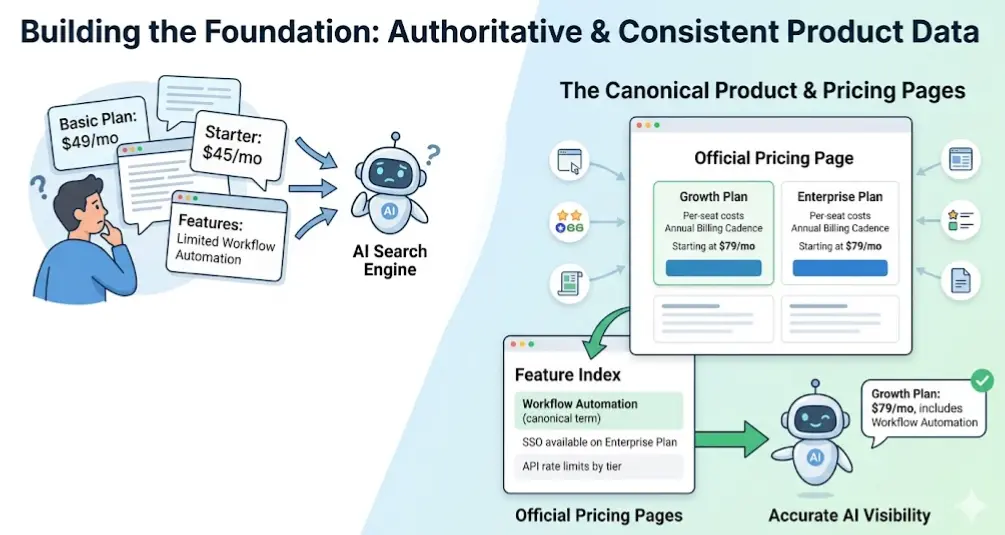
For example, if your website lists a product at $49 per user while a review site shows $45, AI-generated answers may provide inaccurate pricing to potential buyers. The same issue can happen when product names, features, or plan details are updated in one place but not elsewhere.
To avoid this, regularly review your pricing, product descriptions, feature lists, and plan names across all digital channels. Consistent information helps AI platforms understand your offering more accurately, increasing the chances of your product appearing in relevant recommendations and buyer research queries.
2. Structured FAQ Pages on High-Intent Topics
FAQ content is purpose-built for AI extraction. Each entry is a self-contained question-answer pair with a defined scope, exactly the format language models prefer when assembling answers to buyer queries.
The mistake most teams make is publishing generic FAQs (“What is [Product]?”) rather than decision-stage FAQs that reflect real buyer friction. The questions that AI systems surface most often are the ones buyers actually ask during evaluation: compliance posture, integration depth, implementation timeline, data residency, SSO availability by tier.
High-value FAQ topics for SaaS:
- “Does [Product] support SSO on the Professional plan or only Enterprise?”
- “What’s the typical onboarding time for a 50-person team?”
- “Is [Product] SOC 2 Type II certified, and where can I find the report?”
- “Does [Product] integrate natively with Salesforce or require a third-party connector?”
Write answers in present tense. Keep them under 60 words. Avoid hedging language. If the answer changes seasonally (like pricing), add an “as of [date]” qualifier so AI systems treat it as time-bounded rather than evergreen fact.
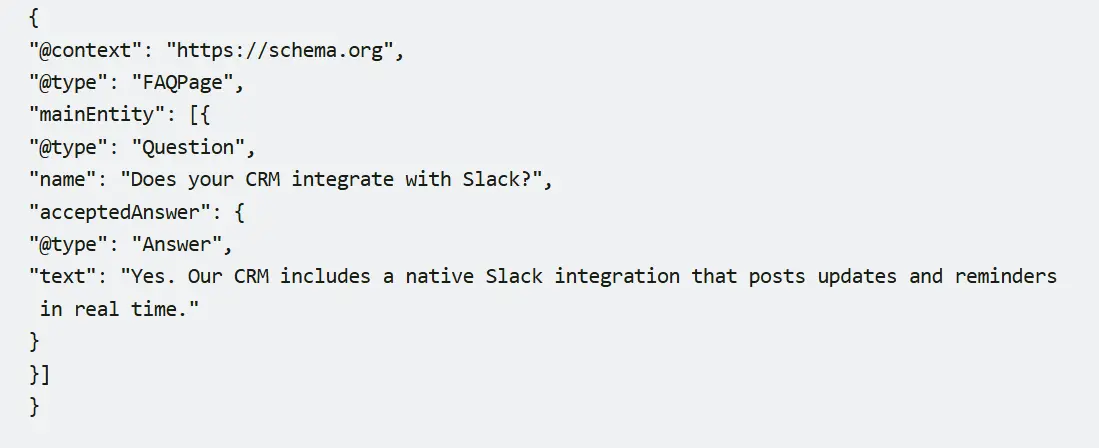
Implement FAQPage JSON-LD markup. The structured data reinforces the content signal, reduces the likelihood of paraphrase errors, and expands eligibility for FAQ-style rich results in traditional search, a compound benefit.
Example:
3. Comparison and Alternative Pages
This content category is where AI visibility battles are often won or lost. When buyers ask:
“What’s the best alternative to [Competitor]?” or “[Your Brand] vs [Competitor] for enterprise security teams,”
AI engines pull heavily from whichever comparison sources they find most authoritative. If you haven’t published and maintained these pages, a competitor’s content or an affiliate listicle fills the vacuum and defines the narrative.
As per a report B2B buyers typically evaluate between 3 and 7 vendors before making a purchase decision, increasing the importance of appearing in comparison-related searches and AI-generated recommendations.
What makes a comparison page AI-ready:
- Use HTML tables, never images or screenshots
AI parsers read HTML; a JPEG comparison matrix doesn’t exist for citation purposes. Your table should include: plan names, per-seat pricing with billing cadence, SSO availability by tier, API rate limits, native integrations, compliance certifications, and support SLA by plan.
- Add “Best for” summaries tied to specific buyer scenarios:
“Best for: engineering teams that need audit logs and role-based access control on every plan.” Add “When you should not choose us” sections. That counterintuitive transparency tends to be the most-cited passage in AI answers because it signals genuine authority rather than vendor positioning.
- Include an “as of [date]” note on any pricing or feature data.
AI systems treat dated claims as more reliable than undated ones because they can contextualize potential staleness.
- Revisit comparison pages quarterly.
Competitors change pricing, rename features, and add integrations. An outdated comparison page that incorrectly represents a competitor will erode credibility with the AI systems that cite you and with the buyers who eventually verify the claims.
4. Glossary Pages and Category Definition Content
AI models are built on the web’s existing text. When they assemble a definition of “customer data platform” or “product-led growth,” they draw from whichever sources have established the clearest, most consistently cited definitions.
If your SaaS product operates in a specialized or emerging category, owning the definitional content for that category is one of the highest-leverage moves available.
Glossary entries should follow a consistent structure that AI systems can reliably parse: a one-sentence definition in plain language, a short mechanism explanation, a practical use case, and two or three cross-links to related terms.
For SaaS go-to-market teams, the highest-value glossary terms are those buyers evaluate during software selection: API rate limits, data residency, user provisioning, SCIM, role-based access control, audit logs, and multi-tenancy. These are the terms that appear in complex AI-generated answers to enterprise buying queries, and your definition page is a citation opportunity.
5. Conversation-Led Feature and Use Case Pages
Buyers in AI-search environments don’t search “CRM software. They prompt
“best CRM for a 40-person financial services firm that needs Salesforce data sync, HIPAA compliance, and can be deployed in under two weeks.”
AI engines deconstruct that prompt into sub-questions: who is asking, what constraints apply, what integrations matter, what timeline is realistic, and then assemble an answer from the content that most directly addresses each sub-component.
Most SaaS content is written for keyword targets, not for the multi-part scenarios buyers actually describe to AI systems. Rewriting your top feature and use case pages to explicitly address scenario-based queries is one of the highest-ROI content investments you can make.
The pattern that works:
Lead with the direct answer. State your recommendation or conclusion in the first paragraph, not buried in the fifth. AI engines extract the first clear statement they find. If your page takes 300 words to warm up before making a claim, the model may extract a sentence from the preamble that doesn’t represent your actual positioning.
Then add evidence: customer proof, benchmark data, implementation timeline specifics. Then close with a clear next step.
Structure pages so both evaluation paths are addressed:
- product-led evaluation (trial friction, onboarding time, time-to-value) and
- procurement evaluation (security documentation, SSO, contract terms, data residency).
Enterprise buyers and self-serve buyers are often researching simultaneously, and AI systems that encounter both buyer types will look for both content types on your pages.
6. Expert-Anchored Thought Leadership and Original Research
AI engines give systematic preference to citable, expert-attributed statements over generic content. Moreover, a report found that 64% of decision-makers say thought leadership content is a more trustworthy basis for evaluating vendors than traditional marketing materials.
A quote that reads “Based on our 2025 analysis of 400 SaaS implementations, teams that complete onboarding within 72 hours show 2.4x higher 90-day retention” is far more likely to be surfaced and cited than “We help teams onboard faster and succeed.”
Build a reusable quote library: 15–25 data-anchored statements from founders, product leads, or subject matter experts, each tied to a specific data point, timeframe, and context. Store them in a shared database with fields for topic, speaker, date, source URL, and active/retired status. Retire quotes when the underlying data changes. Refresh quotes when you launch major features or publish new benchmarks.
Distribute this content through LinkedIn, PR responses, partner co-marketing, and product announcements. The goal is external domain diversity; AI systems reuse your expert statements more reliably when they appear across multiple credible sources, not just your own site.
Related Post: What Is E-E-A-T and Why It Matters in AI Search
7. A Single Source of Truth for Technical Specifications
This is less a content type than an operational discipline, but it’s where most SaaS teams bleed AI visibility without realizing it. When the same technical specification, API rate limits, data retention policy, integration availability, and compliance certifications appear differently across your product page, your docs, your security page, your onboarding materials, and your G2 profile, AI systems average the inconsistency into confusion.
Create a centralized internal document that lists every specification that appears in AI answers: pricing by plan, SSO availability by tier, integration list with connection type (native vs. Zapier), compliance certifications with scope, API limits, data residency options, and SLA terms. Update the source document whenever anything changes, then sync every external surface against it: product pages first, then docs, then comparison pages, then FAQs, then schema.
This is the unglamorous work, but it’s the work that prevents AI systems from confidently telling your prospects incorrect information about your product at scale.
Measuring Whether It’s Working
AI visibility metrics don’t map cleanly to traditional SEO KPIs. Rankings don’t capture whether you’re recommended. Traffic doesn’t capture zero-click influence.
Build a set of 10–15 representative prompts across four query types:
category discovery, comparisons, problem-led queries, and trust queries
Run this prompt set monthly across ChatGPT, Perplexity, and Google AI Overviews. Log whether your brand appears, where it ranks in the answer, whether details are accurate, and whether a source link is included.
Track Share of Answer: The percentage of responses where your brand is mentioned is your primary AI visibility metric. Pair it with the recommendation rate (how often you’re the top suggestion) and accuracy flags (incorrect pricing, outdated features, wrong positioning).
Connect AI visibility to business outcomes by tracking branded search lift, self-reported “found via AI” in your CRM, and assisted conversions through UTM parameters on AI-referred traffic. The zero-click nature of AI answers means some of your best visibility will never appear in Google Search Console; directional trend tracking is more honest than claiming precise attribution.
Where to Start
If you’re prioritizing a limited roadmap, sequence your investment this way:
- First, audit existing content for internal consistency. Fix contradictions in pricing, plan names, and feature specifications before publishing anything new.
- Second, publish or update comparison and alternative pages, the highest-leverage content type for competitive AI visibility and most frequently cited in AI-generated shortlists.
- Third, implement FAQ schema on your top five product and feature pages using buyer-friction questions, not marketing questions.
- Fourth, build or refresh your glossary for the ten terms most central to your product category.
- Fifth, rewrite your two or three highest-traffic feature pages for conversation-led, scenario-based queries.
The teams that win in AI search are not necessarily publishing the most content. They’re maintaining the most internally consistent, structurally clear, and factually precise content, the kind a language model can extract, trust, and recommend without qualification.
Conclusion
As AI-powered search continues to reshape software discovery, SaaS companies must focus on creating content that AI platforms can easily understand, trust, and reference. From product pages and FAQs to comparison content and use-case resources, every asset should deliver accurate, structured, and consistent information. The brands that earn visibility in AI-generated recommendations will be those that answer buyer questions clearly, maintain content accuracy, and position themselves as authoritative sources throughout the decision-making journey.
Ready to make AI search a reliable source of SaaS visibility and pipeline growth? Partner with ResultFirst and our SaaS SEO services to build an AI-focused content strategy that helps your brand appear in AI-generated recommendations, comparisons, and buyer research journeys. Contact us today to get started.
Sources Referenced:
- https://www.linkedin.com/posts/rosspjohnson_we-spend-a-lot-of-time-mapping-the-ideal-activity-7361716980833284097-HieU
- https://clutch.co/resources/ai-agentic-commerce-changing-online-shopping
- https://www.edelman.com/insights/thought-leadership-gets-b2b-buyers-back-into-game
- https://www.linkedin.com/posts/sparkdynamic_gartner-research-shows-b2b-buyers-evaluate-activity-7430126422016569344-rhLy
FAQ’s
WHAT TO READ NEXT
READY TO BUILD PREDICTABLE ORGANIC GROWTH?
We are the only TOP SEO services agency providing Real Results in a Real Performance model. We help growth hungry companies outperform their competition and achieve 300%+ growth in their digital marketing initiatives.
- San Jose, CA, 95120

- +1-888-512-1890

- sales@resultfirst.com

300K+
KEYWORDS RANKED
546M+
REVENUE GENERATED
18 Years
SOLVING COMPLEX SEO
150+
TEAM MEMBERS