



 sales@resultfirst.com
 +1-888-512-1890
Google Drops FAQ Rich Results In Search: What It Means for SEO in 2026

Google officially removed FAQ rich results from Search on May 7, 2026, closing one of the most widely used structured data features in SEO. For years, FAQ schema has helped websites expand their visibility in search results, improve click-through rates, and dominate mobile SERPs. Now, those expandable FAQ snippets are gone.
The change marks a major shift in how Google evaluates content visibility and how modern SEO services must approach optimization moving forward. So, whether you manage your own site or invest in professional SEO services, this change demands an immediate strategic review. The removal marks the end of a feature that gave millions of websites expanded search listings, higher click-through rates, and a competitive edge through a few lines of structured data code.
The update did not happen overnight. Google gradually reduced FAQ rich result visibility beginning in 2023 before fully removing the feature in May 2026. Search Console reporting for FAQ rich results will disappear in June, while API support ends in August.
Here is everything you need to know, and more importantly, what your SEO services strategy should look like going forward.
What Just Happened And Why Google Pulled the Plug
Google added a deprecation notice to its official FAQ structured data documentation, confirming:
“FAQ rich results are no longer appearing in Google Search. We will be dropping the FAQ search appearance, rich result report, and support in the Rich results test in June 2026. Support for the FAQ rich result in the Search Console API will be removed in August 2026.”
The removal follows a three-year rollback that began in 2023, when Google first restricted FAQ rich results to authoritative government and health websites. That restriction already cut off the majority of publishers, bloggers, and businesses from the feature. The May 2026 update removes it entirely, even for those previously eligible sites.
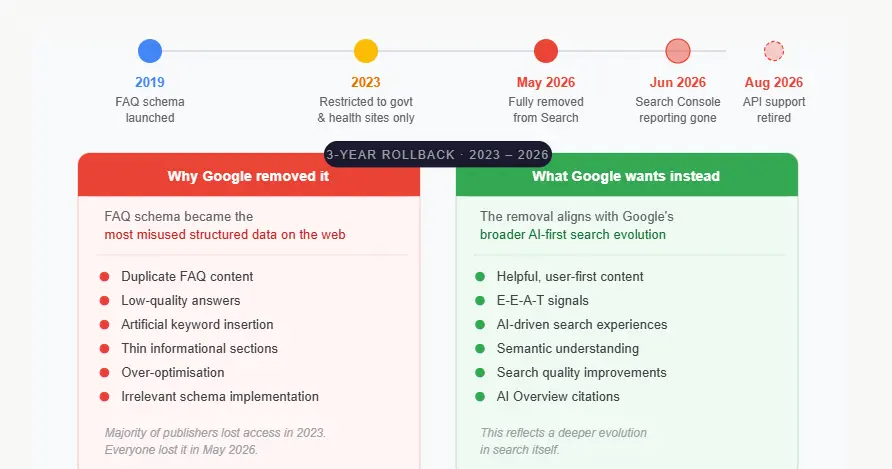
Image Source: Claude
The reason? Since the FAQ schema was launched in 2019, it has become one of the most misused structured data formats on the web. Websites stuffed FAQ sections with keyword-heavy questions, duplicated content, and irrelevant answers, not to help users, but purely to grab more SERP real estate. Google noticed several recurring problems:
- Duplicate FAQ content
- Low-quality answers
- Artificial keyword insertion
- Thin informational sections
- Over-optimization
- Irrelevant schema implementation
As a result, Google began limiting FAQ visibility in 2023 to authoritative government and health websites before fully removing the feature in 2026.
The removal aligns closely with Google’s broader focus on:
- Helpful content
- E-E-A-T signals
- AI-driven search experiences
- Semantic understanding
- Search quality improvements
This change reflects a deeper evolution in search itself.
What’s Changing?
| May 7, 2026: FAQ rich results stopped appearing in Google Search June 2026: Google will remove the FAQ search appearance filter, Rich Results Report, and FAQ support from the Rich Results Test in Search Console. August 2026: Search Console API support for FAQ rich results will officially retire. |
Search Rankings Now Depend More On AI Readiness
Google’s AI Overviews and conversational search experiences are transforming how users interact with search engines. Instead of relying on static rich snippets controlled by publishers, Google increasingly generates AI-powered answers directly inside the SERP.
That means Google now wants:
- Better content interpretation
- Semantic clarity
- Trusted sources
- Contextual understanding
- Entity-based information
FAQ rich results no longer fit cleanly into this AI-first search direction.
According to industry analysis, Google is prioritizing AI-generated summaries that synthesize information dynamically instead of showing pre-defined FAQ dropdowns.
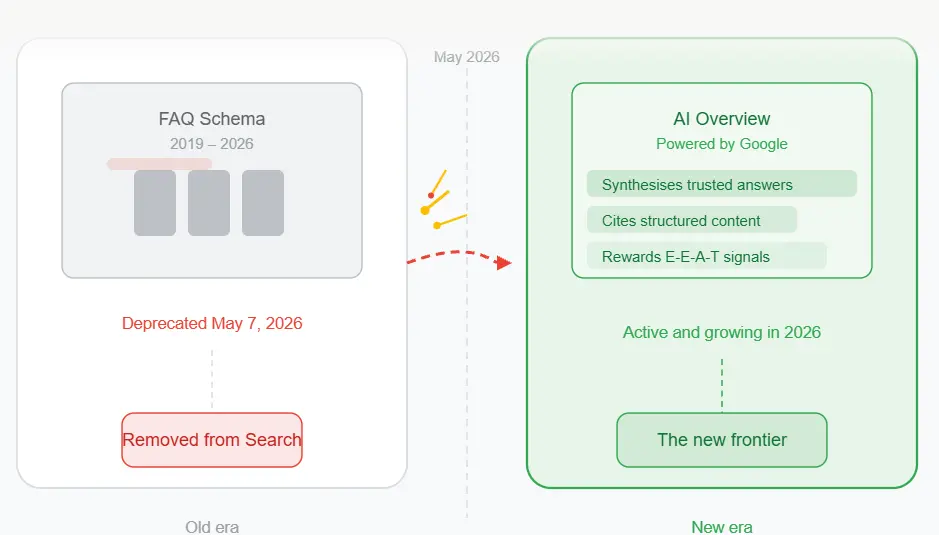
Image Source: Claude
How This Affects Your Search Visibility Right Now
The most immediate impact is the loss of SERP real estate. FAQ rich results previously allowed a single organic listing to occupy three to five times the vertical space of a standard blue link. That visual dominance is now gone. Pages that depended on expandable FAQ dropdowns to push competitors further down the page have lost that advantage entirely.
For businesses invested in quality SEO services, the practical effects include:
Lower click-through rates on affected pages. Without the expanded listing, your result looks identical to every competitor on the page. Early analysis from major SEO publications suggests pages that were heavily dependent on FAQ rich results may see noticeable CTR drops, though the scale varies by industry and keyword type.
Smaller search footprint. If your content strategy was built around FAQ-heavy pages designed to maximise SERP space, you now need a new approach to visibility.
Disrupted Search Console reporting. Teams that built performance tracking around FAQ impressions and rich result status will need to retire those metrics entirely by June 2026 and replace them with more relevant signals.
Does FAQ Schema Still Have Any Value?
Yes, but the reason for using it has fundamentally changed.
Google confirmed that you do not need to remove FAQPage structured data from your site. The markup will not harm your rankings. Other search engines, including Bing, may still use it for their own rich results. More importantly, AI systems, including Google AI Overviews, Perplexity, and ChatGPT, continue to parse FAQ markup as a primary citation signal.
Research shows that pages with FAQPage markup are significantly more likely to appear in Google AI Overviews than pages without structured data. AI-referred sessions grew exponentially through 2025, and that trend is accelerating.
So while the FAQ schema no longer earns a visual result in traditional Google Search, it remains a valuable machine-readable signal that positions your content as an authoritative source for AI systems to cite.
The strategic shift is this: The FAQ schema used to be about SERP display. Now it is about AI discoverability.
What Strong SEO Services Should Be Doing Right Now
The removal of FAQ rich results is not just a technical change; it is a signal about where Google is taking search. Smart SEO service providers will treat this as an opportunity to build a more durable content strategy. Here is what that looks like:
1. Audit Your FAQ Structured Data
Export historical FAQ rich result data from Search Console before the reporting sunsets in June. Identify which pages relied heavily on the FAQ schema for impressions and traffic. Then assess whether the FAQ content on those pages genuinely serves users or was added primarily for SERP manipulation. This is the time to clean up low-quality FAQ sections and strengthen pages that have real user value.
2. Focus More On Featured Snippets, and People Also Ask
Featured snippets and People Also Ask (PAA) boxes remain fully active SERP features in 2026. Well-structured FAQ content still significantly increases your chances of capturing a featured snippet, particularly in healthcare, finance, and other YMYL industries. To optimise:
- Write concise, direct answers to specific user questions
- Format questions as H2 or H3 headings
- Keep answers between 40 and 60 words for snippet eligibility
- Support answers with internal links to build topical authority
3. Optimize for AI Search Citations
This is the highest-leverage opportunity in the current landscape. Pages that are clearly structured, factually accurate, and marked up with schema are the pages AI systems pull from when generating answers. Your SEO services strategy should now explicitly include optimising for AI citation, not just traditional ranking positions.
Focus on clear headings, short answer-first paragraphs, entity-based content, and authoritative sourcing. These signals help AI systems identify your content as reliable and citable.
4. Strengthen EEAT Across Your Site
Google’s Helpful Content System and EEAT (Experience, Expertise, Authoritativeness, Trustworthiness) principles are more important than ever now that structured data shortcuts like FAQ snippets are gone. Invest in:
- Author credentials and bios
- First-hand expertise and original insights
- Credible external citations
- Transparent sourcing and publication dates
5. Monitor the Right Metrics Going Forward
Once FAQ reporting disappears from Search Console, shift your monitoring to:
- Page-level CTR and impressions (compare pre and post May 7 data)
- Featured snippet and PAA presence
- AI Overview citation tracking
- Core Web Vitals and crawl efficiency
- Indexed page ratios and orphan page counts
The Bigger Picture for SEO in 2026
The deprecation of FAQ rich results is not an isolated event. It is part of a consistent pattern: Google is removing structured data features that were widely abused, while simultaneously building AI-first systems that reward genuine expertise and content quality over technical manipulation.
For businesses that invest in quality SEO services, this is actually good news. The sites that will win in 2026 and beyond are the ones that publish authoritative, well-structured, genuinely useful content, not the ones that found the cleverest way to expand their search listing. The playing field is shifting toward substance.
The FAQ schema still works. FAQ content still matters. But the reason you use it has changed. Use it to serve users and earn AI citations, not to manufacture SERP space that Google was never going to keep offering indefinitely.
The best SEO services will help you make that transition cleanly, quickly, and with a strategy built for where search is actually heading.
WHAT TO READ NEXT
READY TO BUILD PREDICTABLE ORGANIC GROWTH?
We are the only TOP SEO services agency providing Real Results in a Real Performance model. We help growth hungry companies outperform their competition and achieve 300%+ growth in their digital marketing initiatives.
- San Jose, CA, 95120

- +1-888-512-1890

- sales@resultfirst.com

300K+
KEYWORDS RANKED
546M+
REVENUE GENERATED
18 Years
SOLVING COMPLEX SEO
150+
TEAM MEMBERS