



 sales@resultfirst.com
 +1-888-512-1890
20 Shopping Cart Abandonment Statistics You Must Know in 2026

Remarkably, almost 70% of online shoppers give up on their carts. How can this be stopped, and what is the cause? Gaining insight into the reasons behind potential customers’ cart abandonment is essential to boosting sales.
This post’s cart abandonment statistics will help you understand why online shoppers leave their carts empty and what you can do to stop it.
You’ll also increase conversion rates and stop customers from leaving their shopping carts empty.
So, without more delay, here are 20 current shopping cart abandonment stats!
What is the Shopping Cart Abandonment Rate?
A shopping cart abandonment rate represents the portion of online shopping sessions where customers add items to their cart but do not complete their purchase. In layman’s terms, it represents the number of abandoned carts compared to completed transactions.
Baymard statistics show an average cart abandonment rate of 70.22%. This means that nearly seven out of ten internet visitors who add an item to their virtual shopping basket will leave without making a purchase.
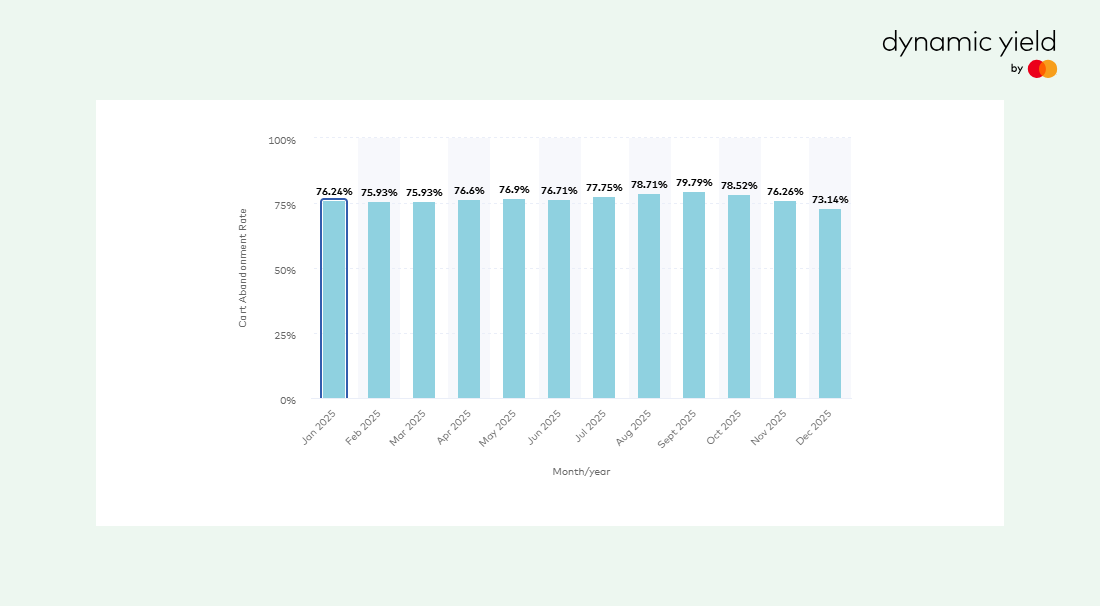
Source: Dynamic Yeild
3 Key Cart Abandonment Rate Statistics
1. Benchmarks for the Industry
According to some studies, the average shopping cart abandonment rate is 70.22%.
A greater-than-average desertion rate could be due to several factors, including a complicated checkout process, shipping fees, a needed sign-up, or limited payment alternatives.
Findings: The average cart abandonment rate is only approximately 70%, based on an analysis of data from 49 different studies.

Statistics on Cart Abandonment by Drip. That means that seven out of every ten shoppers will not complete their transaction—a ratio that many ecommerce company owners find unsettling. Partnering with an ecommerce SEO company can help address this challenge by optimizing your online store to reduce cart abandonment
2: Customers aged 25-44 abandoned their trolleys the most

ContentSquare reports that customers between the ages of 25 and 34 are the most likely to abandon their basket (21%), closely followed by those between the ages of 35 and 44 (20%).
If your target consumer falls into one of these categories, you must understand what causes these customers to abandon their carts more often than other age groups.
- Clothing (40%),
- technology products (18%), and
- homeware (16%)
are the three most often abandoned item categories.
3: Using predictive AI can cut cart abandonment by 18%
Predictive AI is a valuable tool for combating cart abandonment. This is how it works.
Behavior Analysis: AI algorithms methodically study website visitor behavior, discovering patterns that suggest a high abandonment risk.
Personalized Intervention: Armed with this information, the AI can initiate real-time interventions tailored to each unique shopper.
Optimized Incentives: AI adjusts incentives to focus on converting sales while maintaining profit margins. This ensures that offers are targeted to boost sales while remaining profitable.
7 Reasons Why Consumers Abandon Cart
1: Unexpected Hidden Costs
Hidden expenses are the most common cause for visitors to leave without making a purchase, ranking top in terms of probability and impact.
According to Baymard 39% of customers said shipping prices were the main reason they left.
However, you should also consider other hidden costs, such as taxes or essential complimentary items, as these have a comparable effect.

These expenditures generate instant annoyance and frustration. It can even cause people to feel remorseful about their purchases.
2: Complicated and time-consuming checkout
Another common reason customers quit payment is the lengthy, complex checkout procedure. Every additional step and form field slows the user’s payment process and makes it more difficult.
Customers like a simple, convenient process; thus, any extra steps detract from the user experience.
3: Mandatory Account Creation
If you require your visitor to create an account to complete the purchasing process, you create an additional barrier between them and completing their purchase.
The $300 million button, as it is known in the UX industry, is an excellent example of this.
A big ecommerce store wanted to increase conversions by replacing the compulsory “Register” button in their checkout flow with a “Continue” button while emphasizing that creating an account was not essential to completing a purchase.

4: Slow Website or Technical Problems
Even a three-second delay can lower customer satisfaction by 16%, and with 44% of shoppers sharing bad experiences, site speed directly impacts brand reputation.
Performance issues, such as delayed page loading and checkout failures, make purchasing unpleasant. Site faults make customers feel uncomfortable; therefore, if your website is slow and frequently crashes, it will directly impact the visitor’s readiness to purchase.
5: Shipment is slow
Your shipping policy is more than just the price. Many customers place an even higher value on delivery time. You may slip behind your competitors if your website does not provide express or same-day deliveries.
6: Lack of trust
Payment security and data privacy concerns arise when a website appears insecure or untrustworthy.
You can invest in web design and security. Show trust badges, security seals, and clear return policies.
7: Just browsing
Many customers add items to their cart for research purposes, intending to buy later or from another retailer.
Try to use remarketing and cart abandonment emails to remind customers about their abandoned purchases and offer targeted incentives to entice them to return.
4 Cart Abandonment Statistics on Checkout Flow Best Practices
1: Provide Multiple Payment Options
Consumers continuously seek useful and desired things that can be obtained promptly and, most importantly, through flexible payment alternatives such as purchase now, pay later (BNPL).
Offer a choice of payment methods, including credit/debit cards, digital wallets (e.g., PayPal, Apple Pay, Google Pay), and other payment options.
According to various studies, research shows that 13% to 28% of shoppers abandon their carts if their preferred payment method is unavailable.
2: Checkout optimization boosts conversions by 35.62%
The good news is that ecommerce firms are not condemned to suffer from cart abandonment.
According to the Baymard Institute, using the appropriate checkout optimization tactics can raise conversions by a massive 35.62%
While attaining this figure is complex, it is certainly doable.
3: Implement Address Autocomplete and Validation
Integrate address autocomplete and validation functionality by utilizing APIs (Application Programming Interfaces) from services such as Google Places API or AddressFinder.
Incorrect or incomplete address information might cause annoyance and eventual cart abandonment.
According to a some studies, around 22-25% of cart abandonments occur when customers have trouble entering their shipping address. Address autocomplete and validation can help streamline the checkout process and reduce errors, lowering abandonment rates.
4: Streamlined Checkout Process by Reducing Form Fields
Reduce the number of steps required at checkout. Limit the number of form fields to those that are needed.
Baymard Institute research shows that each additional step in the checkout process increases the risk of cart abandonment.
According to same Baymard research long and complicated checkout processes cause over 22% of shoppers to abandon their purchases.

2 Methods To Slash Cart Abandonment Rate For Mobile Devices
1: Optimized Mobile Device
The mobile cart abandonment rate is 80.2%, the highest of any device. The smaller the screen size, the more likely a buyer will not buy. This emphasizes the significance of thoroughly optimizing your ecommerce store for mobile consumers, which can be accomplished using the following techniques:
- Increasing the speed of mobile sites
- Trimming down your copy to include necessary information;
- To organize information effectively, use “mobile accordions” and prioritize important pieces above the fold.

Related: Mobile SEO: 18 Easy Techniques to Make Your Site Mobile Friendly
2: Keeping Easier the Process of Entering Information
Another issue that causes nearly four out of every ten mobile customers to abandon their cart is difficulty submitting information during checkout.
39% of mobile users abandoned it because of difficulty entering their personal information.
You will need to solve this issue.
- A mobile-responsive design for your ecommerce store.
- Use large, easy-to-tap buttons to avoid accidental pressing
- Other elements, and keep forms concise.
4 Ways To Do Cart Abandonment Recovery Right
1: Develop Retargeting Ads
Three out of four customers notice retargeted advertising, which is good given how many people block irrelevant ads.
More than a quarter of those consumers (26%) will click on the retargeted ad and return to your website.
But what constitutes a great retargeting ad? To pique their interest, display the products they left behind or similar ones.
Add actionable content that indicates urgency to get people to click faster and create a useful CTA button.

2: Cart abandonment emails work, too
Emails sent to cart abandoners are a great way to follow up with those who have not clicked on your popups and turn them into paying customers.
Check out these email statistics about abandoned carts!
Moosend reports that 21% of readers click through on 45% of open cart abandonment emails. Of them, 50% chose to complete their transaction! That represents a 10.5% increase in sales.
Combining emails and popups can save up to 27.62% of cart abandoners, or about three out of ten customers.

3: Adding Exit-Intent Pop-ups
Exit-intent pop-ups should be displayed when customers try to depart the website without completing their purchase. Offer unique discounts, incentives, or freebies to pique their interest and persuade them to reconsider.
Websites such as Shopify, for example, enable exit-intent pop-ups that show when visitors move their mouse cursor to the browser’s close button.
According to our internal data, cart abandonment popups convert at a rate of 17.12% on average.

4: Craft Personalized SMS Reminder
According to research, this strategy can recover up to 16.4 orders for every 100 SMS messages delivered. It gives clients enough time to make a decision without feeling overwhelmed.
- Use cart abandonment tracking tools like Drip on your e-commerce website to efficiently recover abandoned baskets.
- Create unique SMS reminders that are succinct and eye-catching.
- Set a 60-minute wait before sending reminders to give clients time to reconsider their purchase.
- To persuade clients to return, offer limited-time incentives such as discounts, free shipping, or gifts.
What effect does shopping cart abandonment have on revenue?
If your consumers have difficulty at the checkout, you are losing money. Optimizing your checkout process is one of the best ways to address usability issues contributing to cart abandonment. Also, according to Baymard, making such improvements could enhance your ecommerce site’s conversion rate by up to 35.26%.
In monetary terms, this conversion rate hike might help businesses recoup up to $260 billion in lost order income.
Read More: How Site Speed Impacts Conversion Rate of Ecommerce Website
Conclusion
Shopping cart abandonment is not just a metric—it’s a clear signal of where the buying journey breaks down. From hidden costs and complex checkouts to mobile friction and trust gaps, every abandoned cart represents lost revenue and missed intent. The data makes one thing clear: reducing abandonment requires a structured approach that combines UX, performance, messaging, and behavioral insights across devices.
For brands looking to turn insights into action, partnering with an experienced SEO service company can help align traffic quality with conversion readiness. ResultFirst works with ecommerce brands to reduce drop-offs by improving visibility, intent targeting, and checkout experience. As a performance-focused SEO service company, ResultFirst helps businesses recover lost opportunities and convert high-intent users into consistent revenue.
FAQ’s:
The typical recovery rate for abandoned carts is between 3% and 5%, depending on the average order value and number of orders each month. Leaders in this industry retrieve 10% to 14% of abandoned carts.
WHAT TO READ NEXT
READY TO BUILD PREDICTABLE ORGANIC GROWTH?
We are the only TOP SEO services agency providing Real Results in a Real Performance model. We help growth hungry companies outperform their competition and achieve 300%+ growth in their digital marketing initiatives.
- San Jose, CA, 95120

- +1-888-512-1890

- sales@resultfirst.com

300K+
KEYWORDS RANKED
546M+
REVENUE GENERATED
18 Years
SOLVING COMPLEX SEO
150+
TEAM MEMBERS