



 sales@resultfirst.com
 +1-888-512-1890
10 AIO Optimization Best Practices to Improve AI Search Visibility in 2026

AIO optimization is the process of optimizing content, website information, brand signals, and data for AI systems. It helps those systems better understand, retrieve, and surface a brand in AI-generated answers. It matters because the face of modern search is changing. As per a report, AI Overviews now appear in approximately 43% to 48% of U.S. search queries as of February 2026, and OpenAI reported ChatGPT reached 900 million weekly active users that same month.
AIO differs from traditional SEO in what it optimizes for; SEO earns a ranking on a results page; AIO earns a citation inside an AI-generated answer, which is a different, less predictable target.
This guide discusses 10 best practices marketers can use to improve how often and how accurately AI platforms surface their brand in 2026. But before that, let’s try to understand what AIO optimization is, how it differs from SEO and GEO
What is AIO Optimization?
As AI-powered search becomes a primary way people discover information, brands need to optimize beyond traditional search rankings. AIO optimization focuses on helping AI systems accurately understand your content, verify your brand, and confidently reference your information. By improving these signals, businesses can increase their chances of appearing in AI-generated answers across platforms such as ChatGPT, Google AI Overviews, Gemini, and Perplexity.
The mechanics behind that distinction matter.
- A traditional search engine indexes and ranks a page, then displays it in a list.
An AI system works differently:
- It retrieves fragments of information from many sources, synthesizes them into a single narrative answer, and selectively decides which sources, if any, to cite.
A brand can rank on page one of Google and still be entirely absent from an AI-generated answer to the same question, or vice versa.
That’s what AIO optimization is built to address. It’s not a single tactic but a practice spanning content structure, structured data, and brand signals maintained across the web, not just on the brand’s own website.
What is the Difference Between AIO vs. SEO vs. AEO vs. GEO
These four terms are related but not interchangeable, and there isn’t yet one universally accepted definition for any of them across the industry. Broadly:
| Optimization | Main Goal | Focus | Key Signals | Example Platforms |
| SEO (Search Engine Optimization) | Improve visibility in traditional search engine results pages | Page ranking and crawlability | Backlinks, keywords, site speed, on-page structure | Google, Bing search results |
| AIO (AI Optimization) | Help AI systems understand, trust, and surface a brand across search and generative platforms | Overall brand legibility and trust to AI systems | Brand mentions and citation frequency across platforms | ChatGPT, Gemini, Copilot, Perplexity, AI Overviews |
| GEO (Generative Engine Optimization) | Improve visibility and citation within generative, AI-written search results | Being cited inside a generated response | Authoritative sourcing, statistics, clear claims | Google AI Overviews, AI Mode |
| AEO (Answer Engine Optimization) | Provide direct, structured answers to specific user questions | Answer format and clarity | Concise Q&A content, FAQ structure, featured snippets | Google featured snippets, voice assistants |
10 AIO Optimization Best Practices For AI Search Visibility in 2026
1. Create Direct Answers to User Questions
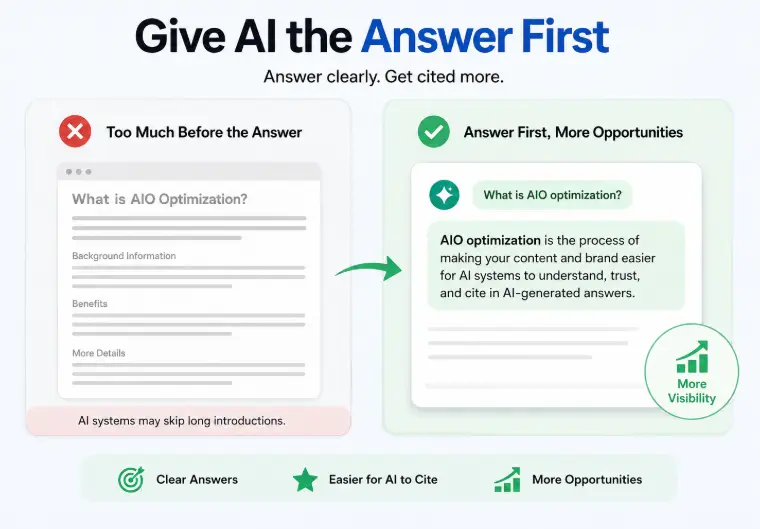
AI systems favor content that answers a question clearly and immediately, rather than content that builds up to an answer through long introductions. A study found that AI summaries appeared in 60% of question-style searches, compared with far lower rates for single-word or vague queries. It means the content written to directly answer a specific question has more opportunities to be pulled into an AI response in the first place.
- Start each H2 or H3 section with a concise, self-contained answer in the first one or two sentences, then follow with supporting detail, data, or examples.
- Use question-based subheadings that mirror how people actually phrase queries in AI tools.
- AI models extract concise, self-contained passages that answer a question without requiring additional context. Pages that provide immediate answers are easier for AI systems to retrieve, understand, and cite.
For example:
Instead of starting with background information under “What is AIO optimization?”, begin with: “AIO optimization is the process of making your content and brand easier for AI systems to understand, trust, and cite in AI-generated answers.” Then expand on how it works and why it benefits businesses.
2. Build Topical Authority
Topical authority means becoming a trusted source on a specific subject by publishing comprehensive, connected content instead of a single article. AI systems are more likely to cite websites that consistently demonstrate expertise across an entire topic.
- Create multiple pages that cover the main topic, related questions, comparisons, use cases, and supporting concepts.
- Connect these pages with internal links so they form a complete content cluster.
- This helps AI understand that your website has deep expertise rather than isolated information. As your topical coverage grows, your chances of appearing in AI-generated answers increase.
For example:
If you offer AIO optimization services, create related content on AI Overviews, entity SEO, structured data, AI citations, and AEO, then interlink these pages. This helps AI systems recognize your website as an authoritative source on the topic.
3. Strengthen Brand and Entity Signals
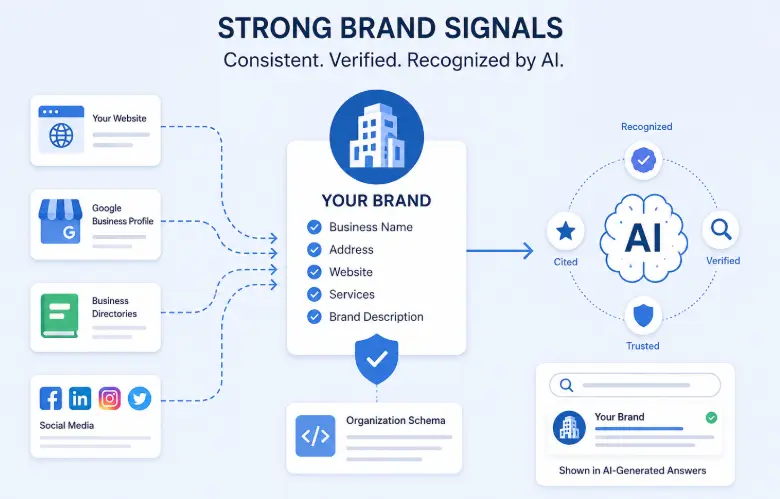
AI systems rely on entity recognition, connecting a brand name to a consistent, verifiable set of facts about who it is, what it does, and where it operates. Inconsistent business information across the web (different addresses, descriptions, or naming conventions) can weaken this recognition and make a brand harder for an AI system to confidently cite.
- Keep your business name, address, website, services, and brand description consistent across your website, Google Business Profile, business directories, and social media profiles.
- Also, maintain an accurate About page and implement Organization schema using the same information.
- Strong entity signals improve AI’s confidence in your brand, increasing the likelihood of your business being recognized and cited in AI-generated answers.
4. Use Structured Data, With Realistic Expectations
Structured data helps search engines and AI systems interpret your content more accurately by identifying entities, products, organizations, authors, FAQs, and other relationships. It strengthens semantic understanding and supports features such as Knowledge Graphs and rich results.
However, don’t expect schema alone to improve AI visibility.
| A May 2026 Ahrefs study found that adding JSON-LD schema to 1,885 pages produced no statistically significant increase in ChatGPT or Google AI Mode citations. The researchers also noted that every page in the study was already heavily cited by AI before schema was added, meaning the findings apply to established pages rather than newly discovered ones. The takeaway is clear: structured data is a foundational optimization that helps AI understand your content, but it works best alongside high-quality content, strong entity signals, and overall SEO, not as a shortcut to AI citations. |
- Treat schema as a clarity and entity-verification tool rather than a guaranteed citation booster.
- Prioritize Organization, Product, FAQ, and Article schema on your highest-value pages, and validate markup with Google’s Rich Results Test, but pair it with the other signals in this list rather than relying on it alone.
5. Make Content Easy to Understand and Extract
Content that is well-organized with clear headings, short paragraphs, and logical structure is easier for AI systems to parse and extract accurately. Dense, unstructured text, long paragraphs without headers, and key facts buried mid-sentence are harder to summarize correctly and more likely to be misrepresented or skipped entirely.
- Use descriptive H2 and H3 headings, short paragraphs, bullet points, and tables where appropriate.
- Place important facts, definitions, and statistics prominently instead of burying them in long blocks of text.
- Answer one question per section so AI systems can extract clear, self-contained responses.
For example:
Instead of presenting product features in a long paragraph, organize them with clear headings and bullet points. This allows AI to quickly identify and extract the most important information.
6. Demonstrate First-Party Expertise
First-party expertise shows AI systems that your content is based on real knowledge, experience, or original insights rather than rewritten information. Content backed by credible experts and firsthand evidence is more likely to be trusted and referenced.
- Publish content under qualified authors, include author bios with relevant credentials, and support your content with original research, proprietary data, case studies, or real-world examples whenever possible.
- Demonstrating genuine expertise strengthens your credibility and trustworthiness.
- It gives AI systems stronger signals that your content is reliable, authoritative, and worth citing in AI-generated answers.
7. Earn Trusted Third-Party Brand Mentions
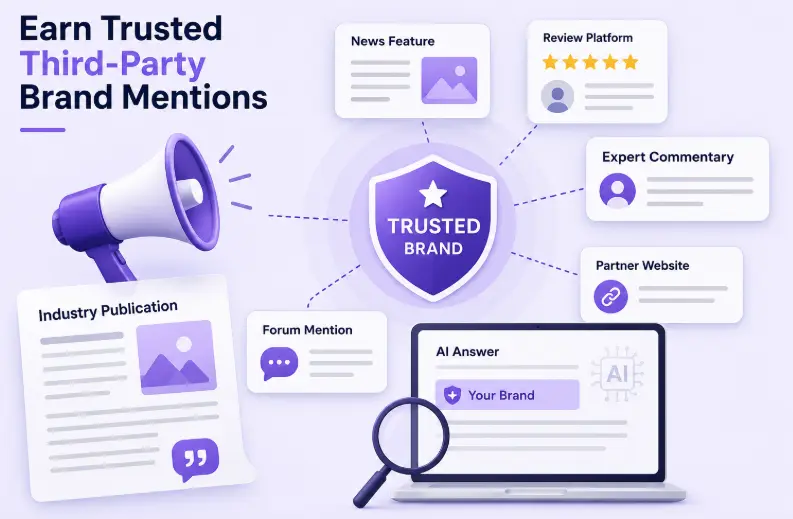
A May 2026 Muck Rack analysis found that 84% of AI citations come from earned media rather than brand-owned content. This shows that credible third-party coverage is one of the most effective ways to improve visibility in AI-generated answers. Mentions and citations from credible external sources, industry publications, review platforms, forums, and partner sites reinforce a brand’s credibility beyond what it says about itself.
- Pursue digital PR, guest contributions, and expert commentary opportunities on reputable, relevant publications.
- Encourage genuine reviews on trusted third-party platforms, and treat digital PR as core to AI visibility strategy rather than a separate marketing function.
8. Optimize Content for Multiple AI Search Platforms
AI Overviews, ChatGPT, Gemini, Copilot, and Perplexity each pull from different data sources and weigh signals differently. Content optimized only for traditional Google rankings may not translate directly to visibility across these platforms. With nearly 68% of Google searches now ending without a click (zero click), brands must optimize for being cited in AI answers, not just earning website visits.
- Monitor how your brand appears or doesn’t across major AI search tools by testing the same prompts on each.
- Adjust content structure, sourcing, and freshness based on the platform-specific patterns you observe rather than assuming one optimization approach fits all platforms equally.
- Review AI-generated answers periodically to identify misinformation, missing context, or competitor mentions that require content improvements.
9. Monitor AI Visibility and Brand Mentions
AI-generated answers change as models, prompts, and data evolve. Regular monitoring helps you understand when your brand is being surfaced and where competitors are appearing instead. AI Overview prevalence itself has shifted dramatically over short periods, from roughly 6.49% of tracked queries in January 2025 to around 48–50% by early 2026, a reminder that visibility benchmarks from even a few months ago may already be outdated.
- Monitoring your brand mentions and citations across AI platforms like ChatGPT, Google AI Overviews, Gemini, and Perplexity.
- Comparing your AI visibility against key competitors to identify content gaps and new opportunities.
- Reviewing visibility trends regularly instead of relying on a one-time audit, so you can adapt to evolving AI models and search behavior.
10. Keep Content Fresh and Factually Accurate
AI systems can deprioritize content that appears outdated or contains unverifiable claims. Regularly updated, accurate content with current statistics, dated sources, and corrected errors supports continued trust and retrieval over time, particularly as models increasingly weigh recency for time-sensitive topics.
- Review high-value pages on a regular schedule and update outdated statistics, examples, and references.
- Replace or remove claims that can no longer be verified, and support important statements with credible, current sources.
- Refresh time-sensitive content to reflect the latest industry developments, products, services, or AI trends.
How Do AI Search Systems Understand Online Information?
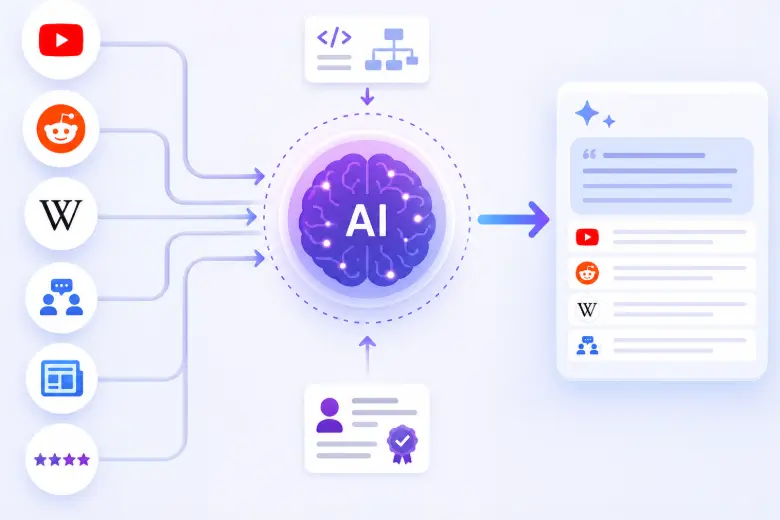
AI search systems don’t rank pages the way traditional search engines do. Instead, they retrieve information from multiple sources and synthesize it into a single answer, then selectively cite a subset of those sources.
According to a Surfer SEO analysis of 46 million AI Overview citations, YouTube accounts for roughly 23% of citations, Reddit around 21%, and Wikipedia around 18%, meaning user-generated and reference platforms often outperform brand-owned pages as citation sources.
Signals that can support better understanding and inclusion include:
- Website content written in clear, direct language
- Structured data (schema markup) that labels entities, products, and relationships
- Product and service information that is consistent across the web
- Brand mentions on third-party sites, publications, and forums
- Expert-authored content with visible credentials
- Reviews and ratings from verified sources
- Third-party citations that corroborate a brand’s claims
Remember:
No single factor guarantees your content will appear in AI-generated answers. AI platforms evaluate multiple signals, and these ranking factors continue to evolve as models are updated. Strengthening all of them together, rather than optimizing for one in isolation, gives a brand the best chance of being retrieved and cited accurately.
Real-World AI SEO Case Studies
To better understand the impact of these best practices, it’s worth looking at real results. Over the past year, ResultFirst has helped brands across industries adapt to the AI search era, improving visibility, accelerating organic growth, and capturing opportunities across emerging AI platforms.
PlushBeds: Achieved a 753% increase in LLM traffic and a 950% surge in AI Overview visibility within just 5 months by optimizing for generative search features and AI-driven SERPs.
Codewars: 22x spike in Copilot traffic and a 2x boost in Gemini traffic in only 3 months.
GMAT Club: 2.6x growth in AI platform traffic and 199% surge in ChatGPT-driven traffic within 6 months.
These outcomes value a consistent pattern: brands that align content structure, entity signals, and topical depth with how AI systems retrieve information tend to see measurable gains in AI-driven visibility and traffic, even in short measurement windows of three to six months.
How to Measure AIO Performance?
AI visibility measurement is still an evolving discipline, and different platforms currently provide different levels of reporting data; there is no equivalent yet to Google Search Console for most AI platforms. That said, several metrics can help track progress:
- Brand mentions in AI-generated answers: how often your brand appears in response to relevant queries
- Citation frequency: how often your pages are directly cited as a source
- Share of voice: how your visibility compares to competitors across the same query set
- Competitor mentions: where competitors are being cited instead of you, and why
- Source citations: which of your pages or third-party mentions are being pulled into answers
- Prompt-level visibility: testing specific, high-value prompts across platforms to see how your brand appears
- Referral traffic from AI platforms: tracking traffic from AI tools where analytics allow it
Note:
Since AI platforms report visibility differently and referral traffic is still emerging, brands use multiple tracking methods instead of relying on a single metric.
Conclusion
As AI continues to reshape how people search for and discover information, AIO optimization is becoming a necessary complement to traditional SEO rather than a replacement for it. With AI Overviews now appearing on roughly half of U.S. Google searches, brands that invest now in clear content structure, strong entity signals, and verifiable third-party credibility will be better positioned as AI search continues to grow.
These 10 AI optimization best practices provide a practical framework for improving visibility across AI search platforms. Brands that consistently apply them will be better positioned to earn citations, build trust, and stay competitive as AI-driven search continues to evolve.
Want your brand to become more visible across AI-powered search? AI SEO Services from ResultFirst help businesses improve AI search visibility, earn relevant citations, and attract qualified traffic through practical AIO strategies.
Sources Referenced:
- https://www.seroundtable.com/half-google-searches-ai-overviews-41780.html
- https://backlinko.com/chatgpt-stats
- https://www.prnewswire.com/news-releases/majority-of-marketers-are-already-optimizing-for-ai-generated-search-answers-as-google-query-volume-hits-an-all-time-high-seo-essex-analysis-finds-302831173.html
- https://ahrefs.com/blog/schema-ai-citations/
- https://muckrack.com/blog/what-is-ai-reading-may-2026
- https://searchengineland.com/google-zero-click-searches-2026-study-479717
- https://surferseo.com/blog/ai-citation-report/
FAQs
WHAT TO READ NEXT
READY TO BUILD PREDICTABLE ORGANIC GROWTH?
We are the only TOP SEO services agency providing Real Results in a Real Performance model. We help growth hungry companies outperform their competition and achieve 300%+ growth in their digital marketing initiatives.
- San Jose, CA, 95120

- +1-888-512-1890

- sales@resultfirst.com

300K+
KEYWORDS RANKED
546M+
REVENUE GENERATED
18 Years
SOLVING COMPLEX SEO
150+
TEAM MEMBERS