



 sales@resultfirst.com
 +1-888-512-1890
How to Get Your Law Firm Recommended by ChatGPT When Someone Asks About Legal Help

The legal hiring process has quietly changed. Before a potential client visits your website, reads your reviews, or asks a colleague for a referral, many of them are doing something else entirely: they are opening AI platforms like ChatGPT and asking it who to call. This is actually the new way people search online. As per a report, AI-generated summaries now appear in 78% of legal-related Google searches, changing how potential clients discover law firms.
At the same time, ChatGPT now processes 2.5 billion queries per day. A growing share of those are legal questions, and a meaningful percentage end with the AI naming specific firms to contact. The prospects who receive those recommendations arrive at intake calls already trusting the firm, already past the evaluation stage, and far more likely to retain than any other inbound source.
Understanding how AI platforms evaluate and recommend law firms is now a critical part of staying competitive.
Why Is ChatGPT Recommending Your Competitive Law Firm Instead of You?
When ChatGPT surfaces a firm in response to a legal query, it is synthesizing signals from multiple sources:
your website, established legal directories, third-party reviews, bar association listings, press coverage, and the model’s broader training data.
The model evaluates which entities to surface based on four overlapping criteria: expertise, verifiability, recency, and relevance to the specific query.

Three structural patterns determine which firms consistently appear:
1. The firm exists as a clear, verifiable entity:
Consistent NAP (name, address, phone) across the web. Schema markup that identifies attorneys and practice areas. Bar association profiles that are claimed and current. Google Business Profile complete and active. When these signals are fragmented, your firm appears as “Smith & Associates” on your website but “Smith and Associates Law Firm LLC” on Avvo — the AI cannot reliably connect the dots, and your authority is diluted accordingly.
2. The firm demonstrates topical depth in the right places:
Substantive content on the practice area the query concerns, authored under a named attorney’s byline, with jurisdictional specificity. “Serving clients throughout California” is meaningfully weaker than “representing clients in Los Angeles County, including Beverly Hills, Santa Monica, and Culver City.”
Remember: The AI is not looking for marketing copy; it is looking for evidence that the firm genuinely operates in a given area and practice type.
3. The firm has independent corroboration:
Mentions in legal trade press, contributions to bar association publications, ratings on recognized directories, peer endorsements. ChatGPT weights external sources more heavily than self-published content, particularly on legal queries, which fall into the YMYL (Your Money or Your Life) category where the model applies heightened scrutiny.
Related Post: Understand How ChatGPT Reads Your Website
Which Sources Does ChatGPT Actually Use to Evaluate Law Firms?
Understanding the source stack is what separates firms that optimize intelligently from those chasing visibility randomly. Based on documented testing across dozens of law firms, ChatGPT draws from a consistent set of signals when formulating legal recommendations.
Legal Directories and “Best Of” Lists
Super Lawyers carries disproportionate weight in ChatGPT’s evaluation because the nomination and peer review process represents independent editorial judgment rather than paid placement. The AI treats this distinction seriously. Beyond Super Lawyers, the following directories all influence AI visibility to varying degrees:
- Avvo
- Justia
- Martindale-Hubbell
- FindLaw
- Three Best Rated
- Expertise.com
- Thumbtack
ChatGPT frequently cites Super Lawyers, Three Best Rated, and Yelp most visibly in its reasoning, but it draws from all of them behind the scenes when assessing local prominence.
Google Business Profile
ChatGPT does not just read your star rating. It reads what your reviews actually say. A review that mentions “settled our commercial lease dispute favorably within three months” signals practice area, jurisdiction, and outcome in language the AI can directly use. Review recency matters independently of volume. A firm with 40 recent, substantive reviews consistently outperforms a firm with 200 dated, generic ones. Your GBP is not just a local SEO asset; it is active input data for AI recommendations.
As per a report, 73% of consumers only trust reviews written in the last month, and listings with consistent review velocity of at least one per week rank 25% higher in local search.
Check Out Google Business Profile Optimization Tips.
Your Website Architecture
The AI checks whether named attorneys are connected to specific practice areas, whether your content is jurisdictionally specific, and whether your site communicates what you do and where with genuine precision. “Serving clients throughout the Southeast” is weaker than “representing clients in Fulton County, Gwinnett County, and DeKalb County.”
Specificity is exactly what the AI uses to match your firm to a precise query, and vague geographic language is one of the most common and correctable reasons firms go unmentioned.
Cross-Platform Review Presence
ChatGPT triangulates reviews across multiple platforms simultaneously; Google, Yelp, Facebook, Super Lawyers, and BBB all contribute. A firm with a strong Google presence but thin Yelp and Facebook profiles appears less authoritative than a firm with consistent, current presence across all of them. Review recency across every platform factors in independently.
Off-Site Editorial Mentions
Bar association publications, legal trade press, expert commentary in local news, CLE contributions- these represent the kind of independent corroboration that AI models weight above self-published content.
ChatGPT applies heightened scrutiny to legal recommendations because they fall under YMYL classification (Your Money or Your Life), meaning the model holds legal content to a higher verification standard than general queries.
Read More: How to Increase Brand Mentions?
What Does Your Firm Need to Build to Appear in AI Recommendations?
Build these in priority order. Not every firm needs all of it immediately. Most need the first three.
1. Fix Entity Clarity Before Anything Else
Conduct a full audit of how your firm appears across every directory, profile, and platform where you have a presence. Your firm name, address, phone number, and practice area descriptions must be identical everywhere. This is called NAP consistency, and it matters more for AI visibility than it ever did for traditional SEO.
If your website says “Smith & Associates” but your Avvo profile says “Smith and Associates Law Group,” ChatGPT may not connect them as the same firm. That fragmentation dilutes authority in ways that are invisible to your staff but deeply consequential to the model’s confidence in citing you.
2. Put Named Attorney Bylines on Every Substantive Page
Anonymous “our legal team” content does not satisfy the AI’s need for verifiable expertise. Every practice area page needs a named attorney’s byline linked to a complete bio — bar number, jurisdictions admitted, years of practice, notable case types handled. This single change transforms your content from marketing copy into verifiable evidence of professional authority that the AI can cite with confidence.
3. Build Practice-Area Pages With Genuine Geographic Depth
One general page covering multiple injury types across multiple states consistently underperforms against targeted pages anchored in specific statutes, local court procedures, and city-level geographic language. A dedicated page for truck accident cases in Harris County will outperform a general personal injury page covering Texas every time. The specificity tells the AI exactly which queries your firm belongs in.
4. Implement Structured Data Markup
Schema.org vocabulary, specifically Attorney, LegalService, LocalBusiness, FAQPage, and BreadcrumbList, allows AI systems to identify your firm’s attorneys, practice areas, and offices as structured, verifiable entities. This is technical work that many firms have not done, and it creates durable competitive advantage because it directly improves AI readability.
5. Build an Off-Site Authority Footprint
Aim for one to two bylined contributions per quarter in credible external sources, state bar publications, legal trade press, and local news expert commentary. It does not need to be prolific. It needs to be consistent and traceable. Three credible external citations will outperform a flawless website with zero off-site presence.
6. Develop a Multi-Platform Review Strategy
Guide clients toward reviews that mention specific practice areas and the nature of their legal matter, where bar rules permit. Distribute review collection across Google, Yelp, Avvo, and Super Lawyers rather than concentrating exclusively on Google. ChatGPT triangulates across platforms; a firm with strong presence on one and weak presence on others is less credible than a firm with consistent presence across all.
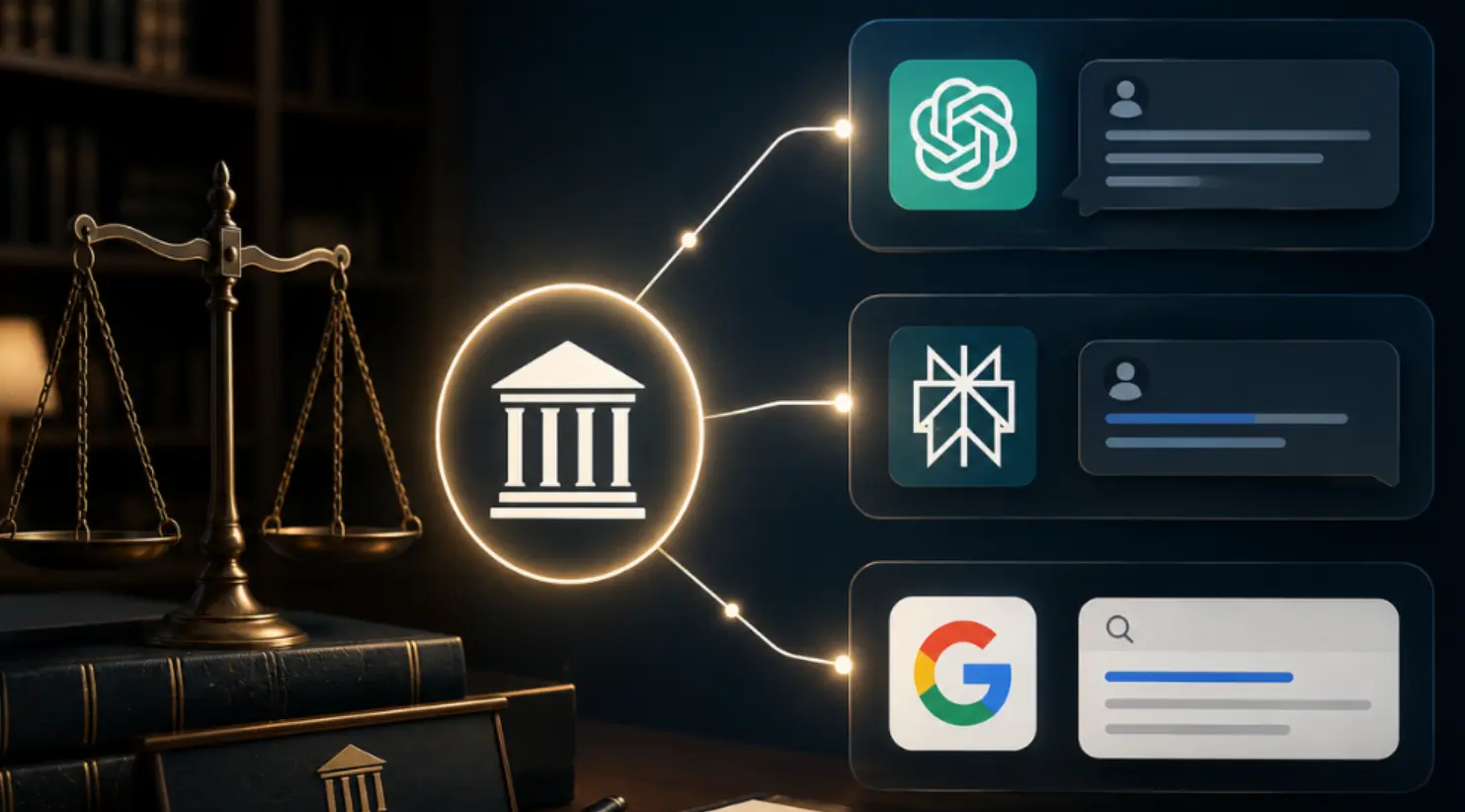
What Changes When ChatGPT Starts Recommending Your Firm?
Ranking well on Google is valuable. Being recommended by AI is different. When ChatGPT, Google AI Overviews, or other AI assistants mention your firm, you’re no longer competing for a click; you’ve already entered the client’s shortlist.
Clients Arrive With More Trust
AI-referred prospects often contact firms after researching their options, understanding their legal issue, and receiving a recommendation. The conversation starts with credibility already established, reducing the trust-building required during intake.
Your Firm Becomes the Default Choice
Many users ask AI tools questions such as:
- “Who is the best personal injury lawyer in my area?”
- “Which law firm handles medical malpractice cases?”
- “Who should I contact for a business dispute?”
When your firm appears in these responses, you gain visibility before competitors are even considered.
Brand Searches Increase Across Channels
A growing number of firms report a rise in direct brand searches after improving AI visibility. Prospects often discover a firm through AI, then search for reviews, attorney profiles, case results, and client testimonials before making contact.
Competitors May Never Get the Opportunity
The biggest shift is often invisible. If an AI assistant recommends your firm first, competing firms may never receive a website visit, phone call, or consultation request. The decision-making process begins upstream, before traditional search rankings, reviews, or advertisements come into play.
AI Visibility Creates a Compounding Advantage
Every citation, mention, and recommendation strengthens your firm’s digital authority. As AI platforms continue influencing how legal services are discovered, firms that establish visibility now are better positioned to capture future demand while competitors struggle to gain inclusion.
Start Here, This Week
The practical entry point is simpler than most firms expect.
Open ChatGPT this week. Enable temporary chat mode. Ask it to recommend a lawyer in your practice area and city. Then ask it to name every source it used to generate that response. Screenshot what comes back. You will learn in twenty minutes whether your firm exists clearly to AI, whether it gets named when prospects ask the questions that matter, and which competitors are being cited in your place.
That is your gap analysis. The remedies- entity consistency, named-attorney content, geographic depth, structured markup, off-site authority, multi-platform reviews are work your firm can sequence intelligently over the next two to three quarters. None of it requires a complete website rebuild. Most of it is disciplined, methodical work that pays compounding dividends from the day you begin.
The firms doing this work right now are not chasing a trend. They are establishing the position that will define competitive advantage in legal marketing for the next decade. The mechanism is quiet. The outcome compounds. And it is already shaping which firms’ prospects call, before they ever visit a website, read a review, or ask anyone they know.
Want your law firm to be the one ChatGPT recommends when potential clients ask for legal help? ResultFirst’s Law Firm SEO services help firms build the authority, visibility, and trust signals AI platforms rely on when generating recommendations. With expertise in SEO, AEO, and AI visibility, we help law firms earn the trust and authority needed to appear in AI-driven recommendations.
Source Referenced:
- https://attorneyatlawmagazine.com/legal-marketing/ai-overviews-are-answering-your-clients-questions-the-only-question-is-whether-theyre-citing-you
- https://www.demandsage.com/chatgpt-statistics/
- https://wiserreview.com/blog/google-review-statistics/
FAQs:
WHAT TO READ NEXT
READY TO BUILD PREDICTABLE ORGANIC GROWTH?
We are the only TOP SEO services agency providing Real Results in a Real Performance model. We help growth hungry companies outperform their competition and achieve 300%+ growth in their digital marketing initiatives.
- San Jose, CA, 95120

- +1-888-512-1890

- sales@resultfirst.com

300K+
KEYWORDS RANKED
546M+
REVENUE GENERATED
18 Years
SOLVING COMPLEX SEO
150+
TEAM MEMBERS