


 sales@resultfirst.com
 +1-888-512-1890
How to Get Your Product Recommended by ChatGPT to Potential Buyers

First and most importantly, to make your brand recommended by ChatGPT and other LLMs, your optimization efforts must move beyond SEO (Search Engine Optimization) to GEO (Generative Engine Optimization). Unlike SEO, which focuses on rankings, GEO focuses on making your brand a trusted source that AI systems can confidently cite. This involves strengthening entity signals, implementing schema markup, and creating content that AI can easily understand and reference.
By publishing fact-rich content and building authority through backlinks, citations, and brand mentions, you increase your chances of being recommended by Google AI Overviews, ChatGPT, Perplexity, and other AI search platforms.
This is the new reality of search. Over 34% of Americans now use AI tools like ChatGPT in their daily lives. And 41% of consumers trust AI-generated search results more than paid ads. That number is only growing. This is not a trend. This is a shift. And every brand must adopt it to survive in this modern search landscape.
Why ChatGPT Recommends What It Does
Before you optimize anything, you need to understand how ChatGPT makes decisions. ChatGPT does not browse websites like a human. It pulls data from its training knowledge and from live web searches. It then evaluates sources based on three core signals.
- Trust: Is the information consistent and verifiable across multiple sources?
- Authority: Do reputable websites and publications mention this brand?
- Extractability: Is the information easy to parse and present in a clear answer?
If your product page fails on any of these three pillars, ChatGPT moves on to a competitor who does it better.
Do you know? ChatGPT now processes over 2.5 billion searches daily, making AI recommendations one of the fastest-growing sources of brand discovery and product visibility.
How Do You Optimize Your Product for ChatGPT Recommendations?
Step 1: Define Your Product as a Clear Entity
The most critical step in earning a ChatGPT recommendation is to define your product and business as a distinct entity. An entity is a well-defined concept. It could be a business, a product, a person, or a location. Without a clear entity definition, ChatGPT sees your website as a collection of random text. It cannot confidently recommend what it cannot clearly understand.
A private knowledge graph solves this problem. It is a structured data system that maps your business and its relationships. It tells AI engines:
- This is our Organization: name, logo, founding date
- These are our Products: features, specifications, pricing
- This is our Location: address, service area hours
- These are our Experts: names, roles, credentials
- These are our Services: what they do and who they serve
How to Build It With JSON-LD Schema
JSON-LD is the technical language used to communicate your knowledge graph to machines. It sits inside your site’s HTML. Users never see it. But AI engines read it constantly.
Here is a checklist of the schema types you need:
- Organization Schema: Your company’s legal name, logo, contact points, and social profiles
- LocalBusiness Schema: Address, service area, hours, and geo-coordinates
- Product and Service Schema: What you offer with pricing and brand links
- FAQPage Schema: Question and answer sections that AI can pull instantly
- Person Schema: Key team members to build human authority connected to your brand
When these are properly nested and interconnected, they create a machine-readable statement of fact about your business. ChatGPT trusts facts it can verify.
Detailed Guide: 7 Essential Schema Markups for Ecommerce Websites
Step 2: Apply for ChatGPT Instant Checkout (For Product Sellers)
As per a survey, half of the respondents said that they now start their buying journey through ChatGPT instead of relying on Google.
To extend this trend, ChatGPT recently launched Instant Shopping: Instant Checkout, a feature that lets buyers go from chatting to purchasing without leaving the Chat. This is powered by the Agentic Commerce Protocol.
Currently, Etsy and Shopify sellers are already eligible. If you sell on another platform, you can apply directly through OpenAI’s merchant application form.
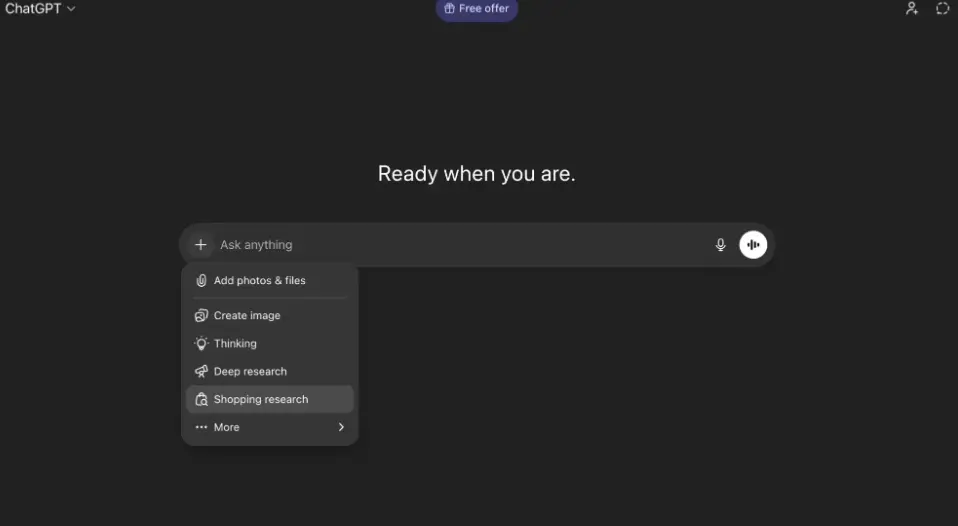
Image Source: ChatGPT
Here is what you need to do:
- Apply to join Instant Checkout using the merchant application form if you are outside Shopify or Etsy
- Prepare your product feed according to ChatGPT’s product feed specifications: this lets ChatGPT index your products and show accurate pricing and availability.
- Build your checkout integration using the Agentic Commerce Protocol, which is built on Stripe.
If you already use Stripe, the integration is straightforward. If you use a different payment processor, you can either use Stripe’s Shared Payment Token API or adopt the Delegated Payments Spec.
Merchants who enable Instant Checkout gain a clear competitive advantage in AI-driven product discovery. Those who do not enable it simply will not appear in purchase-ready results.
Read More: AI shopping Assistants in ChatGPT.
Step 3: Structure Your Content For AI Extractability
AI does not “read” your content. It parses it. It scans for organized factual information it can confidently extract and present to a buyer. That means the way you write matters as much as what you write.
Use the GEAF Framework for Every Product Page
The Generative Engine Answer Format (GEAF) structures content the way AI processes and delivers answers. Follow this sequence on every key page:
Question → Definition → Why it matters → Step-by-step → Contextual relevance → Data points
- Question: Lead with the user’s actual question as a heading
- Definition: Give a simple, direct answer immediately
- Why It Matters: Explain the benefit in one or two sentences
- Step-by-Step: Use a numbered list to walk through key points
- Contextual Relevance: Add a real-world example for a specific buyer type
- Data Points: Include a verifiable stat to add weight and credibility
This format turns every product page into a potential source for an AI answer. ChatGPT picks up content that is pre-packaged as a response.
Write Self-Contained Content Units (SCUs)
Every section of your content should make complete sense on its own. If ChatGPT pulls one paragraph from your page, that paragraph should deliver full value without needing context from the rest of the article.
This modular approach dramatically increases the chance your content gets selected for AI summaries and recommendations.
Create AI-Ready Fact Blocks
Fact blocks are the most valuable content assets for earning AI recommendations. These are structured, scannable elements designed for instant extraction.
High-value fact block types include:
- Comparison tables: Side-by-side feature or price breakdowns
- Process timelines: “Our 4-Step Fulfillment Process” type content
- Pricing blocks: Clear tables with tier breakdowns
- Key data summaries: 3 to 5 verified statistics on a topic
- Step-by-step checklists: Actionable guides with clear outcomes
When ChatGPT needs a quick answer, it will always favor the site that has the cleanest pre-packaged response ready.
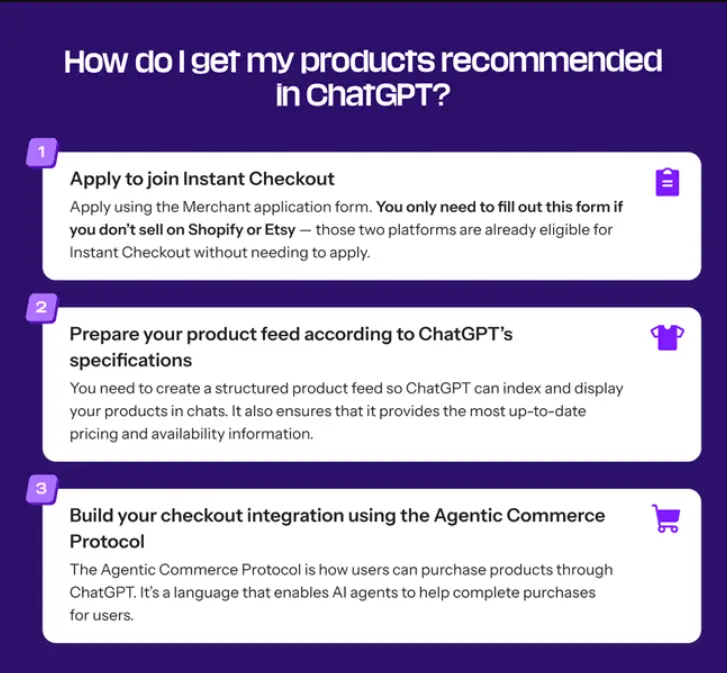
Image Source: SEO
Step 4: Win the Bing Search Battle (Most Sellers Ignore This)
Here is something most product sellers do not know.
ChatGPT primarily uses Bing’s search index when it searches the web in real time. Not Google. Bing.
This creates a massive opportunity. Most businesses optimize exclusively for Google. That means Bing is far less competitive. Sellers who invest in Bing SEO get outsized returns in AI visibility.
Immediate actions to take:
- Submit your site to Bing Webmaster Tools and confirm full indexing
- Optimize for natural language and conversational search queries
- Focus on exact-match keywords: Bing weights these more heavily than Google
- Build social signals and engagement: Bing factors these into rankings more than Google does
This single step alone has helped brands dramatically improve their ChatGPT appearance without changing anything else.
Step 5: Build Off-Site Authority That AI Can Verify
ChatGPT does not take your word for it. It looks for third-party confirmation that your brand is legitimate.
These off-site signals are non-negotiable. A business with a thin online presence almost never gets recommended by AI regardless of how good its website content is.
Remember: AI models cross-reference data from multiple external sources before forming a recommendation. Consistency across those sources is a key trust signal.
The Three Off-Site Signals That Matter Most
1. High-Authority Backlinks
Get your brand mentioned in:
- Top-tier industry publications
- Reputable news outlets
- Niche-specific blogs with strong domain authority
- Educational and research institutions
Each mention tells ChatGPT that credible sources trust your brand.
Read More: How to Increase Brand Mentions and Citations in AI Search
2. Reviews and User-Generated Content
AI models analyze what real buyers say about you.
- Build positive reviews on Google G2, Trustpilot, and relevant platforms
- Participate authentically in Reddit and Quora discussions in your niche
- Encourage customers to share real experiences with your products
As per a report, 97% of consumers read online reviews before choosing a business, making third-party trust signals critical for both buyers and AI recommendations.
3. NAP Consistency
NAP stands for Name, Address, and Phone Number. Consistent NAP information across directories like Yelp, Yellow Pages, and industry-specific sites is a foundational trust signal.
Inconsistencies create doubt. And doubt leads AI to skip your listing.
Step 6: Optimize Across Multiple AI Agents
Not all AI tools work the same way. A strategy that works for ChatGPT may not perform as well on other platforms. The smartest approach covers all major AI agents at once.
| AI Agent | What It Prioritizes |
| ChatGPT | Training data depth and authoritative, well-explained content |
| Google SGE | Google Business Profile data and strong E-E-A-T signals |
| Perplexity | Citations and verifiability: it shows its sources prominently |
| Claude | Comprehensive structured content due to a large context window |
| Gemini and Meta AI | Social signals and real-time conversational data |
| Voice AI (Siri / Alexa) | Concise direct answers readable aloud: FAQ schema works best |
The universal principles that work across all platforms are the same. A strong knowledge graph. Extractable content. Clear authority signals. Build these right, and you win on every platform.
Step 7: Measure Your AI-Readiness With a GEO Scoring System
How Do You Know If It Is Working?
You cannot improve what you do not measure. Tracking AI-driven traffic requires a slightly different analytics setup than traditional SEO.
In Google Analytics 4 (GA4), set up these custom configurations:
- Using GA4’s AI traffic reporting to monitor visitors from AI search and assistants.
- Creating custom explorations to compare AI traffic with organic search and other acquisition channels.
- Configuring key events and conversions to measure the business impact of AI-driven visitors.
- Building dashboards to track AI traffic growth, engagement, top landing pages, and conversion trends over time.
Connect this to your CRM by:
- Adding hidden fields to capture referrer data in lead and purchase forms
- Tagging AI-sourced leads automatically in your CRM system
- Tracking how AI-sourced buyers move through your funnel versus other channels
Beyond traffic numbers, measure your GEO score by auditing each page for:
- Entity Clarity: How well-defined is the product or brand on this page?
- Extractability Score: How many fact blocks and SCUs does the page contain?
- Question Coverage: Does the page answer primary and secondary buyer questions?
- Fact Density: How much verified data does the page include?
- Authority Signals: How strong are the internal and external links from this page?
Run this audit monthly. Improve the lowest-scoring pages first. Over time, your AI visibility compounds.
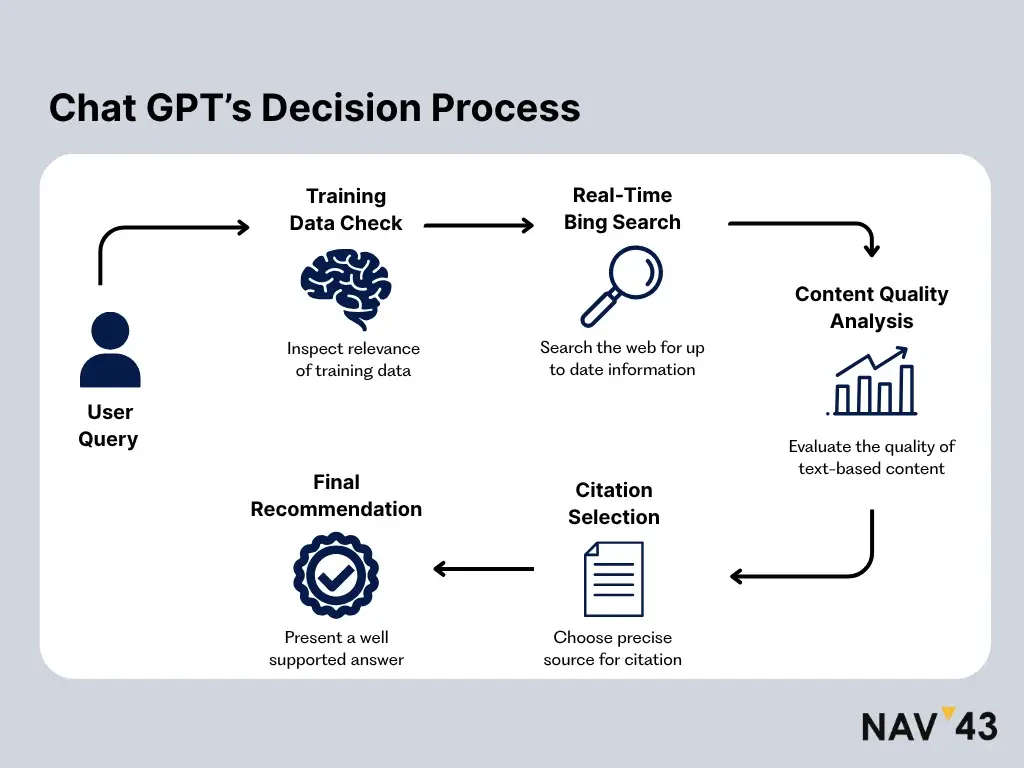
Image Source: NAV43
The Shift From SEO to GEO: What Changed and Why It Matters
For years, digital marketing was built around Search Engine Optimization (SEO). The goal was simple. Rank on Google’s first page. Get clicks.
That model still works. But it is no longer enough.
Today, the smarter strategy is Generative Engine Optimization (GEO). GEO focuses not on ranking but on being cited as the source inside an AI-generated answer.
Here is how the two compare:
| Factor | Traditional SEO | GEO |
| Primary Goal | Rank on Google’s top 10 | Be the cited source in an AI answer |
| Focus | Keywords and backlinks | Entities, trust signals, and data structure |
| Content Strategy | Long-form keyword-driven articles | Modular, extractable, fact-based content |
| Technical Focus | Site speed and mobile-friendliness | Knowledge graphs and advanced schema |
| Sucess Metric | Keyword rankings and organic traffic | AI citations, brand mentions, zero-click visibility |
The transition from SEO to GEO is not about abandoning what works. It is about building on top of it with a smarter layer. One that speaks directly to how AI thinks.
Check out our detailed guide on SEO vs GEO.
Your Quick-Start GEO Checklist
Whether you are a solo seller or a growing brand, you can start today.
For Small Businesses and Independent Sellers:
- Fully optimize your Google Business Profile with accurate hours, services, and photos
- Ensure your NAP is 100% consistent across your top 10 online directories
- Install LocalBusiness and Organization schema on your website
- Rewrite your main product page using the GEAF framework
- Add a structured FAQ section to your homepage with FAQPage schema markup
- Actively request and respond to customer reviews on Google and other platforms
- Submit your site to Bing Webmaster Tools today
For Growing Brands and Enterprises:
- Conduct a full entity audit mapping all products, services, locations, and key team members
- Build a comprehensive private knowledge graph with deeply nested JSON-LD
- Overhaul your top 20 content pages using GEAF and SCU frameworks
- Create a library of AI-ready fact blocks for all core product offerings
- Launch a targeted link-building campaign focused on top-tier industry publications
- Implement a GEO scoring system to track AI-readiness across all pages
- Apply for ChatGPT Instant Checkout to enable direct in-chat purchasing
The Brands That Move Now Will Win the Most
The window to get ahead is open right now. But it is closing.
Early movers in AI optimization benefit from compounding advantages:
- AI systems learn from successful patterns: early positive signals build on themselves
- First-to-publish content on emerging product topics often becomes the definitive source
- Community engagement and thought leadership create moats that are hard to replicate later
- Proper analytics infrastructure takes time to build: starting now means more data sooner
Buyers are already using ChatGPT to find products. They are forming opinions and making purchase decisions inside the chat window. If your product is not in that conversation, you are not in the consideration set.
The next time someone asks ChatGPT for the best product in your category, make sure your brand is the one it recommends. That starts today. With your knowledge graph. Your content structure. Your Bing SEO. Your reviews. And your Instant Checkout integration.
Do the work now because the brands that show up in AI recommendations tomorrow are the ones building their authority today.
Want your products to appear in ChatGPT recommendations and AI-powered shopping results? ResultFirst’s AI SEO services help brands build the authority, entity signals, content structure, and trust factors that AI platforms look for when deciding what to recommend. From GEO strategy and schema optimization to AI visibility audits and authority building, our experts help position your brand for the future of search.
Source Referenced:
- https://www.pewresearch.org/internet/2026/06/17/americans-and-ai-2026-chatbots-smart-devices-and-views-on-impact
- https://www.askattest.com/our-research/consumer-adoption-of-ai-report-2025
- https://learn.g2.com/ai-search-surging-for-b2b-buyers
- https://news.designrush.com/google-tests-ai-review-responses-97-read-reviews
- https://www.demandsage.com/chatgpt-statistics/
FAQs:
WHAT TO READ NEXT
READY TO BUILD PREDICTABLE ORGANIC GROWTH?
We are the only TOP SEO services agency providing Real Results in a Real Performance model. We help growth hungry companies outperform their competition and achieve 300%+ growth in their digital marketing initiatives.
- San Jose, CA, 95120

- +1-888-512-1890

- sales@resultfirst.com

300K+
KEYWORDS RANKED
546M+
REVENUE GENERATED
18 Years
SOLVING COMPLEX SEO
150+
TEAM MEMBERS