


 sales@resultfirst.com
 +1-888-512-1890
Google March 2026 Core Update: Impact, Key Changes & What to Do Next

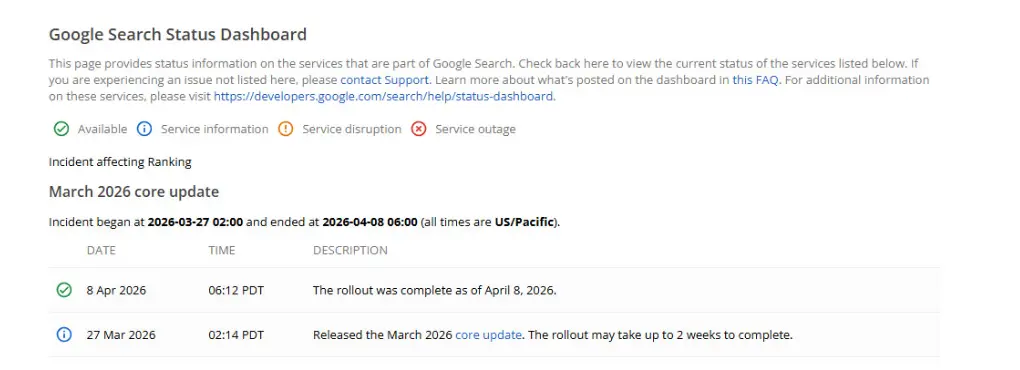
Google’s March 2026 core update officially completed its rollout on April 8 at 6:12 AM PDT. The update started on March 27 and ran for 12 days and 4 hours. This was Google’s first broad core ranking update of the entire year.
Google described it as “a regular update designed to better surface relevant satisfying content for searchers from all types of sites.” It followed the March 2026 spam update and the February 2026 Discover update. March was one of the busiest months Google has had in a long time.
The rollout is now complete. It did not target a single industry or content type. It hit everything globally. And it arrived right on the heels of a spam update that completed in under 20 hours two days earlier. This is one of the most impactful algorithm months Google has delivered in recent memory. If you run a website or manage Performance Based SEO for clients, here is everything you need to know about what changed and what to do next.
The March 2026 Timeline You Need to Know
Three updates hit in one month. Here is the full picture.
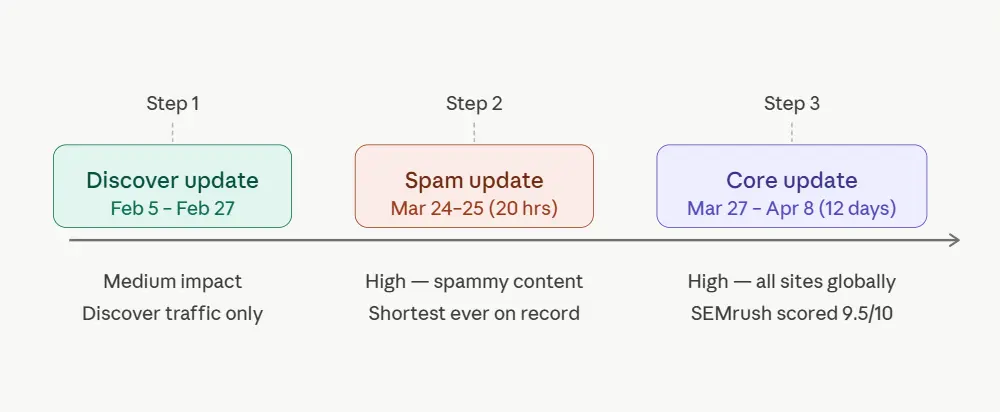
The Spam Update finished two days before the Core Update began. That sequencing matters. Sites that the Spam Update weakened entered the Core Update, already damaged. The combined effect hit harder than either update would have alone.
At this point, you can confidently compare the performance in Google Search Console, now that the rollout is complete.
Here is a glance at the March 2026 update in comparison to the recent ones:
- March 2026: 12 days (March 27 to April 8)
- December 2025 Core Update: 18 days (December 11 to December 29)
- June 2025 Core Update: 17 days (June 30 to July 17)
- March 2025 Core Update: 14 days (March 13 to March 27)
- December 2024 Core Update: 6 days (December 12 to December 18)
The March 2026 update came the second fastest among the last five broad core updates. The December 2024 update was the only one to be completed more quickly.
Why March 2026 Was Busier Than Usual
The month of March was not silent for Google. There were three verified updates released over a period of about five weeks.
- On February 27, 2026, the Discover update was complete following a 22-day release. It was the first publicly declared core update that was named Discover-only by Google.
- The spam update of March 2026 was released and finished in less than 20 hours on March 24-25. That was the briefest confirmed spam update in the history of the dashboard.
- The core update was then followed by March 2026, only two days later, on March 27.
One thing worth noting: the spam update and core update did not happen at the same time by accident. SEO analyst Roger Montti described the spam-then-core sequence as similar to “clearing the table” before recalibrating the core ranking signals. In other words, Google cleaned out spammy content first. Then it ran the deeper quality assessment.
What Google Actually Said About This Update
Google described the March 2026 core update as “a regular update designed to better surface relevant, satisfying content for searchers from all types of sites.”
That language is typical. Google did not publish a companion blog post. It did not announce specific goals. There was no new guidance attached to the completion notice.
Core updates are not targeted at specific content types or policy violations. They introduce broad changes to how Google assesses quality across the entire web. Pages move up or down based on how the update reassesses content relevance and helpfulness.
What This Means for SEO
If your approach to SEO focuses on delivering real value to real people, then this update should not feel threatening. It should feel like validation.
Google’s standing message is clear:
- Ranking drops are not necessarily an indication that there is a problem with your pages.
- The future update and not an immediate fix is the norm rather than an exception.
- The goal is to publish helpful, reliable content made for people, not search engines.
Who Got Hit and Who Got Rewarded
Core updates do not punish rule-breakers alone. They reward quality. They surface content that genuinely helps people. That means even sites playing by the rules can drop if better content exists elsewhere.
Common patterns after core updates:
- Winners tend to publish in-depth, experience-backed content
- Losers often rely on thin content or keyword stuffing
- Recovered sites from past updates often see lifts after new core updates
- Niche authority sites with strong topical depth tend to gain visibility
The sites that win in Performance Based SEO are not just chasing rankings. They build content ecosystems that answer real questions with real depth.
How to Diagnose If This Update Hit You
Before making any changes, run this exact diagnostic in Google Search Console.
Step 1 — Match the timeline. Go to Performance > Search Results. Compare March 27 onwards against the same 4-week period prior. If your drop predates March 27, the Spam Update or an earlier issue may be the cause.
Step 2 — Identify affected pages. Click the Pages tab. Sort by clicks descending. Find your top 20 pages before the update. Filter by March 27 onwards and see which lost the most clicks. Export both date ranges to a spreadsheet and look for patterns.
Step 3 — Separate spam from core. Use this distinction:
- Sudden drop on March 24–25, then stable, likely Spam Update
- Gradual decline starting March 27 and ongoing, Core Update content quality issue
- Both sudden and gradual drops — both updates hit you, and you need a full audit
- Rankings fluctuating with no net loss, normal rollout volatility
Your Rankings Dropped? Here Is What to Do Right Now
First, take a breath. The rankings drop that occurs after a core update does not indicate that you breached any policies. It generally means Google conducted a new assessment of website quality indicators, which resulted in some websites receiving higher rankings while others received lower rankings.
Here is a practical action plan:
- Wait before drawing conclusions. Google recommends waiting at least one full week after the rollout completes before analyzing your data. That means April 15 or later is your earliest reliable comparison point.
- Set the right baseline. Compare your pre- and post-update performance (before and after April 8).
- Watch for spam update overlap. The March spam update was completed on March 25. Any ranking changes between March 24 and March 27 could come from either update. Keep that in mind when reading your data.
- Open Search Console and analyze. Look at your top landing pages. Identify which pages gained and which pages lost. Find patterns in what is winning.
- Study the winners. When specific pages or sites gain visibility after a core update, they are showing you what Google is rewarding.
The Content Rules Have Not Changed: But the Stakes Just Got Higher
Google keeps pointing site owners back to the same guidance: create helpful, reliable, people-first content. That advice did not change with this update. But the update raised the stakes.
Here is what Google values most right now:
- Depth and expertise. Content responding to the actual query, not to the superficial query.
- Trustworthiness. Pages that give readers a reason to trust the author and the source.
- Satisfaction. Does the reader leave the page with what they needed?
- Original value. Content that adds something new rather than restating what already exists.
For anyone focused on Performance Based SEO, these are not abstract principles. They are ranking signals. And they are being reassessed every time Google rolls out a core update.
What Comes Next After the March 2026 Update
The rollout is complete. That means you can now assess impact with confidence. But this is not the end of the road.
Google updated its core updates documentation in December 2025 to confirm that smaller unannounced core updates happen on an ongoing basis between the larger confirmed rollouts. So the ranking environment is always shifting.
- Audit your weakest pages. If certain pages lost rankings, look at them honestly. Do they truly satisfy the searcher’s intent?
- Improve before the next update. Recovery from a core update often comes with the next core update. That means you need to make improvements now.
- Track your competitors. If a competitor gained rankings, study what they are doing differently.
- Invest in your strongest content. Expand and update pages that are already performing well. Give Google more reasons to surface them.
The Bottom Line: Stop Chasing Algorithms and Start Building Value
The March 2026 core update sent a clear message. Google rewards content that truly helps people. It deprioritizes content that exists only to rank. No amount of keyword optimization saves a page that fails to deliver real value.
Performance-based SEO operates according to this exact principle. The objective of the process requires results instead of ranking achievements. Your content will achieve higher rankings when it provides actual value to your target audience.
The update is done. The data is in. Audit your site, fix what is weak, strengthen what is working, and prepare for what comes next. Google keeps raising the bar. The question is whether your content rises with it.
Maximize Your Search Performance
Navigating volatile algorithm shifts requires more than just reactive fixes; it demands a proactive, data-driven strategy. Partner with ResultFirst, a leading performance-based SEO agency with years of experience in turning Google updates into growth opportunities. We focus on delivering tangible business results and high-quality, people-first content that stands the test of time.
Contact ResultFirst today to audit your site and secure your rankings!
WHAT TO READ NEXT
READY TO BUILD PREDICTABLE ORGANIC GROWTH?
We are the only TOP SEO services agency providing Real Results in a Real Performance model. We help growth hungry companies outperform their competition and achieve 300%+ growth in their digital marketing initiatives.
- San Jose, CA, 95120

- +1-888-512-1890

- sales@resultfirst.com

300K+
KEYWORDS RANKED
546M+
REVENUE GENERATED
18 Years
SOLVING COMPLEX SEO
150+
TEAM MEMBERS