



 sales@resultfirst.com
 +1-888-512-1890
Surviving Search Results with AI Content Tools Content Creation

Will AI eventually replace human writers due to its increasing use in content creation?
No.
Even though artificial intelligence (AI) can be useful for idea generation, research, and content creation, human interaction is still essential.
When creating content text, 76% of content marketers employ AI.
It matters greatly to content developers or SEO service providers. AI content tools make our work easier and more productive.
This blog covers how artificial intelligence (AI) is used in content creation and the problems it causes with search engine visibility.
Also, let’s understand the best ways to use AI technologies to produce content that engages your audience and performs well in search engine rankings.
Understanding the Role of AI in Content Creation
The goal of AI’s cutting-edge computer science discipline is to build computers that can mimic human intelligence and problem-solving skills.
- Machine learning,
- Neural networks, and
- Natural language processing
These are just a few of the many methods and tools that fall under the umbrella of artificial intelligence (AI).
These tools allow computers to examine data, make decisions, and learn from their experiences.
Indeed, according to Gartner, by 2026, “more than 80% of enterprises will have deployed generative AI-enabled applications or used generative AI APIs.”
AI plays a key role in automating many tedious and time-intensive manual processes.
For instance, by evaluating enormous text databases and producing human-like writing, AI-driven content generators can produce excellent articles, blog posts, and even poetry.

Source: Faster Capital
Challenges with AI-Generated Content in Search Results
It is impossible to exaggerate the importance of SEO services in USA for rankings; they are essential for improving online visibility and increasing website traffic.
However, AI-generated content must overcome a few obstacles to rank highly in search results.
The following are the main issues with AI content in SEO rankings:
1. AI-generated content lacks depth and nuance
While AI has advanced significantly in many areas, it can still not produce articles that demand in-depth knowledge and intricate analysis.
Let’s look at a few particular instances where AI is unable to produce content:
- Understanding of Context: Writing with nuance and depth requires understanding context, which AI finds difficult to grasp completely.
- Emotional Intelligence: Most AI content producers cannot accurately convey the subtleties of human tone and emotions.
2. Copyright and Moral Issues
Copyright and ethical issues present major obstacles for content providers working with AI-generated content. Concerns about plagiarism and intellectual property rights are becoming more prevalent as AI techniques are employed in content creation on a larger scale.
The Risk of Plagiarism
Large datasets obtained from the internet are frequently used to train AI algorithms. As a result, existing content may inadvertently be reproduced without giving due credit or attribution.
Copyright
For instance, AIs can produce works that precisely replicate an already-existing genre or style, which begs the question of whether doing so violates the original work’s copyright.
“Writers can benefit from using AI, but it’s crucial to remember that it’s only a tool. The real magic happens when people use their imagination and comprehension to give words life. — John Doe, coordinator of content
3. Expertise and Trustworthiness
While convincingly replicating an AI can be challenging, Google’s algorithms are built to identify indicators of expertise, authoritativeness, and trustworthiness (E-A-T).
This implies:
- Writing thoroughly researched articles that highlight your areas of expertise.
- To boost your trustworthiness, make sure credible sources support each assertion.
- Preserving a steady track record of dependability and accuracy to foster trust.
4. Google’s Position on Automated Content Creation and Automation
Automation is useful in the content development process.
Important ideas that Google highlights
- Content Quality
- User Experience
- Spam Detection
Best Practices for Using AI Tools in Content Creation
1. The Right AI tools
Select AI tools with features like fact-checking, plagiarism detection, and SEO optimization recommendations that go beyond simple article creation.
Identifying Plagiarism:
Assume you are writing a blog post discussing the advantages of essential oil use. When you employ AI technology to create content, you may mistakenly end up with a paragraph that has been copied exactly from another website. This plagiarism could greatly affect your website’s ranking and reputation.
Example: Copysmith offers a plagiarism checker that compares your content to billions of web pages, highlighting any potential matches.
SEO Optimization Advice
Keeping up with the most recent SEO best practices is essential for content visibility since search engine algorithms are always changing. A useful tool could be an AI program with SEO optimization capabilities.
Example:Surfer SEO examines the content of your website and that of your rivals, making recommendations for on-page SEO features, content organization, and keyword optimization.
Capabilities for Fact-Checking
Accuracy is crucial regarding information about delicate subjects like health or finances. Artificial intelligence (AI) systems that can fact-check content can confirm facts and ensure that it is trustworthy and dependable.
Example: Besides checking for grammar errors and plagiarism, Grammarly AI provides a basic fact-checking function. It does this by pointing out any discrepancies in the facts and recommending reliable sources for confirmation.
2. Combining AI with Human Editing

Source: Semrush
Your content will stand out and connect with your readers if you add your personality and distinct viewpoint.
Still, using your human skills is the ethical approach to creating information, especially because the internet is still overflowing with mass-produced, low-quality material. Use the AI writer to get past the blank page problem and produce a passable draft.
Nevertheless, add comparisons, personal experiences, special value, and other rich media before publishing.
For example, artificial intelligence tools generate product descriptions for new smartphones. Even though they precisely list the qualities, the descriptions can sound robotic and generic. A human editor could revise the descriptions to make them more interesting, stressing the product’s special features and generating enthusiasm for them.
By fusing the powers of AI and humans, you can produce content that ranks highly on search engines and engages your readers.
Thus, keep in mind that “only quality content survives,” and adhere to the following guidelines when integrating AI tools into your content creation process:
- Create valuable, original content focused on the user to establish credibility, authority, and trust in your field.
- Concentrate on producing content that meets the demands of your audience and is beneficial to individuals.
- Avoid using a “copy/paste/reword” strategy, and make sure your article offers something original to the discussion.
According to a Gartner analysis, “AI interacting with people and improving what they already know can improve customer interactions and reduce mistakes and routine work.”
3. Optimizing AI-Generated Content for SEO
Many marketers use free AI technologies like ChatGPT and Google Bart to streamline their content production process. However, these AI technologies do not aim to optimize content for search engines.
You can use SEO tools to help you optimize your content, or you can use a basic understanding of SEO to produce AI-generated content that can drive traffic to your website.
The main optimization techniques are broken down here.
Research and Utilization of Keywords
- Use tools like Ahrefs or Google Keyword Planner to perform in-depth keyword research and find low-competition, high-volume, relevant keywords.
- Make sure to strategically place these keywords in various parts of your material, such as the title, headings, body, and meta descriptions.
Related: How to Do Keyword Research for An ecommerce Website?

Source: SEO Review Tools
For example, you’re working on an artificial intelligence (AI) blog post about “the best laptops for students.” Relevant keywords like “long battery life,” “lightweight design,” and “budget laptops” are found through keyword research. These are the keywords you purposefully use in the content:
Meta descriptions, title tags, and header tags
- To get people to click on your material, ensure your title tags and meta descriptions are optimized with pertinent keywords and succinct, helpful language.
- Include pertinent keywords in each of the distinct parts you create for your content using header tags (H1, H2, H3).
As an example
Title Tag: Budget & Battery Life Guide: Top Laptops for Students in 2023
See which laptops are best for students in 2023 based on qualities that are most important for academic work and are affordable.
Content Structure and Navigation
- Make sure the navigation inside your content is obvious and simple. Use brief paragraphs, numbered lists, and bullet points to increase readability.
- Improve user experience and establish a solid website hierarchy by incorporating internal linking to pertinent pages.
As an illustration
Segment your blog post into categories such as “Top Laptop Recommendations,” “Key Considerations for Students,” and “Conclusion.”
Track and Make Adjustments
- With SEO analytics tools like Google Search Console, you can track the performance of your content, including keyword rankings, organic traffic, and user interaction data.
- Make any necessary changes to your content based on your data.
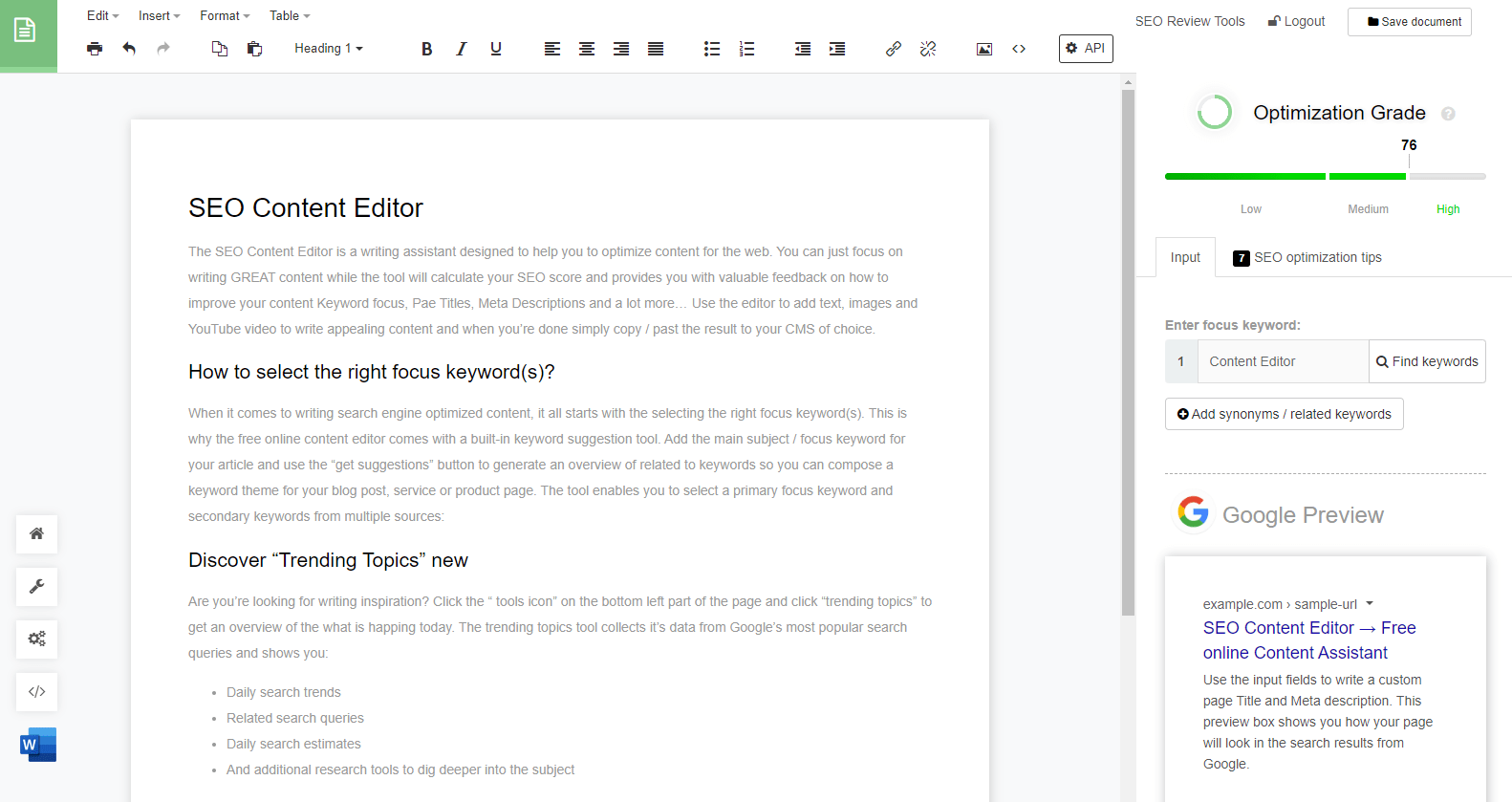
Source: SEO Review Tools
Conclusion
While AI tools provide useful tools for content production, ranking well in search results necessitates a calculated strategy. You can ensure your content sticks out in the constantly changing digital landscape by comprehending the difficulties and implementing best practices—like selecting the appropriate tools, fusing AI with human experience, and optimizing for SEO.
Related: The Role of AI in On-page SEO: Improving Organic Click-through Rates
FAQ’s:
WHAT TO READ NEXT
READY TO BUILD PREDICTABLE ORGANIC GROWTH?
We are the only TOP SEO services agency providing Real Results in a Real Performance model. We help growth hungry companies outperform their competition and achieve 300%+ growth in their digital marketing initiatives.
- San Jose, CA, 95120

- +1-888-512-1890

- sales@resultfirst.com

0K+
KEYWORDS RANKED
0M+
REVENUE GENERATED
0 Years
SOLVING COMPLEX SEO
0+
TEAM MEMBERS