



 sales@resultfirst.com
 +1-888-512-1890
What Product and Category Schema Every eCommerce Site Needs in 2026

Did you know that 61.7% of e-commerce searches now trigger AI mode shopping features? Yet here’s the shocking part: only 18% of e-commerce product pages have complete schema markup. That means most online stores are invisible to AI search engines like ChatGPT, Perplexity, and Google AI Overviews.
In 2026, schema markup isn’t just “nice to have.” It’s the price of entry for visibility. Without proper product and category schema, your products won’t show up in Google Shopping, AI Overviews, or conversational search results.
This guide covers exactly what schema types your eCommerce site needs in 2026. We’ll break down product schema, category schema, and other essential markup that helps search engines understand your store. No fluff. No jargon.
Product Schema: The Foundation of eCommerce Visibility
Product schema is the most important structured data for any online store. It gives the exact information to search engines about what you’re offering, the price, and the availability of the same. In 2026, Google and AI-powered search engines will use schema to pick which items they will display in their rich results and AI-driven recommendations.
Product schema can be considered an identity card of your product. Without it, search engines can’t verify your product details. With it, your products become eligible for star ratings, price snippets, and shopping knowledge panels.
Here’s what makes product schema so critical in 2026:
- AI search engines use it as the primary trust signal for product recommendations
- Products with a complete schema are 3x more likely to appear in AI-generated recommendations
- Rich results can lift your click-through rate by 15% to 30%
Let’s look at exactly what you need to include.
Required Fields for Product Schema in 2026
Google requires three core fields for product schema to work:
- Name: Your product’s full title
- Image: At least one high-quality product image URL
- Offers: Price, currency, and availability information
Here’s a bare-minimum example that passes Google’s validation:
json
{
“@context”: “https://schema.org”,
“@type”: “Product”,
“name”: “Ergonomic Office Chair Pro”,
“offers”: {
“@type”: “Offer”,
“price”: “349.00”,
“priceCurrency”: “USD”,
“availability”: “https://schema.org/InStock”
}
}
This is the floor, not the ceiling. It won’t trigger rich results, but it won’t throw errors either. To actually win those eye-catching search listings, you need more.
Recommended Fields That Drive Results
Google recommends several additional fields that make your product stand out:
- Description: A clear, unique product description
- Brand: Your brand name with @type “Brand”
- SKU: Your internal product identifier
- MPN: Manufacturer part number
- GTIN: Global Trade Item Number (GTIN)
- AggregateRating: Average star rating and review count
- Review: Individual customer reviews
- Category: Product category (more on this later)
With all that being said, the usage of these fields can turn your plain search result into a rich one with prices, ratings, and availability information. Numerous studies prove that using rich snippets increases CTR by 20-30%.
New 2026 Requirements You Can’t Ignore
Google quietly elevated three fields from “recommended” to “effectively required” in 2026:
- shippingDetails: Shipping cost and delivery time
- hasMerchantReturnPolicy: Return window and restocking fees
- priceValidUntil: For promotional pricing
Stores with these fields saw a 31% lift in shopping graph impressions during Google’s October merchant update last year. Sites with complete markup win the price snippet on 60–75% of commercial queries. Sites with bare-minimum markup win it on only 10–20%.
That’s a massive gap. If you’re not including shipping and return information in your product schema, you’re leaving sales on the table.
Category Schema: The Overlooked Traffic Driver
Most store owners focus all their energy on product schema and completely forget about category pages. That’s a huge mistake. Category pages target the highest-volume commercial keywords and are your biggest revenue lever.
Category schema helps search engines understand how your products are organized. It tells them about your store’s structure, product hierarchy, and the relationship between different product types.
By 2026, Google and AI search engines will not simply rank web pages but entire stores. The category schema shows that your store is organized properly and is an authority in its niche.
What Is Category Schema?
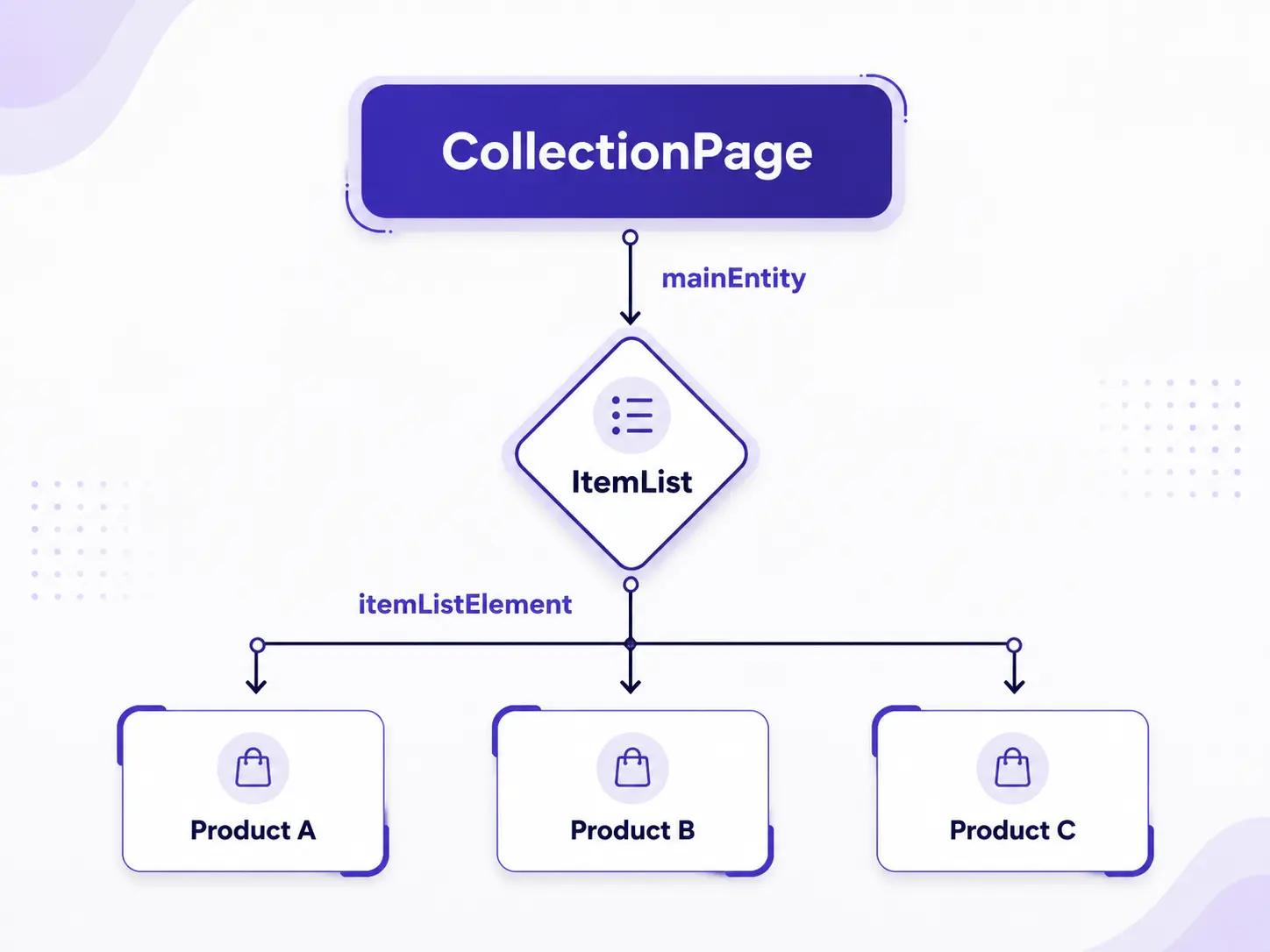
Category schema uses the CollectionPage type from schema.org. It describes a page that lists multiple products within a specific category.
Here’s what category schema typically includes:
- name: The category name (e.g., “Men’s Running Shoes”)
- description: Category description with relevant keywords
- url: The category page URL
- hasPart: References to products within the category
- Breadcrumb: Navigation path showing where the category sits in your site hierarchy
The category schema works alongside the BreadcrumbList schema to create a complete picture of your store’s architecture.
Why Category Schema Matters for SEO
Category schema provides several important benefits:
- Better crawling: Search engines understand your site structure faster
- Rich snippets: Category pages can show product counts and descriptions in search
- AI citations: AI search engines use category structure to recommend your store
- Internal linking: A clear hierarchy helps distribute link equity
It is imperative for your products to follow some sort of naming conventions and organization system. Category schema helps establish the relationship between all products.
Category Schema allows the search engines to know how your products are related to one another without having to guess
How to Implement Category Schema
Category schema is typically implemented as JSON-LD on your category pages. You can use the CollectionPage type or combine it with ItemList for product listings.
A basic category schema example:
json
{
“@context”: “https://schema.org”,
“@type”: “CollectionPage”,
“name”: “Men’s Running Shoes”,
“description”: “Shop our collection of men’s running shoes from top brands.”,
“url”: “https://yoursite.com/mens-running-shoes”,
“hasPart”: [
{
“@type”: “Product”,
“name”: “Brand X Running Shoe”,
“url”: “https://yoursite.com/product/brand-x-running-shoe”
}
]
}
Another way that you can use the Shopify category metafields is by incorporating these metafields in your site’s JSON-LD markup. This will help you to create customized fields that capture characteristics like size, color, and material.
Other Essential Schema Types for eCommerce
Product and category schema are the foundation, but they’re not the whole story. In 2026, you need several other schema types to compete in search and AI results.
Organization and Brand Schema
Organization schema helps Google understand your business entity, branding, and trust signals. It’s especially important for:
- Establishing your brand as a legitimate business
- Connecting your products to your brand entity
- Appearing in knowledge panels and brand search results
Every eCommerce site should implement the Organization schema on its homepage and the Brand schema on product pages.
BreadcrumbList Schema
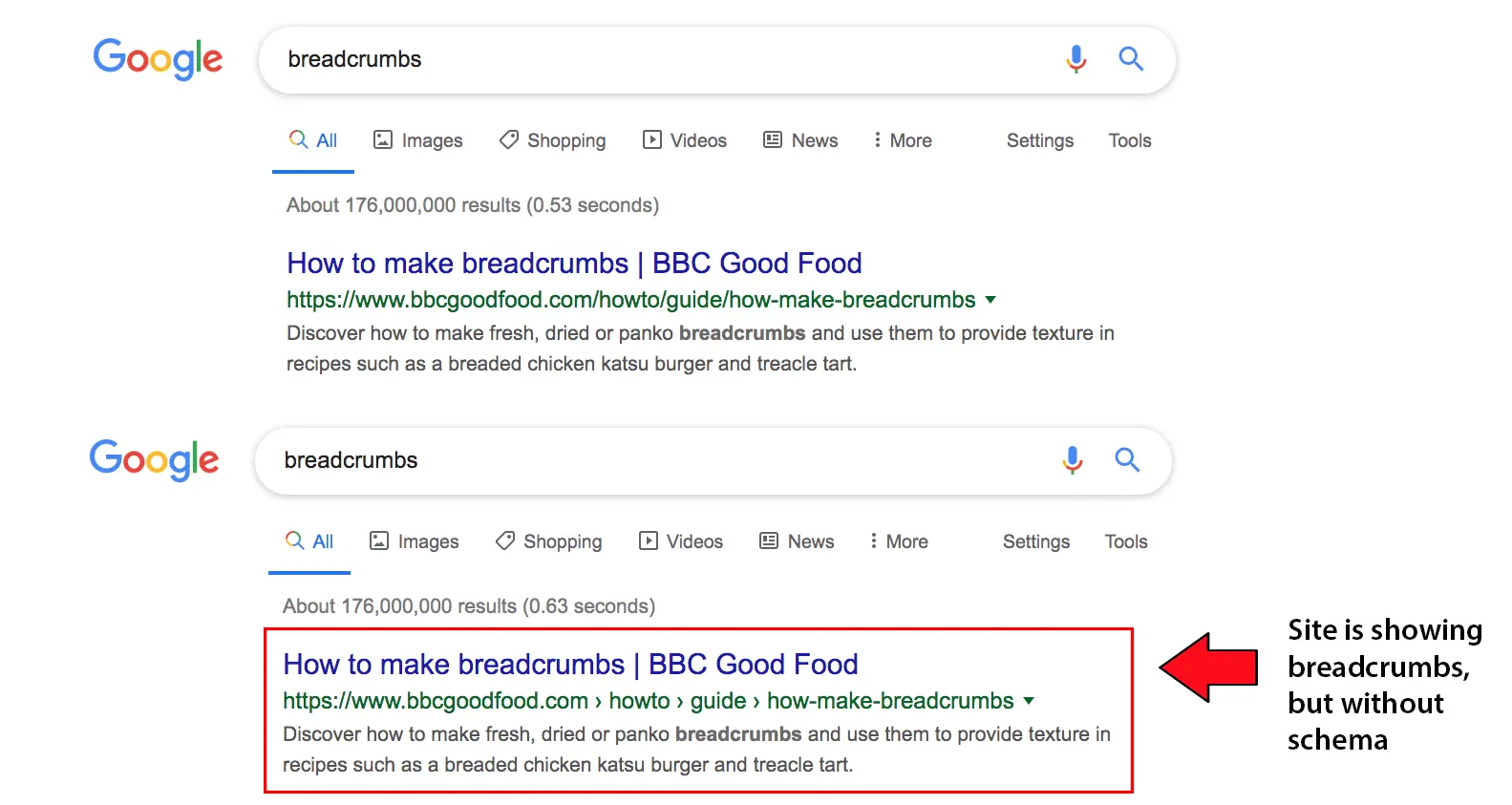
Source: Brodie Clark
The breadcrumb schema informs Google how you reached your current page. It will be easier for search engines to determine the structure of your website and show breadcrumbs in SERPs. In particular, it concerns category pages. The BreadcrumbList, combined with the CollectionPage schema, creates a clear picture of your store’s hierarchy.
Review and AggregateRating Schema
Review schema is a powerful trust signal. Those products that have the AggregateRating schema have three times higher chances of featuring in AI-generated recommendations.
Even though Google discontinued certain types of structured data last year, review schema still plays a significant role in ranking products. AI systems ignore hidden schema that has no visible counterpart, so make sure your reviews are authentic and visible on the page.
FAQPage Schema
FAQPage markup makes pages 3.2x more likely to appear in Google AI overviews. For sites that introduced FAQ blocks, there was an improvement of 44% in AI search citations. Leverage your FAQ block to answer any frequently asked questions from customers regarding the price, delivery, returns, and technical information about your products.
Implementation Best Practices for 2026
Adding schema markup is one thing. Doing it correctly is another. Here are the best practices that separate winning stores from the rest.
Use JSON-LD Format
JSON-LD holds 54.6% market share among structured data formats because it aligns with how AI crawlers process information. Google overwhelmingly prefers JSON-LD over microdata and RDFa.
AI parsing success is 94% for static HTML with schema, dropping to just 23% for JavaScript-rendered content. That means your schema must be server-side rendered. AI crawlers don’t wait for JavaScript to execute.
Match Schema to Visible Content
Every schema field must mirror the content a user can actually see on the page. Every tested AI system ignores hidden JSON-LD that has no visible counterpart. If you add markup to the schema but hide it on your page, you’re wasting your time because Google will detect discrepancies between structured data and visible content.
Keep Schema Consistent Across Channels
What is shown on your website’s structured data needs to correspond with the data within your Google Merchant Center feeds. Discrepancies will confuse search engines and may negatively impact your ranking.
Validate Your Schema
The Google Rich Results Test is an ideal solution to validate your data and fix critical errors. You could even consider addressing non-critical mistakes for better quality. Once you’ve implemented the schema, check with Google using the URL Inspection Tool. After that, ask Google to crawl your URLs.
Common Schema Mistakes to Avoid in 2026
Even experienced store owners make mistakes with schema markup. Here are the most common pitfalls and how to avoid them.
Missing Required Fields
The biggest mistake is an incomplete schema. Remember: name + at least one of review, aggregate rating, or offers is the minimum. But the minimum won’t yield rich results.
In 2026, shipping details and the merchant return policy will be effectively required for retail queries. Missing these fields means losing the price snippet to competitors.
Using Outdated Schema Types
Google removed support for multiple structured data types in 2025. Make sure you’re using current schema types and properties. The schema.org vocabulary evolves, and you need to keep up.
Relying on Client-Side Rendering
AI crawlers do not execute JavaScript. If your JSON-LD loads through client-side JavaScript, AI systems will never parse it. Always use server-side rendering for schema markup.
Duplicating Schema Across Variants
As of March 2026, the expectation is that the variants of products should be submitted separately using unique product IDs. If the same product varies between online and in-store pricing, availability, or condition, they should be considered two products.
Key Takeaway
Schema markup in 2026 isn’t optional. It’s the application form for visibility in Google Shopping, AI Overviews, and conversational search. With 61.7% of e-commerce searches now triggering AI Mode features, your products need structured data to be found.
Start with product schema, name, image, offers, shipping details, and return policy. Add category schema to help search engines understand your store structure. Then layer on Organization, breadcrumb list, review, and FAQ schema for maximum impact.
Implement these schema types today, validate them with Google’s tools, and watch your search visibility grow. Your products deserve to be found.
Ready to get your schema right the first time? At ResultFirst, we specialize in eCommerce SEO and structured data implementation, helping online stores improve visibility across Google Shopping and AI-powered search. If your ecommerce store is ready to turn structured data into measurable growth, our SEO Services for Ecommerce combine technical SEO expertise with proven implementation strategies. Get in touch with ResultFirst for a comprehensive schema audit.
Sources Referenced:
- https://www.frase.io/blog/faq-schema-ai-search-geo-aeo/
- https://w3techs.com/
- https://llmrefs.com/blog/do-rich-snippets-help-seo/
- https://dev.to/syednasir_abbasshah/e-commerce-seo-in-2026-the-completeplaybook-for-stores-that-want-to-survive-alsearch-1n9k#
FAQs:
WHAT TO READ NEXT
READY TO BUILD PREDICTABLE ORGANIC GROWTH?
We are the only TOP SEO services agency providing Real Results in a Real Performance model. We help growth hungry companies outperform their competition and achieve 300%+ growth in their digital marketing initiatives.
- San Jose, CA, 95120

- +1-888-512-1890

- sales@resultfirst.com

300K+
KEYWORDS RANKED
546M+
REVENUE GENERATED
18 Years
SOLVING COMPLEX SEO
150+
TEAM MEMBERS