


 sales@resultfirst.com
 +1-888-512-1890
How to Reduce Customer Acquisition Cost(CAC) Using Organic Search

Every CMO knows this feeling. You check the quarterly report. Paid ad costs went up, again. Your cost per lead from Google Ads is now over $70. Your board wants growth, but your budget isn’t growing with it.
Here’s the truth: paid ads are getting more expensive every year. As per the Studies by The average cost per lead from PPC is $66.69, compared to just $34 from organic search, a 49% cost advantage for SEO. And a company spending $50,000 per month on PPC would generate roughly 276 leads. That same budget allocated to SEO would generate 1,612 leads.
That’s not a small difference. That’s a strategic shift.
Organic search, done right, is one of the most powerful levers a CMO can pull. It lowers your Customer Acquisition Cost (CAC), builds brand authority, and keeps working long after you publish.
Keep reading to learn exactly how to make that happen, with real tactics, real data, and real consideration for how you allocate your marketing dollars.
What Is Customer Acquisition Cost, And Why Does It Matter?
Customer Acquisition Cost (CAC) is simple. It’s how much you spend to win one new customer. You take all your marketing and sales spend, then divide it by the number of new customers you gained in that period.
It includes expenses related to:
- Advertising
- Sales efforts
- Marketing campaigns
- Content creation
- Software tools
For example, if you spend $100,000 a month and acquire 200 customers, your CAC is $500.
That number matters more than almost any other metric. A high CAC means you’re burning cash to grow. A low CAC means your growth is sustainable. As a CMO, your job is to bring that number down without slowing down growth.
Why Paid Channels Push CAC Up
Paid ads seem fast. You launch a campaign, and leads come in within days. But be warned of one thing. The average cost per acquisition through paid platforms has doubled from 2019, and brands are finding themselves having to rethink their approaches to acquiring customers. Each and every time someone outbids you, your costs increase.
That’s the core problem with paid channels. They’re rented, not owned. You don’t build anything lasting.
Why Organic Search Is Different
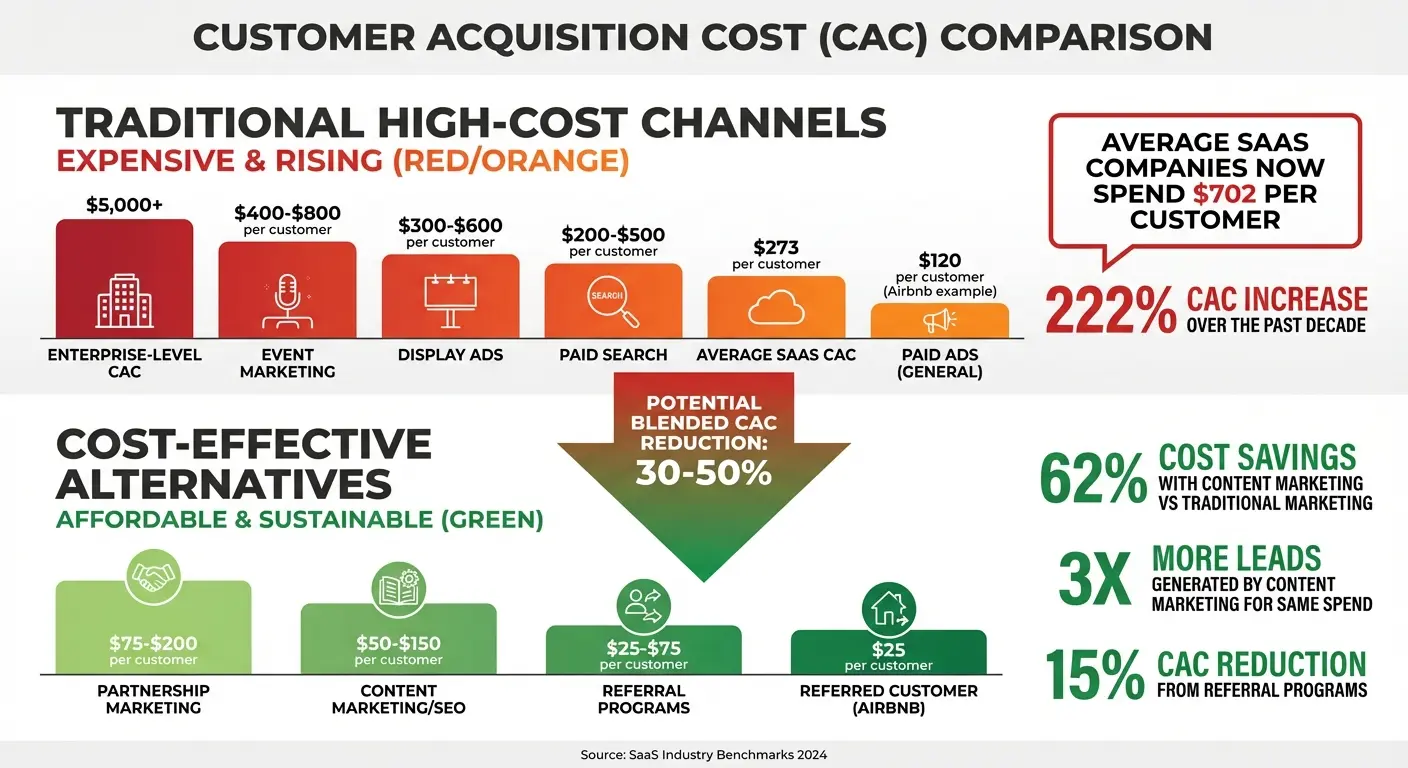
Source: Baremetrics
If you get your blog post ranked among the first results, then leads will come for several months or even years. Businesses concentrating on SEO mention that their cost per lead is 61% less than that for outbound marketing(HubSpot). The more resources you devote to SEO, the better its efficiency gets.
This is the most important aspect that should be considered by any CMO.
How Organic Search Reduces CAC Over Time
Here’s what makes organic search so powerful for CMOs thinking about unit economics. SEO costs don’t scale the same way paid media does. Your investment stays roughly the same, but your returns grow.
While the average organic SEO CAC starts at $743 for new programs in their first 12 months, it drops to an average of $284 for programs operating for 36 months or more. That’s a 62% reduction in CAC, just by staying consistent.
This compounding effect is what separates organic from paid. With paid, you spend $1 and get $X back. Stop spending, and everything stops. With SEO, each piece of content, each backlink, and each technical improvement adds to a growing base of equity.
The Long-Term ROI of Organic Search
Let’s put this in real numbers. The return on investment of SEO for a SaaS company is 702%. That’s not a typo. It reflects the compounding power of content that keeps ranking, earning trust, and converting visitors.
For CMOs managing tight budgets, this ROI is hard to ignore. Every dollar put into organic search today pays back more over time, not less.
Content Equity: The Asset Paid Ads Can’t Build
When you create great content that ranks, you own that traffic. Nobody will be able to beat your price. A research-driven pillar article or a problem-solving blog article can generate targeted traffic for many years ahead.
The cost of developing these articles is set in advance; however, the revenue generated from these pieces can grow and accumulate in the long term. That’s content equity, and it’s one of the strongest levers for reducing CAC.
6 Proven SEO Strategies to Lower Your CAC
So how do you actually do this? Here are six strategies that work, backed by data and real-world results.
1. Target High-Intent Keywords
Not all traffic is equal. People looking for “best project management software for remote teams” have a much higher chance of making a purchase compared to someone searching for “what is project management?” People using high-intent keywords are more likely to be ready to make a purchase.
Target your content based on high-intent keywords to increase your chances of converting visitors into customers. Target keywords such as “best,” “compare,” “review,” “how to choose,” and similar keywords. Visitors targeting these words convert at a much higher rate. And by bringing in the right kind of traffic, you will be lowering your CAC automatically.
You can use tools such as Google Search Console, Ahrefs, and SEMrush to help find these words.
2. Build Topical Authority with Pillar Pages
Google rewards websites that show deep knowledge on a topic. The way to do that is through a content cluster strategy.
Pick a core topic, say, “marketing automation.” Write a comprehensive pillar page on it. Then create several supporting blog posts that go deep on related subtopics. Link them all together. This structure tells Google that your site is a trusted authority.
With 85-90% of global traffic flowing through Google, organic website traffic has emerged as the most sustainable growth engine for scaling businesses. Topical authority is how you capture a meaningful share of that traffic at a fraction of the cost of paid ads.
3. Optimize for Answer Engines and AI Search
The search is not limited to Google anymore. Almost half of all consumers are using AI-driven search today, and the old-fashioned SEO strategies will not suffice in order to attract not only human but also artificial intelligence’s attention. You need to appeal to AI-driven answer engines as people start asking ChatGPT, Perplexity, and AI overviews. So, your content needs to work for these answer engines, too.
What answer engines look for:
- Clear, factual, well-structured content
- Authoritative sources and citations
- Content that genuinely helps readers
- Information that can be extracted and summarized
When Google’s AI Overviews or ChatGPT synthesize answers, they pull from content with strong EEAT signals. If your content isn’t cited there, you’re losing a growing share of visibility.
Read More:
4. Invest in Technical SEO
Even the best content won’t get you any rankings if there are issues with the website itself. Speed, mobile friendliness, crawlability, and core web vitals play a major role here.
Make sure to perform SEO audits frequently and address such factors as fixing broken links, reducing load time, and ensuring proper crawlability of the pages. The faster and more mobile-friendly your site is, the higher its ranking will be compared to sites with poor performance.
SEO in 2026 requires clearness, authority, and authenticity. Start building a solid basis by optimizing your site from a technical perspective.
5. Build EEAT into everything you publish
EEAT refers to experience, expertise, authority, and trustworthiness. This is used by Google to determine which content should be prioritized for ranking highly.
Show your experience. Let real experts write your content. Include author bios with credentials. Quote only reputable sources. Update your content regularly with current dates.
Those who had put effort into creating people-friendly and technically sound content saw no dip in their rankings during recent core algorithm updates. Generic, credential-free content got pushed down.
6. Earn High-Quality Backlinks
Backlinks are votes of confidence. If a well-known website backlinks to your site, Google understands that you have quality content, and this increases your ranking, which then attracts organic traffic, thus bringing down the cost per acquisition.
The best strategy for acquiring backlinks is by creating valuable content. This could be original research, statistics, guides, or any tools that add value to people’s lives.
Digital PR and thought leadership campaigns result in brand mentions on high-ranking sites, and according to SEOs, it is the best way to get backlinks in 2026.
Also, guest posting, expert roundups, and even partnership marketing can be considered as ways to develop backlinks.
7. Track CAC by Channel, Precisely
You can’t optimize what you don’t measure. Many companies track total CAC but don’t break it down by channel. That’s a mistake.
Set up proper attribution in Google Analytics 4. Tag your campaigns. Use a CRM to track leads from organic search all the way to closed revenue. When you see the actual CAC for organic versus paid, the case for SEO investment becomes very clear.
Organic search delivers superior ROI compared to paid alternatives, though it requires longer investment horizons and consistent content investment. Track it properly, and you’ll have the data to justify every dollar spent.
The Key Takeaway
Paid advertising gives you short-term wins. Organic search builds lasting wealth. The numbers don’t lie. CAC has climbed 60% in five years, yet organic leads convert at nearly 15% compared to less than 2% for outbound. Smart CMOs are rebalancing their channels.
Start with one high-intent keyword cluster. Create one genuinely helpful piece of content. Optimize it for both humans and answer engines. Measure your organic CAC against your paid CAC. Then do it again.
The winners of tomorrow will not be those with the fattest marketing budget. It will be the businesses that outwit their competitors through organic search. Your customers are already searching for solutions. Make sure they find you without paying for every single click.
Ready to reduce your Customer Acquisition Cost? ResultFirst helps businesses build sustainable organic growth strategies that lower acquisition costs and strengthen long-term marketing performance. Our Pay for Performance SEO Services align SEO investment with measurable business outcomes, helping you grow qualified pipeline without relying solely on paid media.
Sources Referenced:
- https://firstpagesage.com/reports/seo-roi-statistics-fc/
- https://www.mckinsey.com/capabilities/growth-marketing-and-sales/our-insights/new-front-door-to-the-internet-winning-in-the-age-of-ai-search
- https://gs.statcounter.com/search-engine-market-share
- https://www.wordstream.com/ppc-benchmarks
FAQs:
WHAT TO READ NEXT
READY TO BUILD PREDICTABLE ORGANIC GROWTH?
We are the only TOP SEO services agency providing Real Results in a Real Performance model. We help growth hungry companies outperform their competition and achieve 300%+ growth in their digital marketing initiatives.
- San Jose, CA, 95120

- +1-888-512-1890

- sales@resultfirst.com

300K+
KEYWORDS RANKED
546M+
REVENUE GENERATED
18 Years
SOLVING COMPLEX SEO
150+
TEAM MEMBERS