


 sales@resultfirst.com
 +1-888-512-1890
Google August 2026 Spam Update Is Complete: What to Do Next

Google has completed the rollout of its August 2026 Spam Update, which began on August 18, 2026. The update applies globally across all languages and marks Google’s third confirmed spam update of the year.
Unlike a core update, a spam update focuses on improving Google’s ability to detect and address practices that violate its existing spam policies. Google has not announced a new set of spam policies specifically for the August update, so its existing Search spam policies remain the key reference for site owners.
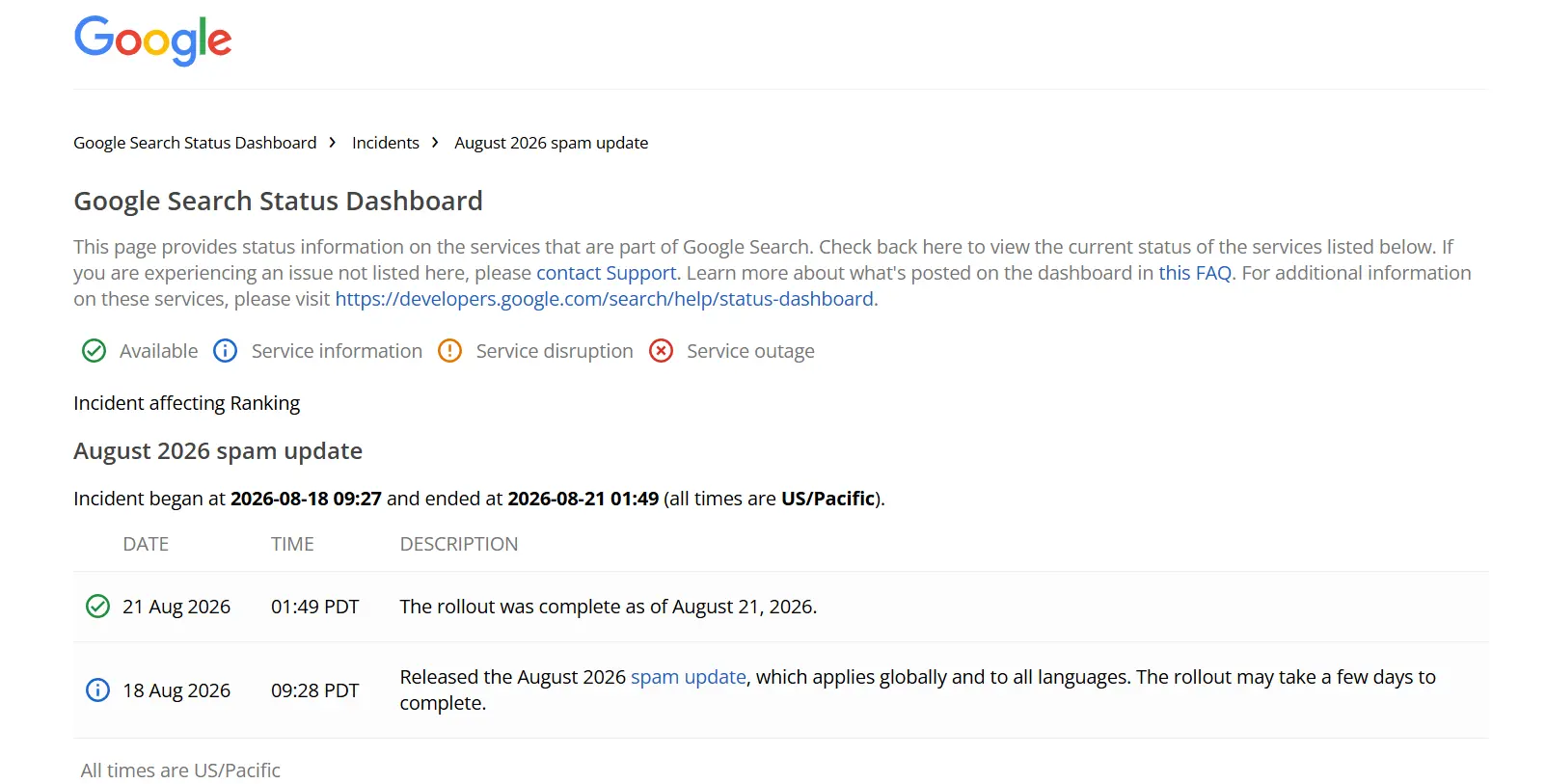
Source: Google Search Status Dashboard
Previous Google Spam Updates in 2026
The August 2026 Spam Update follows Google’s March 2026 Spam Update and June 2026 Spam Update, which were also focused on addressing spam and improving search quality. Reviewing these earlier updates can provide useful context for understanding how Google continues to refine its approach to spam detection.
What Site Owners Should Know About the August Update
Google has not published a detailed breakdown of specific tactics targeted by the August update. Instead, site owners should assess their websites against Google’s existing spam policies.
These policies cover practices such as keyword stuffing, cloaking, doorway abuse, scaled content abuse, scraping, sneaky redirects, thin affiliate content and manipulative link practices. Google’s policies also apply to attempts to manipulate generative AI responses in Google Search.
The absence of a newly announced spam policy is important. Site owners should not assume that a ranking decline means Google introduced a completely new ranking factor. A change may instead indicate that Google’s existing spam-detection systems have become better at identifying practices that were already against its policies.
What to Do After the August 2026 Spam Update
Now that the rollout is complete, site owners can start evaluating whether their organic visibility changed during the update.
Rather than reacting to a single ranking movement, compare Google Search Console performance before and after the rollout. Look for sustained changes in clicks, impressions, rankings and the pages or queries affected.
If a significant decline is visible, review the affected pages against Google’s spam policies. Pay particular attention to patterns involving scaled or low-value content, keyword stuffing, cloaking, deceptive redirects, scraped content or other practices that may violate Google’s guidelines.
It is also important to rule out other causes before attributing a decline to the spam update. Changes in search demand, seasonality, technical issues or other search-system changes can also affect organic traffic. Google recommends checking Search Console data and investigating other possible causes when diagnosing search traffic drops.
Should You Make Immediate SEO Changes?
A ranking decline does not automatically mean that a website needs a complete SEO overhaul.
Start with the pages and queries showing the clearest changes, identify whether there is a policy-related issue, and then make improvements that genuinely improve the website for users. Avoid making large-scale changes simply because rankings moved during the update.
Google notes that when a site violates its spam policies, making appropriate changes can help if its automated systems later determine that the site complies with those policies. This recognition can take time, potentially months.
How Can Businesses Respond to the August Update?
The safest approach is to focus on the fundamentals rather than trying to reverse-engineer an update without confirmed information.
Businesses should review the quality and purpose of their content, remove or improve pages that provide little value, check for manipulative SEO practices, and make sure their website consistently follows Google’s Search spam policies.
For an SEO team, the post-update process should be driven by data. Search Console performance, affected landing pages, ranking trends and technical findings can help determine whether a change is isolated or part of a broader pattern.
This is where performance-driven SEO becomes valuable. Instead of reacting to every ranking fluctuation, businesses can use performance data to identify meaningful changes, investigate the underlying causes and make informed improvements.
The Key Takeaway
The August 2026 Spam Update is now complete, giving site owners an opportunity to move from monitoring the rollout to evaluating its impact.
If your website experienced a sustained decline, don’t assume the update is automatically responsible. Compare performance data, investigate the affected pages, and review the site against Google’s existing spam policies.
For websites that have legitimate issues, the priority should be to correct those issues and improve the overall quality and usefulness of the site rather than looking for a quick algorithm-specific fix. Google’s spam systems continue to evolve, making long-term compliance and a people-first approach more sustainable than reacting to individual updates.
Ranking changes after a spam update can be difficult to interpret without clean data and the right framework. If you’re unsure what your Search Console data is telling you or need help identifying the cause of lost visibility, ResultFirst’s performance-driven SEO services can help you diagnose what changed and build a recovery plan that aligns with Google’s quality standards.
[Get in touch today] to protect your organic visibility.
Sources Referenced:
WHAT TO READ NEXT
READY TO BUILD PREDICTABLE ORGANIC GROWTH?
We are the only TOP SEO services agency providing Real Results in a Real Performance model. We help growth hungry companies outperform their competition and achieve 300%+ growth in their digital marketing initiatives.
- San Jose, CA, 95120

- +1-888-512-1890

- sales@resultfirst.com

300K+
KEYWORDS RANKED
546M+
REVENUE GENERATED
18 Years
SOLVING COMPLEX SEO
150+
TEAM MEMBERS