



 sales@resultfirst.com
 +1-888-512-1890
Effective B2B SaaS Content Marketing Strategy That Drives Pipeline and Growth

Content marketing is considered one of the top-growth channels with the highest ROI for SaaS businesses, and blog writing is the most critical element of this.
According to Ahrefs, “B2B SaaS SEO shows ~702% average ROI with a ~7‑month break‑even across a 3‑year window.
But today, that era is changing.
AI tools like ChatGPT and Google’s AI Overviews now answer those same questions instantly. People do not need to click on your blog anymore. They get the answer in seconds.
A report says that AI overviews reduce clicks to websites by 34.5%.
Many SaaS companies now struggle to stand out.
So yes, content still drives the pipeline. However, the way we approach content marketing must be altered. A new and intelligent SaaS SEO strategy must be employed in such a way that it helps AI and not hinders it.
This guide explains what has changed and how to build a strategy that still drives real growth.
Learn the Basics of B2B SaaS SEO.
What Are the Big Shifts in SaaS Content Marketing?
AI did not remove content marketing. But it changed how it works in a big way. The rules are different now. If you follow old methods, you may lose traffic and leads over time.
Search Behavior Has Shifted
Buyers now use AI tools to get answers quickly. They want fast results and simple explanations. This changes how they interact with content.
- AI gives direct answers in searches.
- Buyers shortlist tools before visiting websites.
- Many decisions happen without clicking links.
- Users trust summarized answers more than long blogs.
This means your SEO strategies for SaaS must focus on being visible inside AI-generated answers. It is no longer enough to rank on page one. Your content must be structured in a way that AI tools can easily pick and display.
Why Educational Blog Posts Are Losing Power
Think about the last time you searched for a simple answer. Did you click on a blog? Probably not. Google showed you an AI summary right at the top. That is what most people see now.
Ryan Law predicts that the value of educational blog content will go to zero in the next ten years. Why? Because AI handles informational queries instantly. No one wants to read a 2,000-word post to learn how to install software. They want the answer in ten seconds.
This means your old strategy of writing “what is” and “how to” articles will stop working. Traffic will drop. Leads will dry up. You need a new plan.
Read More: How to Optimize Content for Answer Engines
Challenges Facing Modern B2B SaaS Content Marketing
B2B marketers today face four major challenges that are forcing a complete reset in content strategy.
1. First, generative AI is a double-edged sword.
Source: Sales Motion
It helps create content and ad copy faster. Marketers use it for personalized emails, which 78% of teams rely on for lead generation. But trust remains very low. Only 4% of marketers rate GenAI content as highly trustworthy. Balancing speed with quality and human oversight is hard.
2. Second, buyers expect hyper-relevant content.
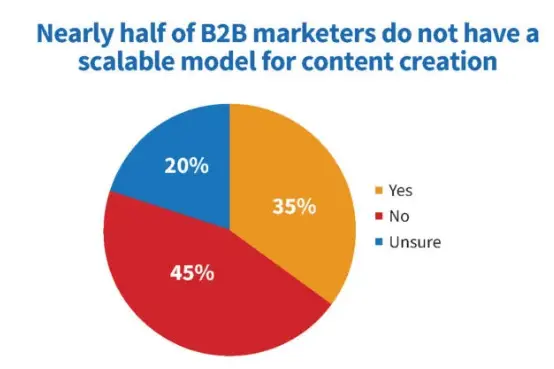
Yet, 45% of B2B teams lack a scalable personalization model. Resource constraints are the top barrier for 54% of marketers. Underperforming lead nurture sequences affect 59% of teams.
Source: Content Marketing Institute
3. Third, search has changed.
Answer Engine Optimization (AEO) is now non-negotiable. Google’s featured snippets account for 40% of all results, and voice search is on the rise. Content now needs to be optimized for AI answer engines, adding another layer of complexity to traditional SEO.
4. Fourth, technology sprawl hampers productivity.
Teams manage too many tools instead of nurturing customers. The ROI requirements are rising, headcounts are stagnating, and budgets are getting smaller. To put it another way, a lack of trust in AI, the need for personalization, the evolving search landscape, financial constraints, and the rapid advancement of technology are all obstacles that B2B marketers must overcome. There must be a compromise.
Two Types of Content That Actually Work in 2026
So, what should you do instead? Focus on two types of content that AI cannot easily replace. First is product-led content. This helps buyers compare options and take action. Second is original content. This is based on your unique data, stories, and opinions. Both require a smarter SEO strategy for SaaS.
- Product-Led Content
- Original Content
What Is Product-Led Content?
Product-led content is any asset that moves a buyer closer to a purchase decision. It does not teach general concepts. It helps someone answer a specific question, like
- “Which tool is best for my team size?”
- “Is Software X worth the extra cost over Software Y?”
- “Can this tool integrate with our existing stack?”
These are high-intent searches. The person asking is already in buying mode. They have a budget. They have a timeline. They just need one final push.
Real Examples of Product-Led Content That Works
First, comparison pages. You worked with a project management tool that wrote a page called “Asana vs. ClickUp vs. Us.” That single page brought in 30% of their demo requests. Why? Because the people searching those words are primed to buy. They just want to know who the winner is.
Second, “best for” listicles. A small HR software customer wrote, “Best Payroll Software for Remote Teams.” They ranked on page one. They got 15 signups for the first month from the post. Not a lot, but the signups had a 40% conversion rate. Much higher than the typical blog posts.
Third, use case walkthroughs. Instead of listing features, walk them through a use case. “How a Marketing Agency Uses Our Tool to Track Billable Hours.”
What Is Original Content?
Original content is anything AI cannot create because it lacks your unique perspective. This includes:
- Survey data from your own customers.
- Case studies with real numbers.
- Founder stories and lessons learned.
- Opinion pieces on industry trends.
- Free tools built from your data.
AI is great at remixing existing information. But it cannot interview your customers. It cannot share your failed experiment. It cannot build a calculator based on your proprietary data. That is your competitive advantage.
How to Build a Modern B2B Saas Content Marketing Strategy That Drives Pipeline
Source: B2BMention
Now, let us get practical. How do you actually build a content engine that works in 2026? Here is a simple five-step framework.
Step 1: Stop Writing These 3 Types of Posts
First, you need to kill some old habits. Stop writing:
- “What is X?” posts. AI answers these instantly. No one clicks.
- Basic tutorials that are everywhere. “How to send an email” is not unique.
- Generic listicles with no real testing. “Top 10 tools” with no screenshots or honest opinions.
These posts waste your time. They also hurt your credibility. Savvy buyers can tell when you have not actually tested the tools you recommend.
Instead, replace them with content that requires effort. Interview a customer. Run a survey. Test five tools and share real screenshots. That is work AI cannot fake.
Step 2: Find Your High-Intent Keywords
High-intent keywords are phrases that signal buying readiness. They often include words like:
- Best
- vs
- alternative
- review
- pricing
- for [specific use case]
For example, “best CRM for real estate agents” is much higher intent than “What is CRM?”
“The first person is comparing options. The second person is just learning.
Source: Omnibound
Use tools like Ahrefs or Semrush to find these phrases. Look for keywords with commercial intent. They usually have lower search volume but much higher conversion rates. That is a trade worth making.
Step 3: Create One Pillar Page and Five Clusters
Topic clusters still work. But update them for 2026. Your pillar page should be a “complete guide to [problem].” ” Then write cluster posts that are product-led.
For example, a pillar page on “resource management for agencies.” Then cluster posts like:
- “Best resource management software for small agencies”
- “Monday vs Resource Guru for creative teams”
- “How [Client Name] saved 20 hours per week with our tool”
- “Free resource utilization template (download)”
Notice how each cluster post either compares tools, shares proof, or gives away a useful template. No generic “What is resource management?” That is the shift.
This structure also helps your SaaS SEO strategy because Google sees the internal links as a sign of expertise. Plus, readers stay on your site longer when they move between related posts.
Step 4: Distribute Where Your Buyers Hang Out
Publishing on your blog is not enough. You need to go where your buyers already spend time. For B2B SaaS, that usually means:
- LinkedIn: Share your comparison posts and case studies. Tag the other tools you compared. It sparks conversation.
- Reddit: Find subreddits where your ideal customers ask questions. Answer honestly. Link to your content only when it is truly helpful.
- Slack and Discord communities: Many B2B niches have private groups. Join them. Become a helpful member. Share your best content when relevant.
- Email newsletters: Build a list of people who have shown interest. Send them your best product-led content.
Step 5: Map Your Content to the Three Funnel Stages
A B2B acquisition funnel has three stages. Each stage needs a different content type to move buyers closer to a purchase.
Top funnel (Discovery)
Buyers know their problem. They want a tool to fix it. Your goal is brand awareness. Create helpful tutorials, use case articles, and strong opinion pieces. Avoid generic “what is” posts. AI answers those instantly.
Middle funnel (Comparison)
Buyers compare options. They want the best fit for their needs and budget. Your goal is to get shortlisted. Write “X vs Y” comparison pages. Collect reviews on G2 and Capterra. Work with influencers to get authentic reviews for your product. A few good comparison pages can drive more demos than months of blog posts.
Bottom funnel (Conversion)
Buyers are ready to purchase. Your job is to eliminate barriers and minimize risk. Feature customer stories and successes. Create landing pages for particular use cases or personas. Make it easy for signups with clear CTAs and simple forms.
A few well-written comparison pages will get you more demos than months of top-funnel blog posts. That small change makes a big difference.
Common Mistakes to Avoid
Mistake 1: Writing for Keywords, Not People
Do not stuff your content with keywords like “SaaS SEO strategies” just for ranking. Write for a human who has a problem. Use keywords naturally. Google is smart enough to understand context.
Mistake 2: Being Afraid to Compare Honestly
Many SaaS brands refuse to write honest comparisons. They only show why they are better. That is a mistake. Buyers trust you more when you admit your weaknesses. “Our tool does not have native Gantt charts, but we integrate with Asana for that.” That honesty builds credibility.
Mistake 3: Giving Up Too Soon
This strategy takes time. You might see traffic drop before it converts. That is normal. Give it at least six months. Track demo requests, not page views. Be patient.
Why Partner With ResultFirst
If your SaaS business wants more than just traffic numbers, ResultFirst offers a smarter path to real growth. As a performance-driven SaaS SEO company, ResultFirst builds strategies that focus on pipeline, not just rankings. The goal is simple. Turn search demand into qualified leads and paying customers.
The team works across the full journey, from search visibility to product sign-ups and demos. Your content does not just rank. It guides buyers, answers key questions, and helps them move closer to a decision. This approach makes your website a strong growth engine, not just a content hub.
With ResultFirst, your SaaS SEO strategy is built around high-intent keywords, clear messaging, and conversion-focused content. Every step is designed to attract the right audience and turn interest into action.
Conclusion
AI has been a game-changer in B2B SaaS content marketing. Nowadays, consumers can use AI tools to find answers in a short period. Content marketing is more competitive than ever. And the same cannot be said of traditional content marketing strategies.
To be successful in content marketing for B2B SaaS companies, you must be flexible. You require a strong SaaS SEO plan that is intent-based, authority-based, and value-based. Your content must not only attract visitors but also generate revenue.
The key is to target high-intent content topics. You need unique content with a focus on experience. You need AI assistance for speed and human expertise for quality. You need to disseminate content across multiple channels and measure real performance metrics.
This is where ResultFirst stands out. We use smart AI tools and human creativity to achieve results. AI is not a substitute; it is a superior decision-maker and an accelerator of speed. It is a moderate way of realizing growth without losing the voice of the brands.
Frequently Asked Questions (FAQs)
WHAT TO READ NEXT
READY TO BUILD PREDICTABLE ORGANIC GROWTH?
We are the only TOP SEO services agency providing Real Results in a Real Performance model. We help growth hungry companies outperform their competition and achieve 300%+ growth in their digital marketing initiatives.
- San Jose, CA, 95120

- +1-888-512-1890

- sales@resultfirst.com

300K+
KEYWORDS RANKED
546M+
REVENUE GENERATED
18 Years
SOLVING COMPLEX SEO
150+
TEAM MEMBERS