


 sales@resultfirst.com
 +1-888-512-1890
How To Build Domain Authority From Scratch In A Competitive Niche

Most websites in competitive niches never rank. Not because the content is bad. Not because the strategy is wrong. But because they skipped the one thing that makes everything else work: Domain Authority (DA) that signals trust, credibility, and expertise to search engines, making it significantly easier to compete for high-value keywords and earn consistent organic visibility.
Websites with a Domain Authority above 50 are 3.7 times more likely to appear in the top 10 results for competitive keywords. According to Semrush data, the top 10 organic results in finance niches average a Domain Authority score of 75. Domain authority plays a major role in helping websites earn and maintain top positions, especially for competitive keywords where trust and credibility matter most.
This guide shows you exactly how to build domain authority and help your website become a trusted resource in even the most competitive markets.
What Does “Starting From Scratch” Actually Mean For Domain Authority?
When you launch a new website in a competitive niche, you start at DA 1. Every website begins at the bottom of a 1 to 100 scale. Your competitors sitting at DA 50 or DA 70 did not get there by accident. They earned it over months and years through backlinks, content depth, brand mentions, and technical trust signals.
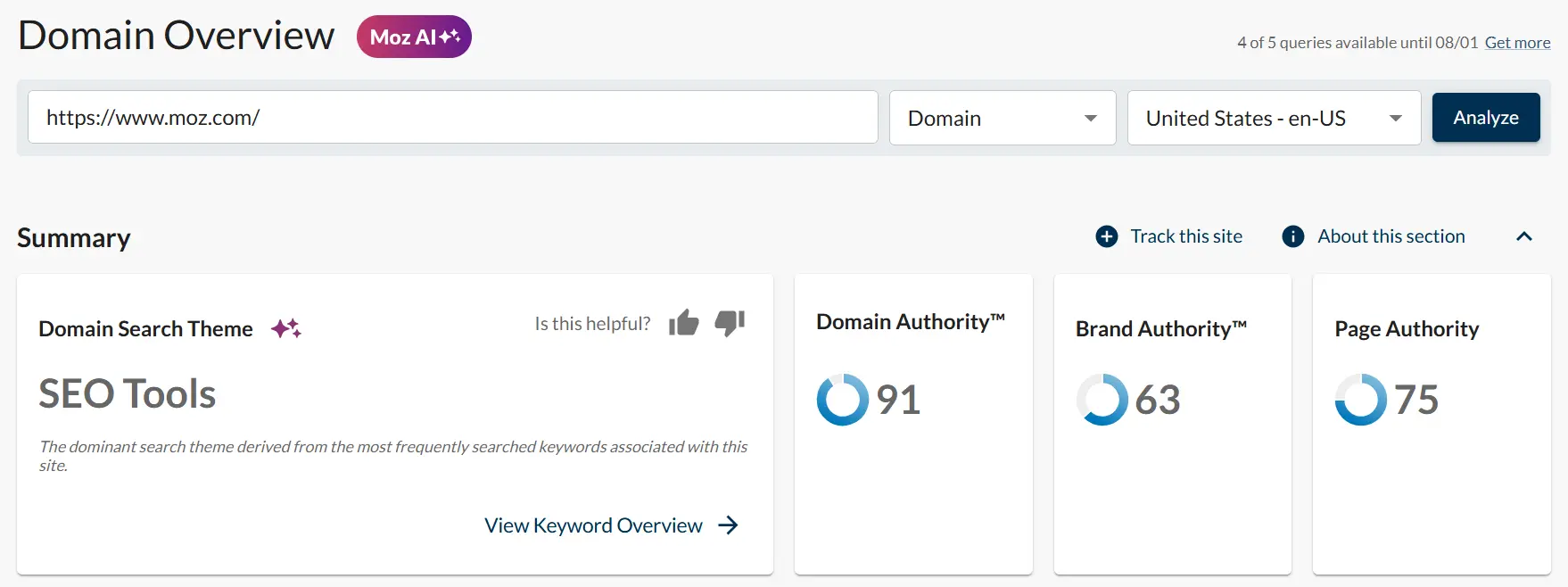
Image Source: Moz
Domain Authority (DA) is a metric developed by Moz that predicts how likely your website is to rank in search results when compared to other websites competing for similar keywords.
It is calculated using:
- The number of websites linking to your domain
- The quality and relevance of those backlinks
- Your overall link profile strength
- Spam signals and unnatural link patterns
DA is not a direct Google ranking factor. But the signals that drive DA are exactly the signals Google uses to rank pages. That is why DA and organic rankings almost always move in the same direction.
What Makes a Good DA Score in a Competitive Niche?
There is no universal number. A DA of 30 might be excellent in a low-competition niche. In finance or healthcare, you may need a DA of 65 or higher just to break into the first page. The only number that matters is whether your DA beats your direct competitors.
Here is a simple breakdown by range:
| DA Score | What It Signals |
| 1 – 20 | New site with minimal backlinks |
| 20 – 40 | Established site with some link building effort |
| 40 – 60 | Strong authority with consistent SEO investment |
| 60 – 80 | Highly authoritative with a quality-heavy link profile |
| 80 – 100 | Industry leaders and dominant brands |
Run a quick DA check on the top 10 sites ranking for your target keywords. Find their average score. Beat that number, and you are in the game.
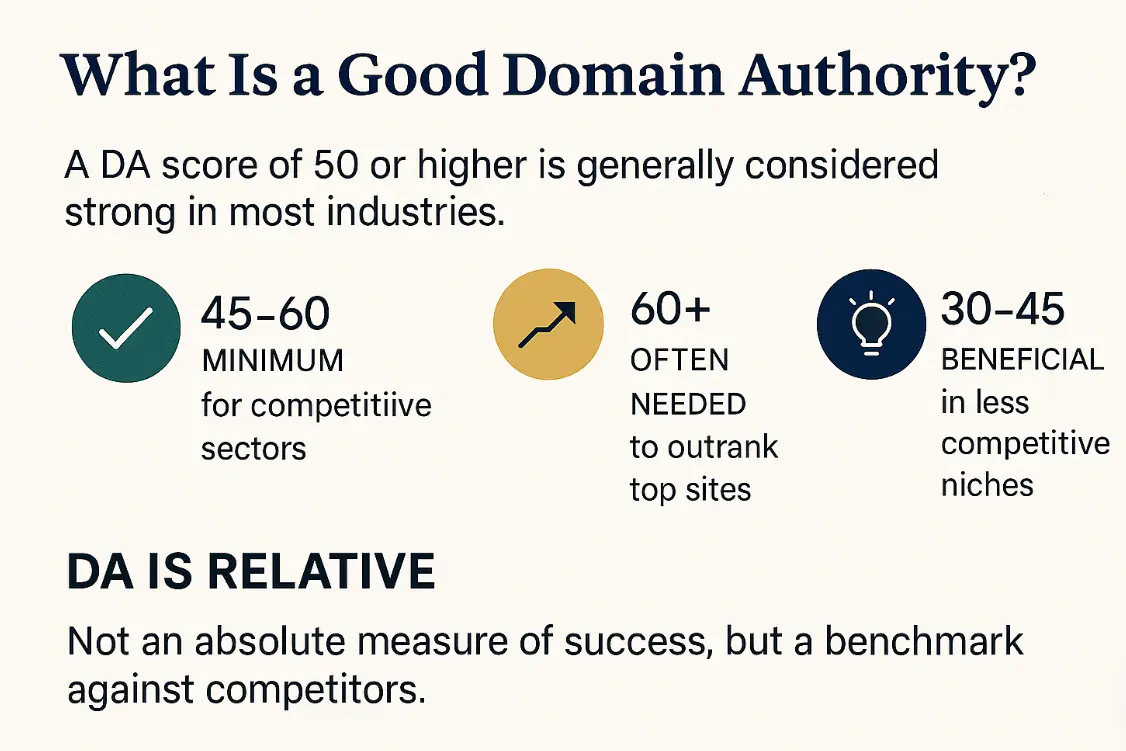
Image Source: Gemini
Why Does Building DA in a Competitive Niche Feel So Hard?
Competitive niches are hard because authority compounds. Older sites have years of backlinks, brand mentions, and user trust built up. You are starting from zero against players who have been building for a decade.
Here is what makes it harder:
- Established brands dominate high-volume keywords
- AI Overviews and zero-click searches favor trusted authoritative sources
- Low-authority sites hit a ceiling where content alone stops moving rankings
- Google’s algorithms reward specialization and depth, not broad coverage
The mistake most new sites make is chasing keyword rankings before building the trust that makes those rankings stick. Authority comes first. Rankings follow.
How to Improve Domain Authority From Scratch: 7 Proven Strategies
1. Build Topical Authority With Comprehensive, High-Value Content
Content is the engine that drives everything else. But not all content builds authority. Generic blog posts with surface-level information add nothing. You need content that earns links, earns trust, and demonstrates genuine expertise.
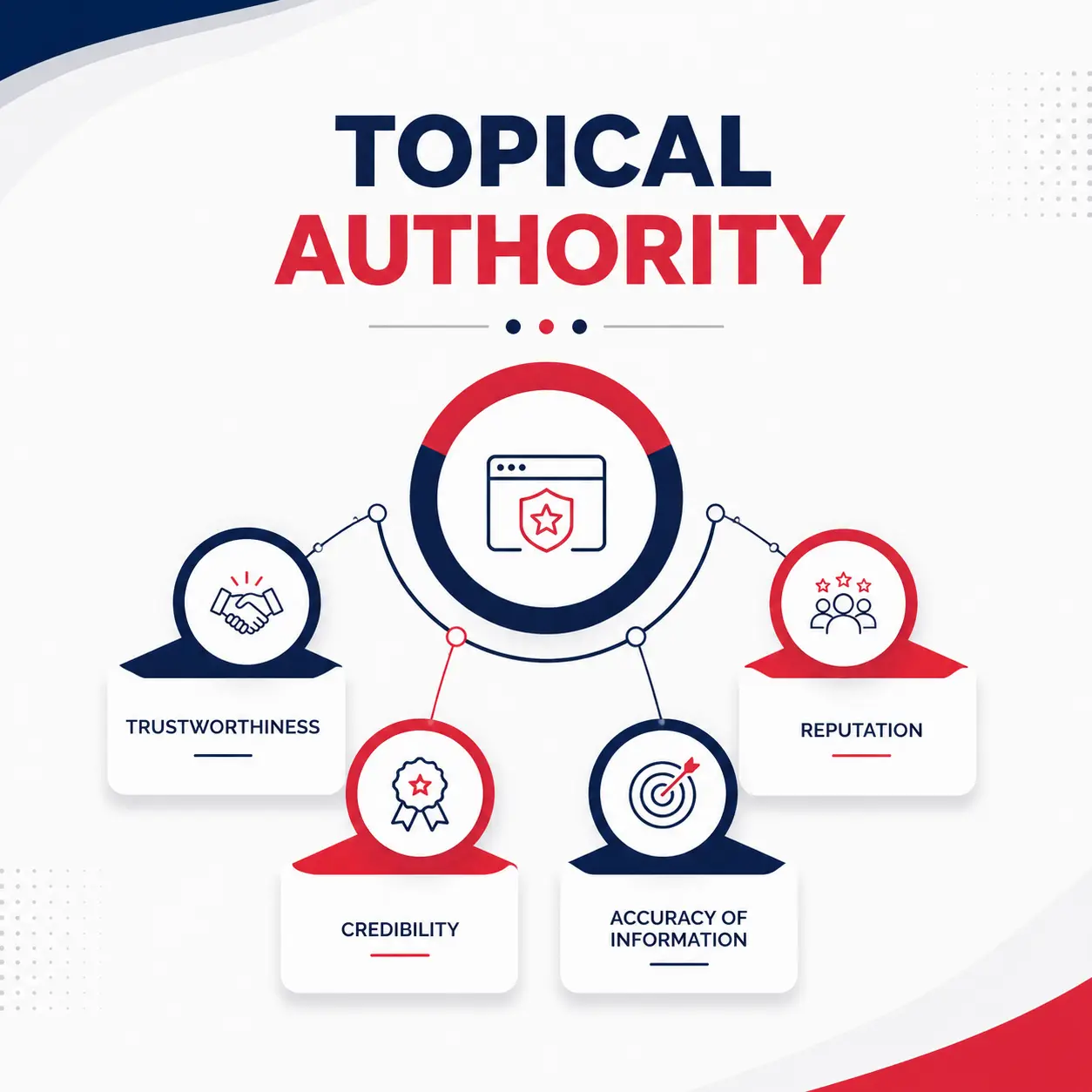
Authority starts with content depth, not content volume.
- Build topic clusters instead of isolated blog posts
- Cover search intent completely: informational, commercial, and navigational
- Regularly update outdated content to maintain freshness and accuracy
- Publish original research, data, and first-party insights journalists can cite
Google’s December 2025 update confirmed that specialized sites consistently outranked broader generalist platforms for competitive keywords.
Each piece of content should answer one question: would a reputable website link to this? If the answer is no, rewrite it until the answer is yes.
2. Earn High-Quality Backlinks From Authoritative Websites
Backlinks remain the single strongest authority signal. Pages ranking #1 on Google typically have 3.8x more backlinks than pages in positions #2–#10. But quality beats quantity every time. One link from a DA 70 industry publication can outperform 100 links from low-authority blogs.
What to prioritize:
- Links from niche-relevant domains: relevance amplifies authority transfer
- Editorial links earned through genuine value: not paid placements
- Diversity of linking domains: 10 links from 10 different sites beats 10 links from one
Proven outreach strategies to earn links without a big budget:
Link insertion outreach: Find articles discussing your topic. Offer your content as a useful addition to a specific section. Be specific, brief, and genuinely helpful.
Broken link building: Find broken links on authoritative sites in your niche. Offer your content as a replacement. Tools like Ahrefs or Semrush make this easy.
Guest posting: Write for reputable sites in your niche. One well-placed guest post on a DA 60 site moves the needle faster than 50 posts on DA 15 blogs.
Resource page outreach: Many authoritative sites maintain resource pages. If your content fits, pitch it directly.
Avoid practices like paid link schemes or private blog networks (PBNs). Google’s algorithms are designed to detect unnatural link patterns, and the penalties can wipe out months of legitimate work.
3. Strengthen Internal Linking Across Key Pages
Internal linking is one of the most underused tactics in competitive niches. When a page on your site earns strong backlinks, it gains authority. Internal links let you pass that authority to other pages.
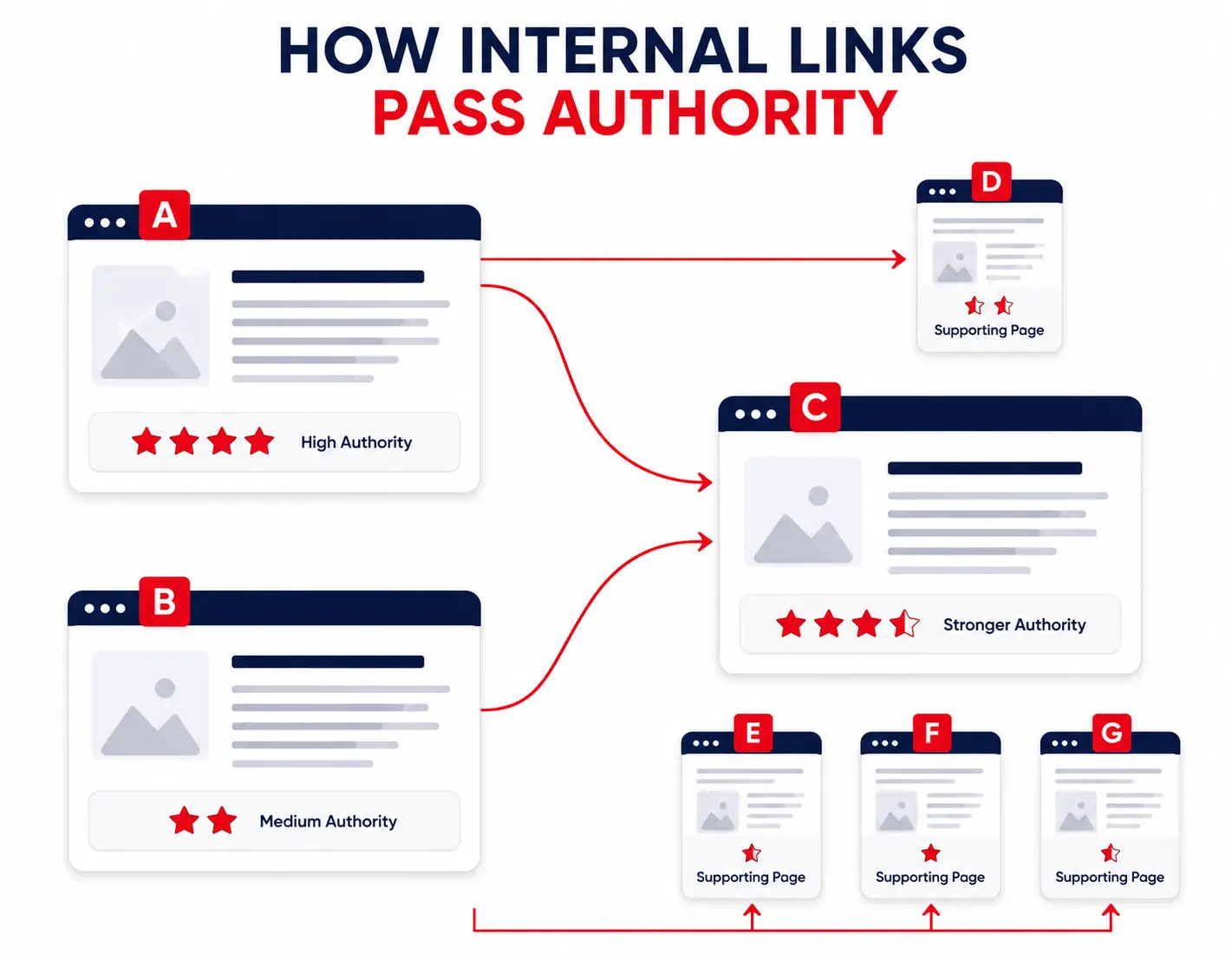
A strong internal structure helps Google understand what matters most and ensures authority flows where you need it.
How to build a strong internal linking structure:
- Find your highest-authority pages using Semrush’s Backlinks report or Ahrefs
- Link from those high-authority pages to the pages you most want to rank
- Build topic clusters: a pillar page supported by multiple cluster pages and link between them
- Fix orphan pages (pages with no internal links pointing to them); they receive zero authority from the rest of your site
- Fix broken internal links: they waste authority and damage user experience
Pass link equity to important pages strategically. Use contextual internal links within content. Strengthen cornerstone pages and commercial URLs. In competitive niches, a well-structured internal linking strategy can meaningfully accelerate rankings without a single new backlink.
4. Fix Technical SEO Issues That Limit Authority
You can build great content and earn strong backlinks, but if crawlers cannot access your pages, none of it matters. Technical issues quietly erode authority even when everything else looks good.
Key technical areas to address:
- Site speed and Core Web Vitals: Slow sites lose trust signals before users even arrive
- Crawlability and indexability: Check your robots.txt file to make sure it does not accidentally block important crawlers, including OAI-SearchBot or PerplexityBot
- Broken links and redirect chains: These waste crawl budget and dilute authority
- Orphan pages: Pages that receive no internal links receive no authority
- Index bloat: Too many thin or low-value URLs dilutes your overall site authority
- JavaScript rendering — If your main content only loads after JavaScript executes, many crawlers will never see it. Use server-rendered or static HTML for key content
- Schema markup: Add structured data to help search engines and AI systems identify who you are. Start with Organization schema, Person schema, and FAQPage schema
The @id property gives each entity on your site a unique identifier. The sameAs property connects your site to official profiles on LinkedIn, Wikipedia, and Wikidata, helping AI systems verify that all your profiles belong to the same brand.
Technical issues dilute authority and waste crawl budget. Before scaling any authority-building effort, make sure your foundation is solid.
5. Build Strong Brand Signals Across the Web
Links are not the only trust signal. Brand mentions, even without a direct backlink, help establish credibility across search and AI systems.
Reddit, LinkedIn, Facebook, and Quora rank among the most cited domains in large language models. AI systems pull from community discussions when generating answers. That means authentic user sentiment about your brand shapes how AI perceives your authority.
How to build brand visibility in a competitive niche:
- Get listed in relevant directories: Yelp, G2, Capterra, and niche-specific directories all build trust signals
- Participate in online communities: Answer questions on Reddit and Quora without being promotional. Contribute value consistently
- Appear on podcasts and roundups: Guest appearances generate mentions that reinforce authority.
- Turn unlinked mentions into links: Use brand Monitoring tools to find mentions of your brand that do not include a link. Reach out and request one.
- Encourage branded searches: Branded search behavior signals trust to Google.
One critical rule: keep your messaging consistent across every platform. If your homepage calls you “an email marketing platform for ecommerce brands,” your G2 profile and LinkedIn bio should say the same thing. Inconsistency confuses AI systems and weakens your entity authority.
In 2026, building brand signals extends beyond traditional mentions. As AI search engines increasingly draw from citation patterns and third-party references to surface brands in answers, earning mentions in sources that LLMs already trust has become a complementary strategy to domain authority building.
6. Remove Low-Quality Pages That Dilute Authority
Not all content helps your site. In fact, thin, outdated, or redundant pages can actively drag your authority down by diluting your overall link equity and signaling low quality to crawlers.
Fewer, stronger pages often outperform large but diluted sites.
- Audit and improve thin or outdated pages
- Reduce index bloat by noindexing or removing weak URLs
- Consolidate overlapping or similar content into single authoritative pieces
No amount of backlinks can compensate for low-value content. Authority is built when content demonstrates expertise, depth, and relevance across entire topics, not isolated pages.
7. Maintain a Clean and Healthy Backlink Profile
Authority growth should look natural. Sudden, unnatural link spikes even from legitimate sources can trigger algorithmic scrutiny. A clean, consistent link profile protects long-term trust.
- Monitor your backlinks regularly using Ahrefs, Semrush, or Moz
- Disavow harmful or spammy links only when necessary and with care
- Avoid sudden, unnatural link spikes
- Never buy links or participate in link schemes, penalties can take months to recover from
Common Mistakes That Kill Domain Authority Growth Before It Starts
Most new sites in competitive niches make the same avoidable mistakes. Knowing them upfront saves months of wasted effort.
Chasing DA as a goal: DA is a reflection of real SEO work, not the work itself. Focus on rankings and traffic. The score follows.
Buying backlinks: Paid link schemes trigger Google penalties. A few can wipe out months of legitimate work.
Ignoring content quality: Ten shallow blog posts do less for authority than one deeply researched pillar piece. No number of backlinks compensates for thin content.
Overlooking technical issues: Broken links, slow speed, crawl errors, and index bloat quietly erode authority even when your content is strong.
Comparing your DA to irrelevant sites: Benchmark only against your direct competitors in your exact niche.
Expecting fast results: Authority compounds over time. Most new sites see meaningful DA movement after 6 to 12 months of consistent effort. Impatience leads to shortcuts that backfire.
How Do You Track Whether Your Authority Is Actually Growing?
Tracking the right metrics keeps your strategy on course. DA alone is not enough. Watch these signals together:
| Metric | What it tells |
| Domain Authority trend | Overall link profile strength is improving |
| Referring domains | Growth in links from unique referring domains |
| Organic traffic growth | Authority gains translating into stronger search visibility |
| Keyword ranking improvements | Target pages moving up in the SERPs |
| AI visibility score | Content being cited by AI search engines and LLMs as a trusted source |
Check your referring domains in the Backlinks report. Monitor your AI citations with the AI Visibility Toolkit.
One important note: choose one tool and stick with it. Moz, Ahrefs, and Semrush all calculate authority slightly differently. Switching tools mid-strategy creates misleading fluctuations that waste your attention.
The Bottom Line: Authority Is Built Not Bought
Building domain authority from scratch in a competitive niche takes time. There is no shortcut. There is no service that delivers it overnight. But the process itself is straightforward when you follow it consistently.
Start with content that earns links. Build backlinks from relevant authoritative sources one relationship at a time. Use internal linking to spread authority across your site. Show up consistently in the communities your audience trusts. Fix the technical issues that block crawlers from seeing your work. Every action you take adds a layer of trust. That trust compounds. Six months from now your DA rises. Twelve months from now your rankings follow. Two years from now your site becomes the authority in your niche that newer sites struggle to compete with.
Want your website to become the authority others link to and search engines trust? ResultFirst helps brands build lasting Domain Authority through proven SEO, strategic content, and high-quality link acquisition that drives long-term visibility and growth.
Sources Referenced:
- https://www.ranktracker.com/blog/domain-authority-statistics-2025/
- https://www.semrush.com/blog/how-to-build-website-authority/
- https://backlinko.com/search-engine-ranking
FAQs:
WHAT TO READ NEXT
READY TO BUILD PREDICTABLE ORGANIC GROWTH?
We are the only TOP SEO services agency providing Real Results in a Real Performance model. We help growth hungry companies outperform their competition and achieve 300%+ growth in their digital marketing initiatives.
- San Jose, CA, 95120

- +1-888-512-1890

- sales@resultfirst.com

300K+
KEYWORDS RANKED
546M+
REVENUE GENERATED
18 Years
SOLVING COMPLEX SEO
150+
TEAM MEMBERS