



 sales@resultfirst.com
 +1-888-512-1890
Google AI Overviews: Everything You Need to Know in 2026

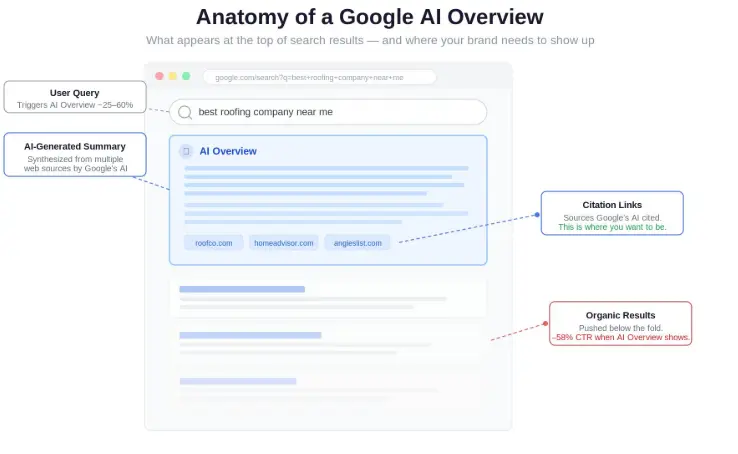
Google AI Overviews are AI-generated summaries that appear within Google Search for queries where an AI-generated explanation can help users understand information quickly.
They provide a concise response and links to supporting web sources, allowing users to get an overview without opening multiple search results.
Google introduced AI Overviews as the successor to its Search Generative Experience (SGE). The experience has since evolved beyond the original SGE experiment, with AI Overviews and AI Mode becoming important parts of Google’s generative search experience. As of 2026, Google says AI Overviews have more than 2.5 billion monthly active users, while AI Mode has surpassed 1 billion monthly users
For businesses and SEO professionals, this creates a new visibility opportunity. Ranking in traditional organic results remains important, but content can now also be surfaced as a supporting source inside AI-generated search experiences.
What Are Google AI Overviews?
Google AI Overviews are AI-generated summaries shown in Google Search that synthesize information from relevant web sources and provide links for users who want to explore the topic further.

Google displays AI Overviews when its systems determine that generative AI can be useful for understanding a query. The format can vary depending on the search. An overview may include paragraphs, lists, links, images, or other supporting elements.
The key difference from a traditional blue-link result is that users receive a synthesized answer before visiting individual webpages.
However, AI Overviews are not a replacement for the web. Google states that AI-generated responses can contain mistakes, which is why supporting links remain an important part of the experience.
For websites, this means the goal is not simply to produce content that contains a keyword. Content needs to provide information that Google can understand, interpret, and confidently connect with a user’s query.
How Does Google AI Overview Work?
Google AI Overview work by using generative AI together with Google Search systems to understand a query, retrieve relevant information, and generate a response supported by web sources.
A simplified process looks like this:
1. Google Understands the Search Query
The process begins when a user enters a query. For example:
“How can businesses improve their visibility in Google AI Overviews?”
Google needs to understand the subject, search intent, entities, and relationships within the query rather than simply matching individual keywords.
For example, a user searching for “how to appear in Google AI Overviews” may also find content discussing AI search optimization, structured content, E-E-A-T, helpful content, and citation-friendly pages, even if those exact words are not used in the query. Google explains that relevant results do not always need to contain an exact keyword match.
2. Google Identifies Relevant Information
Google retrieves information from webpages and other sources that may help answer the query.
The sources can vary according to the topic and search intent. For a complex question, the system may need information from multiple relevant sources before generating an overview.
3. The Information Is Synthesized
The generative AI system uses the information it has retrieved to create a concise response.
Instead of presenting several independent pages, the AI Overview can combine relevant information into a single explanation.
This is why clearly structured content matters. Definitions, direct answers, supporting evidence, examples, comparisons, and clearly separated sections make information easier to interpret.
4. Supporting Links Are Displayed
AI Overviews include links to web resources that support the information presented.
Google’s Search Console documentation confirms that links shown in AI Overviews can be measured through Search Console.
This creates an additional discovery path for websites that provide useful, relevant information.
What Is the Difference Between Google SGE and AI Overviews?
Google SGE was the experimental Search Generative Experience that preceded the wider rollout of AI Overviews. AI Overviews are the current Google Search feature, while SGE should generally be treated as the earlier experimental name and experience.
This distinction matters because older SEO articles often describe SGE and AI Overviews as two competing current features.
Google’s own documentation describes AI Overviews as replacing Search Generative Experience.
AI Mode is another related but distinct experience. Google describes AI Mode as a more interactive search experience where users can explore a topic through follow-up questions and receive links to supporting web resources.
In simple terms:
- SGE: Earlier experimental Google Search experience.
- AI Overviews: AI-generated summaries integrated into Google Search.
- AI Mode: More interactive AI-powered search experience designed for deeper exploration.
These experiences are related, but they should not be treated as identical.
How Can Google AI Overviews Affect SEO?
Google AI Overviews can affect SEO by changing how users interact with search results. Instead of clicking a traditional organic listing first, users may get an AI-generated answer with links to supporting websites.
This means SEO now needs to focus not only on rankings but also on being understood, retrieved, and cited by AI search systems. Clear answers, authoritative content, strong topical relevance, and well-structured pages can help businesses compete for visibility within these AI-generated results.
For SEO teams, the focus should therefore expand from ranking for individual keywords to creating content that answers complete search journeys.
A page should make it easy to understand:
- What the topic means
- What the direct answer is
- Why the answer is correct
- What factors affect the answer
- How the information applies in real situations
- What users should do next
This approach supports both conventional organic visibility and visibility across Google’s generative search features.
Can Websites Appear in Google AI Overviews?
Yes. Websites can appear as supporting sources in Google AI Overviews when Google selects their content as relevant to a user’s query.
However, there is no guaranteed method or special markup that guarantees inclusion.
Google’s current documentation emphasizes that AI Overviews use web sources and are part of Google Search’s broader systems.
Google has also introduced a Search generative AI control in Search Console. As of August 31, 2026, the control is available worldwide and allows site owners to manage whether their content can appear in Google’s Search generative AI features, including AI Overviews and AI Mode.
Importantly, inclusion in generative AI features is not a separate shortcut to traditional rankings. Google says this control affects eligibility for certain generative AI features and does not act as a ranking or inclusion signal for other parts of Search.
How Can You Optimize Content for Google AI Overviews?
You can optimize content for Google AI Overviews by answering search intent directly, using clear and structured content, demonstrating expertise, and making pages easy for Google to crawl and understand.
1. Start With Search Intent
Identify what the user actually wants to accomplish.
Common search intents include:
- Informational: The user wants an explanation.
- Commercial: The user is comparing products or services.
- Transactional: The user is ready to take an action.
- Navigational: The user is looking for a particular website, brand, or page.
For example, these searches have different intents:
- “What is AI SEO?”: informational.
- “Best AI SEO agency”: commercial.
- “Hire an AI SEO agency”: transactional.
The content structure should reflect the intent instead of forcing every keyword into the same article format.
2. Answer the Main Question Immediately
AI-friendly content should not hide the answer behind a long introduction.
If the heading asks:
“What Are Google AI Overviews?”
Start with the definition.
If the question asks:
“Can Websites Appear in Google AI Overviews?”
Start with “Yes”, followed by a concise explanation.
This direct-answer structure helps readers and makes important information easier to identify.
3. Build Content Around Related Questions
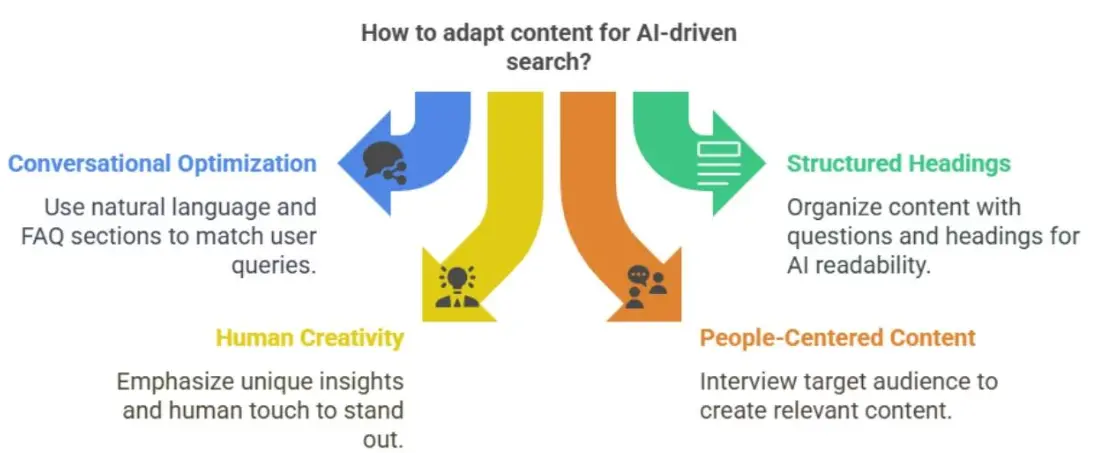
A strong AI SEO article should cover the main topic and the questions naturally associated with it.
For Google AI Overviews, related questions can include:
- What are Google AI Overviews?
- How do Google AI Overviews work?
- Can websites appear in AI Overviews?
- How do you optimize content for AI Overviews?
- Is SGE the same as AI Overviews?
- How does AI search affect SEO?
- How can businesses measure AI search visibility?
This creates topical depth without repeating the same keyword unnecessarily.
4. Use Clear Content Structure
Use descriptive headings, short paragraphs, lists, tables where useful, and direct explanations.
Avoid placing several unrelated ideas under one heading.
A clear structure can look like:
Definition → How it works → SEO impact → Optimization → Measurement → FAQs
This makes the page easier for both users and search systems to navigate.
5. Demonstrate First-Hand Expertise and Reliable Information
Google’s search systems evaluate signals related to the quality and reliability of information. Google’s documentation also notes the importance of expertise, authoritativeness, and trustworthiness in identifying high-quality content.
For this reason, content should avoid unsupported claims.
Where appropriate, include:
- Original research
- Data
- Expert insights
- Specific examples
- Author information
- References to authoritative sources
- Clear explanations of methodology
Do not add statistics simply because they make an article sound authoritative.
6. Strengthen Internal Linking
Internal links help Google and users discover related content.
For example, an article about Google AI Overviews can link naturally to pages covering:
- AI SEO
- Answer Engine Optimization
- Technical SEO
- Content optimization
- Google Search updates
- Search Console
- Entity SEO
The anchor text should describe the destination accurately rather than using generic phrases such as “click here.”
7. Make Pages Easy to Crawl and Understand
Technical accessibility still matters.
Google must be able to crawl and index the content you want to appear in Search.
Use:
- A crawlable page
- A clear canonical URL
- Descriptive title tags
- Useful headings
- Accessible content
- Mobile-friendly design
- Strong internal links
- Appropriate structured data
Google explains that structured data can help its systems understand page content and can support eligible search features.
Structured data should describe the actual content on the page. It should not be used to make unsupported claims about what the page contains.
Does Structured Data Help With AI Overviews?
Yes, Structured data can help Google understand webpage content, but there is no special schema markup that guarantees a page will appear in an AI Overview.
Google’s documentation recommends using structured data to provide specific information about webpages and help Search understand their content.
The more important priority is still the quality and accessibility of the underlying content.
Use relevant structured data when it genuinely applies to the page. Do not add markup solely because you want to trigger an AI Overview.
How Should Businesses Measure AI Overview Visibility?
Businesses should measure AI Overview visibility by tracking impressions, clicks, click-through rate, queries, and traffic from Google’s generative search features.
Google’s Generative AI performance report in Search Console provides data on how a website performs in Google’s AI search experiences. These insights can help businesses identify which queries generate AI visibility, which pages receive engagement, and where content needs further optimization.
The report can provide insights into:
- Generative AI impressions
- Pages receiving visibility
- Changes in visibility over time
- Device-level performance
- Country-level performance
- Performance across AI Overviews and AI Mode
This makes AI search measurement more practical than relying only on manual searches.
An AI Overview tracker can also be used as part of a broader SEO monitoring process to identify queries, pages, competitors, and visibility patterns. However, tracking should complement Search Console and traditional SEO analytics rather than replace them.
What Are the Benefits of Google AI Overviews?
Google AI Overviews can help users understand topics faster by providing concise, AI-generated answers directly in search results. They can:
They can:
- Summarize complex information.
- Provide direct answers.
- Combine information from multiple sources.
- Surface supporting links.
- Help users explore unfamiliar topics.
For businesses, AI Overviews create another potential discovery channel.
A website that is selected as a supporting source can receive visibility from users who may not have clicked the same page through a conventional organic listing.
At the same time, visibility should not be measured only by whether a brand appears in an AI-generated answer. Traffic, conversions, engagement, rankings, impressions, and qualified leads remain important SEO outcomes.
How Can Businesses Prepare for AI Search?
Businesses can prepare for AI search by building helpful, authoritative, and easy-to-understand content that satisfies search intent directly.
AI search should complement a strong SEO strategy, not replace it.
Key steps include:
- Clear search intent targeting.
- Direct answers.
- Complete topical coverage.
- Original insights and evidence.
- Strong internal linking.
- Technically accessible pages.
- Relevant structured data.
- Consistent content updates.
- Search Console monitoring.
- Performance analysis across traditional and generative search.
This creates content that works for users first while remaining understandable to modern search systems.
What Is the Difference Between Google AI Overviews and Traditional Search?
The main difference is how information is presented. Traditional Google Search displays a list of webpages for users to choose from, while Google AI Overviews provide an AI-generated summary that answers the query directly and links to supporting sources.
- Traditional Google Search primarily presents a set of search results that users can evaluate and visit.
- Google AI Overviews add an AI-generated layer that summarizes relevant information and provides links to supporting resources.
| Traditional Google Search | Google AI Overviews |
| Displays organic search results | Displays an AI-generated summary |
| Users browse and select webpages | Users can get a direct answer in Search |
| Focuses heavily on rankings, impressions, and clicks | Can create visibility through AI-generated citations and links |
| Presents individual webpages | Can combine information from multiple sources |
A high-quality webpage can potentially:
- Rank in traditional organic results.
- Be referenced in an AI Overview.
- Appear in AI Mode.
- Earn impressions through multiple search journeys.
The opportunity is therefore to build content that is useful across the broader Google Search ecosystem.
Recommended Read: How to Improve Brand Visibility in AI Search Engines.
Conclusion: How Should Businesses Approach Google AI Overviews?
Google AI Overviews have changed how information can be presented in Search by giving users AI-generated summaries alongside links to supporting webpages. The shift does not eliminate traditional SEO. Instead, it expands the search environment in which high-quality content can be discovered.
Businesses should focus on creating content that answers real questions directly, demonstrates expertise, provides trustworthy information, and remains technically accessible to Google.
For brands that want to improve visibility across traditional and AI-powered search, an experienced AI SEO company can help identify content gaps, optimize pages for search intent, monitor generative search visibility, and build a strategy around Google’s evolving search experience.
At ResultFirst, we combine SEO strategy with AI-focused search optimization to help businesses build content that is easier for search engines and AI-powered search experiences to understand, retrieve, and cite.
Ready to improve your visibility in Google Search and AI-powered search? Connect with ResultFirst to build an AI SEO strategy focused on measurable organic growth.
To stay ahead in this evolving AI-driven search landscape, it’s worth exploring how leading experts are adapting. In our podcast: The Future of SEO: AI-Powered Search Insights with Sam Page from Slack, we discuss how AI is redefining SEO practices and shaping the next generation of search strategies.
Statistical Resources:
- https://blog.google/intl/en-in/company-news/technology/sundar-pichai-io-2026/
- https://developers.google.com/search/blog/2026/06/gen-ai-performance-reports/
FAQ’s
WHAT TO READ NEXT
READY TO BUILD PREDICTABLE ORGANIC GROWTH?
We are the only TOP SEO services agency providing Real Results in a Real Performance model. We help growth hungry companies outperform their competition and achieve 300%+ growth in their digital marketing initiatives.
- San Jose, CA, 95120

- +1-888-512-1890

- sales@resultfirst.com

300K+
KEYWORDS RANKED
546M+
REVENUE GENERATED
18 Years
SOLVING COMPLEX SEO
150+
TEAM MEMBERS