


 sales@resultfirst.com
 +1-888-512-1890
Google’s September 2026 Spam Update is Complete

Google has completed its September 2026 spam update, closing a rollout that lasted nearly two weeks. The update began on September 24, 2026, and finished on October 8, according to Google’s Search Status Dashboard. Its 13-day, 16-hour duration made it the longest spam update of 2026 so far.
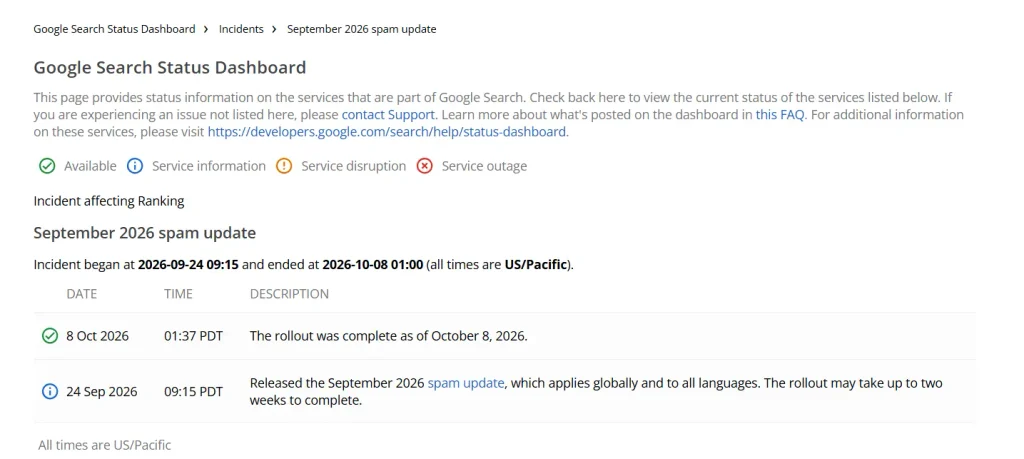
The update applies globally and across all languages. While Google confirmed the rollout’s completion, it did not announce a specific spam technique targeted by this release. Website owners should now compare their search performance before, during, and after the update to understand whether any changes are likely to persist.
What Do We Know About the September 2026 Update?
Google confirmed that the September spam update applied globally and covered all languages. At launch, the company indicated that the rollout could take up to two weeks to complete. It finished just short of that period.
Google launched the update on September 24 at 9:15 a.m. Pacific Daylight Time. Its initial announcement stated that the rollout could take up to two weeks. The process ended on October 8 at 1:00 a.m. PDT, according to the official status record.
The September update took much longer to complete than the three earlier spam updates released in 2026, as shown in this comparison:
| Rollout period | Time taken to complete |
| March 2026 update | 19 hours, 30 minutes |
| June 2026 update | 2 days, 1 hour |
| August 2026 update | 2 days, 16 hours |
| September 2026 update | 13 days, 16 hours |
Google has not explained why the September rollout lasted longer or identified the specific spam practices it addressed. Its official spam updates documentation says these updates improve automated systems that detect search spam.
How Did the Longer Rollout Affect Search Rankings?
The completion of a spam update does not mean every website will experience a ranking change. Some websites may see little movement, while others may notice changes in impressions, clicks, or organic traffic.
A slower rollout isn’t just a technical footnote. It changes how you should interpret ranking and traffic data. Early tracking from Diib, which analyzed 32,569 websites with connected Google Analytics, showed a median drop in the share of visits from unpaid Google search from 34% to 31% during the first days of the update.
More notably, 10% of sites saw their visits drop by half or more, compared with just 5% in the prior period. Diib described those findings as “an early read, not a verdict,” and the longer rollout window reinforces why patience matters.
However, these figures represent an early snapshot, not proof that the update caused every decline. The data does not establish which websites Google identified as spam.
What Should Website Owners Check After the Rollout?
Now that Google has confirmed completion, businesses can use the September 24–October 8 period as a reference for reviewing search performance.
1. Compare Google Search Console Data
Review clicks, impressions, click-through rates, and average positions before and after the rollout. Look for changes affecting specific pages, queries, or sections of your website rather than relying on overall traffic alone.
2. Review Google’s Spam Policies
Check your website against Google’s published spam policies. Pay attention to practices that attempt to manipulate rankings, including keyword stuffing, cloaking, and link spam. Also review whether your content and publishing practices comply with Google’s guidelines.
3. Avoid Reacting to Short-Term Fluctuations
A temporary drop in rankings does not automatically indicate a spam-related issue. Compare multiple days of data and check whether changes in clicks and impressions support what your ranking tracker reports. Make decisions based on sustained patterns rather than a single day’s results.
4. Focus on Long-Term Compliance
If your website has potential spam-policy violations, address them with clear, sustainable improvements. Google’s systems may take time to recognize changes, so a quick recovery should not be expected.
What Does the Completed Update Mean for SEO Strategies?
The end of the September spam update gives businesses a clearer period for evaluating performance. However, Google has not confirmed a specific target or provided evidence that every ranking change during the rollout resulted from spam detection.
This is where data-led SEO services can help businesses assess ranking movements, identify technical or content issues, and prioritize improvements based on measurable evidence. The goal should be to understand the cause of a performance change before deciding what to fix.
Instead of chasing every ranking fluctuation, website owners should focus on following Google’s policies, publishing useful content, and maintaining a consistent process for tracking organic search performance.
Keep Your Search Strategy Ready for Future Google Updates
Google’s September 2026 spam update is complete, but monitoring should continue. Compare your website’s performance across the rollout period, investigate sustained declines, and address any confirmed compliance issues before making broad changes to your strategy.
Want to understand how Google’s latest update may affect your website? Connect with ResultFirst for a data-led SEO review that can help identify potential ranking issues, assess organic search performance, and plan your next steps with confidence.
Source References:
- https://status.search.google.com/incidents/XhUDXP7A67iHCD2kmbVu
- https://status.search.google.com/incidents/XhUDXP7A67iHCD2kmbVu
- https://developers.google.com/search/docs/essentials/spam-policies
- https://diib.com/start/insights/google-september-2026-spam-update-early-data/
- https://developers.google.com/search/docs/essentials/spam-policies/
WHAT TO READ NEXT
READY TO BUILD PREDICTABLE ORGANIC GROWTH?
We are the only TOP SEO services agency providing Real Results in a Real Performance model. We help growth hungry companies outperform their competition and achieve 300%+ growth in their digital marketing initiatives.
- San Jose, CA, 95120

- +1-888-512-1890

- sales@resultfirst.com

300K+
KEYWORDS RANKED
546M+
REVENUE GENERATED
18 Years
SOLVING COMPLEX SEO
150+
TEAM MEMBERS