



 sales@resultfirst.com
 +1-888-512-1890
Google Rolls Out February 2026 Discover Core Update: What You Need to Know

Google has rolled out a new Discover-focused core update in February 2026, and this one isn’t about traditional search rankings. Instead, it targets how content appears in Google Discover, the personalized content feed many users see on mobile devices.
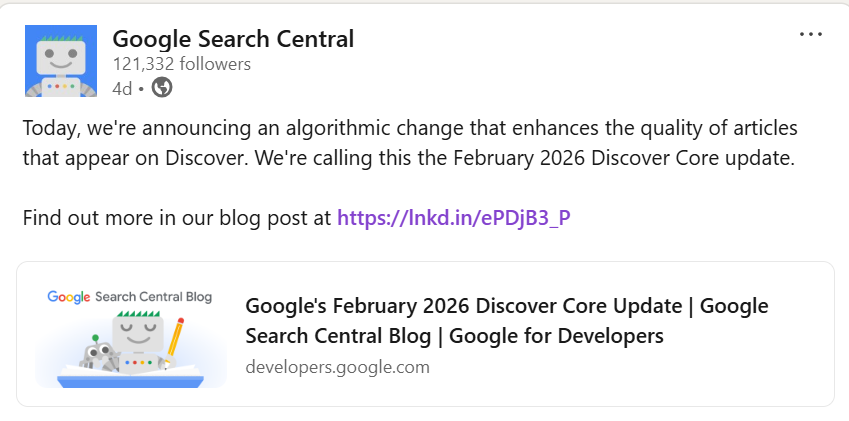
Source: Google LinkedIn
According to Google, this is a broad systems update designed to improve how articles are selected and displayed in Discover. The rollout has started for English-language users in the United States and is expected to expand globally over the coming months. Google says the full rollout could take up to two weeks.

If Discover is a meaningful traffic source for your site, this update is worth paying attention to.
What’s changing in Google Discover
Google says the update improves the Discover experience in several key areas. In simple terms, it focuses on relevance, quality, and credibility.
1. Stronger focus on local relevance
One of the biggest changes is how Google evaluates location-based relevance. Discover will now prioritize content from websites based in the same country as the user.
For example:
- U.S. users are more likely to see content from U.S.-based publishers
- Content from international sites targeting U.S. audiences may see reduced visibility
Google notes that this impact may decrease as the update expands to more countries and languages.
2. Less room for clickbait and sensational content
Google is also dialing back the visibility of:
- Sensational headlines
- Overly dramatic framing
- Click-driven content with limited substance
The goal is to surface content that informs rather than provokes. Articles designed mainly to grab attention without delivering real value may struggle to perform in Discover after this update.
3. Greater emphasis on topic-level expertise
Another important shift is how Google evaluates expertise. Instead of judging a site as a whole, Discover now looks at expertise on a topic-by-topic basis.
Source: Search Engine Land
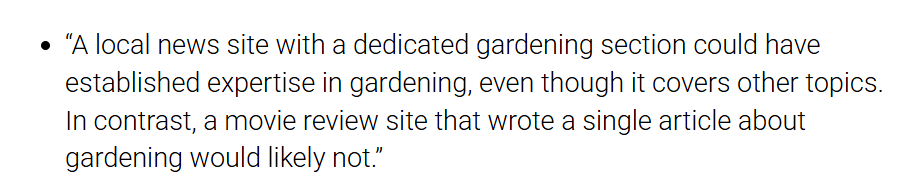
Google shared an example to clarify this approach:
- A local news website with a well-established gardening section may be recognized as authoritative in gardening
- A movie review site that publishes a single gardening article is unlikely to be treated as an expert source on that topic
“Since many sites demonstrate deep knowledge across a wide range of subjects, our systems are designed to identify expertise on a topic-by-topic basis. So whether a site has expertise in multiple areas or has a deep focus on a single topic, there’s equal opportunity to show up in Discover. For example, a local news site with a dedicated gardening section could have established expertise in gardening, even though it covers other topics. In contrast, a movie review site that wrote a single article about gardening would likely not.” (Google)
This means smaller or multi-topic sites can still perform well in Discover if they consistently publish high-quality content within specific subject areas.
Personalization still plays a role
Despite these changes, Discover remains personalized. Google will continue showing content based on:
- User interests
- Preferred creators and sources
- Past engagement behavior
Any site can appear in Discover, whether it covers multiple topics or focuses on a single niche, as long as it demonstrates depth and consistency where it matters.
Expect traffic fluctuations
Google is clear that publishers should expect some volatility.
Some websites may see:
- Increased Discover traffic
- Decreases in visibility
- No noticeable change at all
Fluctuations are normal with Discover updates and do not necessarily indicate a problem with your site.
Rollout timeline
Google said the update is rolling out first to English-language users in the United States and will gradually expand to additional countries and languages in the coming months.

- Initial release: English-language users in the U.S.
- Expansion: Additional countries and languages over the coming months
- Estimated rollout time: Up to two weeks per phase
Why this update matters
For publishers who rely on Discover traffic, this update reinforces a familiar message:
original, timely, and well-researched content performs best.
Google says internal testing showed users found Discover more useful and more engaging after these changes. The update aligns with Google’s ongoing effort to reward depth, reduce noise, and surface content from sources that demonstrate real knowledge in their field.
If your site already focuses on:
- Clear topical authority
- Honest headlines
- Locally relevant context
- Consistent publishing within key subject areas
You may benefit from this update or at least avoid negative impact.
Google recommends following its general core update guidance and reviewing its official “Get on Discover” documentation if traffic changes occur.
If Google Discover is an important traffic channel for your site, this update reinforces how closely Discover visibility is tied to core SEO fundamentals—topical authority, content quality, and consistency over time. As a full-service SEO services agency, ResultFirst helps brands strengthen these foundations through data-driven SEO and content strategies that support sustainable visibility across Search and emerging surfaces like Discover. If you’re assessing how updates like this may influence your traffic, our team can help you identify where to focus next.
Check Out Previous Core Updates
If you’re tracking how Google’s systems continue to evolve, you may also find these recent updates helpful:
WHAT TO READ NEXT
READY TO BUILD PREDICTABLE ORGANIC GROWTH?
We are the only TOP SEO services agency providing Real Results in a Real Performance model. We help growth hungry companies outperform their competition and achieve 300%+ growth in their digital marketing initiatives.
- San Jose, CA, 95120

- +1-888-512-1890

- sales@resultfirst.com

0K+
KEYWORDS RANKED
0M+
REVENUE GENERATED
0 Years
SOLVING COMPLEX SEO
0+
TEAM MEMBERS