


 sales@resultfirst.com
 +1-888-512-1890
SaaS Technical SEO: Checklist for Scalable Growth

You built a great SaaS product. You have a clean UI. You have paying users. But your website sits on page three of Google. That hurts. Most SaaS founders focus on product and ignore the engine that brings users to the door. That engine is technical SEO for SaaS. It ensures your platform is structured, fast, and crawlable so search engines can consistently discover, index, and rank your product pages at scale. It works quietly in the background. It fixes the things Google cannot read. It clears the path between your product and the people searching for it. And when done right, it becomes one of the most powerful growth channels you will ever own.
This guide walks you through a practical checklist built for scale.
Why Technical SEO Hits Different for SaaS Companies
SaaS websites are not like regular websites. They grow fast. They have dynamic pages. The website contains all its content through its login portals, dashboards, feature pages, pricing tiers, and blog content. That complexity creates problems that basic SEO advice does not solve.
SaaS technical SEO deals with those exact problems. It makes sure Google can crawl every important page. It makes sure duplicate content from dynamic URLs does not split your ranking power. It makes sure your site speed does not push a trial user away before they even read your headline.
Here is what makes SaaS sites unique from an SEO standpoint:
- Dynamic URL structures that generate thousands of indexable pages
- App subdomains like app.yourproduct.com that confuse crawlers
- Thin feature pages that target high-intent keywords but carry low content value
- Frequent product updates that change page structure without an SEO review
- Gated content behind login walls that search engines cannot access
The Cost of Ignoring Technical SEO Early
Many SaaS startups treat SEO as a marketing channel they will get to later. That decision costs them compounding traffic they can never recover. Every month without a crawlable site structure is a month Google fails to trust your domain. Every duplicate product page splits your link equity. Every uncompressed image adds load time that pushes users away.
The truth is this: the benefits of technical SEO for SaaS startups show up slowly, but they never stop compounding. The content of your website will generate value for many years to come when you establish your main elements from the beginning.
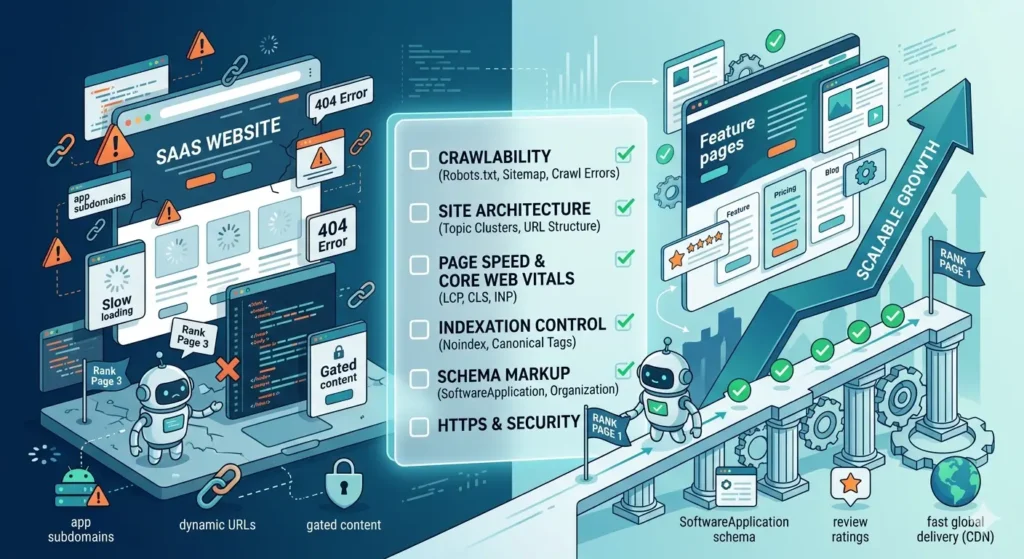
Image Source: Gemini
Crawlability: Make Sure Google Can Actually Read Your Site
Before Google ranks your pages, it has to read them. If Googlebot hits errors or gets blocked by poor configuration, your pages do not exist in Google’s eyes.
Start with these crawlability essentials:
- Audit the robots.txt file: Check to ensure that it doesn’t block any critical sections, such as your features or pricing pages.
- Check your XML sitemap: it should include only canonical live URLs with a 200 status code
- In Google Search Console, Fix crawl errors: 404 errors and redirection chains consume the crawl budget.
- Avoid crawl traps: A crawl trap includes an infinite pagination loop or a faceted navigation scheme, which feeds into an endless list of URLs that GoogleBots can’t keep up with.
How Internal Linking Shapes Crawl Depth
Internal linking is not just a UX feature. It is how you tell Google which pages matter most. SaaS sites often have deep pages with zero internal links pointing to them. Googlebot never finds them. They never rank.
Build a logical internal link structure. Link your homepage to core feature pages. Link your blog posts to relevant landing pages. Link your comparison pages to your pricing page. Every link you add is a path you open for Google to walk.
Site Architecture: Build a Structure That Scales With Your Product
Your site architecture is the skeleton of your SEO strategy. A weak skeleton cannot hold weight as your content grows. A strong one makes every new page you publish easier to rank.
Follow these architecture principles for SaaS:
- Group content by topic cluster to develop pillar pages, which need core theme content to function as their main support materials.
- The website needs to maintain all essential pages within three clicks from its main page because Google assigns a lower value to pages that exist beyond three clicks from the homepage.
- The system requires you to use flat URL structures with example.com/feature-name as the preferred format over example.com/category/subcategory/feature-name.
- Your blog should be a separate section from your product pages because slugs that mix content types will confuse users about their intended purpose.
Strong site architecture also helps users. When someone lands on your pricing page, they should find a path to your feature pages. When they read a blog post, they should find a related case study. Architecture serves both Google and the humans making buying decisions.
Page Speed and Core Web Vitals: Speed Is a Ranking Signal
Google Core Web Vitals functions as a direct element for determining website rankings. SaaS websites that implement substantial JavaScript frameworks show low performance in this area. Slow sites lose rankings, and they lose trial signups.
The three Core Web Vitals to nail are:
- The Largest Contentful Paint (LCP) test measures the main content loading speed, which should complete within 2.5 seconds.
- Cumulative Layout Shift (CLS) testing measures your page layout stability during the rendering process. You should achieve a score below 0.1.
- The Interaction to Next Paint (INP) test measures page response time to user input. The target response time should be below 200 milliseconds.
To improve these scores:
- Compress and convert images to WebP format
- You should reduce the amount of JavaScript and CSS that stops content from displaying to users.
- The implementation of a content delivery network (CDN) will improve global asset delivery speed.
- Enable browser caching for static resources.
Speed improvements do not just help rankings. They improve trial conversion rates. The research shows that each second of page load delay decreases the conversion rate by 7 percent. The business loses actual income due to those unclaimed earnings.
Indexation Control: Tell Google What to Rank and What to Ignore
Not every page on your SaaS site deserves to rank. Login pages, thank-you pages, internal search result pages, and duplicate feature variations should stay out of Google’s index. Sending the wrong signals wastes your crawl budget and dilutes your domain authority.
Use these indexation controls strategically:
- Noindex tags should be applied to every page that requires complete Google search engine exclusion.
- Canonical tags serve to direct duplicate content, which exists as near-duplicate pages to the selected page that you wish to achieve search engine ranking.
- Hreflang tags provide Google with information about which version of your content to display in different countries when your website supports multiple languages and regional variations.
- Parameter handling: set URL parameters in Google Search Console to prevent duplicate indexation from tracking UTMs or session IDs
Handling Dynamic Content and SaaS App Pages
Many SaaS platforms generate pages dynamically. A project management tool might create a unique URL for every workspace template. A CRM might generate pages for each integration partner. Left unchecked, these URLs multiply into thousands of thin pages that dilute your authority.
The fix is clean. Decide which dynamic pages carry real search intent. Canonicalize or noindex the rest. Build dedicated landing pages for your top integration partners and let those rank with real content behind them. SEO for SaaS ensure dynamic page growth is controlled while concentrating authority on high-intent pages that actually drive qualified traffic and conversions.
Schema Markup: Give Google Richer Context About Your Pages
Schema markup is structured data that helps Google understand what your page is about beyond the text on it. SaaS companies underuse this tool consistently.
Add these schema types to your SaaS site:
- Organization schema: name, logo, contact info, and social profiles
- SoftwareApplication schema: pricing, platform, rating, and category for your product
- FAQPage schema: expands your listing in search results with question-and-answer pairs
- Review schema: pulls in star ratings from your G2 or Capterra reviews
- BreadcrumbList schema: shows your URL path structure directly in search results
Schema markup does not guarantee ranking. However, it increases your click-through rate because it makes your listing more visually appealing in Google search results.

Image Source: Yandex
HTTPS and Security: A Non-Negotiable for SaaS Trust
Google treats HTTPS as a vital ranking signal. But more importantly, your users expect a secure connection when they sign up for your product. A non-HTTPS SaaS site loses trust before a user even reads your copy.
- Redirect all HTTP pages to HTTPS with a 301 permanent redirect
- Fix mixed content warnings where HTTP resources load on HTTPS pages
- Check that your app subdomain also runs on HTTPS
- Validate that your sitemap uses HTTPS URLs throughout
Security signals matter even more for SaaS because you handle user data. A padlock in the browser bar is basic hygiene at this point.
Mobile Optimization: Your Users Search on Their Phones
Google indexes the mobile version of your site first. This is called mobile-first indexing. If your SaaS site looks broken on a phone, your rankings suffer even if your desktop version looks perfect.
Check these mobile optimization points:
- Make buttons and CTAs large enough for touchscreen interaction
- Avoid interstitials and pop-ups that block content on mobile
- The Mobile-Friendly Test tool from Google needs to be used for testing your website.
- Check that your mobile load time meets Core Web Vitals thresholds.
Most SaaS buyers research tools on a desktop before buying. But they also search on mobile during commutes, meetings, and late-night scroll sessions. Meeting them where they are makes the difference.
Learn More: Mobile SEO: Best Practices and Tips
How SEO Services for SaaS Drive Real Business Outcomes
Growing SaaS companies often reach a point where internal teams cannot keep up with technical debt. That is where SEO services for SaaS come in. A specialized SEO partner brings three things that in-house teams often lack.
First, they bring dedicated bandwidth. Technical audits, log file analysis, structured data implementation, and crawl budget management take real time. Second, they bring tools. Third, they bring pattern recognition. An agency that has worked with ten SaaS companies has already seen the crawl architecture mistakes your team is about to make.
The ROI on professional SEO services for SaaS is straightforward. Organic traffic has the lowest customer acquisition cost of any channel. It scales without increasing ad spend. It works while your sales team sleeps.
The Full Technical SEO Checklist for SaaS Growth
Print this. Save it. Review it quarterly.
Crawlability
- Robots.txt allows access to key pages
- The XML sitemap is clean and submitted to Search Console
- No crawl traps from infinite pagination
- Crawl errors resolved in Google Search Console
Architecture
- Topic cluster structure in place
- Key pages are within three clicks of the homepage
- Flat and logical URL structure
- Blog and product pages are clearly separated
Speed and Core Web Vitals
- LCP under 2.5 seconds
- CLS under 0.1
- INP under 200 milliseconds
- Images compressed and served in WebP
- CDN in place
Indexation
- Noindex tags on non-ranking pages
- Canonical tags on duplicate content
- Dynamic pages are controlled and audited
- Hreflang implemented for multi-region sites
Schema and Structured Data
- Organization schema live
- SoftwareApplication schema live
- FAQPage schema on relevant pages
- Review schema pulling in ratings
Security
- HTTPS across all pages and subdomains
- 301 redirects from HTTP to HTTPS
- Mixed content warnings resolved
Mobile
- Responsive design tested across devices
- Buttons and CTAs usable on touchscreen
- No intrusive interstitials on mobile
Conclusion: Build the Foundation That Compounds Over Time
Technical SEO for SaaS is not a one-time task. It is a system. You build it once. You maintain it quarterly. And it pays you back in organic traffic, lower CAC, and sustainable growth for years. The changes you implement today will eliminate existing website obstacles that were causing performance issues, according to Google’s assessment. Each accessible webpage you create functions as a new opportunity for potential customers to enter your business. Your audit process should begin at this point. First, address the urgent problems before you begin to complete the checklist section by section. The compounding rewards of getting this right are worth every hour you invest.
Turn Your SEO Into a Revenue Engine With ResultFirst
Fix your technical SEO and unlock scalable growth with ResultFirst. We help SaaS brands improve site structure, speed, and crawlability so search engines can rank them consistently. We go beyond audits. We implement, optimize, and scale what works using real performance data. The result is a faster site, better visibility, and a steady flow of high-intent users ready to convert. Start now and build an SEO system that keeps delivering long-term growth.
FAQs
WHAT TO READ NEXT
READY TO BUILD PREDICTABLE ORGANIC GROWTH?
We are the only TOP SEO services agency providing Real Results in a Real Performance model. We help growth hungry companies outperform their competition and achieve 300%+ growth in their digital marketing initiatives.
- San Jose, CA, 95120

- +1-888-512-1890

- sales@resultfirst.com

300K+
KEYWORDS RANKED
546M+
REVENUE GENERATED
18 Years
SOLVING COMPLEX SEO
150+
TEAM MEMBERS