



 sales@resultfirst.com
 +1-888-512-1890
What Claude Can Actually Do for Your SEO (And Why That Still Is Not Enough)

There is a conversation happening inside almost every enterprise marketing team right now. Someone runs a Claude prompt, gets a technical SEO audit back in four minutes, and asks the obvious question: “Do we still need an agency?”
It is a fair question. And the honest answer has more layers to it than most agencies will admit.
Claude has become genuinely capable at specific SEO tasks. It can crawl a page, identify schema gaps, flag thin content, score your entity authority, and even run a basic GEO check to assess whether your brand would get cited by large language models. For individual pages or small sites, a skilled in-house practitioner with the right setup can get real work done with it.
But enterprise SEO is not a set of individual pages. And eCommerce at scale is not a content problem. It is a systems problem. That distinction matters more than most brands currently realize.
Where Claude Genuinely Delivers in SEO
Before getting into limitations, it is worth being direct about what Claude can do well. This matters because understanding the tool is exactly what helps enterprise teams make better decisions about how to use it.
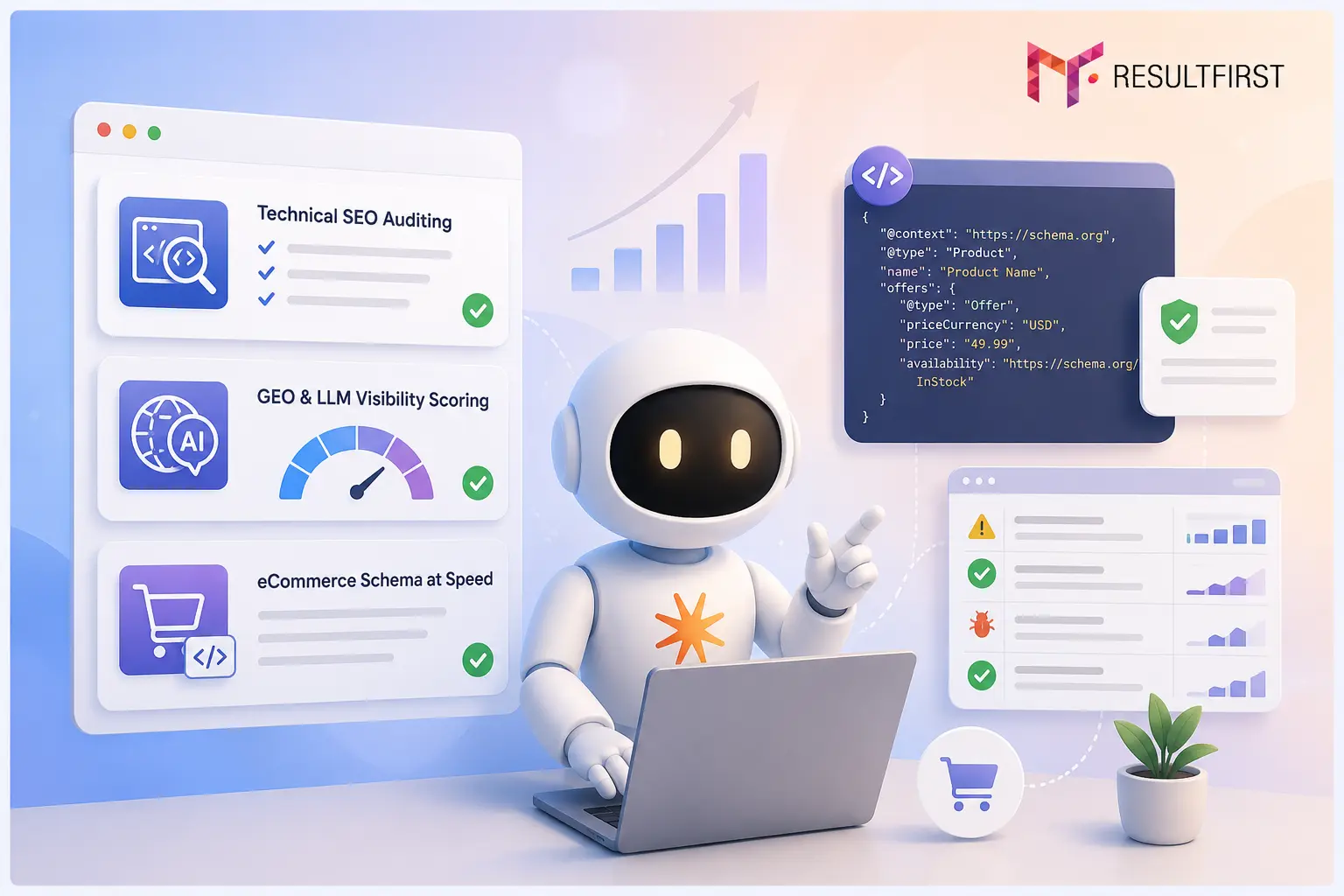
Technical SEO Auditing
Claude processes large documents with accuracy that other tools often miss. Upload a full crawl report, a content audit, or an existing schema file and it will return structured analysis rather than surface-level summaries. For technical tasks specifically, it generates valid schema markup, builds regex patterns for URL rewrites, and identifies crawl issues at a level that previously required specialist time.
A 2026 review of Claude’s SEO capabilities noted that technical SEO is where the tool consistently delivers its strongest results, particularly for code-level tasks like schema generation and site architecture analysis (Stridec, April 2026).
GEO and LLM Visibility Scoring
This is the newer capability that has attracted the most attention. Claude-based SEO skills can now run what is called a GEO audit: scoring a site for its likelihood of being cited by large language models across ChatGPT, Perplexity, Google’s AI Overviews, and Claude itself. The audit flags missing author attribution, weak entity signals, absence of FAQ schema, and content structure that fails the readability tests LLMs use when deciding what to cite.
For a single brand audit, this is genuinely useful. The output gives a directionally accurate picture of where a site stands in the current search environment.
eCommerce Schema at Speed
For product-focused businesses, Claude can generate Product, Offer, AggregateRating, and BreadcrumbList schema at a pace that manual processes cannot match. It validates markup against current standards, flags deprecated schema types, and produces clean JSON-LD that can be pushed directly into a product catalog workflow. Understanding which schema types matter most for eCommerce visibility is something our eCommerce SEO audit checklist covers in detail.
The Numbers Behind the Urgency
Here is why none of the above is optional for enterprise and eCommerce brands anymore.
Between November 2024 and November 2025, organic search traffic to more than 2,500 monitored sites dropped by 33% globally and by 38% in the United States (Mirakl, 2026). That is not a Google algorithm story. That is a behavioral shift. Shoppers and buyers are beginning their research conversations inside ChatGPT, Perplexity, and Claude, and they are often reaching conclusions before they ever open a browser tab.
Gartner projected that traditional search engine volume would decline by 25% by 2026 due to the shift toward conversational search platforms. That projection is now being validated in live traffic data across multiple industries (Mersel AI, 2026).
For enterprise brands, the hit is particularly sharp on informational queries. Ahrefs analyzed 300,000 keywords and found that position-one organic click-through rates fell from 1.41% to 0.64% on pages where Google’s AI Overviews appeared, an effective 54% drop (Ahrefs, via GoodFirms AI SEO Statistics, 2026). Pew Research confirmed this pattern in a separate study of 900 US adults, finding that click rates on traditional results fell from 15% to 8% when an AI summary was present above them (Pew Research Center, March 2025).
What makes this harder to manage is that the rules for appearing in AI answers are not the same as the rules for ranking on Google. By February 2026, the overlap between top-10 organic rankings and AI Overview citations had collapsed from 75% in mid-2025 to between 17% and 38% (Mersel AI, 2026). High rankings no longer guarantee AI visibility. And for eCommerce brands managing thousands of product pages, that gap is not theoretical. It is a revenue problem that most analytics dashboards are not yet set up to surface.
What Claude Cannot Do on Its Own (And Why That Gap Matters)
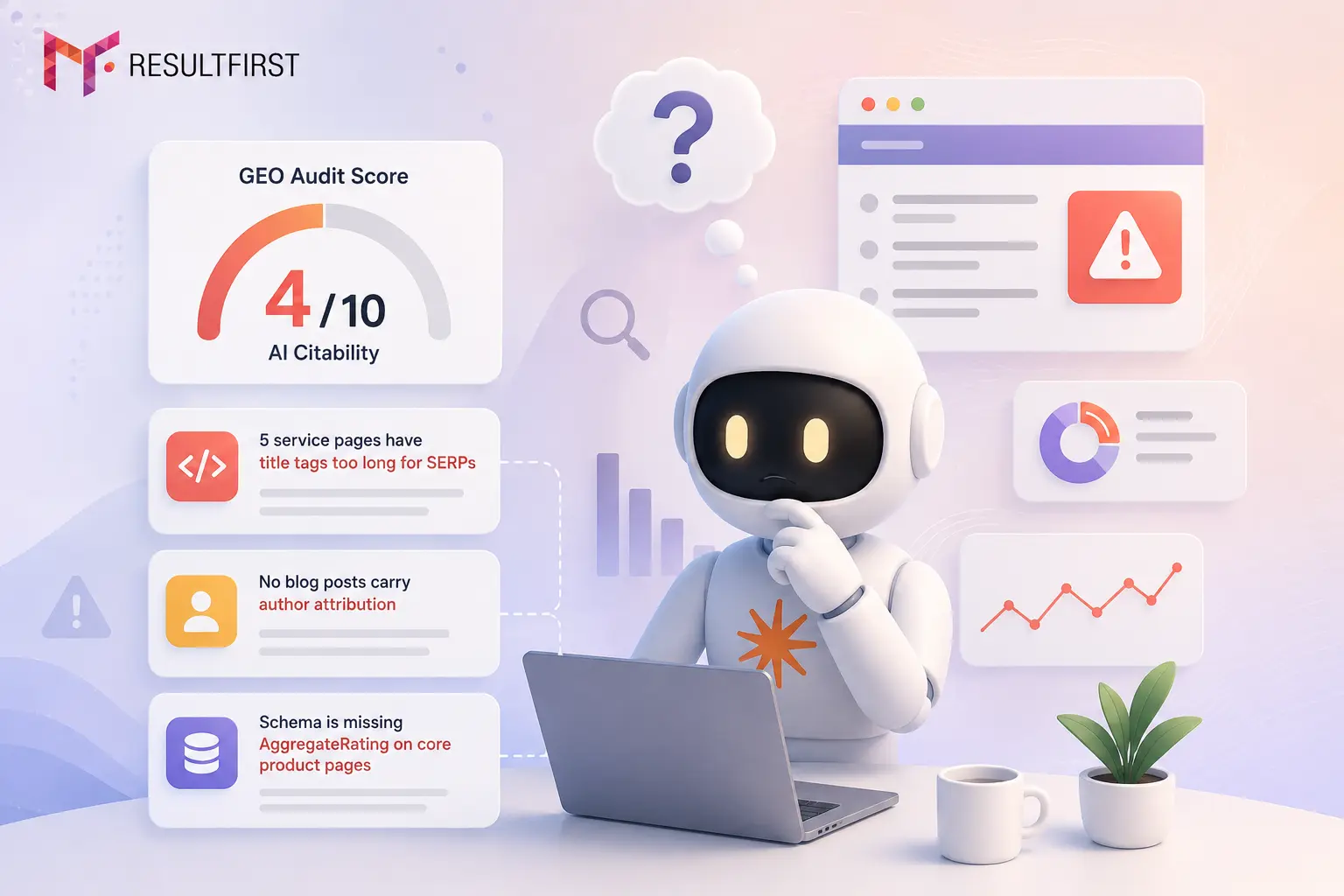
Claude the tool, running a GEO audit, gives you a score. It tells you that your site scored a 4/10 for AI citability. It identifies that five service pages have title tags too long for SERPs, that no blog posts carry author attribution, and that your schema is missing AggregateRating on core product pages.
What it cannot do is fix any of it at scale.
For a site with 50,000 product SKUs, schema remediation is not a prompt task. It is a data architecture task. It requires working across product information management systems, development pipelines, and content teams simultaneously. The output from a Claude audit is the starting point, not the solution.
The same applies to entity authority building, which is increasingly the primary driver of whether an LLM cites your brand. SE Ranking data from 2025 showed that sites with over 1.16 million monthly visitors earned an average of 6.4 LLM citations per relevant query, while sites with fewer than 3,000 monthly visitors earned only 2.4 (SE Ranking, via AI Search Statistics 2026). Domain authority and brand signal strength still matter for AI visibility, but building those signals is a sustained, multi-channel effort that does not happen inside a single audit window.
The complexity multiplies fast at enterprise scale. Consider what a full Claude SEO skill covers in practice: technical SEO, E-E-A-T compliance, schema generation and validation, GEO scoring, backlink gap analysis, semantic clustering, local SEO signals, and eCommerce-specific optimizations including product data structure and dynamic page performance (GitHub / claude-seo project, 2026). That list represents months of execution work for a brand operating at scale, not a single deliverable.
For eCommerce teams managing seasonal catalogs, cross-border sites, or marketplace integrations, the execution surface is even larger. Research published in late 2025 formalized the eCommerce GEO benchmark, confirming that most enterprise product detail pages currently score average or below on generative engine readiness. Knowing that score and closing that gap are two entirely different problems. The technical requirements behind closing that gap for large catalogs are covered in our enterprise SEO guide.
What Actually Moves the Numbers
The case data from brands that have invested in structured GEO and LLM visibility programs points to outcomes that cannot be achieved through tooling alone.
A B2B technology client documented by The Optimist content agency achieved a 4,900% revenue increase and 2,622% traffic growth from LLM-referred sources over a 14-month engagement (Stackmatix GEO Case Study Review, 2026). The methodology centered on first-party research as a consistent content pillar, structured data implementation, and consistent entity-building across owned and earned channels.
A separate case for a brand called Farringdons, documented in the Digital Agency Network’s 2026 GEO case study compilation, showed a 140% increase in LLM-driven search traffic and a 62% rise in AI mentions within a short engagement window (Digital Agency Network, 2026). The work was grounded in aligning traditional SEO signals with AI citation requirements, not in running tools but in executing a coordinated strategy across content, structure, and authority.
According to the foundational academic study on GEO from Princeton, Georgia Tech, and IIT Delhi, published in 2024 and updated through 2026, websites that applied structured GEO strategies saw citation visibility in AI-generated responses improve by up to 40% compared to baseline content (GEO: Generative Engine Optimization, Princeton et al., via Stackmatix, 2026).
None of these results came from running a tool. They came from sustained execution of a strategy built around what LLMs actually reward: structured clarity, demonstrated authority, original data, and consistent brand signals across multiple surfaces.
The Forward Picture: 2026 and Beyond
The brands most at risk over the next three years are not the ones without access to Claude or GEO auditing tools. Those are now accessible to almost anyone. The brands most at risk are the ones that mistake access to information for a strategy.
By early 2026, 86% of enterprise SEO teams had integrated some form of AI into their workflow, and 82% planned to increase that investment (Marketing LTB, 2026). The tools are table stakes. What separates results is the capacity to act on what those tools surface.
The trajectory from here moves in a direction that makes execution harder, not easier. AI Overviews are projected to appear in the majority of all Google searches as coverage continues to expand. The zero-click rate in Google’s AI Mode already sits at 93% for certain query types (Mersel AI, 2026). That number does not mean organic SEO is dead. It means the brands that show up in AI answers are capturing attention at the top of the funnel, while brands that are absent are being filtered out before buyers ever reach a consideration stage.
For eCommerce specifically, LLM visitors who do arrive convert at 4.4 times the rate of standard organic search visitors, according to Semrush data from July 2025 (Position Digital / AI SEO Statistics, 2026). The volume of LLM-referred traffic is still growing, and the quality of that traffic when it arrives is measurably higher. The opportunity is real. But capturing it requires operational infrastructure that goes well beyond an audit.
Looking ahead to 2027 and 2028, the next layer of complexity arrives with multimodal search, voice-integrated LLM queries, and conversational commerce agents that recommend products directly inside chat interfaces. eCommerce brands that have not built the structured data foundation and brand entity authority by then will face a much steeper climb. The window to build these foundations at reasonable cost and competitive advantage is open now, not later. Our piece on enterprise technical SEO outlines how teams should be thinking about crawl architecture and structured data readiness in this environment.
The Honest Case for Working with a Performance SEO Partner
Here is what a Claude-powered SEO audit tells an enterprise marketing leader: the gaps exist, the scope is real, and the remediation requires coordination across technical, content, and authority-building workstreams simultaneously.
What it does not tell them is who will do the work, how long it will take, how it will be prioritized across a 50,000-page site, and how progress will be measured against revenue outcomes rather than vanity metrics.
That is the agency’s job. Not to run the audit, but to turn the audit into a compounding growth program.
ResultFirst’s pay-for-performance SEO model was built around exactly this reality. You do not pay for reports. You pay for rankings, traffic growth, and the downstream revenue those rankings produce. That model makes sense in a world where the difference between knowing and doing has never been more expensive.
For enterprise brands managing complex site architectures, the enterprise SEO services at ResultFirst are built to handle the execution layer that tools cannot reach: coordinating schema implementation across development teams, building entity authority through content programs, managing GEO and LLM visibility alongside traditional search performance, and tracking all of it against revenue rather than impressions.
For eCommerce teams watching organic traffic erode while their product catalog grows, the eCommerce SEO services address the structural data challenges that determine whether a product gets recommended by an LLM or disappears from the consideration set entirely.
Claude is a strong tool. GEO audits are necessary. But tools produce outputs. Agencies produce outcomes. And in a search environment where the rules shifted faster in the last 18 months than in the previous decade, the distance between those two things is where growth is either won or lost.
Where to Start
If you are running a brand with more than 10,000 pages and you have not yet audited your LLM citability, the first step is understanding where you actually stand. Not through a generic tool run, but through a structured assessment that connects your current schema coverage, entity authority signals, and content architecture to the specific citation patterns of the platforms your buyers are using.
That assessment looks different for every site. A legal services brand needs different signals than a B2C retailer. A SaaS platform optimizing for developer audiences is being evaluated differently by Claude than a consumer goods brand chasing lifestyle queries on Perplexity.
The performance SEO team at ResultFirst works with brands at this level of specificity, connecting AI visibility to measurable traffic and conversion outcomes. If your analytics are starting to show the patterns described in this piece, the right move is a conversation, not another tool run.
Sources referenced:
- Stridec: How to Use Claude AI for SEO, Complete Platform Guide (April 2026)
- Mirakl: What is eCommerce GEO? (2026)
- Mersel AI: Why Is Organic Traffic Declining in 2026?
- GoodFirms: AI SEO Statistics, AI Search Rankings and Zero-Click Trends (2026)
- Track My Visibility: AI Search Statistics 2026
- arXiv: E-GEO, A Testbed for Generative Engine Optimization in E-Commerce (November 2025)
- Stackmatix: AEO and GEO Case Studies, Real Results and Proven Strategies (2026)
- Digital Agency Network: GEO Case Studies (2026)
- Marketing LTB: GEO Statistics 2026
- Position Digital: AI SEO Statistics 2026
- GitHub / claude-seo: Universal SEO Skill for Claude Code
WHAT TO READ NEXT
READY TO BUILD PREDICTABLE ORGANIC GROWTH?
We are the only TOP SEO services agency providing Real Results in a Real Performance model. We help growth hungry companies outperform their competition and achieve 300%+ growth in their digital marketing initiatives.
- San Jose, CA, 95120

- +1-888-512-1890

- sales@resultfirst.com

300K+
KEYWORDS RANKED
546M+
REVENUE GENERATED
18 Years
SOLVING COMPLEX SEO
150+
TEAM MEMBERS