



 sales@resultfirst.com
 +1-888-512-1890
How to Get Your Blog to Generate Pipeline, Not Just Traffic

Most marketing blogs hit record traffic. Yet the sales pipeline stays empty. This is the single biggest frustration for marketing leaders today. Traffic feels like progress. It looks good in dashboards. But a visitor who reads your blog and leaves is not a lead. They are a missed opportunity. In fact, 43% of B2B marketers track website traffic as their primary top-of-funnel metric, while only 42% track revenue generated, a gap that explains why so many blogs look successful on paper but produce nothing in the pipeline. The real goal is not page views. The real goal is the pipeline. And the pipeline starts when you stop writing for everyone and start writing for buyers. Yet 60% of the content produced by B2B marketers goes completely unused, not because there isn’t enough of it, but because it was never built to convert. This guide gives you a practical step-by-step system to turn your blog into a revenue-generating machine.
Your Blog Doesn’t Have a Traffic Problem: Here’s What It Actually Lacks
Here is the uncomfortable truth. Most blogs are not failing because of traffic. They are failing because the traffic they attract has zero intent to buy. You rank for broad informational keywords. You pull in thousands of readers. And then nothing happens. The funnel leaks before it even starts.
1. Shift from informational to commercial intent.
The fix starts with the keywords you chase. Informational keywords like “what is a CRM” bring curiosity seekers. Commercial and transactional keywords bring buyers.
- Target long-tail keywords with purchase signals like “best CRM for B2B SaaS companies.”
- Go after “vs” and “comparison” searches; these readers sit in the evaluation stage.
- “Pricing” and “alternative to” searches show high-purchase intent
- Use “best [product type] for [specific use case]” as your keyword formula
The search volume on these terms is lower. The conversion rate is dramatically higher. Every post you write around a commercial keyword brings in readers who are already thinking about buying.
Tip: Pull your top 10 blog posts by traffic right now. Check how many target commercial or transactional keywords. If the answer is fewer than three, you have found your biggest pipeline leak.
Once you fix the intent problem, the next step is making sure your content serves buyers at every stage of their journey.
2. Build a Full-Funnel Blog: Not Just a Content Library
Most blogs live entirely at the top of the funnel. They educate. They inform. They generate awareness. But they never push a reader to take the next step. A pipeline-driven blog covers every stage of the buyer journey, from problem recognition to final decision. In fact, 55% of B2B marketers say it’s hard to create content that actually leads to a conversion action like a sign-up or demo request, a clear sign that most blogs aren’t built with the full funnel in mind.
Map every post to a funnel stage.
Think of your blog as a three-floor building. Each floor has a specific job.
- Top of funnel (awareness): Educational posts that name the problem your buyer faces
- Middle of funnel (consideration): Comparison guides and solution-focused content that position your approach
- Bottom of funnel (decision): Case studies, ROI calculators, and success stories that prove you deliver results
Most blogs are 80% TOFU and 20% everything else. Flip that ratio for the content you publish next quarter. Decision-stage content has a direct line to the pipeline. A case study about a $2M deal your product helped close is worth ten “what is X” blog posts. Research backs this up: 49% of B2B SaaS marketers say case studies are very effective at generating sales, compared to just 10% who say the same about standard blog posts.
Internal linking ties the building together. Every TOFU post should point to an MOFU resource. Every MOFU post should link to a case study or product page. Guide the reader floor by floor; do not make them find the elevator on their own.
With the right funnel structure in place, now you need to give readers a reason to raise their hand before they leave your page.
3. Stop Using Generic CTAs: They Are Killing Your Conversions
You spent hours writing a brilliant post. The reader reaches the end. They see a button that says “Subscribe to our newsletter.” And they leave. Generic calls to action are one of the biggest conversion killers in B2B content marketing.
Every post should have a CTA that matches the specific problem discussed in that post. A reader who just spent eight minutes learning about sales pipeline management does not want a newsletter. They want the next logical step in solving that exact problem.
Use context-driven CTAs at three points in every post
- Mid-article soft CTA: A natural link to a relevant resource or product example placed when reader engagement is at its peak
- End-of-article CTA: A clear next step tied to the post topic, demo request, guide download, or free audit
- Exit-intent pop-up: A targeted offer triggered when a user moves to leave, turns a bounce into a lead capture
The keyword here is contextual. A post about email marketing should CTA to an email audit. A post about revenue forecasting should CTA to a revenue calculator. Relevance drives clicks. Clicks drive pipeline.
Test this week: Pick your top traffic post. Replace the generic CTA with one that directly relates to the post topic. Watch your conversion rate on that page change within 30 days.
Now that you have contextual CTAs, you need something worth converting on. That is where gated content upgrades come in.
4. Turn Every Blog Post Into a Lead Magnet Machine
A content upgrade is a downloadable resource that directly extends the value of the post a reader just finished. It is specific. It is immediately useful. And it is worth giving an email address for.
The formula is simple. The post solves a problem. The content upgrade gives readers a ready-to-use tool to implement the solution.
- Post about building a content calendar → Upgrade is a ready-made content calendar template.
- Post about improving email open rates → upgrade is a subject line swipe file with 50 examples.
- Post about pricing strategy → Upgrade is a pricing comparison worksheet
- Post about sales pipeline management → Upgrade is a pipeline audit checklist
This works because the reader already demonstrated interest by reading the post. The content upgrade is the natural next step. They get immediate value. You get a qualified lead. Both sides win. B2B companies that blog consistently generate 67% more leads per month on average than those that don’t, and pairing those posts with targeted content upgrades pushes that number even higher.
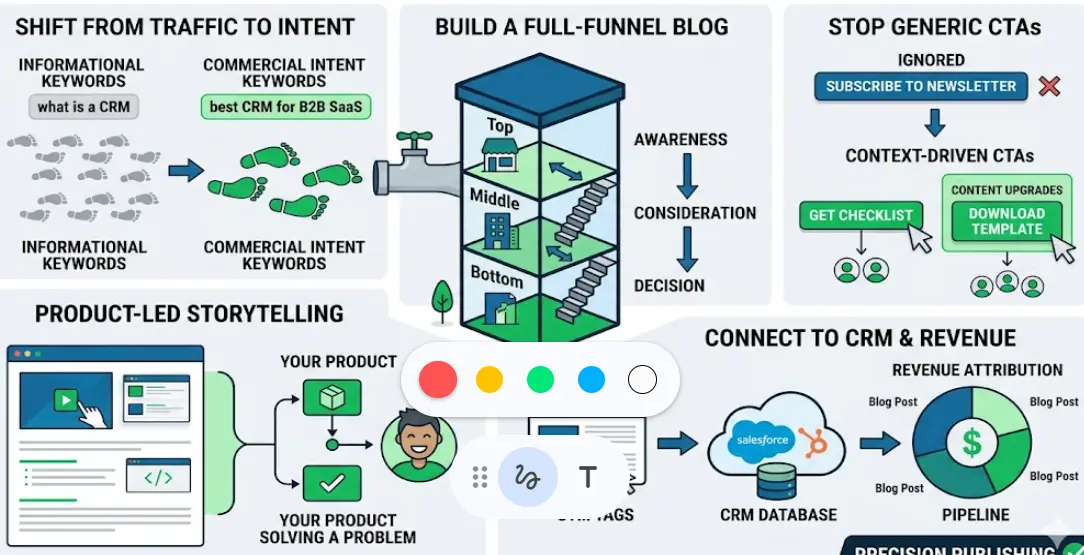
Image Source: Gemini
What makes a content upgrade convert
- It must be immediately usable: not another long read
- The value is specific to the post topic, not generic e-books
- The format matters: templates, checklists, and calculators outperform whitepapers
- The ask must feel fair: high perceived value for a simple email exchange
Generic advice converts readers into followers. Product-led storytelling converts readers into buyers. Here is why that difference matters more than anything else.
5. Use Product-Led Storytelling to Close the Gap Between Content and Revenue
Here is what separates a pipeline-generating blog from a thought leadership blog. One of them shows how a real product solves a real problem. The other gives good advice that could apply to any tool on the market.
Product-led storytelling does not mean turning every post into a product pitch. It means naturally weaving your product into the solution when it genuinely fits. Show the reader what the solution looks like in practice, inside your platform.
Three ways to embed product proof into content
- Reference your tool naturally: When describing how to solve a problem, show a screenshot or workflow from your product as an example.
- Turn customer stories into posts: Take a real client win and write it as a problem-solution narrative; this is your most credible content type.
- Build free micro-tools: An ROI calculator embedded in a blog post keeps readers on the page longer and captures leads with commercial intent.
Customer story posts deserve special attention. A post titled “How [Client Name] Reduced Sales Cycle by 30% Using [Your Tool]” does three things at once. It builds credibility. It speaks directly to buyers with the same problem. And it naturally introduces your product as the proven solution. That is a BOFU post that sells without selling. 53% of B2B marketers rate case studies and customer stories as one of the most effective content formats, second only to video.
Action step: Identify your three most recent customer wins. Each one is a blog post waiting to be written. Brief your customer success team this week to start capturing story details.
Great content that never gets measured is great content that never gets scaled. The final piece of this system is connecting your blog to your CRM and sales data.
6. Connect Your Blog to Your CRM: Track What Actually Drives Revenue
Content that does not connect to revenue data is just content. Pipeline-driven blogging requires you to track the full path, from first blog visit to closed deal. Most marketing teams only measure last-touch attribution. That misses the entire story.
A prospect reads three blog posts over two weeks. They download a template. They attend a webinar. They request a demo. Last-touch attribution credits the demo CTA. But the blog was doing the heavy lifting the entire time.
7. Build the infrastructure to measure the content-influenced pipeline
- UTM tagging: Tag every blog link with UTM parameters so you can trace which posts bring in revenue, not just traffic
- CRM integration: Connect your blog forms to HubSpot, Salesforce, or your CRM of choice so every lead maps to the content that converted them
- Assisted conversion reports: Set up multi-touch attribution reports that show which content pieces appear in the journeys of closed-won deals
- Sales enablement content: Share your top-performing posts with your sales team as follow-up resources.
When you connect content to revenue, you stop arguing about whether blogging “works.” You show the CFO exactly which posts contributed to the pipeline last quarter. That is a conversation that secures the budget. Companies that use content marketing see conversion rates six times higher than those that don’t, 2.9% versus 0.5%.
Pre-publish pipeline checklist
Before every post goes live, run through these six questions.
- Does this post address a real pain point of your ideal customer profile?
- Does the topic target a commercial or transactional keyword?
- Does this post include a contextual content upgrade or lead magnet?
- Is there a clear next-step CTA that matches the post topic?
- Have you added internal links to BOFU content like case studies and product pages?
- Is this post tagged with UTMs and connected to your CRM?
Conclusion
Every tactic in this guide comes down to one shift in thinking. Stop writing to attract everyone. Start writing to convert buyers. High-traffic blogs and high-pipeline blogs are not the same thing. The difference lies in keyword intent, funnel coverage, contextual CTAs, gated upgrades, and product-led proof.
You do not need to scrap what you have. Start with your next three posts. Apply the pre-publish checklist above. Tag one existing post with a contextual CTA. Build one content upgrade for your highest-traffic page.
Pipeline does not come from volume. It comes from precision. And precision starts the moment you publish your next post with a buyer in mind, not a crawler.
Turn your blog into a consistent pipeline engine with ResultFirst, an SEO agency focused on revenue, not just rankings. With years of experience driving measurable growth for B2B brands, ResultFirst builds content strategies that attract high-intent buyers and convert them into qualified leads. From keyword intent to conversion-focused execution, every step is designed to deliver real business outcomes. Contact us today to get started.
WHAT TO READ NEXT
READY TO BUILD PREDICTABLE ORGANIC GROWTH?
We are the only TOP SEO services agency providing Real Results in a Real Performance model. We help growth hungry companies outperform their competition and achieve 300%+ growth in their digital marketing initiatives.
- San Jose, CA, 95120

- +1-888-512-1890

- sales@resultfirst.com

300K+
KEYWORDS RANKED
546M+
REVENUE GENERATED
18 Years
SOLVING COMPLEX SEO
150+
TEAM MEMBERS