



 sales@resultfirst.com
 +1-888-512-1890
Content Marketing vs. SEO: What’s the Difference and Do You Need Both?

Most business owners believe they must choose between investing in search engine optimization (SEO) or allocating funds to content marketing. In 2026, that choice is costing you money.
Recent data shows that SEO advertising converts at 2.4%, which is nearly double the 1.3% conversion rate of PPC (Pay-Per-Click). At the same time, content marketing generates approx $3 for every $1 spent.
This creates a big question for businesses. Should you focus on SEO or content marketing? Many think they are the same. Others treat them as rivals. The truth is different. These two strategies work best together.
Search engines now reward helpful, expert-driven content. At the same time, even great content fails without proper optimization. So the real question is not which one is better. It is how they connect.
This guide explains the difference, shows how each works, and helps you decide if you need both.
What Is SEO? The Engine Behind Online Visibility
Search engine optimization, or SEO, helps websites rank higher on search engines. It focuses on improving visibility when users search for specific queries. It is about the technical infrastructure.
- Technical SEO: Enhancing page loading speed, making it mobile-friendly, and optimizing Core Web Vitals for crawlability by Google.
- On-Page SEO: Using keyword research to optimize titles, descriptions, and headers on your webpage.
- Off-Page SEO: Link building from external sites in order to demonstrate your credibility.
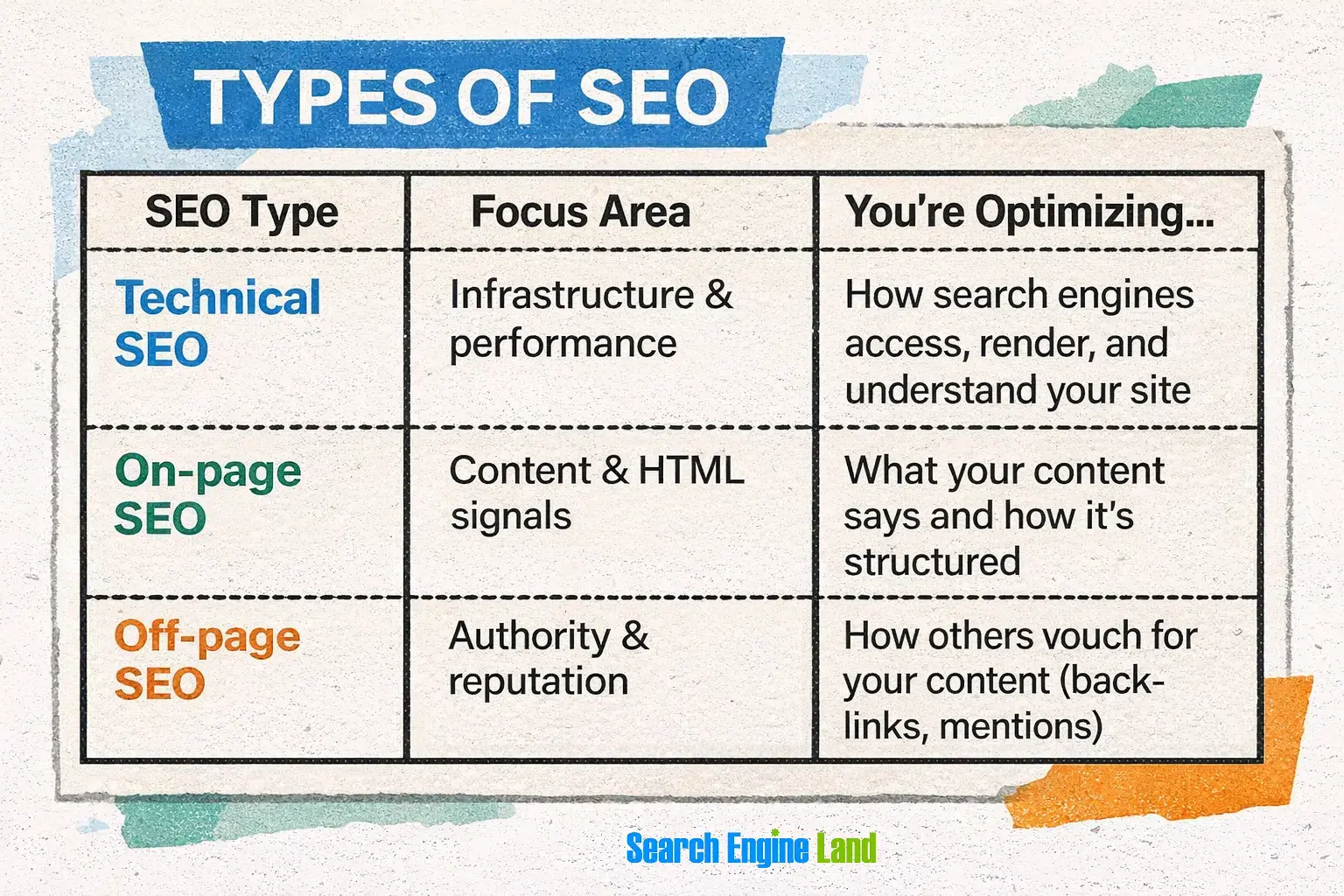
Source: Search Engine Journal
Without SEO, your site won’t appear in any search results. But with proper SEO, it will become visible to your target audience.
Check Out Our Full Guide on Search Engine Optimization.
Why SEO Still Dominates in 2026
SEO continues to drive results because it targets intent. People search when they need answers.
Key benefits include:
- Long-term traffic growth
- High-intent audience targeting
- Cost-effective compared to paid ads
- Strong ROI over time
Also, Over 90% to 99% of users never venture beyond the first page of search results. This makes ranking critical.
What is Content Marketing?
Content marketing is the strategic creation of content to keep a human user engaged. It cares less about code and more about value. It is much wider than SEO.
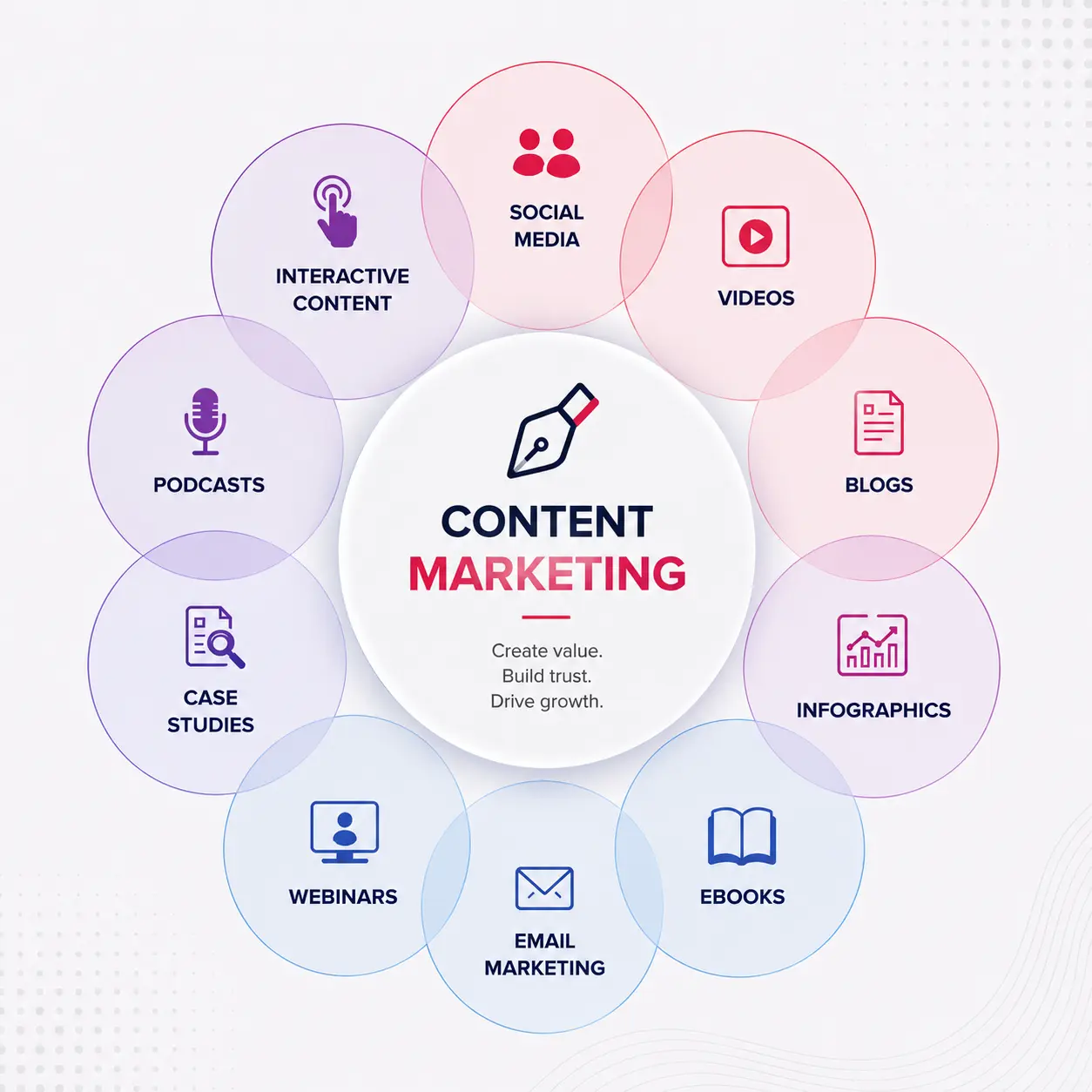
Content marketing also involves developing content for platforms that have absolutely nothing to do with search engines. The content marketing strategy is comprehensive regarding all the content developed by an enterprise.
It can come in many different ways, such as:
- Blogs post specific searches.
- White papers help buyers make their decisions.
- Videos make difficult subjects easy to understand.
- Other items, like case studies, templates, emails, social media, and lead generation pieces, are all throughout the buying process.
Why Content Marketing Matters Today
Modern buyers research before they buy. They look for answers, comparisons, and insights. Content marketing helps you:
- Build trust and authority
- Educate your audience
- Create demand
- Support long-term engagement
In reality, 72% of B2B organic traffic is generated by informational content, not sales pages. This demonstrates that content creates awareness, whereas SEO addresses demand.
How E-E-A-T and AI Changed the Rules
In the past, you could do just one. Today, answer engines (like Perplexity AI and Google AI Overviews) have forced SEO and content to merge.
Why Google Demands Both
Google’s algorithm now uses E-E-A-T to rank pages.
- Experience: Does your content prove you have actually used the product? (Content marketing writes the story; SEO puts the author bio on the page).
- Expertise: Do you have the credentials? (SEO places the schema markup to highlight the author’s degree).
- Trust: Do others trust you? (SEO builds the backlinks; content earns the shares).
The Answer Engine Effect
Answer engines don’t just look for keywords. They look for semantic structure. They want to pull a quote from a list or a table. If you do SEO without content, you have no tables. If you create content without SEO, you have cluttered lists, and AI does not listen to you.
Read More: How to Improve Brand Visibility in AI Search Engines
SEO vs. Content Marketing: Key Differences Explained
Many people confuse SEO with content marketing. They overlap, but they are not the same.
Quick Comparison Table
| Features | SEO | Content Marketing |
| Main Goal | Visibility: Ranking high on Google. | Engagement: Retaining visitors on the page. |
| Target Audience | Search Engines (Bots) & Searchers | Human Beings (Buyers & Readers) |
| Key Tools | Google Search Console, Ahrefs, Screaming Frog | Grammarly, Canva, Video Editors, CMS |
| Main activities | Technical Audit, Link Building, Broken Link Fixing | Blogging, Creating Reels, Infographic Creation |
| Success Metrics | Click-Through Rate, Impressions, Core Web Vitals | Time on Page, Bounce Rate, and Social Shares. |
| Life Span | Long (if code stays good). | Variable (news dies fast; evergreen lives long). |
Simple Way to Understand It
- SEO = Visibility
- Content marketing = Value
Without SEO, people cannot find your content.
Without content, SEO has nothing to rank.
How SEO and Content Marketing Work Together
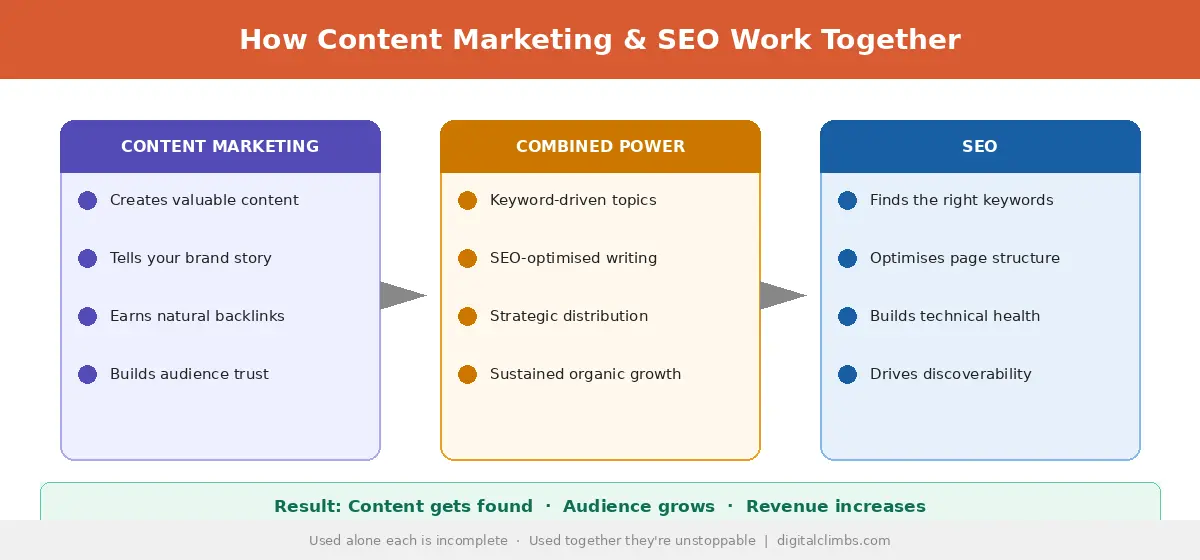
Source: DigitalClimbs
Companies often make the mistake of viewing SEO and content marketing as separate campaigns, when in reality, they are closely intertwined. While SEO provides direction, content offers value. Together, they form a process that will lure, engage, and convert users. The following is an elaborate description of each step.
1. Create Content Based on Keyword Clusters
The “Pillar and Cluster” model is the backbone of modern site architecture. Instead of writing random articles, you build a topic cluster. Create a pillar article that is comprehensive in content, such as one about “organic dog food.” Identify your long-tail keywords, which include phrases such as “best organic food for senior dogs,” through keyword research.
The content role is to write the main pillar page as the “home base.” The SEO role is to write the 10 specific blogs and use internal linking. You hyperlink from each specific blog back to the main pillar page.
This will help pass “link juice” (relevancy and authority) from the individual pages to the pillar page. By employing this SEO technique, you show Google that your pillar page is the most authoritative page for the particular subject matter, hence enhancing search rankings.
2. Write for the “Featured Snippet”
Featured snippets are the boxes that appear above other websites on Google (Position Zero). They play an important part in answer engine optimization (AEO). In the SEO process, one needs to study the “People Also Ask” boxes. You identify a specific question your audience asks that triggers a list (e.g., “5 ways to train a puppy”).
The content role is to answer that question in two specific parts. First, write a direct paragraph of fewer than 50 words. Immediately after that paragraph, create a bulleted list or numbered steps.
This structured format helps Google’s parser extract the data easily. Winning this spot results in a zero-click search, where users get the answer instantly, establishing your brand as the primary authority.
3. Build “Trust Links,” Not Just “Ranking Links”
In 2026, off-page SEO relies on E-E-A-T (Experience, Expertise, Authority, Trust). You cannot just buy any backlink; you need trusted links from high-authority domains. The SEO role is to identify the top 20 industry websites with high domain authority (DA) where your competitors appear.
The content role is to create an asset worth linking to. Do not write a generic blog; write original research or a unique data study. Since you own the proprietary data, high-authority news sites need to cite you.
The Result: You pitch your statistic to the high-authority domain. They link back to your research. This backlink acts as a “vote of confidence,” signaling to Google that your site is a trusted leader in the space.
4. Measure both SEO and Content Metrics
If you only look at “traffic,” you will never see the ROI. You need to separate the metrics.
For SEO (The Efficiency Metric):
- Conversion Rate: How many of those searchers actually clicked through? (Goal: Beat the 2.4% average) .
- Bounce Rate vs. Exit Rate: Are they leaving immediately? That means your content didn’t match the search intent.
For Content (The Quality Metric):
- Scroll Depth: Are people reading to the bottom of the page?
- Customer Acquisition Cost (CAC): Content marketing lowers CAC by 55% compared to paid ads. Track this number.
Do You Need Both SEO and Content Marketing?
Yes, you do. Using only one limits your growth.
What Happens If You Use Only SEO
- You may rank, but fail to engage users
- Bounce rates increase
- Conversions stay low
What Happens If You Use Only Content Marketing
- Great content stays unseen
- Traffic remains low
- Growth slows down
The Balanced Approach
Using both helps you:
- Attract visitors
- Engage them
- Convert them into customers
This creates a complete digital strategy.
The Key Takeaway
SEO and content marketing have become interdependent. There is no point in separating them to achieve effective outcomes. SEO helps you reach your target audience by improving the visibility of your content. Meanwhile, content marketing provides users with valuable information and builds relationships with them, increasing their trust in you and your products.
If you ignore one, your strategy weakens. Rankings without value lead to high bounce rates. Content without optimization stays hidden. That is why balance matters. On the other hand, if you do not pay enough attention to SEO, your content may never be seen by anyone.
SEO and content marketing are not competing strategies. They are two halves of the same system. Without optimization, great content stays hidden. Without content, SEO has nothing to rank. When both work together, the results compound.
We offer SEO services designed to align search visibility with content strategy, driving qualified traffic, stronger rankings, and conversions that move the needle for your business. Ready to stop leaving organic growth on the table? [Contact ResultFirst today.]
Source Referenced:
WHAT TO READ NEXT
READY TO BUILD PREDICTABLE ORGANIC GROWTH?
We are the only TOP SEO services agency providing Real Results in a Real Performance model. We help growth hungry companies outperform their competition and achieve 300%+ growth in their digital marketing initiatives.
- San Jose, CA, 95120

- +1-888-512-1890

- sales@resultfirst.com

300K+
KEYWORDS RANKED
546M+
REVENUE GENERATED
18 Years
SOLVING COMPLEX SEO
150+
TEAM MEMBERS