


 sales@resultfirst.com
 +1-888-512-1890
GEO Agency vs Traditional SEO Agency: What’s the Difference?

Traditional SEO agencies focus on helping websites rank higher in Google. GEO (Generative Engine Optimization) agencies focus on helping brands appear in AI-generated answers from platforms like ChatGPT, Gemini, and Perplexity.
The difference matters because search behavior is changing fast. By 2026, traditional search will lose 25% of search traffic, according to Gartner, since the user base increasingly moves toward using AI assistants. This doesn’t imply that SEO is going away. Google is still handling billions of search queries per day and is still the biggest search engine. However, visibility now extends beyond search rankings. Brands need to rank in Google and be cited by AI systems.
That is where the difference between a GEO agency and an SEO agency becomes important. One focuses on improving organic search visibility. The other one focuses on boosting the number of AI citations, recommendations, and mentions in generative search platforms.
Knowing the differences between these strategies can help you make more informed decisions about what to do in 2026 and beyond. In this article, we will talk about how a GEO agency differs from a more traditional SEO agency.
Start by Understanding the Difference Between SEO and GEO.
Google Rankings and AI Citations Now Require Different Strategies
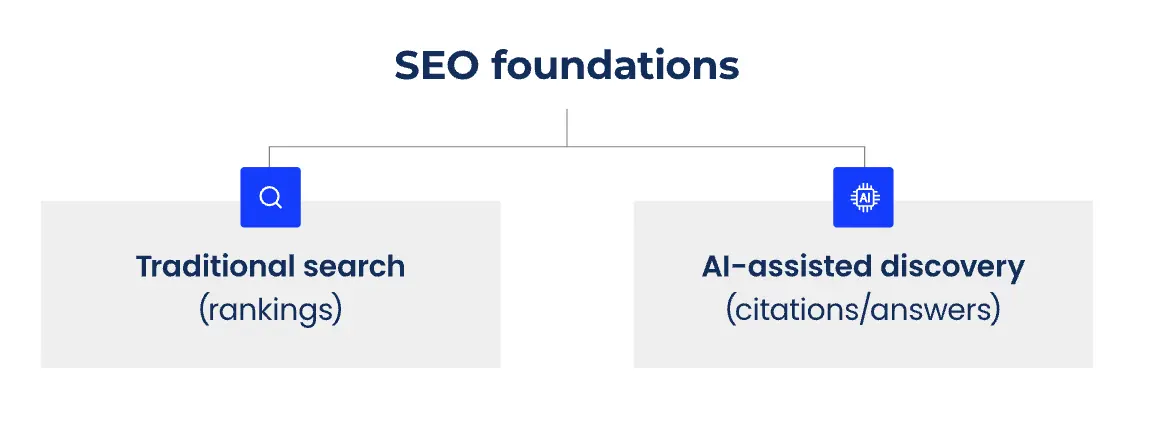
Over 65% of Google searches now end without a single click. Users get their answer directly on the results page and move on. On top of that, AI tools like ChatGPT and Perplexity handle millions of purchase-intent queries every single day. These platforms do not show a list of links. They write a direct answer and cite a handful of trusted sources.
That means two very different visibility goals now exist:
- Strategy 1: Ranking in Google’s organic search results
- Strategy 2: Earn Mentions and Citations in AI-Generated Answers
A traditional SEO agency focuses on the first objective. A GEO agency focuses on the second. The brands winning in 2026 are the ones investing in both at the same time.
Source: ChatGPT
What Does a Traditional SEO Agency Actually Do?
A traditional SEO company helps the website to be seen once somebody enters a search term in Google or Bing. These companies provide services behind the scenes for your website to improve its rank in the typical search engine listings. A report states that the first organic result on Google still gets an average CTR of 39.8%, giving SEO agencies a reason to pay attention to rankings.
The Core Services a Traditional SEO Agency Delivers
A strong traditional SEO agency provides a focused set of services that build long-term search authority:
- Keyword research: finding the exact terms your audience types into search bars
- On-page optimization: writing title tags, meta descriptions, and headers that signal relevance to Google
- Technical SEO audits: fixing broken links, improving page speed, and making sites mobile-friendly
- Backlink building: earning links from reputable websites so Google sees your site as trustworthy
- Content creation: producing long-form blog posts and landing pages built around specific keywords
- Rank tracking: measuring where your pages sit in Google’s results over time
The ultimate goal of all this work is one thing: a high-ranking link that a user sees and clicks. Success is measured through organic traffic, keyword positions, and click-through rates. Traditional SEO results typically take three to six months to show up in meaningful numbers.
Why Traditional SEO Still Matters?
Some marketers treat SEO like a relic. That thinking is expensive. Google still handles roughly 16.4 billion searches per day. A single page ranking in position one can generate thousands of visitors every month without a single dollar spent on ads. Your website authority also plays a direct role in GEO success because AI models often pull from pages that already rank well on Google. Strong SEO builds the foundation that GEO then leverages.
What Does a GEO Agency Actually Do?
A Generative Engine Optimization agency helps your brand get noticed by AI systems. These teams specialize in making sure models like ChatGPT, Claude, Gemini, and Perplexity see your business as a credible and citable source. When someone asks an AI a question, the model scans the web for the most trustworthy information it can find. A GEO agency structures your content so the AI picks your brand to deliver that answer.
As per research, GEO techniques can improve visibility in AI-generated answers by up to 40%, giving brands a significantly better chance of being cited by AI systems.
The Core Services a GEO Agency Delivers
GEO agencies work across a broader and more technical set of disciplines:
- Question research: mapping the exact conversational phrases users type into AI tools
- Answer-first content structure: writing content that leads with direct answers so AI can extract them easily
- Fact-density optimization: packing pages with verifiable statistics, expert quotes, and clear data points
- Schema markup implementation: using structured data so AI crawlers understand the meaning of your content
- LLMs.txt configuration: a newer technical file that signals to AI crawlers how to index your site
- Off-page reputation building: earning brand mentions and citations across trusted third-party websites
- AI citation tracking: monitoring how often your brand appears inside AI-generated answers
- Share of voice analysis: measuring how often your brand beats competitors in AI responses
How GEO Changes the Content Game
GEO agencies build content to be quoted. That is a fundamental shift from building content to rank.
A traditional SEO writer asks, “What keyword does this page target?” A GEO strategist asks, “what direct question does this page answer, and can an AI extract that answer in three sentences?”
This leads to content that looks different from standard SEO content:
- Short declarative sentences
- Clearly labeled sections with descriptive headings
- Original data, research, and statistics that AI can cite
- FAQ sections that mirror real user questions
- Expert quotes with full attribution
- Definitions placed early in each section
Read More: How to Optimize Content for AI Search
GEO Agency vs SEO Agency: Main Differences
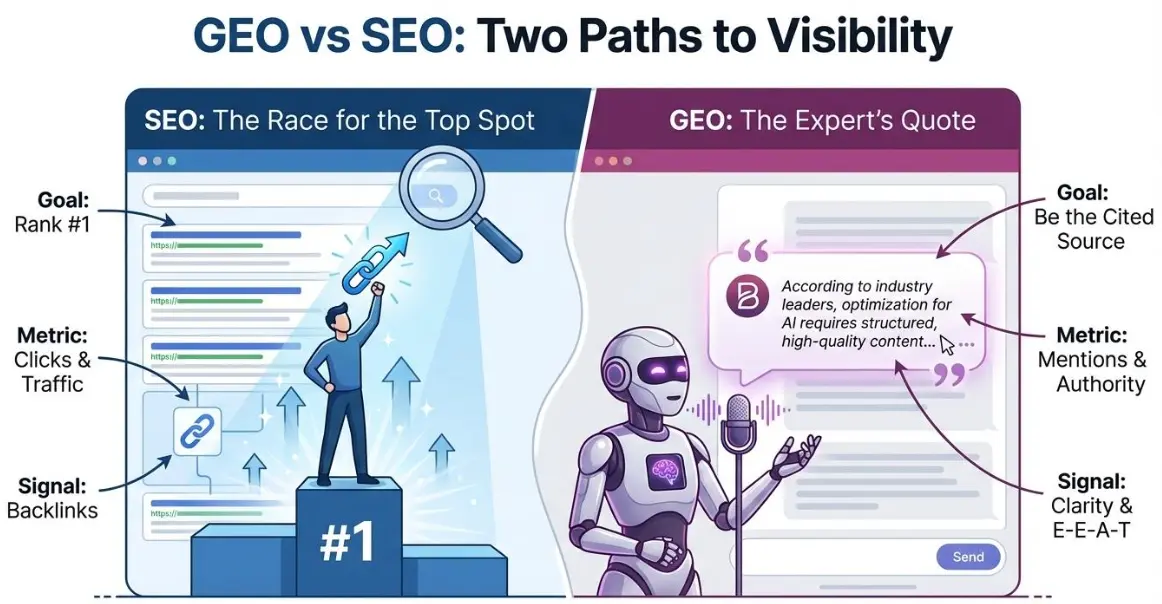
The table below puts the key differences in one place so you can see exactly where each agency type focuses its energy.
| Feature | Traditional SEO Agency | GEO Agency |
| Primary Goal | Rank #1 on Google SERPs | Get cited inside AI-generated answers |
| Target Platforms | Google and Bing | ChatGPT, Perplexity, Claude, Google AI Overviews |
| Core Method | Keywords and backlinks | Authority signals and structured citations |
| Content Strategy | Keyword-targeted long-form pages | Answer-first, fact-dense, citation-ready content |
| On-Page Efforts | Backlink outreach and PR placements to signal domain authority. | Passage-level optimization for fact density, information gain, and inclusion in generative answers. |
| Technical Focus | Crawlability, Core Web Vitals, indexing | Schema, LLMs.txt, AI crawler behavior |
| Key Metric | Organic traffic and keyword rankings | AI citation rate and share of voice in AI answers |
| Time to Results | Three to six months | Days to weeks |
| User Interaction | User clicks a link to visit your site | User reads your brand name inside the AI answer |
The most important row in that table is user interaction. Traditional SEO drives visitors to your website. GEO brings your brand to the user inside a third-party platform. Both outcomes build brand visibility. They just do it in completely different places.
Source: Gemini
Is GEO Replacing Traditional SEO?
No. GEO is not replacing SEO. That headline gets clicks, but the data does not support it. According to a report, ChatGPT drives just 0.21% of total website traffic, while Google still accounts for 40%. Traditional search still dominates the web by a massive margin.
Where Each Strategy Wins
- SEO wins when users want to do deep research, compare options, or visit a website directly
- GEO wins when users want a fast direct answer without clicking anything
- Both win together when your brand appears in AI answers, and then users search for you by name on Google
The brands becoming invisible in 2026 are not the ones ignoring AI. They are the ones ignoring one side of the equation entirely. A marketer who builds perfect SEO but no GEO presence loses every query that ends with an AI summary. A marketer who chases AI citations but neglects site authority loses every query that still ends in a click.
How SEO and GEO Work Together to Build Visibility
SEO and GEO share more common ground than their differences suggest. Understanding that overlap helps you build a strategy where each discipline strengthens the other.
Quality Content Benefits Both Disciplines
A comprehensive, well-researched blog post that ranks on Google position one is also more likely to be pulled as a source by an AI model. AI systems trust pages that already carry high search authority. This creates a direct feedback loop. Better SEO builds stronger GEO visibility. Stronger GEO visibility drives more branded searches, which then boosts SEO performance further.
E-E-A-T Signals Matter in Both Worlds
Google’s framework of E-E-A-T (Experience, Expertise, Authoritativeness, and Trustworthiness) sits at the core of both disciplines:
- For SEO: Google rewards pages that demonstrate genuine expertise through depth, citations, and author credentials
- For GEO: AI models prioritize sources that show verifiable authority and consistent third-party recognition
Building E-E-A-T is not two separate jobs. It is one job that pays dividends across both channels.
Structured Data Serves Both Engines
Schema markup helps Google display rich snippets in search results. That same markup helps AI crawlers parse your content quickly and accurately. Implementing proper structured data for FAQs, how-to guides, and product information benefits your Google visibility and your AI citation rate at the same time.
Learn More: How Structured Data Improves Visibility in AI Search Engines
When Should You Choose a Traditional SEO Agency?
A traditional SEO agency makes the most sense in these situations:
- Your website does not yet rank for key terms in your industry
- You are early in your digital marketing journey with limited brand authority
- Your business depends heavily on users visiting your site to convert
- You operate in a market where users still prefer clicking through to read full content
- You need long-term compounding organic traffic growth
Over 68% of online experiences still begin with a search engine. Building that foundation first makes everything else easier, including GEO.
When Should You Prioritize a GEO Agency?
A GEO agency becomes critical when your visibility in AI answers starts to matter for revenue:
- Your competitors appear in ChatGPT and Perplexity answers, and you do not
- Your traditional SEO performance has plateaued, and you need a new growth channel
- You operate in a high-competition niche where rankings alone no longer drive enough traffic
- Your customers ask AI tools for buying advice before they ever open Google
- You want to capture demand at the research and evaluation stage of the buying journey
One industry expert described ignoring GEO as being like ignoring mobile apps ten years ago. You might survive, but you will not lead.
How to Measure Success in Each Approach?
Measuring SEO success is straightforward. Measuring GEO success requires new thinking.
Traditional SEO Metrics
- Keyword ranking positions in Google SERPs
- Monthly organic traffic volume
- Click-through rate from search results
- Conversion rate from organic visitors
- Backlink count and domain authority growth
GEO Metrics
- Citation rate: how often your brand appears inside AI-generated answers
- Share of voice in AI: how often your brand beats competitors in AI responses for target topics
- AI traffic attribution: identifying website visits that came from AI platform referrals
- Answer accuracy: whether AI tools represent your brand and products correctly when they cite you
- Prompt inclusion rate: how many of your target questions result in a brand mention
Several new tools now track these GEO metrics automatically. Running manual checks by typing your target questions directly into ChatGPT, Gemini, and Perplexity also works well as a starting point.
Smartest Move in 2026 and Beyond: Build A Unified Agency
The debate between GEO vs SEO misses the bigger point. These are not competing strategies. They are two layers of the same visibility system. Traditional SEO gives you the website authority that AI models trust. GEO gives you the content structure that AI models can actually use. One without the other leaves a significant visibility gap.
A Practical Starting Point for Most Businesses
Start with a strong SEO foundation:
- Ensure your site is technically clean and fully crawlable
- Publish well-researched authoritative content on your core topics
- Build backlinks from reputable sources in your industry
Then layer GEO on top:
- Restructure top-performing pages with clear answer-first sections
- Add verifiable statistics and expert quotes throughout your content
- Implement FAQ schema and article schema across key pages
- Monitor your brand mentions inside AI tools regularly
- Track which questions your competitors get cited for and fill those gaps
The businesses building this dual strategy right now are the ones that will dominate both search engines and AI answers in the years ahead.
The Race Has Already Started, Are You In?
The search landscape split two years ago, and the gap keeps widening. Users now move fluidly between Google, ChatGPT, Perplexity, and AI Overviews depending on what kind of answer they need. Your brand needs to show up across all of those surfaces. A traditional SEO agency handles one side of that challenge with skill and experience. A GEO agency handles the other side with a completely different toolkit. The brands that recognize this early and act on it will not just stay visible. They will become the default answer their target customers hear no matter where they search.
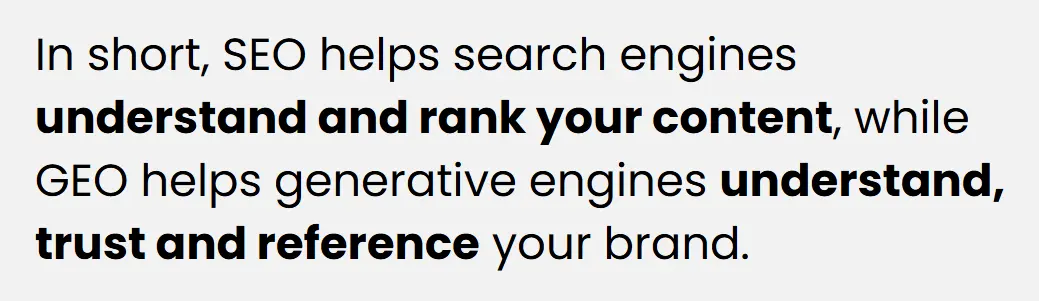
The question is not whether you need SEO or GEO. The question is how fast you can build both.
SEO and GEO are not competing strategies. They are two parts of the same visibility strategy. As search continues to evolve, businesses need more than traditional SEO to stay competitive. They need a partner who understands how to build authority in Google while earning trust across AI-powered search. That’s where ResultFirst comes in. As an AI SEO Agency, we combine technical SEO, authoritative content, and AI search optimization to help brands strengthen their visibility across Google, ChatGPT, Gemini, Perplexity, and other AI-powered search platforms.
Source Referenced:
- https://www.gartner.com/en/newsroom/press-releases/2024-02-19-gartner-predicts-search-engine-volume-will-drop-25-percent-by-2026-due-to-ai-chatbots-and-other-virtual-agents
- https://www.forbes.com/councils/forbesbusinesscouncil/2026/03/02/the-zero-click-economy-why-60-of-searches-end-without-a-click-and-what-ceos-should-do-about-it/
- https://ahrefs.com/blog/seo-statistics/
- https://explodingtopics.com/blog/google-searches-per-day
- https://ahrefs.com/blog/chatgpt-has-12-percent-of-googles-search-volume/
FAQs:
WHAT TO READ NEXT
READY TO BUILD PREDICTABLE ORGANIC GROWTH?
We are the only TOP SEO services agency providing Real Results in a Real Performance model. We help growth hungry companies outperform their competition and achieve 300%+ growth in their digital marketing initiatives.
- San Jose, CA, 95120

- +1-888-512-1890

- sales@resultfirst.com

300K+
KEYWORDS RANKED
546M+
REVENUE GENERATED
18 Years
SOLVING COMPLEX SEO
150+
TEAM MEMBERS