


 sales@resultfirst.com
 +1-888-512-1890
How to Rank for High-Intent SaaS Keywords Without a Massive Content Team

You do not need a 20-person content team to rank for high-intent SaaS keywords. What you need is a sharper strategy. Most SaaS marketers open a keyword tool. They type in their product category. They see a keyword with 50,000 monthly searches. They get excited. Then they spend three months writing content around it and land on page six where nobody ever clicks.
Today, over 20% of keywords now appear in AI overviews, which means visibility depends entirely on how well your content matches what the searcher actually wants. And that brings us to the real problem. Generic keyword targeting does not work. High-volume terms are dominated by companies with domain authority scores above 70 and content budgets that most SaaS startups will never match. At the same time, SaaS companies that focus on high-intent keywords convert at rates 3x to 5x higher than those chasing broad traffic. You do not need more content. You need the right content.
Let’s talk to understand better!
Why High-Intent Keywords Consistently Drive Better SEO Results
High-intent keywords are search terms that signal a buyer is close to making a decision. They are not looking to learn. They are looking to act. Think about the difference between someone searching “what is project management software” versus “Asana alternatives for remote teams under $50 a month.” The second searcher knows what they want. They have compared options. They are ready to click and sign up.
This is why intent beats volume every time.
The Four Types of High-Intent Keywords You Should Target
| Keyword Type | Example | Buyer Stage | Priority Level |
| Alternative keywords | “Monday.com alternatives” | Decision | Very High |
| Comparison keywords | “Asana vs Trello for agencies” | Decision | High |
| Use-case keywords | “best CRM for SaaS startups” | Consideration | High |
| Feature-specific keywords | “email tool with built-in automation” | Consideration | High |
| Problem-aware keywords | “how to reduce customer churn.” | Awareness | Medium |
Each of these keyword types pulls a different buyer. Start with the top two. They drive the fastest results.
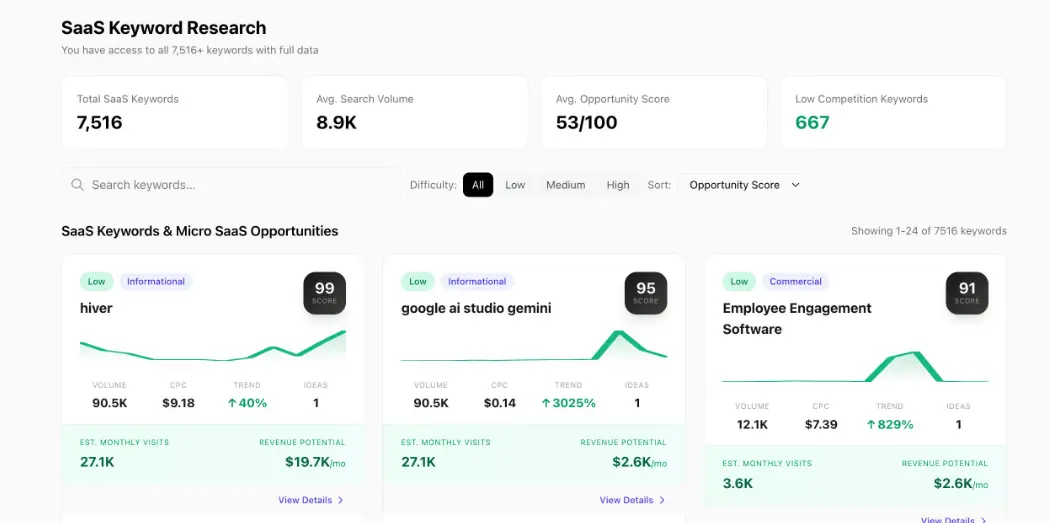
Image Source: ChatGPT
Learn to Find High-Intent Keywords with Our Advanced Keyword Research Guide.
Start With Problems Not Product Features
This is the step almost every SaaS team skips. They open Ahrefs or Semrush first. That is backwards.
Before you touch a keyword tool, answer these three questions:
- What specific problem does your product solve? Not features. Problems. If you sell a scheduling tool, the problem is not “scheduling.” The problem is “our sales team misses follow-ups because there is no system to track them.”
- Who is the exact person feeling that problem? A CRM for solo consultants and a CRM for enterprise sales teams live in completely different keyword universes.
- What does that person actually type into Google? Talk to your sales team. Talk to support. The language your customers use is almost never the language your marketing team uses.
Write down 15 to 20 seed topics from these three answers. That is your real starting point. Everything else flows from here.
As per a report, 67% of B2B buyers prefer a rep-free buying experience, meaning they research and define their problems long before speaking with a vendor. If you do not understand those problems, you will miss the searches that matter most.
How to Do Keyword Research Without Wasting Months On the Wrong Terms
Step 1: Pull From Your Own First-Party Data First
Google Search Console is the most underused tool in SaaS marketing. It shows you the exact queries real people typed before they landed on your site. Look for keywords getting impressions but zero clicks. Those are direct signals from Google that a content gap exists. Fill those gaps before you go looking for new keywords.
Sites with strong keyword clusters see 40 to 60 percent higher session durations compared to sites with scattered unrelated content. That tells you Google rewards depth and structure over volume.
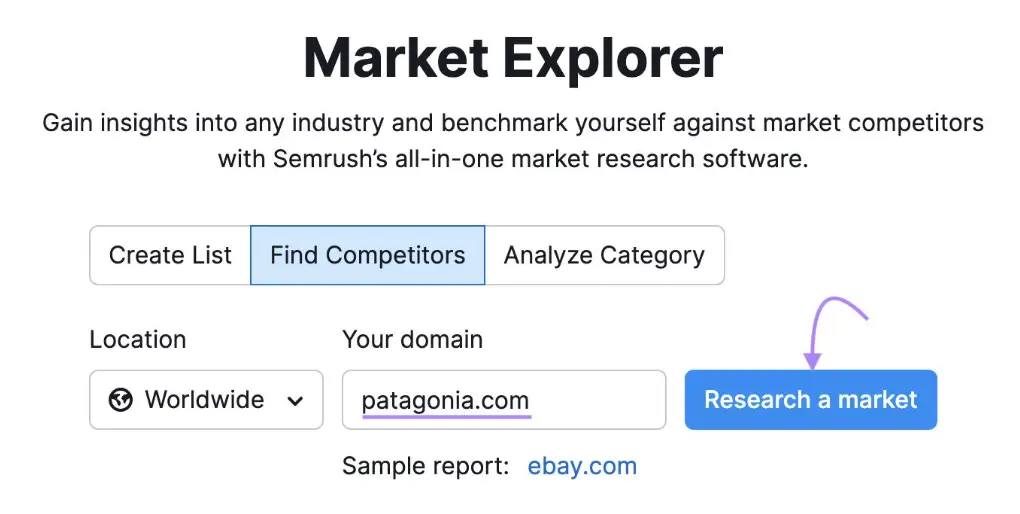
Image Source: Yandex
Step 2: Run Competitor Gap Analysis
Take your top two or three competitors. Drop their domains into Ahrefs or Semrush. Run the Content Gap tool. This shows you every keyword they rank for that you do not. Look specifically for:
- Bottom-of-funnel terms they rank for (alternatives, comparisons, pricing pages)
- Problem-aware terms where their content is thin or outdated
- Long-tail use-case keywords with low difficulty scores
These are your fastest wins. You are not starting from scratch. You are finding proven demand and building better content around it.
Step 3: Check Reddit and Community Forums
Reddit threads and Slack communities give you keyword gold that no tool picks up. Go to the subreddits where your audience hangs out. Look at how people describe their problems. Those exact phrases often make perfect long-tail keywords.
For example, if you sell invoice software and you see five Reddit threads asking “how do I follow up on unpaid invoices without being annoying,” that is a keyword. “How to follow up on unpaid invoices” is a real search term with real intent behind it.
You can also do keyword research using the tools featured in our article, Best Keyword Research Tools.
The SEO Pyramid: Your Framework for Prioritizing Every Keyword
The SEO Pyramid organizes keywords by purchase intent and search volume. Here is how to read it:
- Top of the pyramid: brand terms and solution terms. Low volume. High intent. Fast conversions.
- Middle of the pyramid: problem terms and integration terms. Medium volume. Medium intent.
- Bottom of the pyramid: general terms and upstream product terms. High volume. Low intent. Slow conversions.
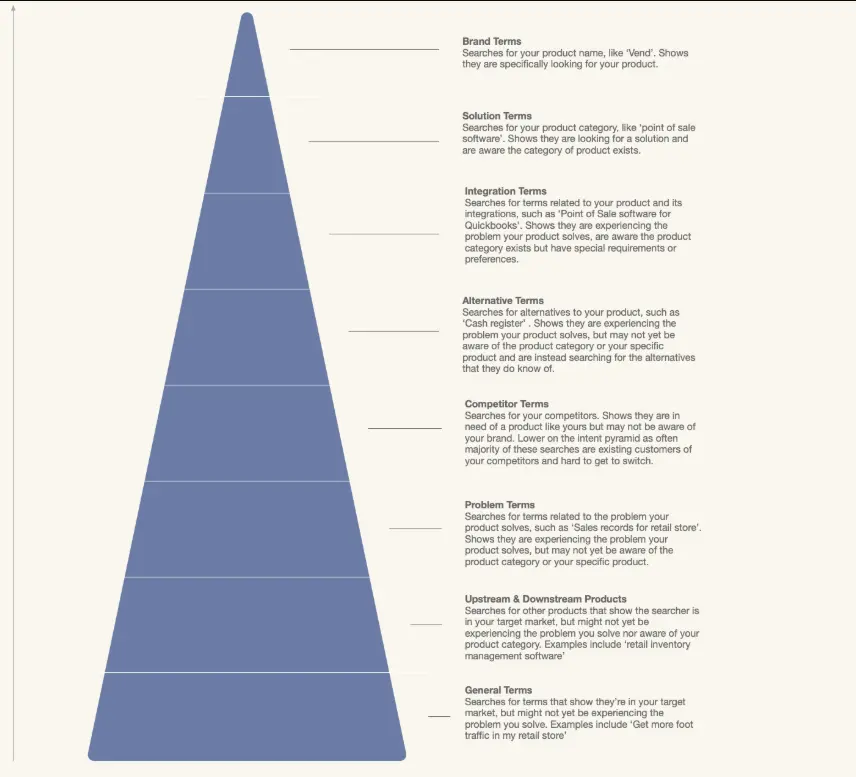
Image Source: Yandex
Most SaaS marketers put all their energy into solution terms. That is a mistake. Consider this: “proposal software” gets around 1,500 searches a month. But “business proposal template” gets over 500,000 searches a month. The second term has lower purchase intent but dramatically better ranking potential for a smaller team.
The pyramid helps you spot where the real opportunity is. For most lean content teams, the biggest wins sit in the problem terms and alternative terms categories.
What Does “Ranking Without a Big Team” Actually Look Like in Practice?
Here is a real example. Simul Docs is a version control tool for Microsoft Word. Their main solution term gets fewer than 200 searches a month globally. Instead of fighting for that term, they built pages targeting “coauthor Word documents,” “compare Word documents,” and “revert Word documents.” Those terms pull nearly 100,000 searches a month combined.
They did not need a huge team. They needed a smart framework.
Here is how a small team can replicate this:
- Pick one keyword cluster per month: Not 20 topics. One tightly related cluster.
- Write one pillar page: a comprehensive 1500 to 2000 word page targeting the main keyword.
- Add two to three supporting pages: shorter posts targeting closely related sub-keywords that link back to the pillar.
- Update before you create: Before publishing anything new, check if an existing page can be improved to rank. Moving a page from position 15 to position 5 takes less effort than building a new page from zero.
SaaS companies with well-developed topical clusters see 2 to 3 times higher rankings for competitive keywords compared to companies with scattered content. That is not a small advantage. That is the entire game.
How to Evaluate a Keyword Before You Spend Weeks Writing About It
Stop relying on difficulty scores alone. A keyword with a difficulty of 35 means nothing if the top 10 results are all from sites with domain authority above 80.
The Three-Question Test for Every Keyword
Before committing to any keyword, run it through this filter:
- Does the intent match your product? Someone searching “how to reduce churn” is problem-aware. Someone searching “best churn reduction software” is solution-aware. Different pages. Different angles. Know which one you are writing.
- What does the actual SERP look like? Open an incognito window and search the keyword. If you see Reddit threads, outdated posts, or thin content from small sites that is your opening. If you see G2, HubSpot, and Salesforce filling every result, skip it for now.
- Is there a natural path to your product? If someone reads your article and finds it useful, is there a logical next step toward your product? If the answer is no, the keyword might bring traffic, but it will not bring pipeline.
Building High-Quality Backlinks Without a Large Outreach Team
Here is what most small teams get wrong about link building. They try to earn links to product pages. Product pages do not attract links naturally. Nobody links to a features page for fun.
Instead, build links through these three approaches:
- Free tools inside your content: Simul Docs embedded a small tool that lets users compare two Word documents directly on the page. That page earned links naturally because it gave value. Replicate this in your niche.
- Integration directory listings: If your product integrates with Salesforce, QuickBooks, or HubSpot, get listed in their app directories. One link from Salesforce AppExchange carries more authority than 50 links from random blogs.
- Guest posts on niche sites: Not general marketing sites. Specific sites your exact buyer reads. One guest post on a site your ICP follows beats ten posts on generic content marketing blogs.
Read More: 5 Types of Quality Backlinks You Need to Know for SEO
Track What Actually Moves Revenue, Not Just Rankings
Rankings are a vanity metric if they do not connect to business outcomes. Here is what to track inside each keyword cluster:
| Metric | Target Benchmark | What It Tells You |
| Organic traffic growth | 10 to 15% month-over-month | Your cluster is gaining momentum or not |
| Click-through rate (informational pages) | 3 to 5% | Whether your title and meta description match intent |
| Click-through rate (commercial pages) | 5 to 8% | If buyers are finding your decision-stage content |
| Time on page | Above 1 minute | Whether your content genuinely answers the question |
| Bounce rate | Below 60% | Whether visitors find what they expected |
| Conversion rate (demo or trial) | 2 to 4% | Whether your content is pulling the right audience |
Review these numbers every quarter. Update underperforming pages with fresh data. Expand pages that are already working by adding more depth. This is how a small team compounds results over time.
The One Mistake That Halts Small-Team SEO Efforts
Keyword cannibalization. This is when you write multiple articles targeting similar keywords and your own pages end up competing against each other. Google gets confused. Both pages lose.
The fix is simple. Before writing any new content, search your own site for the topic first. If a page already exists, either update that page or add the new angle as a supporting section. Do not create a separate article.
Clustering similar keywords under one strong page is almost always the better move than creating ten separate thin posts.
The Bottom Line: Intent Wins
You do not need a massive content team to rank for high-intent SaaS keywords. You need a clear understanding of your buyer’s problems. You need a keyword framework that prioritizes intent over volume. And you need the discipline to go deep on fewer topics rather than wide on many.
The SaaS companies winning in organic search right now are not publishing more. They are publishing smarter. They build content ecosystems where every page connects to the next. They track conversions, not just clicks. And they treat SEO like a product, ship an MVP, measure it, and improve.
Start with one cluster. Prove the model. Then scale it. That is how you rank without a massive content team.
Ranking for high-intent SaaS keywords isn’t about publishing more content. It’s about building the right strategy around buyer intent, topical authority, and sustainable SEO growth. If you’re ready to turn organic search into a predictable growth channel, ResultFirst can help. As a SaaS SEO Agency, we help SaaS brands identify high-intent opportunities, build content strategies that convert, and create long-term organic growth without relying on massive content teams.
Source Referenced:
- https://searchengineland.com/google-zero-click-searches-2026-study-479717
- https://click-vision.com/saas-seo-statistics
- https://www.gartner.com/en/newsroom/press-releases/2026-03-09-gartner-sales-survey-finds-67-percent-of-b2b-buyers-prefer-a-rep-free-experience?
FAQs:
WHAT TO READ NEXT
READY TO BUILD PREDICTABLE ORGANIC GROWTH?
We are the only TOP SEO services agency providing Real Results in a Real Performance model. We help growth hungry companies outperform their competition and achieve 300%+ growth in their digital marketing initiatives.
- San Jose, CA, 95120

- +1-888-512-1890

- sales@resultfirst.com

300K+
KEYWORDS RANKED
546M+
REVENUE GENERATED
18 Years
SOLVING COMPLEX SEO
150+
TEAM MEMBERS