



 sales@resultfirst.com
 +1-888-512-1890
Which eCommerce Platform is Best for SEO?


It’s no secret that selling products and services online requires a reliable eCommerce platform. And if you’re planning to launch or scale an online store, your first step is choosing a platform that is fast, flexible, scalable, and SEO-friendly. When it comes to driving organic visibility and conversions, the platform you select plays a major role in how well your store performs on search engines.
One of the most common questions businesses ask today is: Which eCommerce platform is best for SEO? With so many options available, making the right decision can feel overwhelming. Some platforms are designed with strong built-in SEO features, while others provide advanced customization and control for long-term growth.
To make the decision easier, we’ve done the deep research and compiled a list of the most SEO-friendly eCommerce platforms trusted by millions of online retail businesses. This guide will help you understand what makes a platform good for SEO and which option may be the best fit for your business needs.
Why Choose SEO-friendly Platform for Online Stores?
An SEO-friendly eCommerce platform helps you manage and increase conversions and appear in Search Engine Results Pages. Whether you’re starting your first store or your 10th one, such a platform significantly impacts your business.
Choosing the best eCommerce platform for SEO is a hard start with so many options in the market. Also, regarding SEO, some platforms are better than others. Therefore, we have done some deep research and compiled a list of top eCommerce platforms for SEO.
6 Best eCommerce Platform for SEO
Choosing the right eCommerce platform plays a major role in how well your online store can rank on search engines. Many business owners ask: “Which eCommerce platform is best for SEO?” The answer depends on key factors such as SEO control, hosting flexibility, speed optimization, URL structure, metadata editing, and scalability.
If fast setup and built-in SEO features are your priority, Shopify and BigCommerce are great options. However, if you want full control over technical SEO elements, schema markup, and structure customization, WooCommerce and Magento typically provide a deeper level of flexibility.
To help you compare the top platforms more effectively, here’s a quick side-by-side SEO-focused comparison chart:
| Criteria | Shopify | WooCommerce | Magento (Adobe Commerce) | BigCommerce | Squarespace | Volusion |
| SEO Flexibility | Strong built-in SEO features, but limited deep URL customization and full technical control. | Excellent SEO control with full customization (built on WordPress). | Advanced SEO flexibility with full control, great for complex sites. | Strong SEO capabilities with good customization options. | Basic SEO features suitable for simple websites. | Supports basic SEO settings but lacks advanced controls. |
| Ease of Use | Very easy to use, ideal for beginners. | Moderate — depends on hosting and plugin setup. | Advanced — requires technical expertise or developer support. | Easy to use with some learning curve for advanced configuration. | Very easy to use, beginner-friendly. | Easy to use with simplified interface. |
| Performance & Hosting | Fully hosted SaaS with optimized performance. | Performance depends on hosting provider and configuration. | Self-hosted with full server control (great performance when optimized). | Fully hosted SaaS with reliable performance. | Fully hosted SaaS. | Fully hosted SaaS. |
| Best For | Small to mid-sized businesses wanting simplicity and fast setup. | SEO-focused businesses or stores relying heavily on content marketing. | Enterprise-level stores, large product catalogs, and advanced custom setups. | Growing mid-sized stores requiring scalability without heavy customization. | Small businesses, portfolios, and simple product catalogs. | Small to mid-sized stores needing simple structure. |
| SEO Tools & Plugin Availability | Large third-party SEO app marketplace. | Extensive SEO plugins and integrations available. | Enterprise extensions available, fewer plug-and-play tools. | Good selection of apps and integrations. | Limited SEO-focused extensions. | Limited plugin ecosystem for SEO. |
| Cost Level | Medium cost (subscription + paid apps). | Low-to-medium cost depending on hosting and plugins. | High cost (licensing + development). | Medium-to-high depending on plan and scaling. | Low-to-medium cost. | Medium cost structure. |
Selecting the right platform is only the first step. To ensure it performs well in search and drives measurable growth, many businesses partner with professional eCommerce SEO services for setup, implementation, and ongoing optimization.
BigCommerce

BigCommerce is one of the best online store creation platforms that features robust capabilities in search engine optimization (SEO), hosting, marketing, and security, catering to businesses ranging from small startups to large enterprises. With its powerful tools and customizable features, BigCommerce SEO ensures that your online store is optimized for maximum visibility and effectiveness in driving traffic and conversions.
Features:
- Mobile-friendly
- Built-in 301 redirect features
- SEO-friendly URLs
- Access to edit your txt file
- 40 different payment methods
- Customization and Functionality
- Unlimited file storage, bandwidth, and products
- Single-page checkout
- Less downtime, Omni Channels
- Product Videos, Coupons & Gift Certificates
- Bulk Pricing, Ratings & Reviews
- Product Swatches, Customer Groups & Segmentation
- Persistent Cart, Strong SEO Performance, B2B Edition,
Adobe Commerce (Magento)
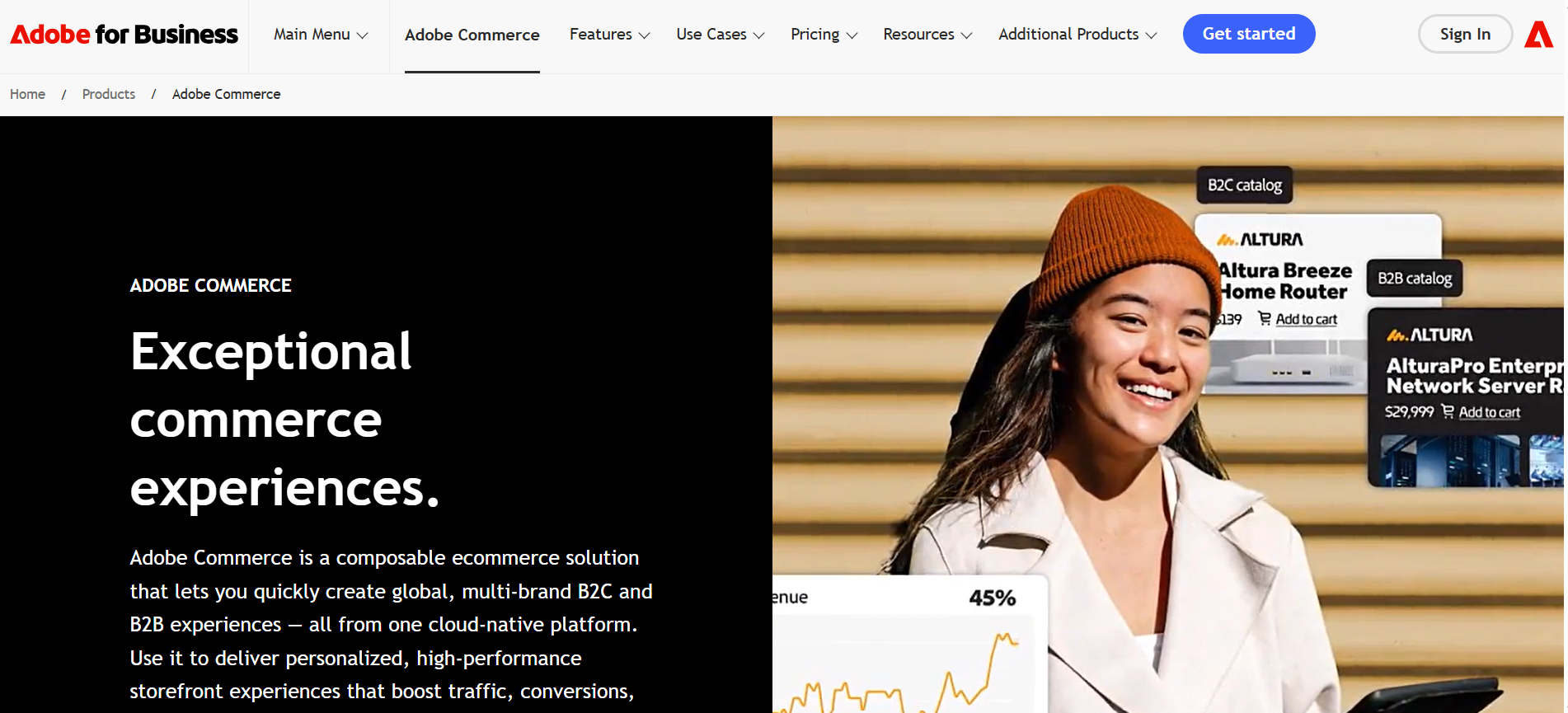
Adobe Commerce (formerly Magento Commerce, powered by Magento Open Source) is another eCommerce platform on the list because of its fully customizable feature, sitemap enhancements, tools for structured markup data optimization, independent navigation links, customizable H1 Tags, integrated content pages, specialized checkout process, and more.
Features:
- Robust and feature-rich
- 1-Click Selling Apps
- Pricey Themes, Easily Slowed Down
- Drag and drop capabilities
- Analytics insights, Page editing
- Multiple, detailed permissions
- B2B negotiation, Multi-source order
- Inventory management
Related: Magento SEO: The Ultimate Guide for (2026)
Shopify
Shopify is great for beginners who want to set up their first eCommerce website. It integrates Google Analytics into your website to monitor traffic, leads, and conversions. It allows custom metatags creation, blog features with editable tags, organized site structure, free hosting, and CDN for images to help improve SEO.
Features:
- Fast Loading & Easy To Use
- Excellent for Dropshipping
- Weak at SEO/Content Marketing
- Customer Profiles Creation
- Payments Acceptance Anywhere With Shopify POS
- Exploit the Power of Discount Codes.
- Shopify-Facebook Integration
- Live Chat, Auto-Calculate Shipping Prices for Each Customer
Related: 11 Important Shopify SEO Tips To Rank #1 on Google
WooCommerce
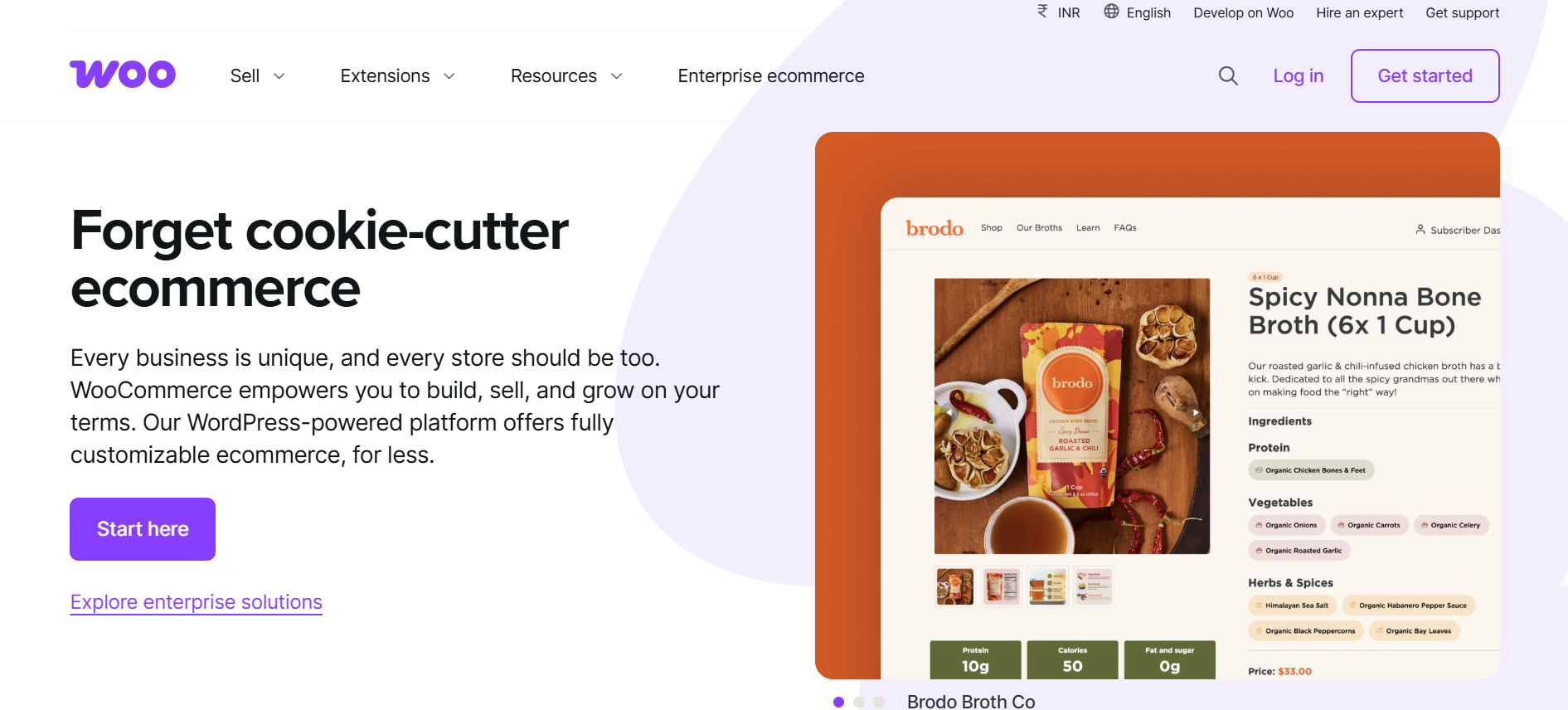
WooCommerce is among the best SEO-friendly e-commerce platforms because of its features like URL customization, built-in 301 redirects, mobile-friendliness, built-in blogging, and text editing.
Features:
- Seamless WordPress Integration
- Built-in Blogging Feature
- Remarkable Flexibility
- Large Library of Extensions
- In-Built Payment Process
- Smooth Integration with Marketing Tools
- Products Sorting & Rating
- Unlimited Products and Product Photos
Also Read: WooCommerce SEO Tips to Boost Your Ranking
Squarespace

Squarespace is also in the race among top eCommerce platforms for SEO with 100 flexible templates, blogging capabilities, mobile responsiveness, and support from users in the Squarespace community.
Features:
- Easy to set up, great for simple stores
- Stunning Template Designs
- Limited Ecommerce Integrations
- Limited Payment Gateways
- Inventory management
- Automatic emailing, Configuring sales taxes
- Custom color palettes, flexible layouts
- Unique background art creation tool
- Built-in photo editing capabilities
- Video and background banners
Volusion

Volusion is SEO-ready due to features like URL customization, 301 redirects, keyword research, content optimization, and blogging.
Features:
- Great On-boarding
- Recurring Payments Included
- SMB Friendly, Lacks Up/Cross-Selling
- Slower Load Times
- Manage Returns
- Subscription-Based Products
- Modern Checkout Solution
- Manage Customer Accounts
How Ecommerce Platforms Impact SEO?
Most eCommerce and web design platforms have ample features that let you optimize your eCommerce stores for search engines like Google, Bing, MSN, Yahoo, and other search engines. Since SEO involves several factors (speed, user experience, meta tags, and more), search for an eCommerce platform that excels with all of them.
Sadly, some eCommerce platforms include only basic, automated SEO tools. So, you’ll need more advanced tools to compete with other brands.
For instance,
A few eCommerce platforms automatically create page titles, metadata, and URLs, depending on your product title and category. They don’t allow you to customize your content. This can adversely affect SEO performance because people are reluctant to search for the creative name you gave to your product. Instead, they use something specific like “shoes for long-distance walking.”
This being said, you need an eCommerce platform that has the quality to supersede the automated metadata and allows you to customize independent SEO elements to target what people are searching for!
Some free eCommerce platforms give you no option to override this. They compel you to pay more for the best SEO features. Therefore, choosing the best eCommerce platforms for SEO right from the beginning is important.
What to Look When Finding the Best Ecommerce Platform for SEO?
Top eCommerce platforms mean you can create the perfect storefront for your business on a relatively modest budget, expand your services and offerings, use built-in tools to engage your customers and prioritize customer service to support customer loyalty, conversion, and retention.

Here’s how to find the best eCommerce platform for SEO to drive more leads and improve conversions.
- Ownership Costs: All platforms have a monthly fee and processing costs. Check their licensing fees, any commission-based costs, hosting costs, maintenance costs, etc.
- Plugins & Integration: Check features like Customer Loyalty Programs, Payment & Shipping, 3rd Party Digital Tools (CRMs, ERPs) Accounting (to get updates about sales, taxes, revenues, and profits), and Email Marketing (to contact customers).
- Themes & User Experience (UX): See built-in themes and customizable UX to deliver the best possible user experience to turn browsers into buyers.
- Speed & Scalability: Evaluate platform performance and scalability. Confirm how many customers the platform can handle at peak traffic times and how it scales horizontally and vertically.
- Product Management System: Scan functions like bulk product upload (CSV, Excel files), categorization, wish list, product comparison, recently viewed, shipping options, sorting, price range, color, size, and location.
- Platform Security: Inspect if the eCommerce provider has the necessary security protocols like an SSL certificate, Level 1 PCI compliance, and authentication of data sources.
- Payment Gateways Support: Consider multiple payment gateways (Stripe, PayPal, Braintree, Amazon Pay, Square, BlueSnap) and support for safely moving funds from customers’ bank accounts to your own.
- Personalization: Make sure the eCommerce platform shows shoppers your products based on age, sex, location, interest, personality, lifestyle, recently viewed items, current searches, or previous purchases.
- Mobile-friendliness: Take a look at whether the design of the eCommerce platform you have chosen supports smooth customer journey, navigation, layout, and general user experience, on smartphones.
- SEO Friendliness: See what SEO capabilities are included, like options to update metadata, add canonical tags, create a custom domain name, access to robot.txt file, customize URL structures, update XML sitemap and integrate Google Analytics.
- Order Management System: Check ERP and CRM through API integration or plugin installation. Also, features like tracking, email notifications, and shipping service API should be considered.
Key SEO Factors for the Best Ecommerce Platform

Key factors that play important roles in how well eCommerce stores rank in the SERPs (search engine results pages):
- Navigation Links Some eCommerce platforms auto-generate Navigation links. For the best SEO experience, select one that lets you customize navigation links.
- Page Titles: Choose an SEO eCommerce platform that offers full functionality to create custom page titles. Maybe you need some basic coding ideas, or you can ask your developer to complete this simple task for you.
- Custom Page URLs: Reputable eCommerce platforms allow the creation of URLs using keywords for the best SEO practice. They let you change the page URL in some way.
- Custom Meta Descriptions: Avoid going with a platform that auto-generates Meta descriptions. Ensure you can create custom descriptions relevant to your products or services to let visitors click on your page.
- Custom H1 Heading: The best eCommerce platform for SEO empowers you to customize H1 tags as per your business requirements to show the most important text on your page.
- Canonical URLs: Make sure the platform you choose allows you to add or edit a canonical URL for an individual blog post, landing page, or website page to keep things “clean.”
- Social Sharing buttons: Check social sharing buttons to let visitors share your site, products, and blog posts on popular social networks. If your platform doesn’t have these buttons, install a plugin or look for a different template.
- Auto XML Sitemaps: Maintaining an XML sitemap for eCommerce is quite difficult. Select an eCommerce platform that automatically generates an XML sitemap whenever a new page is added to or removed from your website.
- 301 Redirects: It’s a command to redirect a browser or search engine from one URL to another. Some eCommerce platforms, like Shopify, have a tool to complete a redirect. While a platform like WooCommerce requires a plugin for this.
What Makes an Ecommerce Platform Good for SEO?
SEO is an important element in online marketing. When building an online store, ensure your eCommerce platform supports all the features to apply SEO best practices.
But what makes an eCommerce platform great for SEO? Get the answer below.
- Page Load Speed: Site speed is important. Ensure the eCommerce platform allows image optimization, minification, caching, and compression to improve site speed.
- Taxonomy Options: The taxonomy options help create brand and category pages and organise groups of posts and custom post types that can drive valuable traffic to your site.
- Customizable HEAD Sections. Many things (like structured data markup, meta robots tags, canonical tags) can be placed in a web page’s HEAD. Use a platform that allows you to add whatever you want to the HEAD section of each individual page.
- Indexing Control: The best eCommerce platform for SEO gives webmasters control over what’s being indexed and what’s not by providing a so-called “canonical tag”. This leads to preventing substantial SEO problems.
- Content Features: Ensure you’re free to add as much content as you like to any product page or category to attract a lot of organic traffic. That positively impacts conversion rates.
- Mobile Optimization: A great eCommerce platform for SEO offers a mobile optimization feature which lets your products fit on any mobile screen size.
Related: Mobile SEO: 18 Easy Techniques to Make Your Site Mobile Friendly
- Meta Descriptions: Meta descriptions impact the click-through rate. The best SEO-friendly eCommerce platform helps you create your own meta descriptions, unlike those that auto-generate based on product descriptions and categories.
- Customization without Developers: Choose an eCommerce platform that enables you to quickly make any architectural changes to the website without help from a developer. You should be able to create and upload well-optimized content by providing a solid framework from which they can work.
- Product Descriptions: A good platform for eCommerce stores lets you write unique and sufficient product descriptions without restrictions because default descriptions by eCommerce platforms are usually fairly short and duplicate.
- Built-In SEO Tools: The right eCommerce platform for SEO allows easy implementation of page titles, meta descriptions & SEO-friendly URLs. It facilitates easily managing your SEO through sitemap generation, canonical URLs, 301 redirect management, and Robots.txt editing.
Conclusion
Choosing the right eCommerce platform is a strategic decision that directly impacts your SEO performance, search visibility, and long-term revenue. While platforms like WooCommerce and Adobe Commerce (Magento) offer advanced SEO flexibility, solutions such as Shopify and BigCommerce provide strong built-in tools and faster deployment. Each platform serves different business needs.
Ultimately, the best eCommerce platform for SEO isn’t just the one with the most features. It is the one aligned with your growth stage, technical resources, and long-term marketing strategy.
If you’re still unsure which eCommerce platform is best for SEO based on your business model, products, and goals, you’re not alone. Many brands struggle with this decision, and choosing the wrong solution can cost time, rankings, and profitability.
This is where we can help.
At ResultFirst, we help businesses choose, implement, and optimize the right platform while ensuring it is fully SEO-ready from day one. Whether you’re launching a new online store or migrating from an existing system, our experts can guide you toward a solution that supports both immediate performance and scalable growth.
Additional Read:
10 Things to Consider Before Switching Ecommerce Platforms
What’s holding brands back from investing in eCommerce?
WHAT TO READ NEXT
READY TO BUILD PREDICTABLE ORGANIC GROWTH?
We are the only TOP SEO services agency providing Real Results in a Real Performance model. We help growth hungry companies outperform their competition and achieve 300%+ growth in their digital marketing initiatives.
- San Jose, CA, 95120

- +1-888-512-1890

- sales@resultfirst.com

300K+
KEYWORDS RANKED
546M+
REVENUE GENERATED
18 Years
SOLVING COMPLEX SEO
150+
TEAM MEMBERS