



 sales@resultfirst.com
 +1-888-512-1890
What Is AI’s Share of Voice and How Do You Measure It?

In the era of AI, how people find brands online has changed. People no longer click through ten blue links to find answers. Instead, they ask questions in AI platforms like Perplexity, ChatGPT, and Google AI Overviews and get direct responses. That shift is reshaping how marketers measure visibility.
Here is the stat that should grab every CMO’s attention: as of early 2026, 73% of B2B buyers use AI tools during their research process. Meanwhile, according to Conductor’s 2026 benchmarks, approximately 93% of AI search sessions end without a single website click.
Your brand could rank on page one of Google and still be completely invisible where buyers are actually making decisions.
That is exactly why AI Share of Voice (AI SoV) matters. This metric shows you how frequently your brand name is mentioned in AI-powered content and how frequently it is not.
This guide will explain to you everything about AI SoV, from the reasons for its implementation to how to calculate it.
What Is AI Share of Voice?
Source: LBZ Advisory
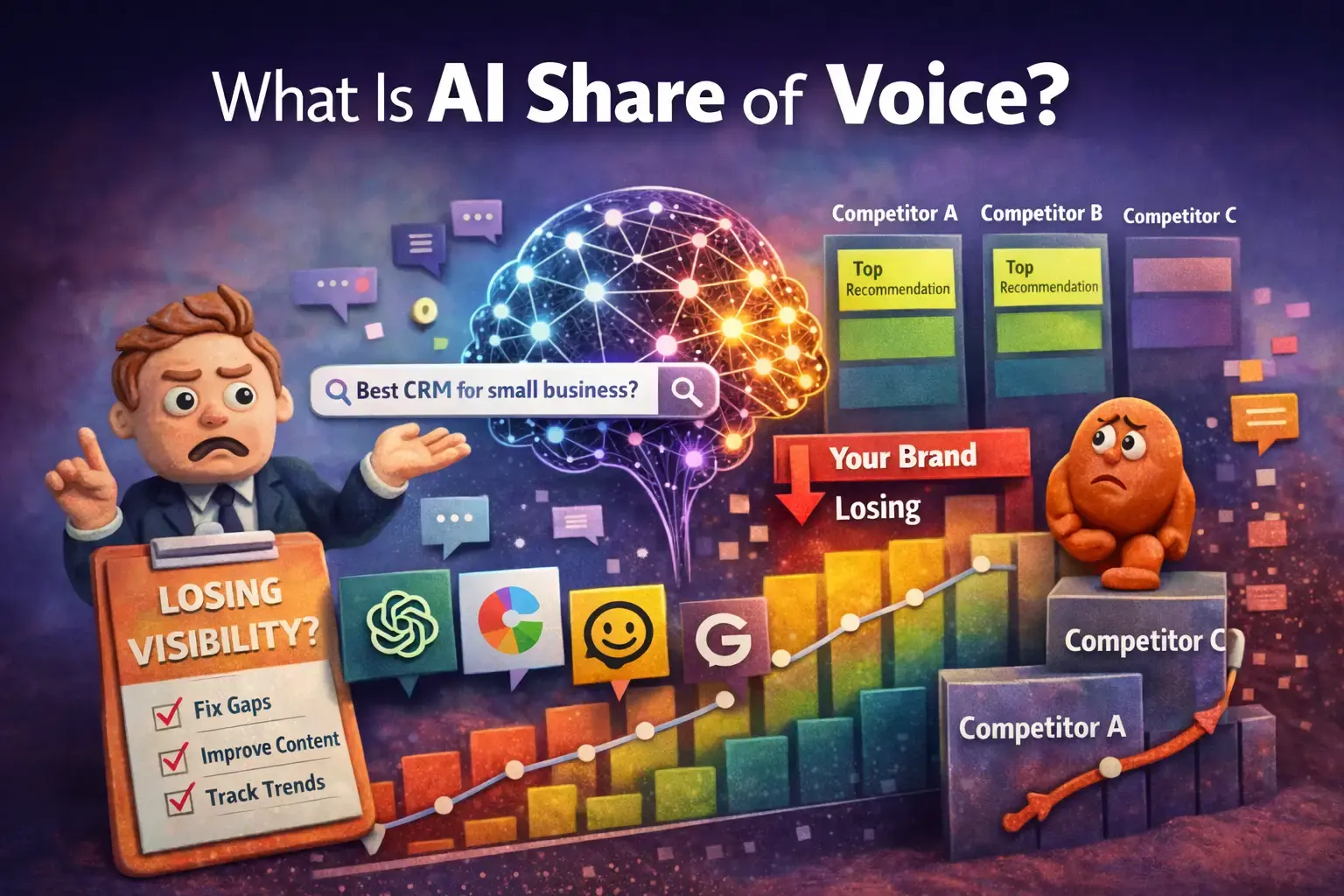
AI Share of Voice is essentially the frequency at which your brand is cited as a source in AI-generated results compared to your competitors. This isn’t related to keyword ranking; it is more about citation frequency on various AI platforms such as ChatGPT, Google AI Overviews, Perplexity, Gemini, Claude, etc.
This is what it is all about: when ChatGPT receives an inquiry such as “What is the best project management tool for remote teams?” will your brand be mentioned? Does a competitor? AI SoV answers that question at scale.
For example, imagine a user asks Perplexity the following:
“What are the best SEO agencies for enterprise businesses?”
If your company appears in 25 out of 100 relevant AI-generated answers, your AI share of voice would be 25%.
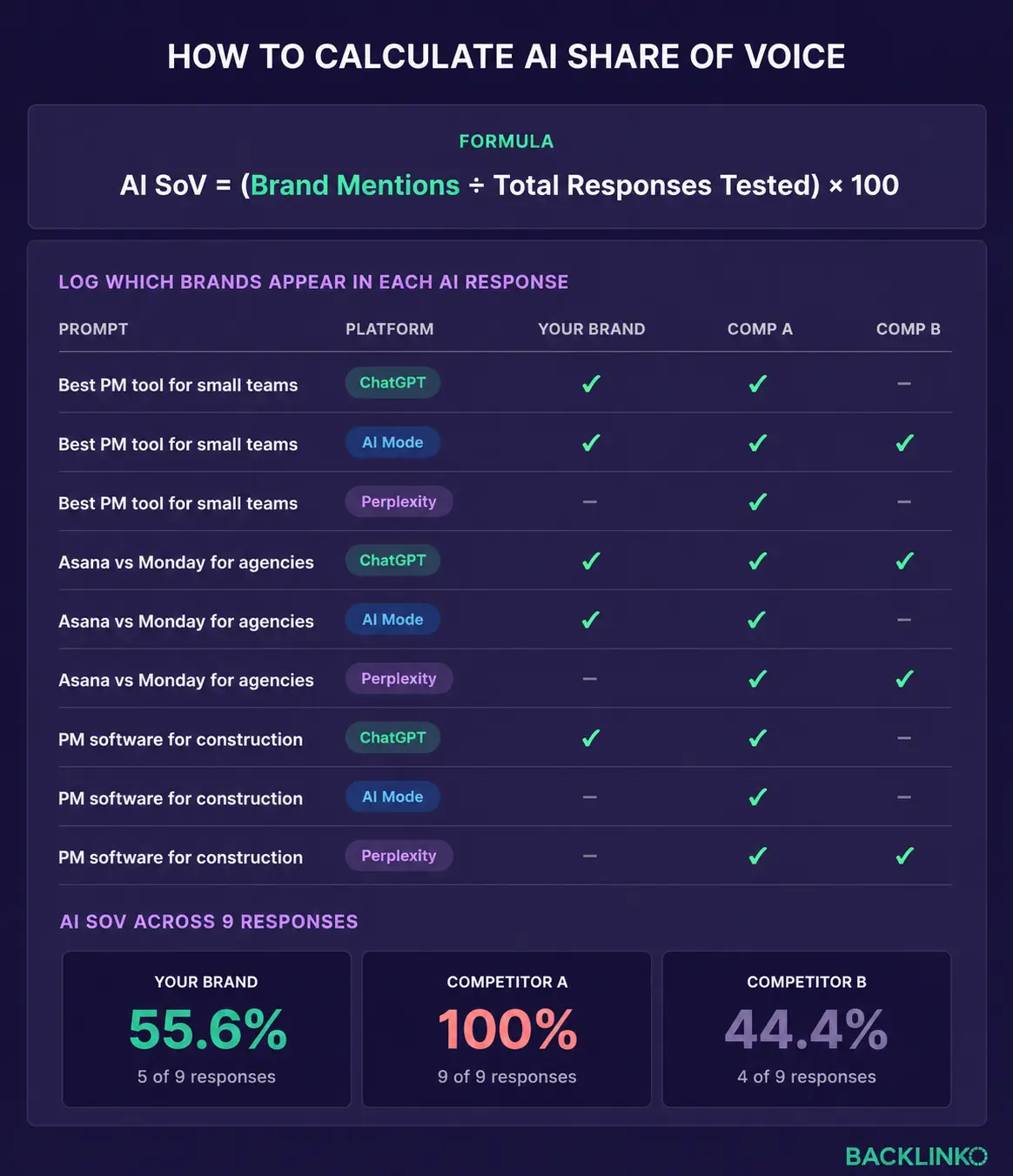
The formula to calculate this:
SOV = (your brand mentions / total brand mentions across tracked prompts) x 100
Source: Backlinko
How AI Share of Voice Differs From Traditional SEO Metrics
Old SOV tied visibility to ad spend, keyword positions, or media mentions. That worked when users clicked links. Today, users receive one synthesized answer. They never see the source list. Gartner predicts traditional search volume may drop 25% due to zero-click answers. Traditional SOV tells you where you rank. AI SoV tells you whether you exist where buyers actually look.
| Factor | Traditional SEO Metrics | AI Share of Voice (AI SoV) |
| Primary Goal | Drive website traffic through search rankings | Increase brand visibility within AI-generated answers |
| What It Measures | Rankings, clicks, impressions, and organic traffic | Brand mentions, citations, and recommendations in AI responses |
| User Journey | Users click a search result to visit a website | Users often get answers directly without clicking |
| Key Success Metric | Higher keyword rankings and traffic growth | Higher frequency of brand appearances in AI answers |
| Authority Signals | Backlinks, keyword relevance, and technical SEO | Expertise, trustworthiness, citations, and topical authority |
| End Result | More website visitors and conversions | More AI visibility, trust, and brand consideration during buyer research |
Why AI SoV Is a Must-Track KPI
Source: Tech Target
Not all visibility is equal, but all of it matters. Appearing in a Google AI overview is different from being cited in a ChatGPT answer. Both signal that AI systems consider your content trustworthy enough to use.
Here is what makes this urgent for your pipeline:
- LLM-referred traffic converts at 30–40%, far above traditional SEO or paid social.
- As of 2026, ChatGPT has 900 million weekly active users, while, Google AI Overviews reach 1.5 billion monthly users.
- Citation volumes for the same brand can differ by 615x between Grok and Claude, making multi-platform tracking non-negotiable.
The AI Visibility Gap
Your brand can be perfectly optimized for Google and still be invisible in AI answers. AI engines pull from a small, trusted set of sources. If your content is hard to parse or lacks authority signals, you get skipped entirely. A competitor with lower domain authority but better-structured content can consistently beat you in AI citations. That gap is a real competitive risk, and most brands have not measured it yet.
How to Measure AI Share of Voice
Source: Fast Slow Motion
Measuring AI SoV follows a clear process. You do not need expensive enterprise tools to start. A spreadsheet and a solid prompt bank can get you your first baseline.
Here is exactly how to do it.
Step 1: Build Your Prompt Bank
Start by listing the questions your buyers actually type into AI tools. These are not short keywords. They are open-ended, conversational prompts, the sort that users type into ChatGPT or Perplexity when they are researching a product.
Try to gather between 20 and 50 prompts. They must be intent-based, and they must contain long-tail wording. Don’t use phrases like “best CRM.” Instead, try something along the lines of “What is the best CRM for a 50-person sales team with a limited budget?” More specific prompts produce better data.
Categorize prompts according to topic or purchase stage. Some prompts will target awareness: “What tools help with AI search visibility?” Others will target a decision: “Which agency should I hire for Answer Engine Optimization?” Both are valuable and equally important to your brand.
Step 2: Run Prompts Across Multiple Platforms
When the bank of prompts is compiled, try each one on at least four websites: ChatGPT, Perplexity, Gemini, and Claude. They use their unique sources and cite their brands in different ways. Something that appears on Perplexity might not appear on ChatGPT, and so forth.
Each time you get a response, list all the brands cited in that response, whether positively or negatively. Take down the name of the website you used, the prompt itself, and all the brands that were mentioned in it. Do this consistently across every cycle.
Step 3: Calculate Your Citation Share
After having collected your data, the calculations become straightforward.
Find out how many times your brand was mentioned throughout the entire exercise. Find out how many mentions of all brands occurred during the exercise altogether. Divide the first result by the second one. Multiply by 100.
That number is your AI SoV score.
The formula is simple:
AI Share of Voice = Brand Mentions ÷ Total Mentions × 100
Example:
- Total mentions across prompts = 500
- Your brand mentions = 100
AI Share of Voice = 20%
This gives you a benchmark for future growth.
Step 4: Benchmark Against Competitors
Your score only gets meaning by comparison. Retrieve the same citation count for your top three or five competitors based on the same dataset.
With an AI SoV score of 12% and a competitor with 30%, you immediately understand what you have to achieve. If a newer competitor you barely track holds 25%, that is a signal worth acting on fast. Competitive context turns a data point into a strategic priority.
Track each competitor’s score alongside yours every week. Watch for shifts. A sudden rise in a competitor’s SoV indicates that they have either produced a powerful output, received a prominent mention, or revamped their content for AI extraction.
Step 5: Track Weekly, Not Monthly
AI models update often. Citation patterns shift faster than traditional search rankings do. When a monthly measurement is done, one can only deal with old information. A weekly schedule keeps one up to date and provides enough cycles for detecting patterns and reacting while there is still time to outperform competitors.
Schedule a weekly activity. Set a recurring weekly task. Run the same prompt bank. Log the results. Compare week over week. Over time, this rhythm turns AI SoV from a one-time audit into a living competitive intelligence system.
Best Tools to Track Your AI Share of Voice
You do not need to do this work by hand. Many smart tools now exist to track AI visibility for you. These tools save time and give you accurate data.
Tools for Every Budget
Here are some of the top options in the market today:
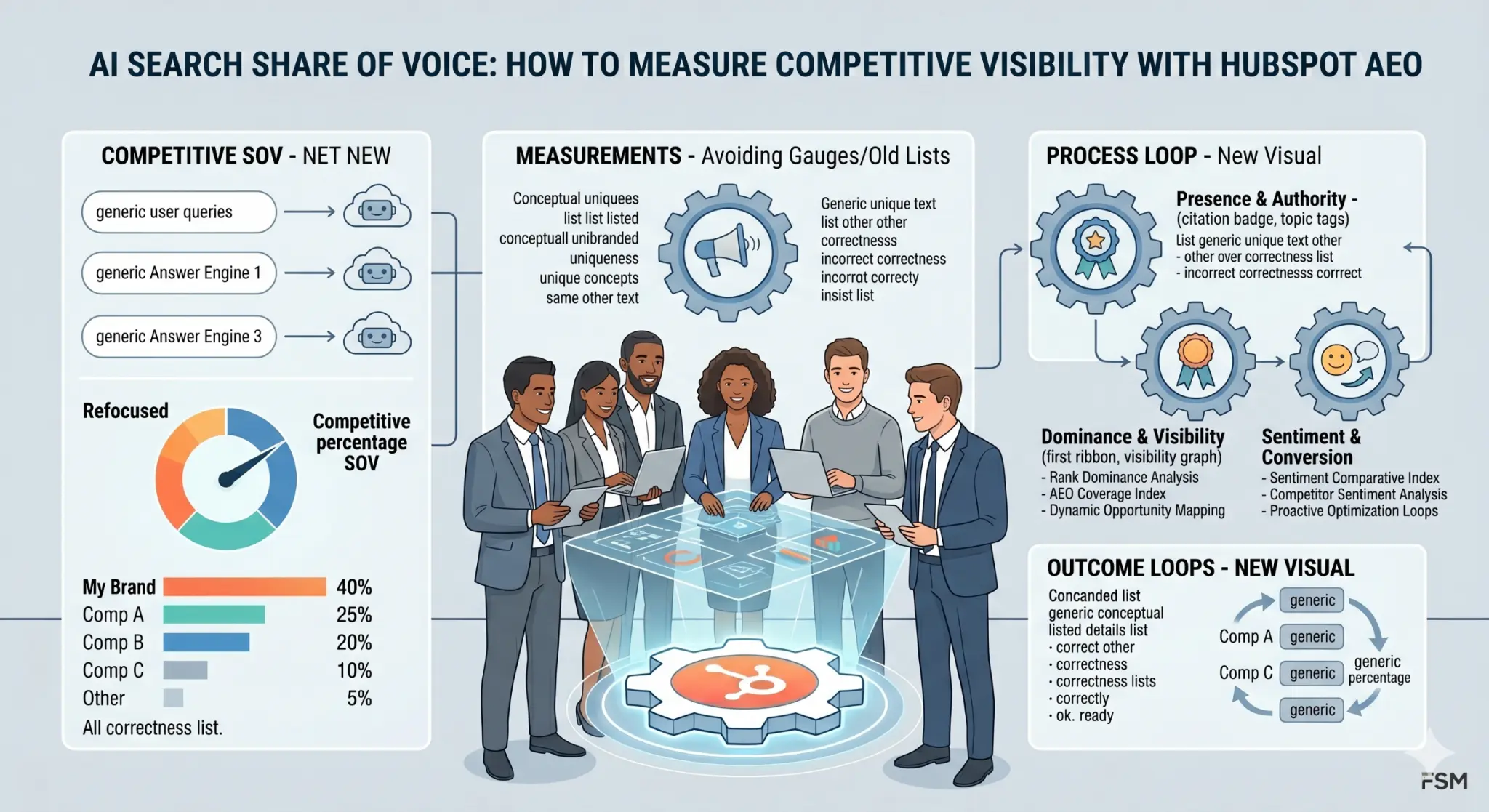
- HubSpot AEO Tool: Tracks mentions across ChatGPT, Perplexity, and Gemini. Gives you a simple share of voice score. Great for mid-market teams.
- Ahrefs Brand Radar: Monitors over 350 million search prompts across six AI platforms. You can search any brand instantly. No setup required.
- Similarweb AI Brand Visibility: Shows both visibility percentage and mention share. It automatically counts every brand in the responses.
- Semrush AI Visibility Toolkit: Tracks your presence across ChatGPT, Google AI Mode, and Perplexity. Puts all metrics in one view.
- Akii AI Search Tracker: The first tool to unify visibility across Google AI, ChatGPT, Perplexity, and Copilot.
Each tool has a different price and feature set. Start with a free audit. Then invest in the tool that fits your needs.
How to Improve Your AI Share of Voice
Measuring is the first step. This is where things start getting done when growing SoV with AI. There are some common elements among brands mentioned by AI: their content is fresh, structured, and authoritative.
Here are the most effective strategies:
- Make your site crawlable for AI bots. Make your website readable for AI spiders. Grant permission to both GPTBot and CCBot to crawl your website. Your pages will not be cited by AI bots if they can’t read them.
- Use question-based headings. Structure content the way buyers ask questions. AI engines extract answers from well-labeled sections much more easily.
- Write answer-first content. Lead with the direct answer. Then add supporting detail. This mirrors how AI systems prefer to pull information.
- Add schema markup. Structured data helps AI engines understand your content type, context, and credibility.
- Update content regularly. AI systems favor fresh content. A freshness calendar for key pages is now a core content operations requirement.
Earn Third-Party Validation
Your AI sources will have faith in any sources that have been cited by other sources it trusts. As such, gaining backlinks from trustworthy publishers, academics, trade magazines, and popular industry blogs immediately makes you a likely source for being cited by AI.
Branded search volume also rises when AI SoV improves. Users see your brand cited in an AI answer and then search for you directly on Google. People are exposed to your brand being cited in an AI response and then search for it on Google.
Monitor Sentiment, Not Just Mentions
Appearing in AI answers is not always good news. If an AI system describes your brand negatively, even in passing, that matters. Effective AI SoV measurement tracks sentiment alongside frequency. Negative mentions can harm your brand more than no mention at all.
Conclusion
AI has changed the game for brand visibility. The conversations that win customers now happen inside chatbots and answer engines. Clicks and rankings still matter, but they no longer tell the full story. AI Share of Voice gives you the missing piece. It tells you if AI trusts your brand enough to recommend it.
The brands that win in the next five years will be the ones that measure and optimize their AI SOV today. Stop relying on old metrics alone. Start tracking how AI talks about you. Your future market share depends on it.
AI Share of Voice becomes valuable when you use it to improve how your brand is discovered across AI platforms. ResultFirst helps businesses turn AI visibility insights into practical growth strategies through our AI Search Optimization Services. Ready to understand where your brand stands? Get in touch with ResultFirst and start building stronger visibility across AI-powered search.
Sources Referenced:
- https://finance.yahoo.com/sectors/technology/articles/73-b2b-buyers-ai-tools-231200431.html
- https://medium.com/@brian-curry-research/the-ai-dark-funnel-why-93-of-your-customer-journey-is-now-invisible-to-analytics-a8fe287558c7
- https://www.gartner.com/en/newsroom/press-releases/2024-02-19-gartner-predicts-search-engine-volume-will-drop-25-percent-by-2026-due-to-ai-chatbots-and-other-virtual-agents
- https://venturebeat.com/technology/llm-referred-traffic-converts-at-30-40-and-most-enterprises-arent-optimizing
- https://quickseo.ai/blog/ai-search-vs-google-search-in-2026-40-stats-that-show-why-your-brand-needs-to-track-both
FAQs:
WHAT TO READ NEXT
READY TO BUILD PREDICTABLE ORGANIC GROWTH?
We are the only TOP SEO services agency providing Real Results in a Real Performance model. We help growth hungry companies outperform their competition and achieve 300%+ growth in their digital marketing initiatives.
- San Jose, CA, 95120

- +1-888-512-1890

- sales@resultfirst.com

300K+
KEYWORDS RANKED
546M+
REVENUE GENERATED
18 Years
SOLVING COMPLEX SEO
150+
TEAM MEMBERS