


 sales@resultfirst.com
 +1-888-512-1890
Website Traffic Without Conversions: Is It an SEO Problem or a CRO Problem?

Website traffic looks great on reports. However, traffic alone does not grow revenue. Conversions do.
Many marketing leaders face the same issue. Their website attracts visitors, but leads and sales stay flat. This creates confusion. And here’s the question everyone asks wrong: “Is our SEO broken?”
Sometimes it is. But often, SEO is doing its job just fine. The real gap is what happens after the visitor lands on the page.
According to recent data, roughly 60% of all Google searches now end without a single click to any website. AI overviews, featured snippets, and zero-click results have depleted the pool of traffic. That means every visitor who does reach your site is more valuable than ever before. Wasting their potential is not something you can afford anymore.
So what is the actual situation? Is it a matter of SEO, CRO, or both? This guide will make everything clear for you. After reading it, you will precisely know where the hole in your revenue chain is.
What SEO and CRO Actually Do
Most marketing teams treat SEO and CRO as separate departments with separate goals. One team chases rankings. The other team runs A/B tests. But the truth is, these two functions share one outcome: revenue from your website.
SEO brings people to your front door. CRO makes sure that people will enter, remain, and make a purchase. If traffic fails to convert, the first instinct may be to blame it on SEO. However, it doesn’t matter how high you are in ranking if your landing page pushes visitors away from your website.
SEO: Getting Found Online
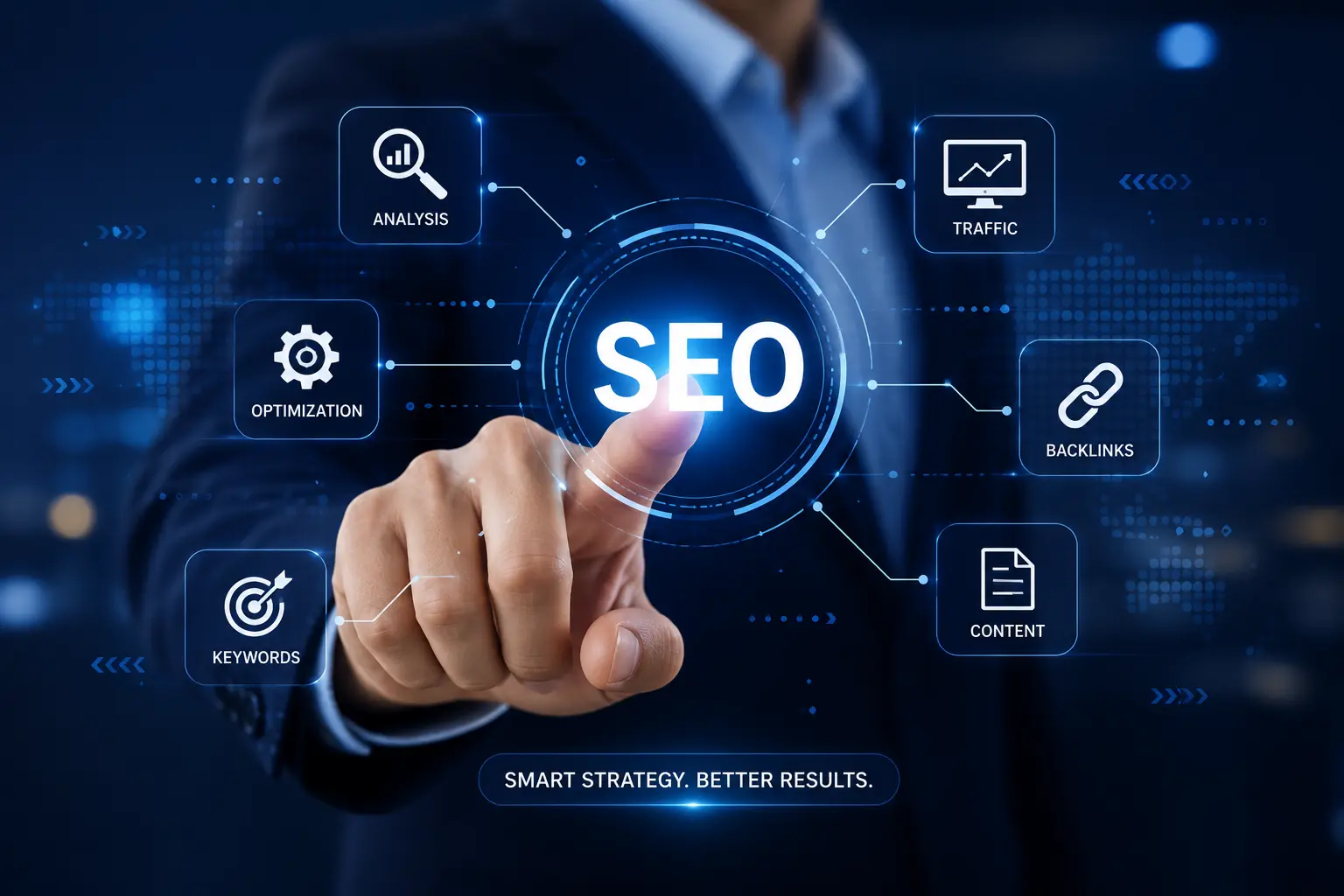
Search engine optimization helps your website appear in searches. Quality SEO includes the following:
- Ranking for keywords that have the right intent
- Answering questions through content creation
- Establishing authority to make search engines trust your website
- Addressing technical problems preventing indexing and visitor flow
But when SEO is done well, the right people will find you at the right time. However, once they land on your site, the job of SEO is over. That’s where CRO comes into play.
CRO: Turning Visitors into Customers
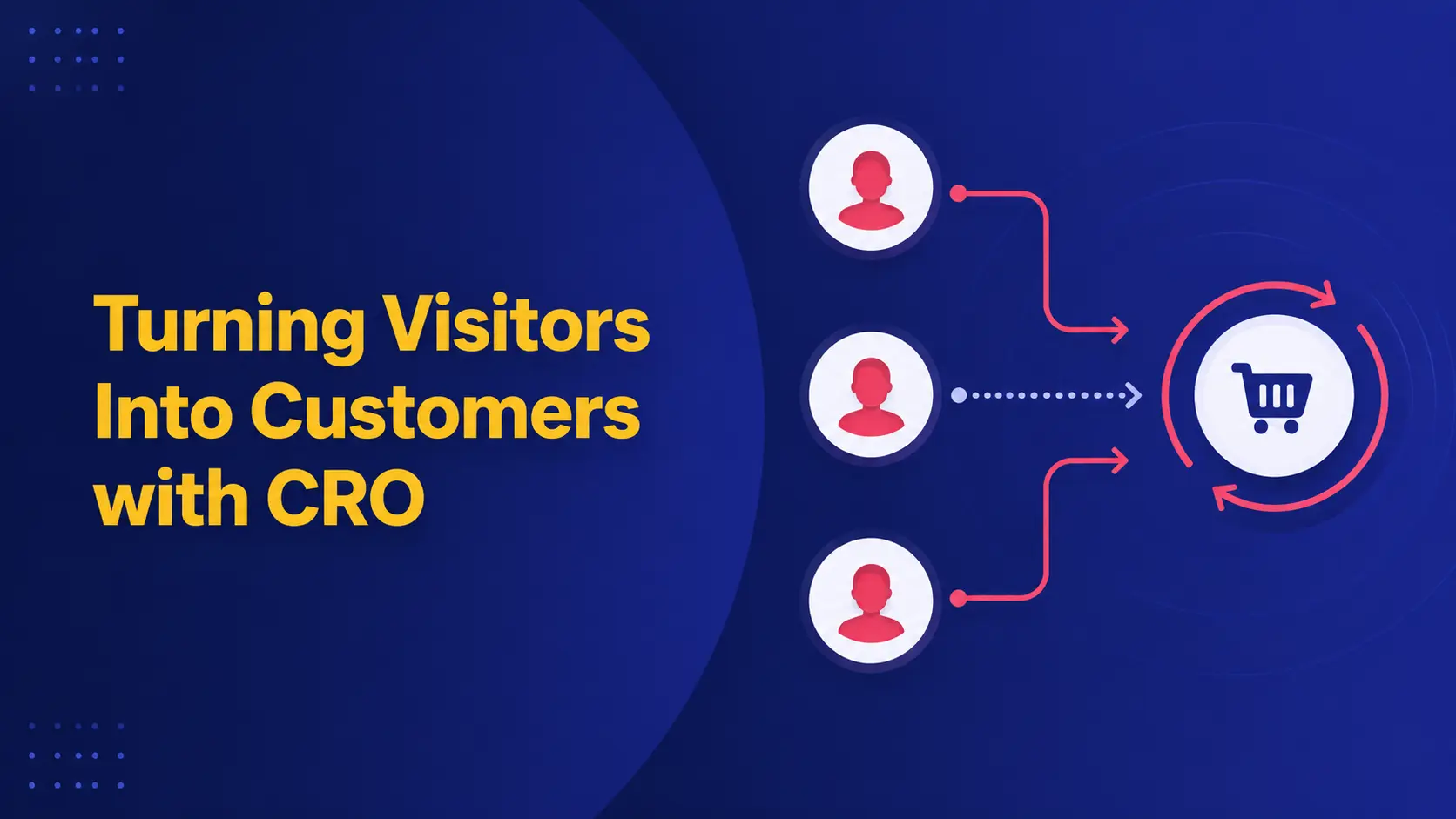
Conversion rate optimization focuses on what happens on your website. It answers one question: why do visitors leave without taking action? CRO involves:
- Headline testing
- CTA testing
- Website layout testing
- Page load speed and mobile optimizations
- Form friction reduction
- Message alignment with visitor intent
- Trust building (reviews, case studies, etc.)
One positive aspect is the fact that the conversion rate for most websites is just 2.35%. However, for high-converting websites, the conversion rate is above 11%. The difference between average and best is always a CRO problem rather than an SEO problem.
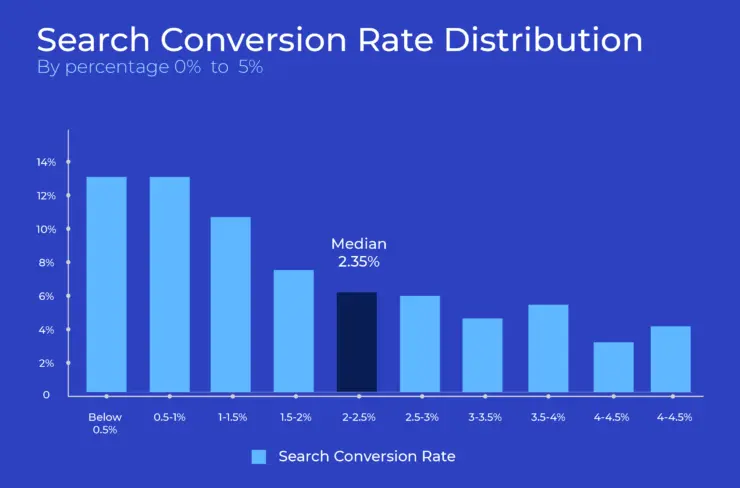
Source: Invespcro
How to Tell If You Have an SEO Problem
Before you assume your landing page is the issue, you must first determine whether you are getting enough of the right kind of traffic. Poor SEO results in low traffic, low visibility, and irrelevant traffic. If any of the following apply, then your conversion problem may come from your SEO.
The key here is to understand all these signs in combination and not in isolation. The information in itself is never enough, but when these signs come into play, it is time to concentrate on the search strategy
Signs Your SEO Needs Work
- Too low an amount of organic traffic: If you receive fewer than several hundred visitors a month, this means that people cannot find you on Google.
- You rank on irrelevant keywords: Informational keywords mean that people visit you to get information and not to purchase something, while high-intent keywords mean that people will purchase something.
- Bounce rate is too high for organic traffic: If visitors leave your website in 10 seconds or even faster, it means that the content is bad.
- Bad CTR (click-through rate): If you have a bad click-through rate on the page with results, it means that your meta description and title attract too few people.
- Poor-quality or duplicated content: Good content will rank higher and will be found by the right visitors, while poor-quality and duplicated content will rank very low.
- Technical issues: Broken links, loading problems, and crawl issues stop search.
How to Tell If You Have a CRO Problem
Here comes the opposite situation. Let’s say that your organic traffic is fine, you get decent numbers of monthly visitors, strong keyword rankings, and even strong CTR, yet your conversion rate is below 1%. Guess what? It’s not an SEO problem; it’s a CRO problem!
As per the recent stats, businesses spend $92 for traffic generation for every $1 for converting that traffic. This ratio reveals why the majority of sites fail to unlock their full revenue-generating potential. The fix isn’t more traffic. The fix is better conversion.
Signs Your CRO Needs Work
- High traffic, no conversions: People visit your website, look around, and leave without doing anything.
- Good SEO ranking, but no increase in sales: SEO is working, but you still have no new leads.
- Visitors abandon your website at certain stages: There is a pattern in their abandoning process that you can see in heat maps or funnels.
- Long loading time: Even 1 second of extra time in page loading time can decrease your conversion rate by 7%.
- Poor CTA: Users don’t know what to do next. Your call to action is not visible.
- Absence of trust-building elements on your page: Absence of testimonials, certification, and case studies makes users doubt your product/service.
- Bad mobile version: If 60% of traffic comes from mobile phones, you lose potential customers quietly.
Quick fix: Adding a video to your landing page will give you an additional 80% of conversions.
Personalizing your CTAs can improve conversion rate by as much as 202%. These are CRO levers, not SEO levers.
The “Wrong Traffic” Problem: When SEO and CRO Both Miss
Sometimes the problem is neither purely SEO nor purely CRO. Sometimes the issue is an intent mismatch. Your site ranks well. Your page looks polished. But the visitors arriving are not your buyers; they are researchers, students, or people looking for free information.
This is a structural problem that sits between both disciplines. It’s one of the most overlooked conversion killers. Fixing it requires both teams to work together.
What Intent Mismatch Looks Like
| Scenario | What’s Happening | Fix |
| Blog ranks for “what is CRM software” | Attracts curious readers, not buyers | Add bottom-of-funnel CTAs + create buyer-ready pages |
| Landing pages target broad keywords | Mixed-intent visitors arrive | Narrow targeting to high-intent, purchase-ready terms |
| Content ranks, but doesn’t match the brand | The wrong audience converts poorly | Align content to your ICP (Ideal Customer Profile) |
The visitors who DO reach your site in today’s AI search era are often higher intent than before. Many casual browsers now get their answers directly from Google’s AI Overviews. The people clicking through to your site genuinely want to go deeper. That makes it even more critical to deliver an experience that earns their trust immediately.
Aligning SEO Keywords With Buyer Intent
Great SEO for conversions means targeting the right keywords, not just the high-volume ones. Consider the difference:
- Informational keyword: “how does email marketing work?” attracts learners
- Commercial keyword: “best email marketing platform for SaaS” attracts evaluators
- Transactional keyword: “email marketing software pricing” attracts buyers
Most underperforming websites rank heavily for informational keywords and wonder why nobody converts. The answer is simple: they are attracting the wrong stage of the buying journey.
When SEO and CRO Work Together, Revenue Follows
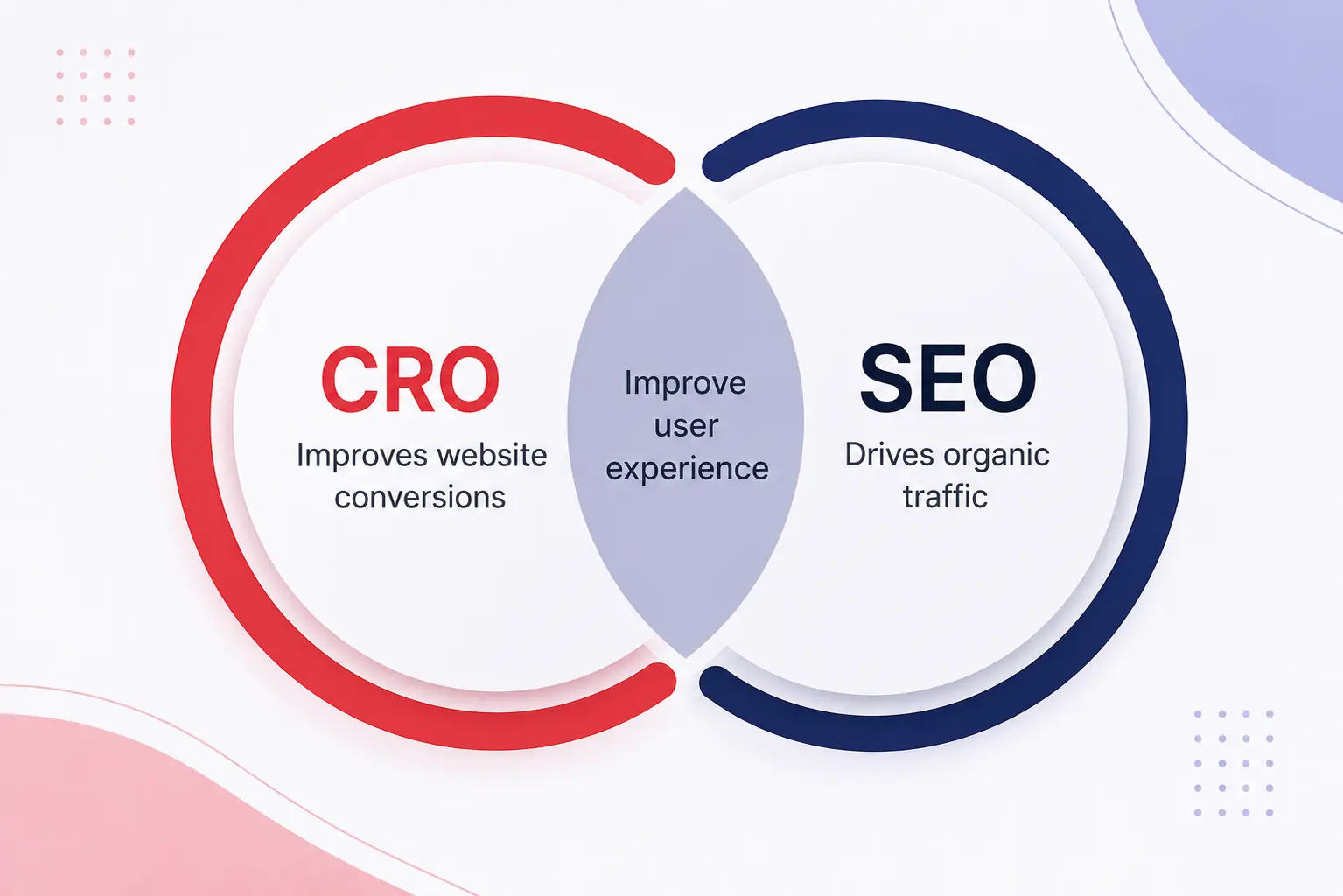
Marketing teams that are the most successful in 2025 and 2026 have already learned not to view their SEO and CRO efforts in isolation. These two aspects amplify one another when operating together. A better UX not only drives conversions but also boosts ranking. The result is a positive feedback loop that gets stronger and stronger with time.
Think about this: organic search traffic converts 8.5x better than outbound traffic. In other words, the visitors who come to you via Google are already warmed up. All it takes is providing them with a good experience. A poor one wastes the best traffic you have.
CRO Improvements That Also Help SEO
- Page Speed Improvement: Lowers bounce rate (CRO success) and increases Core Web Vitals (SEO success)
- Content Organization: Enables quicker navigation for users (CRO success) and helps Google in understanding your content (SEO success)
- Optimization for Mobile: Lowers mobile bounce rate (CRO success) and assists Google’s mobile-first indexing (SEO success)
- Internal Linking: Helps guide users toward their next move (CRO success) and spreads page authority (SEO success)
- Effective Headlines: Attracts users’ attention (CRO success) and increases click-through rate in search engines (SEO success)
Main idea: Time on page, scrolling depth, and bounce rate are user behavioral indicators monitored by search engines. When your CRO improvements keep users engaged, your SEO ranks get higher as well. These fields are not rivals but complement each other.
How to Diagnose Your Own Traffic-to-Conversion Gap
You do not need to guess. You need a simple diagnostic framework. Start with data before you start spending. The right sequence saves both time and budget, and it builds the kind of cross-functional consideration that VP-level decision-makers rely on.
Step 1: Check Your Traffic Quality
- Go to Google Search Console: Performance: check which keywords are sending traffic
- Filter for keywords with high impressions but low clicks (CTR problem, SEO fix needed)
- Filter for keywords sending traffic but resulting in zero conversions (intent problem, both SEO and CRO fix)
Step 2: Audit Your On-Page Experience
- Run a Google PageSpeed Insights test for your top-performing landing pages.
- Analyze where people click through or scroll using a heat map analyzer such as Hotjar and Microsoft Clarity.
- Check your form completion rate: Where do users start filling in and then abandon?
- Perform testing of your mobile experience on an actual device and not just on a simulated browser.
Step 3: Ask the Right Diagnostic Questions
- Is traffic growing, but conversions are flat? CRO problem
- Is traffic low despite good content? SEO problem
- Is traffic growing, but from the wrong audience? Intent and keyword strategy problem
- Are paid ads converting, but organic traffic is not? Page experience problem (CRO) for organic pages
- Are conversions happening, but at a low rate? CRO optimization needed
Final Thoughts
Traffic without conversions is a sign of a problem. But it is a problem you can fix. It is rarely a choice between SEO and CRO. The issue is usually a combination of both. SEO brings people to your website. CRO gives them the confidence to take the next step. When they work together, your website becomes a stronger growth channel.
The first step is understanding where the real bottleneck exists. Look closely at your keyword intent, user experience, and conversion journey. Is your content attracting the right audience? Does your website make it easy for visitors to trust your brand and take action? The answers to those questions will tell you where to focus next.
Knowing whether your challenge is SEO, CRO, or a combination of both is what helps businesses make smarter marketing decisions. If your website is attracting visitors but not generating the leads or sales you expect, that’s where ResultFirst can help. As an SEO Services Agency, we build strategies that improve traffic quality, strengthen on-page performance, and align SEO with real business goals, helping turn more of your existing traffic into measurable growth.
Sources Referenced:
- https://www.linkedin.com/top-content/marketing/generating-leads-online/conversion-rate-optimization-for-lead-generation/#:~:text=For%20every%20%2492-,spent,-on%20generating%20leads
- https://www.smartinsights.com/digital-marketing-platforms/video-marketing/personalized-video-landing-pages-that-convert/#:~:text=videos%20on%20landing-,pages,-increased%20conversions%20by
- https://www.forbes.com/councils/forbesbusinesscouncil/2026/03/02/the-zero-click-economy-why-60-of-searches-end-without-a-click-and-what-ceos-should-do-about-it
FAQs:
WHAT TO READ NEXT
READY TO BUILD PREDICTABLE ORGANIC GROWTH?
We are the only TOP SEO services agency providing Real Results in a Real Performance model. We help growth hungry companies outperform their competition and achieve 300%+ growth in their digital marketing initiatives.
- San Jose, CA, 95120

- +1-888-512-1890

- sales@resultfirst.com

300K+
KEYWORDS RANKED
546M+
REVENUE GENERATED
18 Years
SOLVING COMPLEX SEO
150+
TEAM MEMBERS