



 sales@resultfirst.com
 +1-888-512-1890
What Content Should a Law Firm Produce to Rank for High-Intent Legal Searches

Finding a lawyer online is not like shopping for shoes. People search with fear, stress, and a sense of urgency. When a user types “hire a car accident lawyer near me,” they are not browsing for fun. They need help fast.
Here is a powerful stat: 78% of all legal searches now show AI-generated overviews on Google, and organic traffic for law firms dropped by 19% last year. In fact, 96% of people seeking legal advice now start their search online.
To win in 2026, you cannot just write random blog posts. You must create specific content for high-intent legal searches. Content that answers real questions. Content that builds trust. Content that turns a searcher into a client.
Today, the users see directly within ChatGPT, Perplexity, and Copilot are being intercepted, as are clicks to businesses’ websites from AI searches, Google’s AI Overviews, and AI Mode. This is not only happening but also growing, and it is affecting large law firms much more than other industries due to the history of Big Law content marketing.
This guide will show you exactly what to write to turn readers into paying clients.
What Are High-Intent Legal Searches and Why Are They Important?
High-intent searches are queries from people who are ready to take action. They are not just curious. They want help now.
For law firms, these searches fall into a few clear patterns:
- Transactional: “Hire a DUI attorney in Dallas”
- Local: “Car accident lawyer near me”
- Urgent: “What do I do after a slip and fall accident?”
- Decision-stage: “Best personal injury lawyer in Chicago”
These searches are gold for law firms. The person typing them is not browsing. They are deciding. Your content needs to meet them at that moment and answer their question better than anyone else.
For example, a person might search for a car accident lawyer near me after a crash. This search shows commercial and transactional intent. The user wants to find a local expert, compare options, and call an office.
Organic search drives up to 66% of call conversions in the legal industry. This means high-intent searchers are the most valuable visitors for your website.
With answer engines, AI Overviews, and voice search rising fast, your content must be the direct answer, not just a page that contains keywords. The best practices for optimizing content for answer engines all point to one thing: solve the problem clearly and completely.
The Shift From Informational to Transactional Content
For years, law firms wrote “What is personal injury?” blog posts. But Google changed. Why? Because AI now answers those simple questions instantly.
Users get their answer right on the search page. They never click your link. So you must stop writing shallow definitions. Instead, write content that shows you are the best choice for their specific problem.
This shift is why AI SEO services now prioritize transactional content. You want to answer the question “Why should I pick YOU?” not just “What is the law?” When you focus on your unique value, you beat the AI answers every time.
Let’s take a look at what content a law firm should produce to rank for high-intent legal searches.
1. Practice Area Pages: Your Foundation for High-Intent Rankings
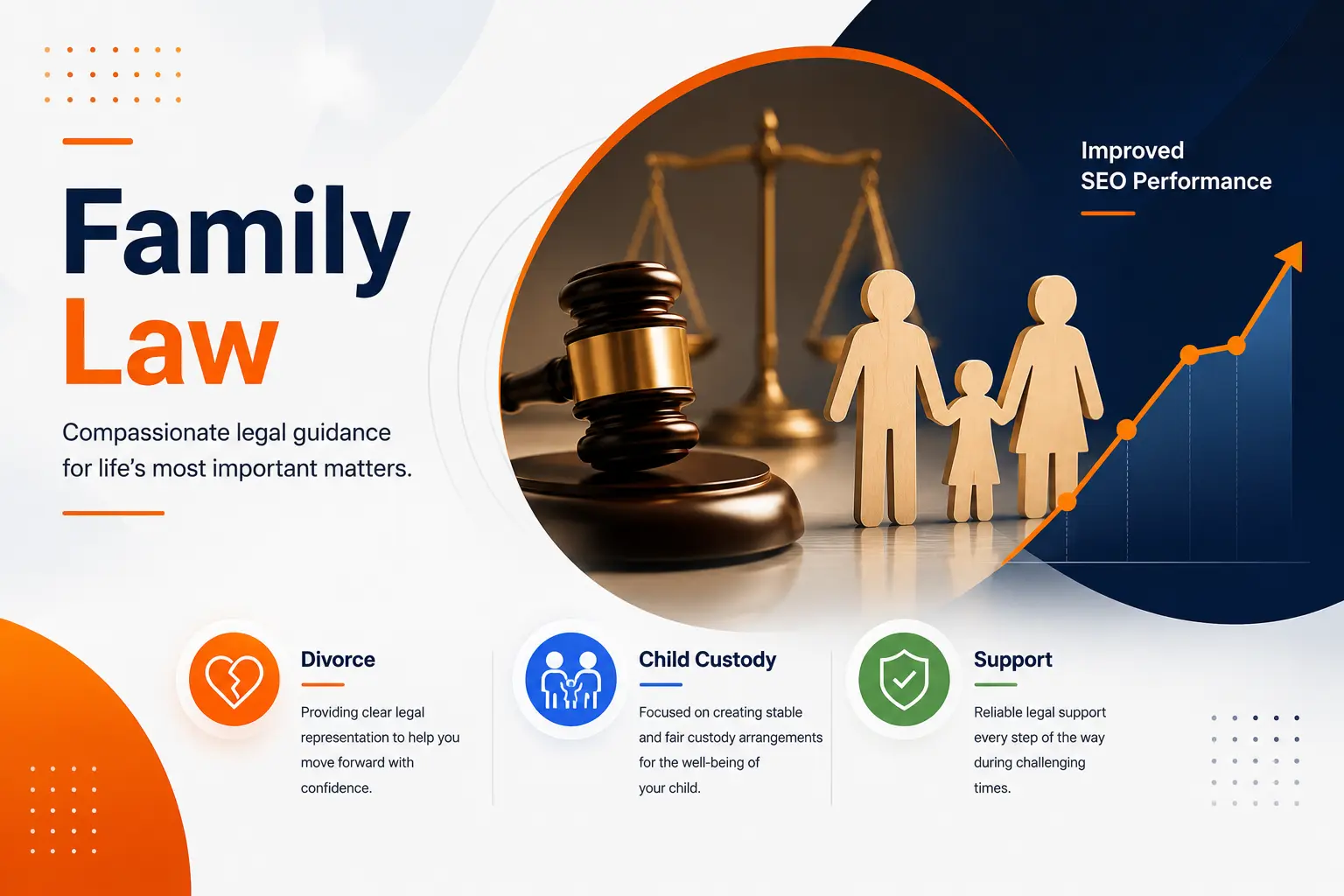
Every law firm needs strong practice area pages. These are the backbone of your SEO strategy and often the first place a high-intent searcher lands.
A weak practice area page lists services. A strong one answers questions, builds trust, and moves the visitor toward a consultation.
What Strong Practice Area Pages Include
Your practice area pages need to do more than describe what you do. They need to address the exact concerns a potential client has when they search for help.
Include these elements on every practice area page:
- A clear explanation of the legal issue in plain English
- What the process looks like from start to finish
- Common mistakes clients make (and how your firm helps them avoid them)
- What outcomes clients can realistically expect
- Attorney credentials relevant to that practice area
- A strong call to action with a phone number or form
Use Semantic Clusters, Not Just Keywords
Google understands connected concepts. If your page is about car accident cases, it should also naturally mention terms like insurance claims, medical bills, fault determination, and settlement timelines. This shows Google that you understand the full topic.
This approach, called semantic SEO, also helps with AI SEO services and answer engine optimization. AI tools pull from content that shows deep expertise, not just keyword repetition.
2. Blog Content: Answering the Questions Clients Actually Ask
Blogs are not optional for law firms anymore. They are how you capture the massive volume of question-based searches that happen before someone is ready to hire.
But not all blog content works. Generic posts like “Why You Need a Lawyer” do nothing. Specific, question-based posts that match real search behavior drive real traffic.
Types of Blog Posts That Attract High-Intent Traffic
The best law firm blog content falls into a few proven categories:
“What Happens If” Posts: These match the exact language people use when they are worried or scared.
- “What happens if I miss a court date?”
- “What happens if insurance denies my claim?”
- “What happens if I refuse a breathalyzer in Florida?”
“How Much Does It Cost?” Post: Cost is one of the most searched topics in legal. People want to know before they call.
- “How much does a divorce lawyer cost in California?”
- “How much compensation can I get for a car accident?”
“Step by Step” Guides: These rank well for people in the middle of a legal situation who need to understand what comes next.
- “Step-by-step guide to filing a workers’ comp claim in Ohio”
- “How to respond to a custody modification request”
Write for Answer Engines, Not Just Google
The best practices for optimizing content for answer engines require a specific structure. AI tools like Google’s AI Overviews and ChatGPT pull answers from content that is clearly organized. That means:
- Start your blog with a direct answer to the question in the title
- Use short paragraphs that address one idea at a time
- Add numbered steps or bulleted lists where it helps
- Use FAQ sections at the end of every post
Zero-click Google searches jumped from 56% to 69%. That means more people are getting answers without clicking. If your content is structured well, your firm gets cited as the source, even without a click. That builds brand authority and trust.
3. Local SEO Content: The Fastest Path to High-Intent Clients
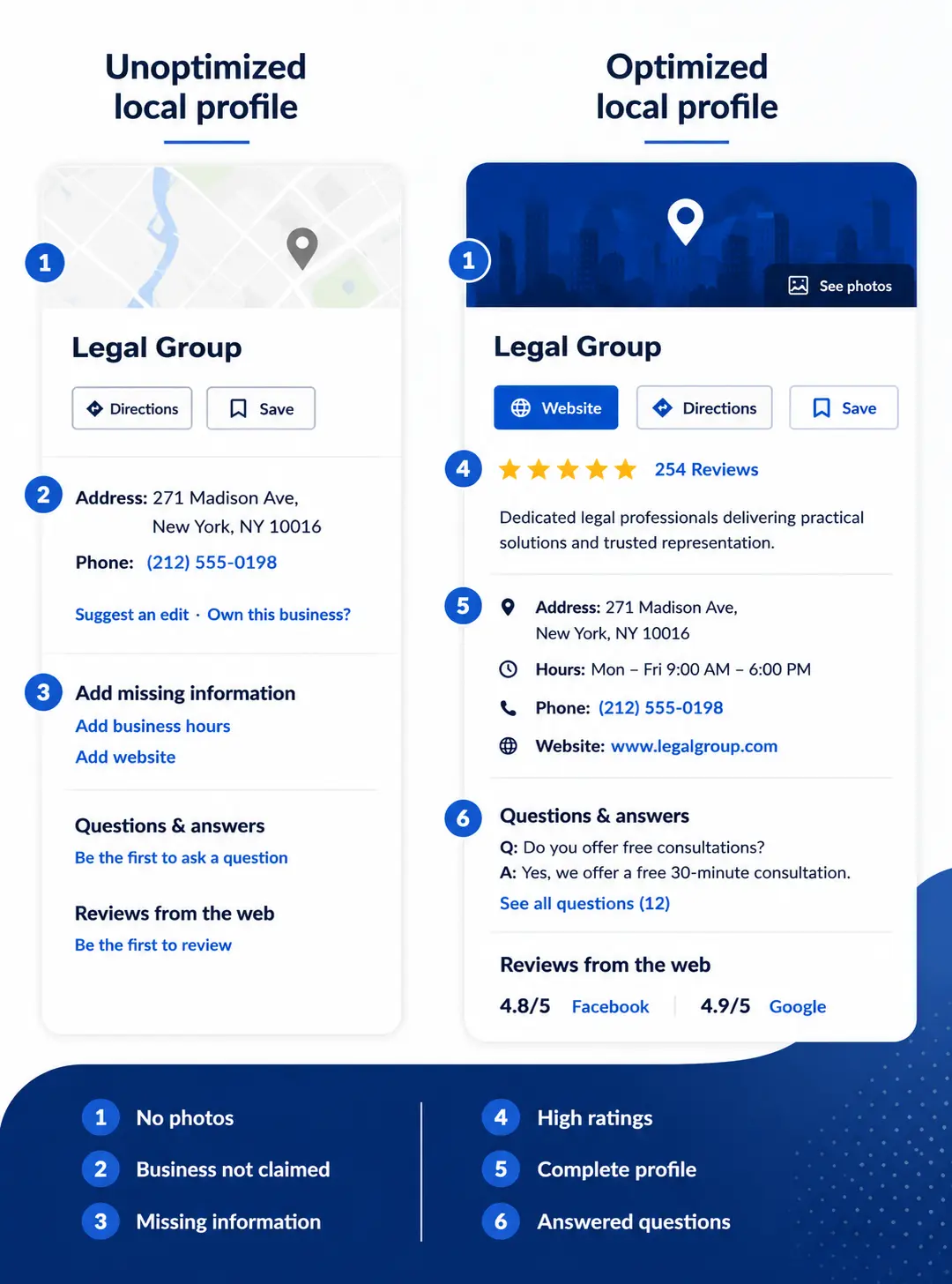
Local content is where law firms win the most high-intent traffic. When someone searches “personal injury lawyer near me,” they are ready to call. Your local content strategy determines whether that call comes to you.
Mobile “near me” searches for legal services have increased by 500% in recent years, highlighting how quickly potential clients now turn to local search when they need legal help.
City and Location Pages
If your firm serves multiple cities or counties, create a dedicated page for each one. Do not copy and paste the same content with just the city name changed. That approach gets penalized and ignored.
Instead, make each page genuinely useful for someone in that area:
- Reference local courts, local laws, or local statutes that apply
- Mention specific neighborhoods or landmarks when relevant
- Include a local phone number and address
- Add attorney bios that mention local bar memberships or local case experience
Google Business Profile Content
Your Google Business Profile is content, too. Treat it that way.
Post updates weekly. Answer the questions people ask in the Q&A section. Respond to every review. Add photos of your office and team. Firms with complete, active profiles generate 7x more engagement than those with incomplete listings.
For high-intent local searches, the Google Map Pack often shows before regular results. Winning that spot depends heavily on how well-maintained your profile is.
4. FAQ Pages and Schema Markup: Winning the Answer Engine Game
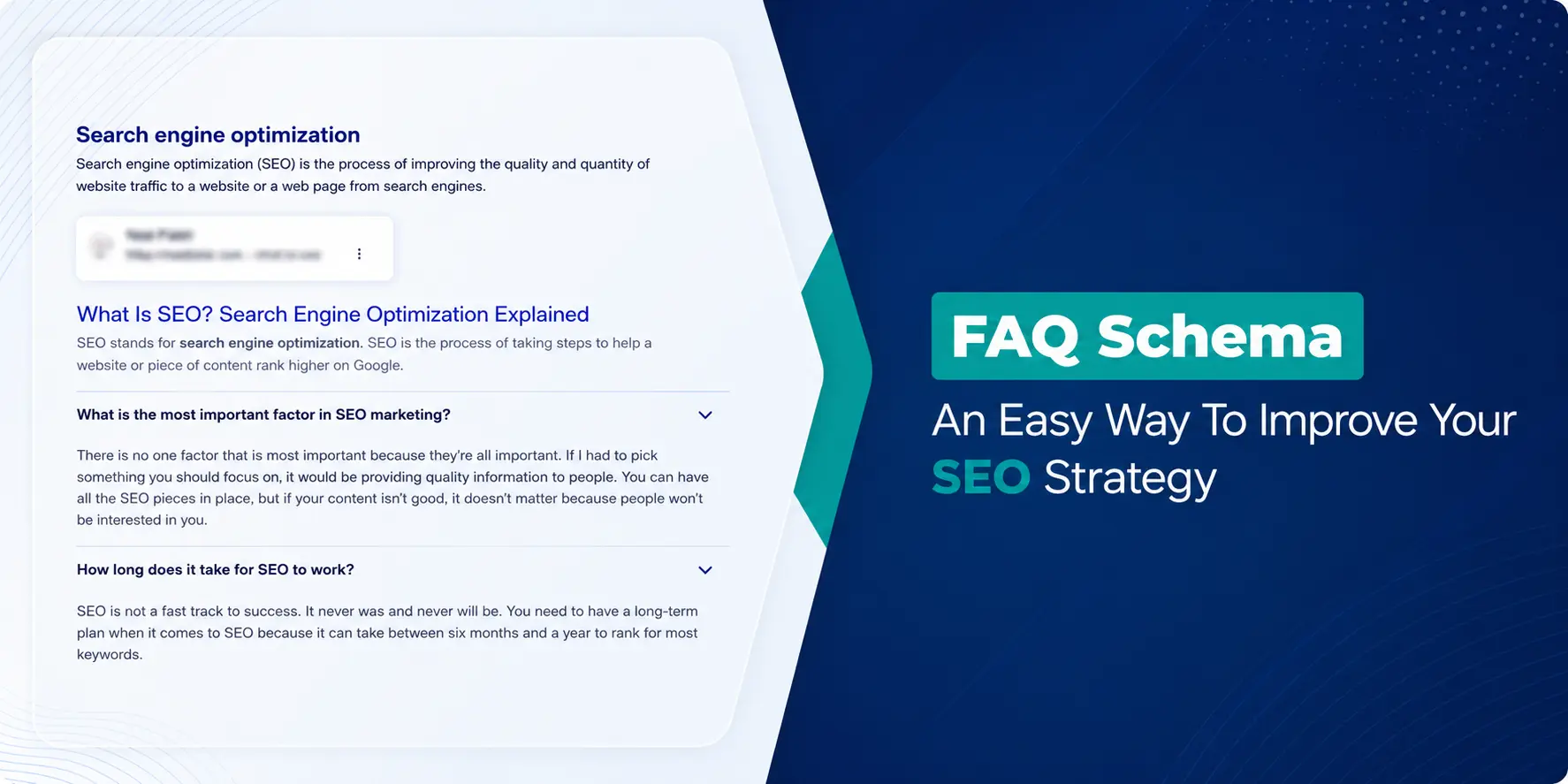
FAQ pages are one of the most powerful tools law firms underuse. Done right, they directly feed the best practices for optimizing content for answer engines and put your firm in AI-generated answers.
When someone searches “Can I sue my landlord for mold?” and your FAQ page has a clear, concise answer to that exact question, Google and AI tools are far more likely to pull your answer and show it to the user.
How to Build Effective Legal FAQ Pages
Focus your FAQ pages on the real questions clients ask. The best source for these questions is your own intake team. Ask them what clients ask most often in their first call. Then build FAQs around those exact questions.
Structure each answer to start with a direct response:
Q: Can I be fired for filing a workers’ comp claim? A: No. In most states, it is illegal for an employer to fire you for filing a workers’ compensation claim. This is called retaliatory discharge.
Then expand with two to three more sentences of helpful context.
Add FAQ Schema Markup
Schema markup is code that tells Google exactly what your FAQ content is. It helps your FAQ answers appear directly in search results as expandable questions. This markup is one of the most important technical steps in AI SEO services for law firms today.
Work with your web team to add FAQ schema to every practice area page and every blog post that includes question-and-answer content.
5. Case Studies and Client Stories: Building EEAT Through Real Proof
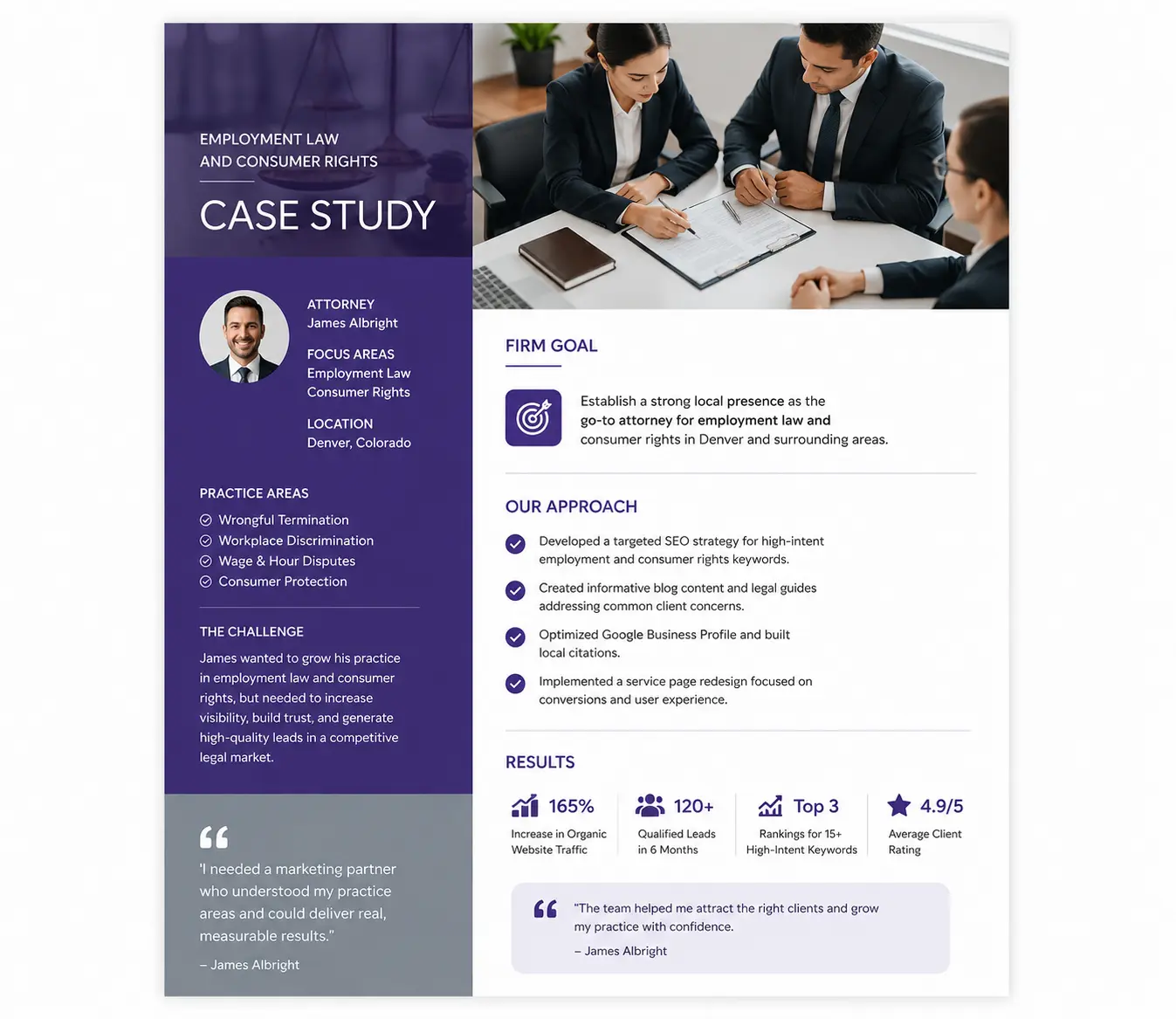
Google’s EEAT framework stands for Experience, Expertise, Authority, and Trustworthiness. For law firms, this means showing real results, not just making claims.
Case studies and client stories do this better than any other content type. They show Google and potential clients that your firm has actually handled cases like theirs and gotten results.
How to Write Legal Case Studies That Rank
A strong legal case study follows a simple format:
- The situation: What was the client dealing with when they came to you?
- The challenge: What made the case difficult or complex?
- The approach: What did your firm do? What strategy did you use?
- The result: What happened? What did the client receive or avoid?
6. Video Content: The Rising Force in Legal SEO
Video is no longer optional for law firms serious about ranking. Short-form video is now a core part of law firm content marketing, and platforms like YouTube act as search engines in their own right.
More importantly, placing a video on your practice area pages and blog posts increases the time visitors spend on your site. That signal tells Google your content is valuable, which helps rankings.
What Types of Legal Videos Perform Best
- Attorney Q&A videos: Record a 60–90 second answer to a common legal question. Keep it simple and direct.
- Process explainers: Walk clients through what to expect in a case step by step.
- Settlement and verdict announcements: These build authority and attract searches from people with similar cases.
Conclusion
High-intent legal searches are your fast track to more clients. Stop writing generic articles that AI can answer instantly. Start writing deep service pages, client question blogs, and specific location content. Show your wins. Prove your authority. Keep your sentences short and your phone number visible.
Law firms that consistently publish high-intent content gain visibility across traditional search, AI overviews, and answer engines. The challenge is building a strategy that aligns content, local SEO, and conversion goals. That’s where specialized legal SEO expertise can help.
High-intent legal searches reward law firms that publish the right content at the right stage of the client journey. ResultFirst helps law firms build content strategies that improve visibility for high-intent legal searches and attract qualified legal leads through our law firm SEO services. Ready to strengthen your firm’s online presence? Contact ResultFirst to discuss your strategy and mention this guide for a complimentary content audit.
Sources Referenced:
- https://rankings.io/seo-for-lawyers/
- https://www.answeringlegal.com/blog/7-things-didnt-know-law-firm-marketing
- https://seoprofy.com/blog/legal-marketing-statistics/
- https://www.seroundtable.com/similarweb-google-zero-click-search-growth-39706.html
FAQs:
WHAT TO READ NEXT
READY TO BUILD PREDICTABLE ORGANIC GROWTH?
We are the only TOP SEO services agency providing Real Results in a Real Performance model. We help growth hungry companies outperform their competition and achieve 300%+ growth in their digital marketing initiatives.
- San Jose, CA, 95120

- +1-888-512-1890

- sales@resultfirst.com

300K+
KEYWORDS RANKED
546M+
REVENUE GENERATED
18 Years
SOLVING COMPLEX SEO
150+
TEAM MEMBERS