



 sales@resultfirst.com
 +1-888-512-1890
10 Best Ecommerce SEO Agencies in the United States (2026)

U.S. ecommerce is now a $1.23 trillion market. In 2025, online retail sales reached $1.2337 trillion, growing 5.4% from the previous year and accounting for 16.4% of total U.S. retail sales. The momentum has continued. In the second quarter of 2026, e-commerce sales reached $340.2 billion, up 12.2% year over year.
As online competition grows, ecommerce SEO has become more complex than ranking individual product pages. Stores must compete across Google Search, Shopping, AI Overviews, product comparisons, marketplaces, and other discovery channels.
Ecommerce websites also face challenges that typical business sites do not. Thousands of product URLs, variants, filters, duplicate pages, seasonal inventory, pagination, and discontinued products can create serious technical SEO issues.
That makes choosing the right ecommerce SEO agency important. A capable agency should understand technical SEO, product and category optimization, site architecture, structured data, internal linking, and emerging AI search experiences.
This guide compares 10 of the best ecommerce SEO agencies serving the U.S. market and explains what each offers.
How We Selected These Ecommerce SEO Companies
The companies were assessed using ecommerce-specific criteria rather than generic SEO factors.
1. Ecommerce SEO experience
An agency should demonstrate experience with product pages, category pages, ecommerce architecture, product variants, faceted navigation, and commercial search intent.
2. Technical SEO capability
Large ecommerce websites can generate thousands or millions of crawlable URLs. The agency needs a process for handling indexation, canonicalization, redirects, crawl efficiency, internal linking, structured data, JavaScript rendering, and site migrations.
3. Platform expertise
Shopify, WooCommerce, Magento or Adobe Commerce, BigCommerce, and custom ecommerce platforms do not behave identically.
An agency should understand the technical limitations and SEO opportunities of the platform your store actually uses.
4. Revenue measurement
Traffic and rankings matter, but ecommerce SEO ultimately needs to support transactions and revenue.
A strong reporting process should connect organic visibility with conversions, product performance, revenue, and other commercial metrics.
5. AI search readiness
Search behavior is expanding beyond traditional blue links.
Google AI Overviews and other generative search systems can summarize products, compare options, answer purchasing questions, and recommend brands.
Modern ecommerce SEO therefore needs content and structured data that can be understood by both conventional search engines and AI systems.
10 Best Ecommerce SEO Agencies in the United States
1. ResultFirst: Best Performance-Based Ecommerce SEO Agency
ResultFirst stands out for its pay-for-performance SEO model, which ties fees to agreed outcomes instead of a fixed monthly retainer. This shifts more of the performance risk to the agency.
Its ecommerce SEO services cover technical SEO, keyword research, product and category optimization, internal linking, structured data, Google Shopping, content, and performance tracking. It supports Shopify, Magento, BigCommerce, WooCommerce, Amazon, and Salesforce Commerce Cloud.
What sets ResultFirst apart in 2026:
- Scale and experience: 18+ years in business, 150+ team members, 300,000+ keywords ranked, and $546M+ in client revenue generated.
- AI search expertise: Its GEO and AEO services target visibility across ChatGPT, Perplexity, Gemini, and Google AI Overviews. Reported results include a 753% increase in LLM referral traffic and a 950% increase in AI Overview visibility for PlushBeds.
- Ecommerce depth: Product and category optimization, technical audits, product schema, and GA4 ecommerce revenue tracking.
- Global SEO: Multilingual and international SEO for ecommerce brands selling across multiple markets.
For US ecommerce brands looking for performance accountability rather than a traditional retainer, ResultFirst is worth considering. See its ecommerce SEO services or contact the agency.
- Best for: Performance-based ecommerce SEO
- Platforms: Shopify, Magento, WooCommerce
- Notable ecommerce clients: Samsung, MedCline, PlushBeds, BaxterBoo, Clovia
- Pricing model: Pay-for-performance
- Location: San Jose, CA
2. OuterBox: Ecommerce SEO for Large and Complex Catalogs

Image Source: OuterBox
OuterBox has specialized in ecommerce since 2004. Its current ecommerce SEO services cover technical SEO, content, product and category optimization, CRO, analytics, development, and AI search.
Large catalogs create different SEO problems from smaller websites. Filters can generate thousands of URLs. Product variants can create duplication. Category structures can become difficult to crawl. Important products can become several clicks away from the homepage.
The agency reports 20+ years of experience, 1,000+ client partnerships, 2 million+ page-one Google rankings, and 300+ U.S.-based in-house experts. Its ecommerce work also spans Shopify, Magento, BigCommerce, WooCommerce, and other platforms.
OuterBox is a good fit for ecommerce businesses where SEO requires more than content updates. Large catalogs, complicated navigation, technical problems, and conversion issues often need to be addressed together.
- Best for: Large and complex ecommerce catalogs
- Platforms: Shopify, Magento, BigCommerce, WooCommerce
- Key strength: Technical SEO combined with development and CRO
3. Thrive Internet Marketing Agency: Best for Integrated Digital Marketing
Image Source: Thrive
Thrive combines ecommerce SEO with other digital marketing services, including PPC, content marketing, web development, social media, and conversion optimization. Its ecommerce SEO work focuses on improving product and category visibility while strengthening the technical foundation of the store.
This broader approach can work well for ecommerce brands that manage SEO alongside paid search and other acquisition channels. Instead of treating organic search as a separate activity, the different channels can be managed as part of one wider marketing strategy.
- Best for: Integrated ecommerce marketing
- Focus: SEO, PPC, content, development, and CRO
- Key strength: Connecting SEO with broader digital marketing
4. Coalition Technologies: Best for Ecommerce SEO and Development
Image Source: Coalition Technologies
Coalition Technologies combines ecommerce SEO with web development, paid media, content, and conversion optimization. That makes it useful for stores where technical website issues directly affect organic visibility.
Its ecommerce SEO services cover technical SEO, product and category optimization, site architecture, structured data, and AI search. The agency works with platforms including Shopify, BigCommerce, WooCommerce, and Magento.
Coalition is particularly relevant for ecommerce brands that need both SEO strategy and technical implementation rather than SEO recommendations alone.
- Best for: SEO combined with development
- Platforms: Shopify, BigCommerce, WooCommerce, Magento
- Key strength: Technical ecommerce SEO and implementation
5. First Page Sage: Best for Research-Led Ecommerce SEO
Image Source: First Page Sage
First Page Sage takes a research-driven approach to SEO. Its ecommerce strategy combines search research, long-form content, authority building, and optimization for emerging AI search environments.
This approach can be useful for ecommerce brands in competitive categories where shoppers research products before making a purchase. Buying guides, comparisons, educational content, and product-focused resources can capture that demand before shoppers reach a specific product page.
- Best for: Research-led ecommerce SEO
- Focus: SEO, content, GEO, and AEO
- Key strength: Search research and authoritative content
6. Siege Media: Best for Content-Led Ecommerce Growth
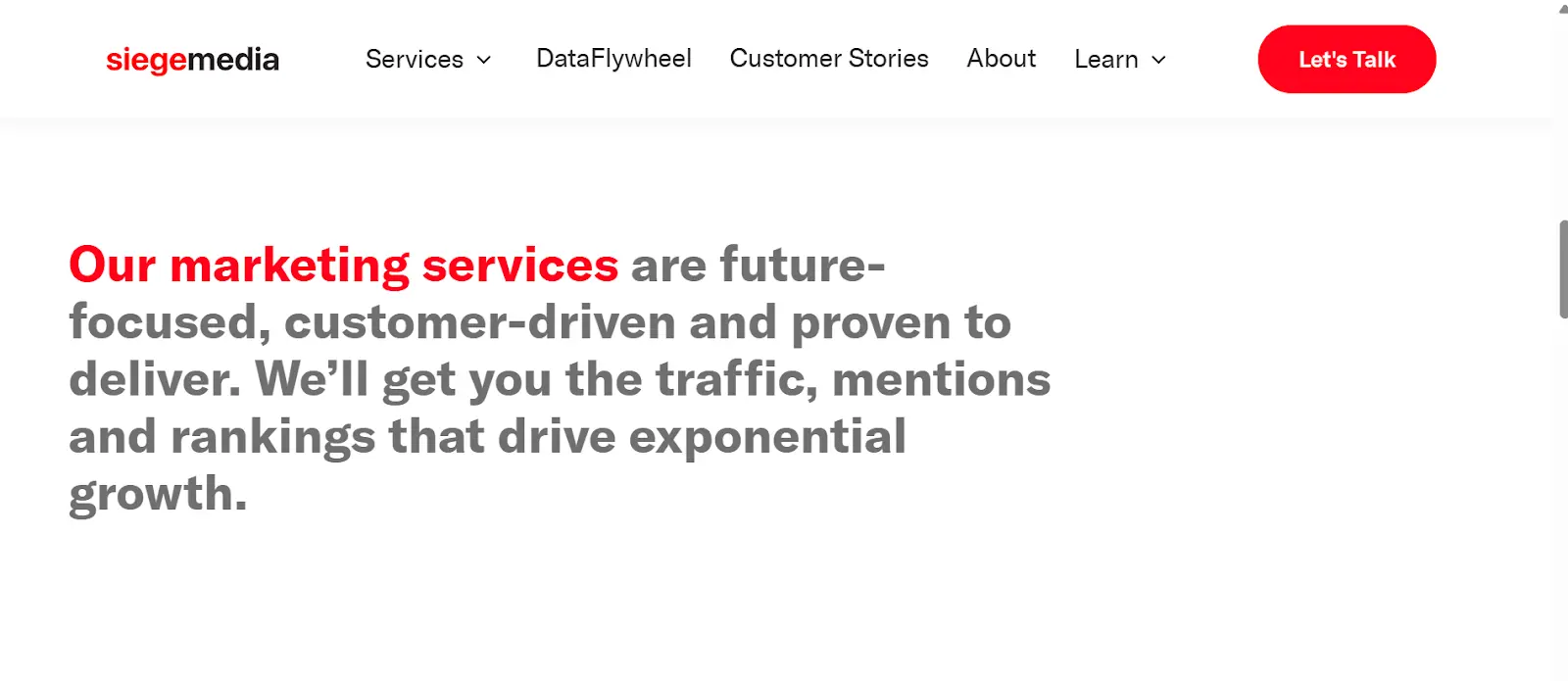
Image Source: Siege Media
Siege Media focuses heavily on content as a driver of organic growth. Its ecommerce strategy uses buying guides, comparisons, product education, and other useful content to reach shoppers earlier in the buying journey.
This approach is particularly relevant when product pages alone cannot capture enough search demand. Strong supporting content can attract informational searches and then guide users toward relevant categories and products.
- Best for: Content-led ecommerce SEO
- Focus: Content, organic traffic, and link acquisition
- Key strength: Building search visibility through useful content
7. Inflow: Best for Experiment-Driven SEO Rollouts
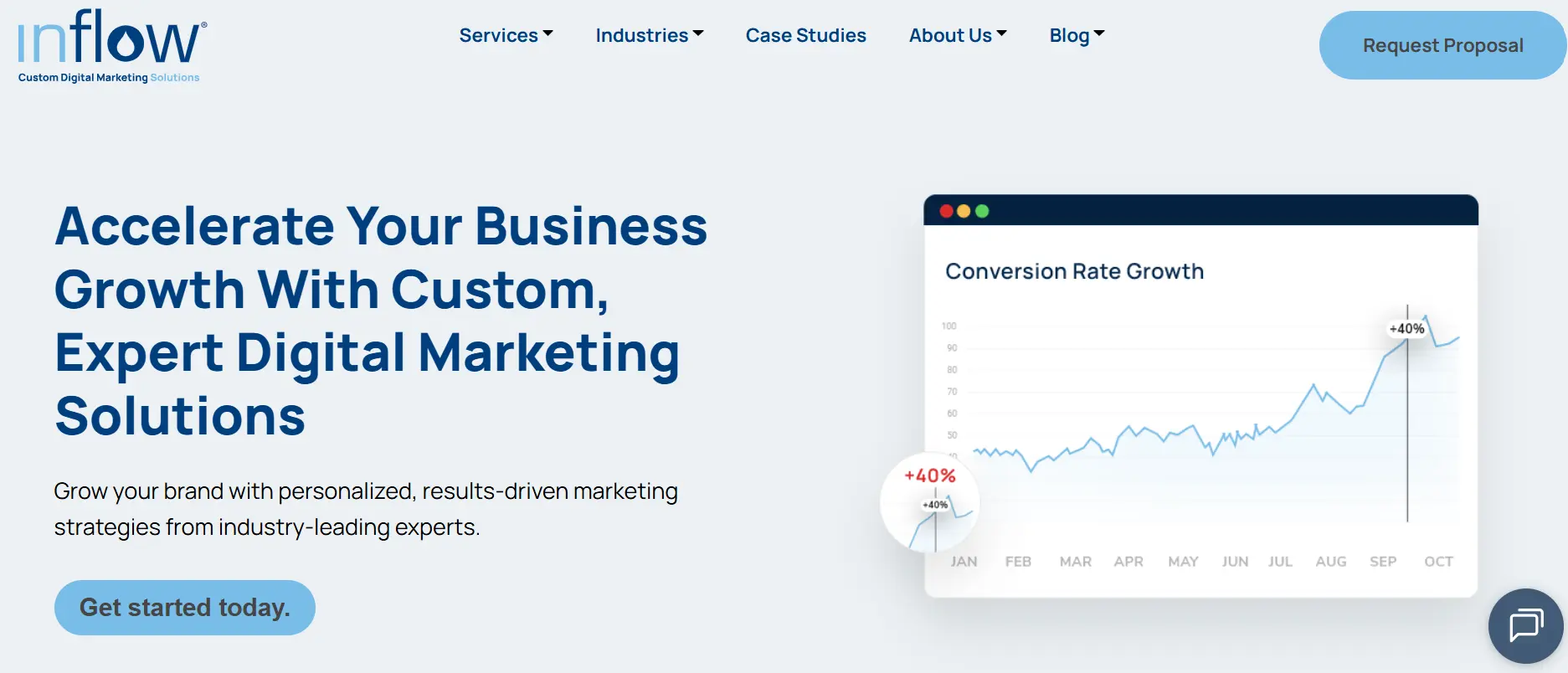
Image Source: Inflow
Inflow specializes in ecommerce SEO and focuses on organic growth, technical optimization, content, analytics, and conversion performance.
Its ecommerce-first approach is useful because online stores have different SEO requirements from standard business websites. Product catalogs, category structures, inventory changes, and conversion data all need to be considered when building an SEO strategy.
- Best for: Ecommerce-focused SEO
- Focus: Technical SEO, content, analytics, and CRO
- Key strength: Ecommerce specialization
8. Searchbloom: Best for Scalable Ecommerce SEO
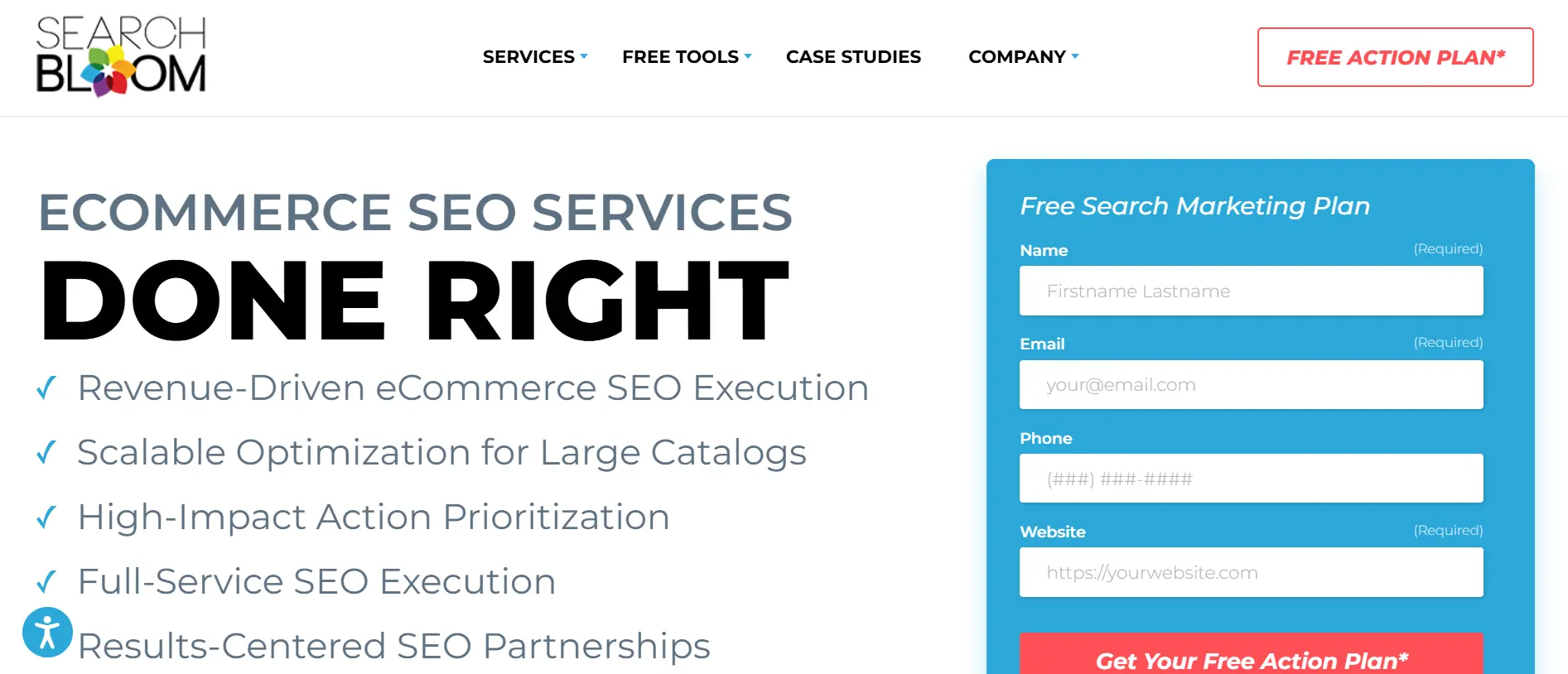
Image Source: Searchbloom
Searchbloom focuses on scalable SEO for ecommerce websites. This matters for stores with hundreds or thousands of products where manual optimization cannot keep pace with catalog growth.
Its approach covers technical SEO, content, keyword strategy, and catalog optimization. The goal is to create processes that can be applied across large numbers of product and category pages without treating every URL as an isolated SEO project.
- Best for: Scalable ecommerce SEO
- Focus: Technical SEO, catalog optimization, content
- Key strength: SEO processes that scale with large catalogs
9. (un)Common Logic: Best for Data-Driven Ecommerce SEO
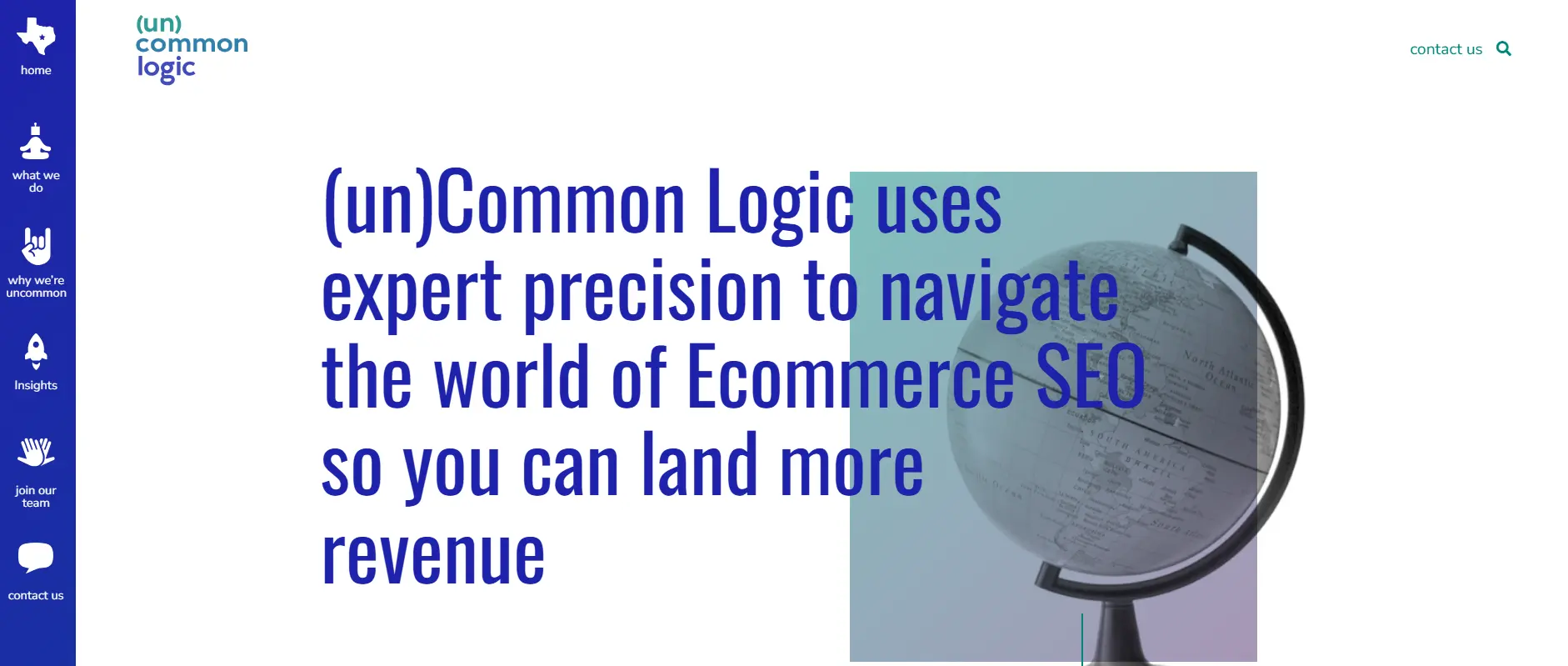
Image Source: (un)Common Logic
(un)Common Logic takes a data-focused approach to SEO and digital marketing. Rather than relying only on general SEO benchmarks, its strategy uses website and performance data to identify where a business has the strongest opportunities.
For ecommerce brands, this can help prioritize the product categories, landing pages, and search opportunities that have the greatest commercial relevance. The approach is particularly suited to businesses that already have substantial performance data to work with.
- Best for: Data-driven ecommerce SEO
- Focus: Analytics, SEO strategy, and performance
- Key strength: Site-specific data and measurement
10. Straight North: Best for Full-Service Ecommerce SEO
Image Source: Straight North
Straight North provides ecommerce SEO across technical optimization, keyword research, content, and link building. Its full-service approach allows businesses to manage several core SEO activities through one agency.
The agency is a practical option for smaller and mid-sized ecommerce brands that need ongoing SEO support without coordinating separate technical, content, and link-building providers.
- Best for: Full-service ecommerce SEO
- Focus: Technical SEO, content, keywords, and link building
- Key strength: Multiple SEO services under one engagement
Agency Comparison Table
| Agency | Best For | Pricing Model | Platform Expertise |
| ResultFirst | Performance-accountable, AI-search-ready ecommerce SEO | Pay for Performance | Shopify, Magento, WooCommerce |
| Outerbox | Large catalog technical SEO | Retainer | Shopify, Magento, WooCommerce, BigCommerce |
| Thrive | Integrated SEO + paid media | Retainer | Shopify, WooCommerce, Magento |
| Coalition Technologies | Platform migrations | Retainer | Shopify, WooCommerce |
| First Page Sage | ROI-focused methodology | Retainer | Multi-platform |
| Siege Media | Content-led growth | Retainer | Multi-platform |
| Inflow | Experiment-driven rollouts | Retainer | Shopify, Magento, WooCommerce |
| Searchbloom | SEO + CRO combined | Retainer | Multi-platform |
| (un)Common Logic | Analytics-driven strategy | Retainer | Multi-platform |
| Straight North | All-in-one in-house delivery | Retainer | Multi-platform |
What Should an Ecommerce SEO Agency Actually Do?
An ecommerce SEO agency should grow organic revenue by improving technical site health, optimizing product and category pages, strengthening internal linking, and increasing visibility across traditional search and AI platforms.
Technical SEO for Ecommerce Architecture
Ecommerce websites can generate large numbers of URLs through:
- Product variants
- Filters
- Faceted navigation
- Sorting parameters
- Pagination
- Internal search
- Duplicate category paths
- Out-of-stock products
- Discontinued products
- Tracking parameters
The agency should identify which URLs need to be crawled and indexed and which should not.
It should also examine canonical tags, redirects, XML sitemaps, robots directives, internal links, JavaScript rendering, Core Web Vitals, and crawl efficiency.
The objective is simple:
Help search engines find and understand the pages that matter to the business.
Product Page SEO
Product pages need more than a keyword in the title tag.
A strong product page should make the product easy to understand.
That includes:
- Accurate product names
- Useful descriptions
- Product specifications
- Images and supporting media
- Availability information
- Pricing
- Reviews where applicable
- Clear internal links
- Relevant structured data
- Helpful answers to purchase questions
The content should also be genuinely useful rather than created solely to increase keyword density.
Category Page Optimization
Category pages are often central to ecommerce SEO because they target broader commercial searches.
An agency should evaluate:
- Category hierarchy
- Search intent
- Page titles
- Headings
- Introductory content
- Product selection
- Internal linking
- Breadcrumbs
- Structured data
- Supporting content
- Cannibalization between categories
A category page should help both search engines and shoppers understand what the category contains and why it is relevant to the query.
Product Schema and Structured Data
Structured data helps search engines interpret information such as products, prices, availability, ratings, and other eligible attributes.
For large ecommerce stores, the challenge is not simply adding schema once.
The implementation needs to remain accurate as products change.
A product that is out of stock, discontinued, repriced, or replaced should not continue sending outdated information through structured data.
Ecommerce Content Strategy
Ecommerce content should support the buying journey.
Useful formats include:
- Buying guides
- Product comparisons
- “Best” product guides
- How-to content
- Product education
- Category guides
- Product selection resources
- Troubleshooting content
The purpose is not to publish hundreds of articles.
The purpose is to capture relevant searches that product and category pages cannot capture on their own and then connect that discovery to commercially important pages.
Internal Linking
Internal linking is especially important for ecommerce sites because the site itself can contain thousands of pages.
A good internal linking structure helps search engines understand relationships between:
Category → Subcategory → Product
It can also connect:
Buying guide → Category → Product
This creates clearer topical and commercial relationships across the website.
How Should You Choose an Ecommerce SEO Agency in 2026?
Choose an ecommerce SEO agency based on your platform, technical needs, revenue goals, and AI search requirements.
- Technical issues: Choose an agency with strong ecommerce technical SEO and catalog management expertise.
- Platform migration: Look for proven experience with Shopify, BigCommerce, Magento, WooCommerce, or your specific platform.
- Low conversions: Prioritize agencies that connect SEO with product-page performance, conversion rates, and revenue—not just rankings.
- AI search visibility: Ask how the agency optimizes product content for Google AI Overviews, ChatGPT, and other AI search platforms.
- Limited internal resources: Choose an agency that can work with your developers, content team, merchandising team, and analytics team.
- Accountability: Compare performance-based SEO models with traditional retainers and understand exactly how results are measured.
Before hiring, ask the agency to explain what it would prioritize first, why those actions matter, how success will be measured, and what it would not prioritize yet. This gives you a clearer basis for comparing agencies than promises of higher rankings alone.
Conclusion
Choosing an ecommerce SEO agency in 2026 requires looking beyond rankings and traffic. The right agency should understand technical SEO, product and category optimization, content, structured data, AI search visibility, conversions, and revenue measurement.
Before making a decision, compare agencies based on your platform, catalog size, technical complexity, content needs, development resources, migration requirements, AI search goals, reporting, and pricing model. The best fit is the agency that can clearly explain what it will prioritize, why it matters, how results will be measured, and how SEO will contribute to ecommerce growth.
For ecommerce brands that want to understand where their current SEO program stands, ResultFirst provides ecommerce SEO services covering technical optimization, product and category optimization, Google Shopping, AI search visibility, and revenue-focused reporting.
ResultFirst works with US ecommerce brands on a pay-for-performance model where agency fees are tied to results achieved, not hours logged. If you want to understand where your current ecommerce SEO program stands before evaluating any agency, contact ResultFirst for a baseline assessment.
More SEO Agency Guides You Should Explore
- Explore best AI-driven SEO agencies.
- See performance-based SEO agencies specializing in ROI.
- Learn how enterprise SEO firms scale large websites.
- Compare SEO agencies that only charge for results.
Sources Referenced:
- https://landmarkglobal.com/eu/en/news-insights/top-10-essential-facts-about-us-e-commerce-2026-edition/
- https://www.shopify.com/in/enterprise/blog/erp-benefits
- https://www.census.gov/retail/ecommerce.html
FAQs:
WHAT TO READ NEXT
READY TO BUILD PREDICTABLE ORGANIC GROWTH?
We are the only TOP SEO services agency providing Real Results in a Real Performance model. We help growth hungry companies outperform their competition and achieve 300%+ growth in their digital marketing initiatives.
- San Jose, CA, 95120

- +1-888-512-1890

- sales@resultfirst.com

300K+
KEYWORDS RANKED
546M+
REVENUE GENERATED
18 Years
SOLVING COMPLEX SEO
150+
TEAM MEMBERS