


 sales@resultfirst.com
 +1-888-512-1890
Claude Can Find Revenue Leaks: SEO Agencies Help Recover Them

There is a specific moment that most marketing leaders recognize when they hear it described. The Claude audit comes back. The score is low. The findings are specific and credible. Schema gaps, crawl waste, thin category pages, missing author signals, and faceted navigation create a million near-duplicate URLs.
The room goes quiet for a different reason than expected. Not because the findings are surprising. Because everyone in the room knows the findings are correct, and everyone knows what happens next. The document gets saved. The team gets busy. Three months pass.
This is not a story about bad intentions. It is a story about the distance between a diagnosis and a recovery plan and why those two things require completely different capabilities.
Claude is genuinely excellent at the first one. An SEO agency that ties fees to results is built for the second.
Why Audit Findings Alone Do Not Recover Revenue
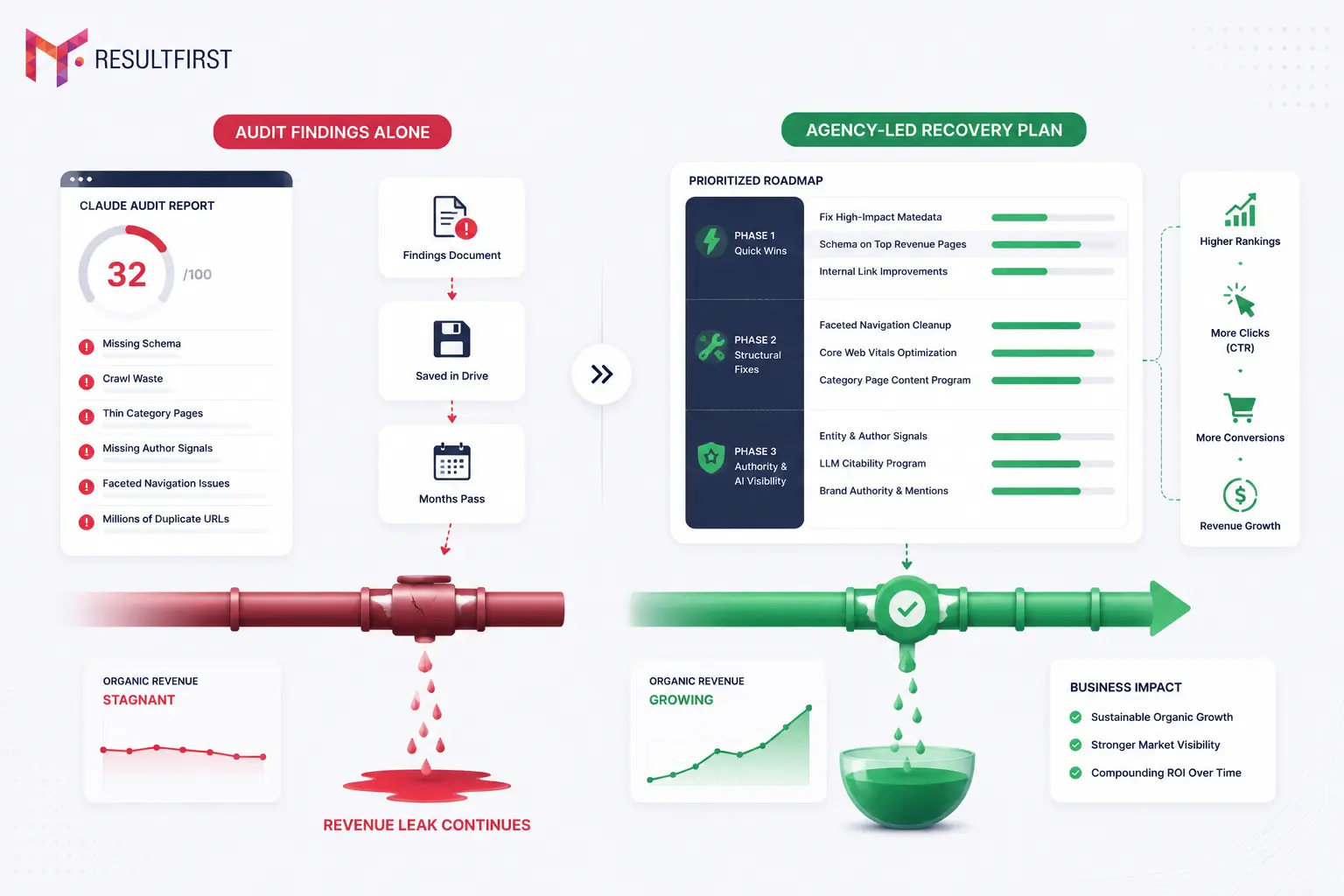
The organic search channel, when well managed, delivers a median return of 748% on investment, and SEO leads close at 14.6% compared to just 1.7% for outbound marketing. Organic search also drives over 40% of company revenue across most industries, according to the same research. These are not marginal numbers. They represent the core revenue engine for most enterprise and eCommerce brands.
When Claude runs an audit and surfaces a list of gaps, it surfaces the reasons that the engine is running below capacity. Every unresolved finding on that list is a revenue leak. Missing schema means missed click-through opportunities. “Crawl waste” means product pages that should rank are invisible to search engines. Thin category pages mean high-volume queries landing on pages that cannot convert. Broken canonical chains mean link equity bleeding across URL variants that should never exist.
The problem is that knowing where the leaks are and having a plan to resolve them are two entirely different things. A finding without a prioritized fix sequence, a resource allocation, a development coordination plan, and a measurement framework is just a number on a slide. Revenue does not recover from numbers on slides.
The Gap Between Finding and Fixing
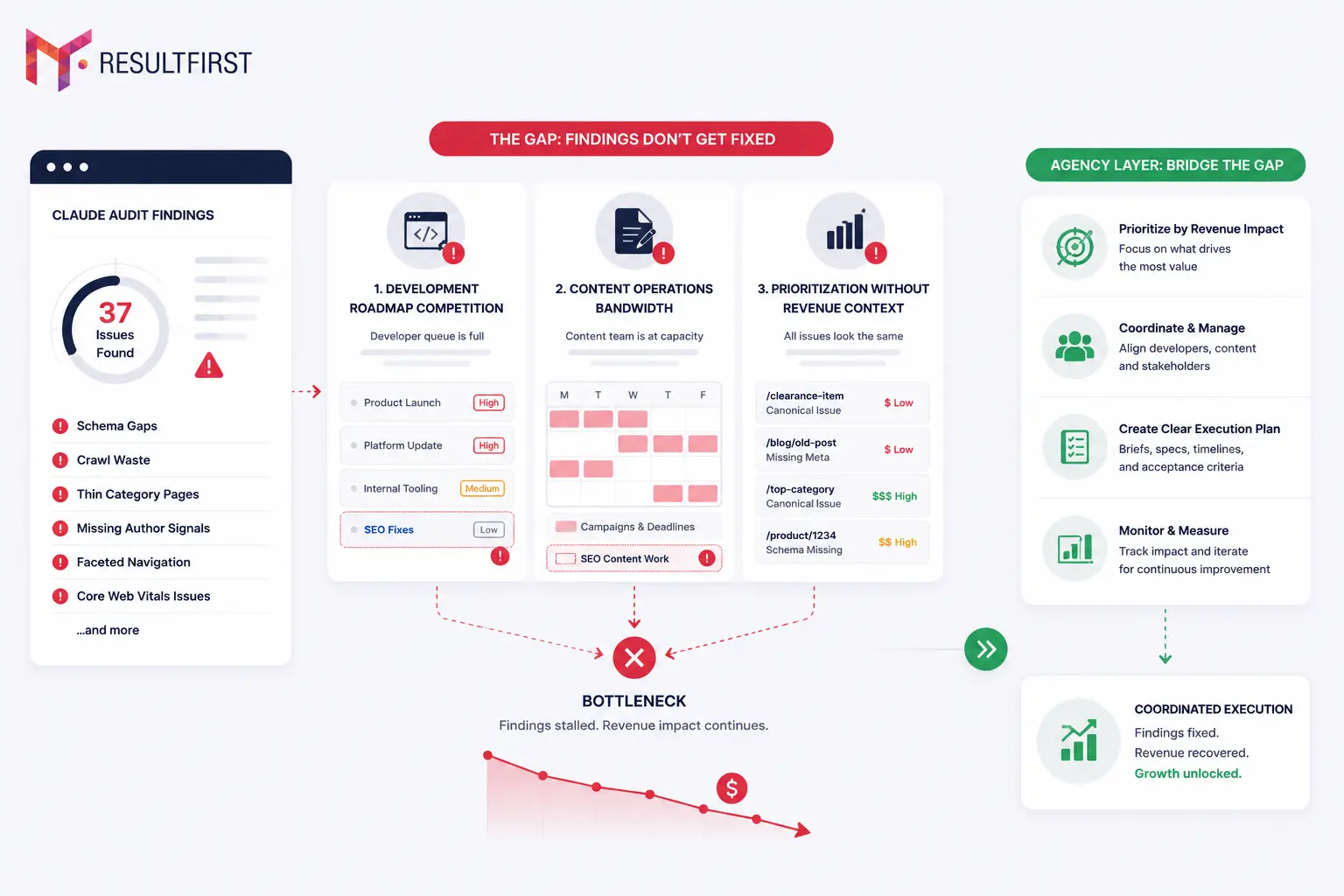
Most in-house teams that run Claude audits or commission third-party technical reviews face the same three constraints when they try to act on the findings.
Development roadmap competition. Technical SEO fixes require developer time. Developer time at any enterprise or mid-market company is the most competed-for resource in the building. Schema remediation across 40,000 product pages, canonical restructuring across faceted navigation, and Core Web Vitals improvements requiring front-end engineering work: all of these sit in a queue behind product launches, platform updates, and internal tooling requests. SEO findings rarely win that queue without someone whose job is to push them through.
Content operations bandwidth. Many of the highest-impact findings from a Claude audit are content problems, not technical ones. Thin category pages need substantive editorial work. Blog content needs author attribution retrofitted across years of archives. FAQ schema needs structured question-and-answer content written to match how buyers actually phrase queries. These are not tasks that get done by the content team between campaigns. They require dedicated bandwidth and a publication system that connects the findings to the editorial calendar.
Prioritization without revenue context. A Claude audit returns findings in order of severity, not in order of revenue impact. A canonical tag error on a clearance page and a canonical tag error on the highest-converting product category both appear as the same type of finding. Without the commercial context to separate which fixes recover the most revenue fastest, teams work through a list in the wrong order and lose momentum before the highest-value work gets done.
What a Recovery Plan Actually Looks Like
A recovery plan built around Claude’s audit findings is not a to-do list. It is a sequenced program with three distinct phases, each with its own timeline, resource requirements, and measurable outcomes.
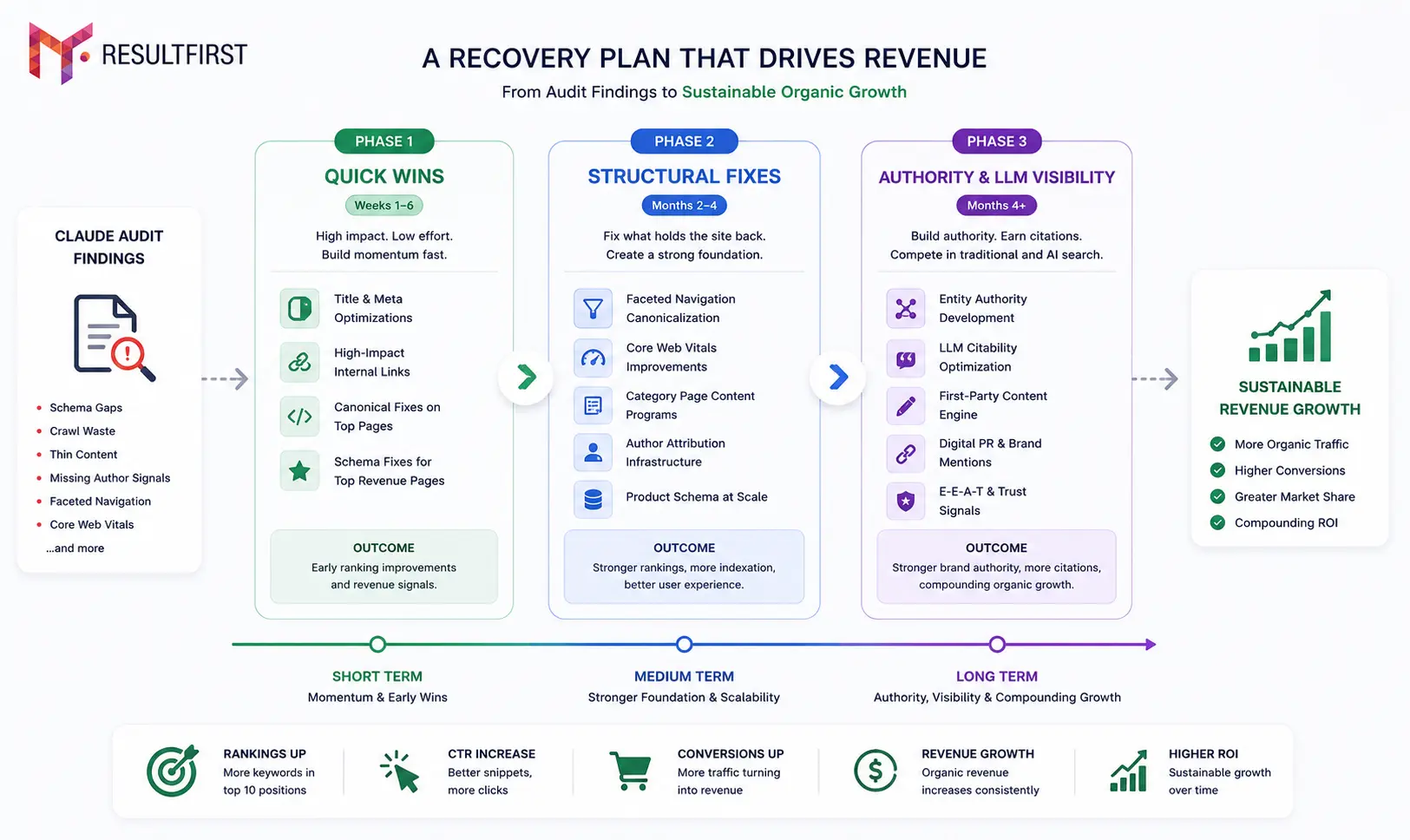
Phase 1: Quick Wins (Weeks 1 to 6)
Quick wins are fixes that have high revenue impact, low implementation effort, and do not require coordination across multiple teams. They produce early momentum and prove the program is working before the longer work shows results.
In most Claude audits, the quick wins include title tag and meta description corrections on high-traffic pages, internal link additions connecting high-authority pages to high-converting product or service pages, canonical tag fixes on the highest-traffic URL variants, and structured data corrections on the top 50 revenue-generating product pages.
These fixes are executable within the first six weeks of an engagement. DeltaV Digital’s research on SEO timelines confirms that individual pages typically begin finding their ranking positions within 30 to 90 days of technical fixes, meaning quick wins started in week one produce measurable ranking signals before the end of the first quarter.
The point of Phase 1 is not to fix everything fast. It is to demonstrate that the findings are being acted on, show early revenue signal movement, and generate the organizational confidence needed to resource the longer programs.
Phase 2: Structural Fixes (Months 2 to 4)
Structural fixes are the findings that require developer coordination, content operations planning, or both. These are the gaps that stall in-house teams most often: faceted navigation canonicalization, Core Web Vitals remediation across product page templates, category page content programs, author attribution infrastructure, and product schema engineering across the full catalog.
Each structural fix requires a brief, a development ticket with clear acceptance criteria, a testing protocol, and a monitoring plan after deployment. An agency manages this coordination layer so the client’s internal team is briefed and reviewed rather than project-managing work they do not have the context to own.
The 90-day sprint model is well established as the right cadence for this phase. Quarterly objectives with clear measurable outcomes keep the work from drifting and give leadership a reporting cycle they can connect to revenue.
Phase 3: Authority and LLM Visibility Programs (Months 4 Onward)
Once the technical and content foundations are repaired, the growth ceiling shifts to authority. This is where Claude’s audit findings around entity signals, GEO scoring, and LLM citability become the primary work.
Building the entity authority that causes Claude, ChatGPT, and Perplexity to recommend a brand in response to buyer queries is not a one-sprint task. It requires sustained first-party content creation, consistent external citation building, structured data that signals expertise across the domain, and an author credibility program that gives LLMs verifiable signals to cite.
The brands that invest in this third phase are building something compounding. At 12 months, SEO ROI reaches 2.6 times the initial investment, and at 18 months it rises to 3.8 times, with organic search becoming the main revenue source for most eCommerce sites, according to Incremys’s SEO ROI analysis (2026). For enterprise brands and SaaS companies, the compounding effect is even more pronounced because authority signals build across larger content libraries and broader link profiles.
How Revenue Prioritization Changes the Fix Sequence
This is the piece most audit tools and one-time diagnostic services miss entirely. A recovery plan that ignores commercial context produces the wrong fix sequence and wastes the first quarter of an engagement on findings that do not move revenue.
Revenue prioritization means asking four questions before anything gets scheduled for development.
Which pages drive the most revenue right now? High-revenue pages with fixable technical issues get prioritized regardless of where they appear on the severity list. A canonical error on the company’s top-converting landing page outranks a missing meta description on a blog post from three years ago.
Which pages are closest to ranking? Pages sitting in positions 4 to 10 for high-intent queries are the fastest revenue recovery opportunity in any audit. A small ranking improvement for a page already on the first page of Google generates a disproportionate traffic gain. Ahrefs data from 2025 shows that page 2 results earn roughly 0.78% click-through rate. The gap between position 11 and position 3 in terms of clicks is not linear. It is a cliff.
Which fixes affect the most pages simultaneously? Template-level fixes that correct a schema error or canonical structure across thousands of pages deliver more value per development hour than page-by-page corrections. An agency that understands eCommerce architecture targets these template fixes first because the leverage is multiplicative.
Which gaps are causing LLM invisibility? Claude’s GEO audit findings need their own prioritization layer. A brand that ranks well on Google but does not appear in Claude or Perplexity recommendations is losing the fastest-growing segment of buyer traffic. The 62% of enterprise brands currently invisible to generative AI when asked unbranded questions about their core services, according to Fuel Online’s 2026 AI Index of 1,000 enterprise domains, need an LLM visibility program running alongside the traditional recovery work, not after it.
What Gets Measured in a Recovery Program
The measurement framework for a recovery program looks different from a standard SEO reporting dashboard, and this distinction matters for enterprise and eCommerce teams reporting upward.
Traditional SEO reporting tracks rankings and traffic. A revenue recovery program tracks rankings, traffic, and the commercial outcomes those metrics drive. This means organic-attributed revenue by page and section, conversion rate changes on pages where technical fixes have been applied, LLM citation rate changes on the brand’s core service or product queries, and click-through rate movements on pages where schema and meta corrections have been made.
Search Engine Land’s guidance on retiring vanity SEO metrics in 2026 is direct on this point: the metrics that matter are those that connect to business outcomes. Reporting organic traffic as a standalone number is no longer enough when 60% of Google searches end without a click and AI Overviews are compressing CTR on queries where rankings have not moved. The recovery program has to measure what actually changed in revenue terms, not just what moved in the rank tracker.
For enterprise brands with complex reporting structures, an agency builds this measurement layer into the engagement from day one. The findings from Claude’s audit become the baseline. The recovery program becomes the intervention. The revenue and ranking outcomes become the proof that the investment produced returns.
The Forward Demand Picture
The urgency of building a recovery program in 2026 rather than 2027 is not arbitrary. The search environment is compressing faster than most organizations are moving.
Organic click-through rates for informational queries have declined by 61% since the rollout of AI Overviews, according to Fuel Online’s 2026 enterprise analysis. AI Overview coverage is growing across commercial queries. The brands earning citations inside those AI answers see 35% more organic clicks than brands that are not cited, according to the same research, meaning the gap between cited and non-cited brands is compounding with every passing month.
By 2027 and 2028, agentic commerce will add a third evaluation layer. AI agents completing purchases on behalf of users will select from a pool of brands their model already trusts and cites. Brands not in that citation pool by the time agentic commerce reaches mainstream adoption will face a recovery task that is structurally harder than anything they face today. The structured data foundations, entity authority programs, and LLM citability work that a recovery plan builds now are exactly the signals that determine whether a brand is in that pool.
92% of marketers planning to maintain or increase SEO investment in 2026 despite AI search disruption, according to HubSpot’s State of Marketing 2026 as cited by BizIQ, are not doing so out of habit. They are doing so because organic search, properly managed across traditional and AI search channels, remains the highest-returning acquisition channel available.
The question is not whether to invest in SEO. The question is whether the audit findings sitting in a shared document are going to produce a recovery program or another quarter of stalled execution.
Why ResultFirst Is the Right Partner for This Work
The recovery plan described above requires two things that most in-house teams do not have in combination: the technical depth to execute complex SEO fixes across large sites without disrupting live rankings, and the commercial judgment to sequence those fixes in the order that recovers revenue fastest.
ResultFirst’s pay-for-performance SEO model is built specifically around this reality. Fees are tied to ranking outcomes, not to hours spent or audit reports delivered. That model only works when the agency is confident it can build and execute a recovery program that produces measurable results on a defined timeline.
For enterprise brands managing hundreds of thousands of pages, ResultFirst’s enterprise SEO services handle the coordination layer that keeps technical fixes moving through development queues, content programs running in parallel with structural work, and authority building starting before the technical phase is complete.
For eCommerce brands watching revenue leak through schema gaps, crawl waste, and thin category pages, ResultFirst’s eCommerce SEO services address the catalog-scale execution work that the audit identifies but cannot resolve.
For SaaS and B2B brands whose buyers are building vendor shortlists inside Claude and Perplexity before making first contact, the GEO and LLM visibility work built into every ResultFirst engagement closes the gap between traditional search performance and AI search citability.
Claude found the leaks. The next conversation is about who builds the plan to close them and what it produces in revenue terms when they do.
Talk to the ResultFirst team about turning your audit findings into a sequenced recovery program.
Sources Referenced:
- SeoProfy: SEO ROI Statistics for 2026
- First Page Sage: eCommerce SEO ROI Report
- Incremys: How to Calculate SEO ROI (2026)
- BizIQ: SEO Statistics 2026, Organic Traffic, Rankings and ROI Data
- Fuel Online: 2026 State of Generative Search and AI SEO Statistics
- DeltaV Digital: How Long Does SEO Take to Show Results?
- Search Engine Land: Retire These 9 SEO Metrics Before They Derail Your 2026 Strategy
- Digital Applied: SEO Strategy Template 2026, Complete Planning Guide
- The Digital Bloom: Organic Traffic Crisis Report, 2026 Update
WHAT TO READ NEXT
READY TO BUILD PREDICTABLE ORGANIC GROWTH?
We are the only TOP SEO services agency providing Real Results in a Real Performance model. We help growth hungry companies outperform their competition and achieve 300%+ growth in their digital marketing initiatives.
- San Jose, CA, 95120

- +1-888-512-1890

- sales@resultfirst.com

300K+
KEYWORDS RANKED
546M+
REVENUE GENERATED
18 Years
SOLVING COMPLEX SEO
150+
TEAM MEMBERS