


 sales@resultfirst.com
 +1-888-512-1890
How a Shopify SEO Agency Helps Stores Rank Higher and Increase Sales in 2026

Shopify SEO agencies exist because Shopify stores run into the same problems again and again. A 2026 audit of nearly 2,850 Shopify stores found that 73% had critical technical SEO issues serious enough to block proper indexing of their product. Additionally, duplicate content, the most common issue, showed up on 92% of the stores audited. These aren’t rare misconfigurations. They’re close to the default state of an unmanaged Shopify store, hiding behind a perfectly good-looking storefront.
That’s the gap a specialized Shopify SEO agency is built to close. Shopify handles the basics: hosting, checkout, mobile responsiveness, but its templated structure quietly generates duplicate URLs, thin collection pages, and app-driven speed issues that a general SEO freelancer rarely knows to look for. A professional agency works around these platform-specific limitations, rebuilds product and category data for real search intent, and turns organic traffic into a repeatable revenue channel instead of a one-time spike.
This guide breaks down exactly what a Shopify SEO agency does, why generic SEO advice underperforms on Shopify specifically, and what results merchants can realistically expect from working with one.
What Does a Shopify SEO Agency Do?
A Shopify SEO agency improves rankings and sales by fixing platform-specific issues like duplicate URLs and thin collection pages, optimizing product and category content for search intent, improving site speed and Core Web Vitals, implementing structured data, and preparing store content to be surfaced by AI search tools like Google AI Overviews and ChatGPT Search. The goal isn’t just higher rankings; it’s more qualified organic traffic that actually converts.
Why Do Shopify Stores Need a Specialized SEO Agency?
Shopify wasn’t built for enterprise-grade SEO. It was built to sell fast. That trade-off shows up in duplicate content, thin pages, and cannibalized URLs baked into unique themes and apps. Miss these issues and your organic growth stalls, no matter how strong your products or marketing are.
Generalist SEO practitioners often can’t catch these problems. Shopify’s architecture behaves differently from WordPress or a custom build, and the traps don’t show up the same way. You need someone who has actually worked inside Shopify’s backend, not someone applying a generic SEO checklist.
Read More: How to Choose the Right Shopify SEO Agency
In practice, three categories of problems come up again and again in Shopify audits:
1. Duplicate URLs and Faceted Navigation Issues
Shopify automatically generates multiple URL variations for the same product or collection — through filtering, sorting, tagging, and pagination parameters. Left unmanaged, this creates duplicate content that dilutes ranking signals across several near-identical URLs instead of consolidating them into one strong page. Ahrefs has flagged duplicate URL handling as one of the most persistent Shopify SEO mistakes merchants make, largely because the platform doesn’t surface the problem in an obvious way inside the admin dashboard.
A common example:
For example, imagine your Shopify store sells a “Wool Crewneck Sweater.” The same product can be accessed through different URLs depending on where the customer finds it:
- Direct product page: /products/wool-crewneck-sweater
- Men’s Sweaters collection: /collections/mens-sweaters/products/wool-crewneck-sweater
- New Arrivals collection: /collections/new-arrivals/products/wool-crewneck-sweater
So, one sweater is the same product, but Shopify can create multiple URLs for it when it appears in different collections. This can create duplicate URL versions of the same product page, which is why Shopify SEO needs to handle canonical URLs properly.
Each of those is technically a separate crawlable URL, so instead of one page accumulating ranking authority, that authority gets split three ways, and none of the versions is strong enough on its own to compete for a meaningful keyword.
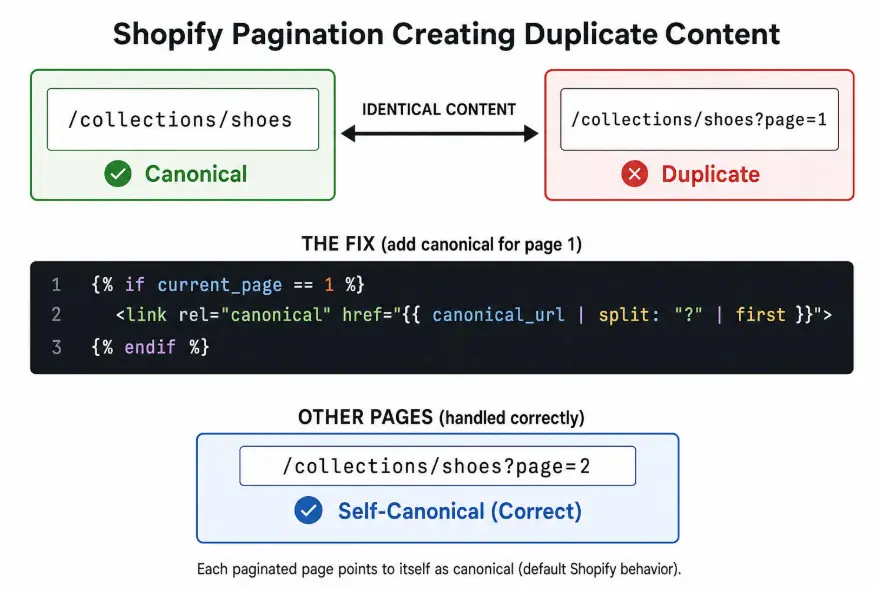
In Shopify audits, it’s common to see a single product spread across four or five indexed URL variants this way.
A Shopify SEO agency resolves this with proper canonical tagging, cleaner collection architecture, disciplined URL parameter handling, and theme-level adjustments that stop the duplication at the source rather than patching it after the fact.
2. Theme Speed and Script Bloat
Theme speed is how quickly your Shopify website’s theme loads and displays its content to visitors whereas Script bloat happens when too many apps, tracking codes, JavaScript files, or unnecessary scripts are added to the store, making pages slower to load.
Site speed affects both search rankings and shopper conversion, and Shopify themes are particularly prone to slowing down over time. Every new app a merchant installs, reviews, upsells, loyalty programs, and live chat tends to inject its own JavaScript into the theme, and very few of them get removed cleanly when the app is uninstalled.
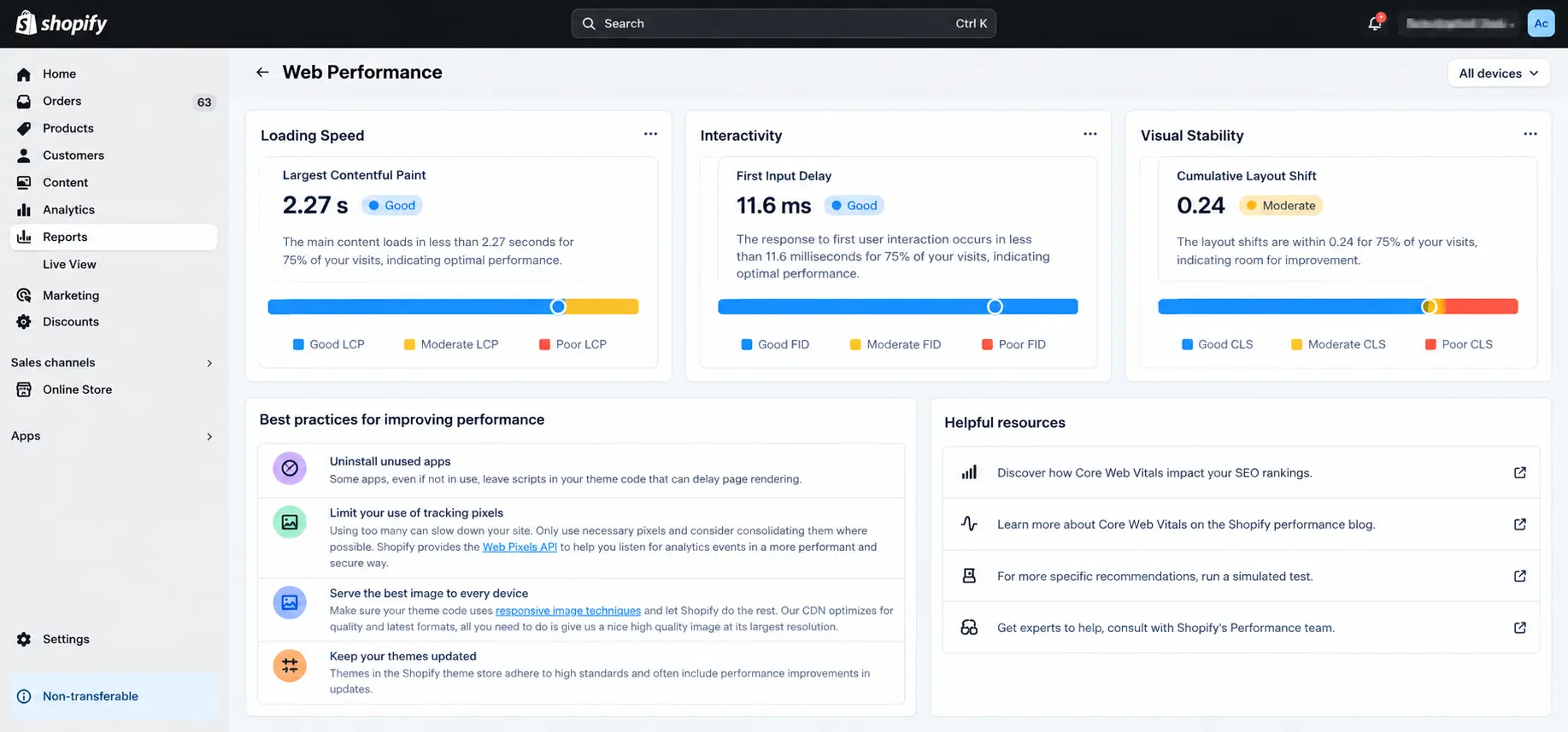
A Shopify SEO agency approaches this systematically: auditing every installed app for its script footprint, removing dead code left behind by uninstalled apps, compressing and lazy-loading images, and monitoring Core Web Vitals against thresholds specific to Shopify’s theme rendering behavior rather than generic web benchmarks.
3. Underdeveloped Product and Collection Pages
Shopify Product Detail Pages (PDPs) often rely on short, templated descriptions, while Collection Landing Pages (CLPs) may contain little more than a title and product grid. This leaves limited content for search engines to understand the page’s relevance. Adding detailed, useful content to both PDPs and CLPs can improve topical relevance, target more search queries, and help customers make informed purchase decisions.
- Weak collection URL: /collections/shoes
- Better collection URL: /collections/mens-running-shoes, supported by content covering product types, buyer needs, sizing guidance, and a short FAQ block
- Weak product description: “High-quality shoes made with premium materials.”
- Better product description: “Designed for daily runners, these lightweight shoes provide breathable comfort during long-distance training, with a reinforced heel for added stability on uneven terrain.”
The difference isn’t just tone; it’s specificity. Vague, interchangeable copy gives search engines and AI systems nothing to differentiate one product from a hundred similar ones. Specific, benefit-driven copy gives both a reason to surface that particular page.
Not sure whether duplicate URLs or theme scripts are quietly capping your rankings? Get a Shopify SEO audit from ResultFirst and pinpoint the exact issues costing you traffic.
What Does a Shopify SEO Agency Actually Do for Organic Growth?
A specialized Shopify SEO partner works across five interconnected areas: technical health, content strategy, on-page optimization, conversion rate improvements, and increasingly, AI search readiness. Here’s what that looks like in practice.
Full Shopify SEO Audit
Every engagement should start with a comprehensive audit that goes well beyond a generic SEO checklist. On Shopify specifically, this means examining:
- Crawlability and indexation status across the full catalog
- Duplicate URLs created by filters, tags, and sorting parameters
- Faceted navigation configuration
- Schema markup coverage and accuracy
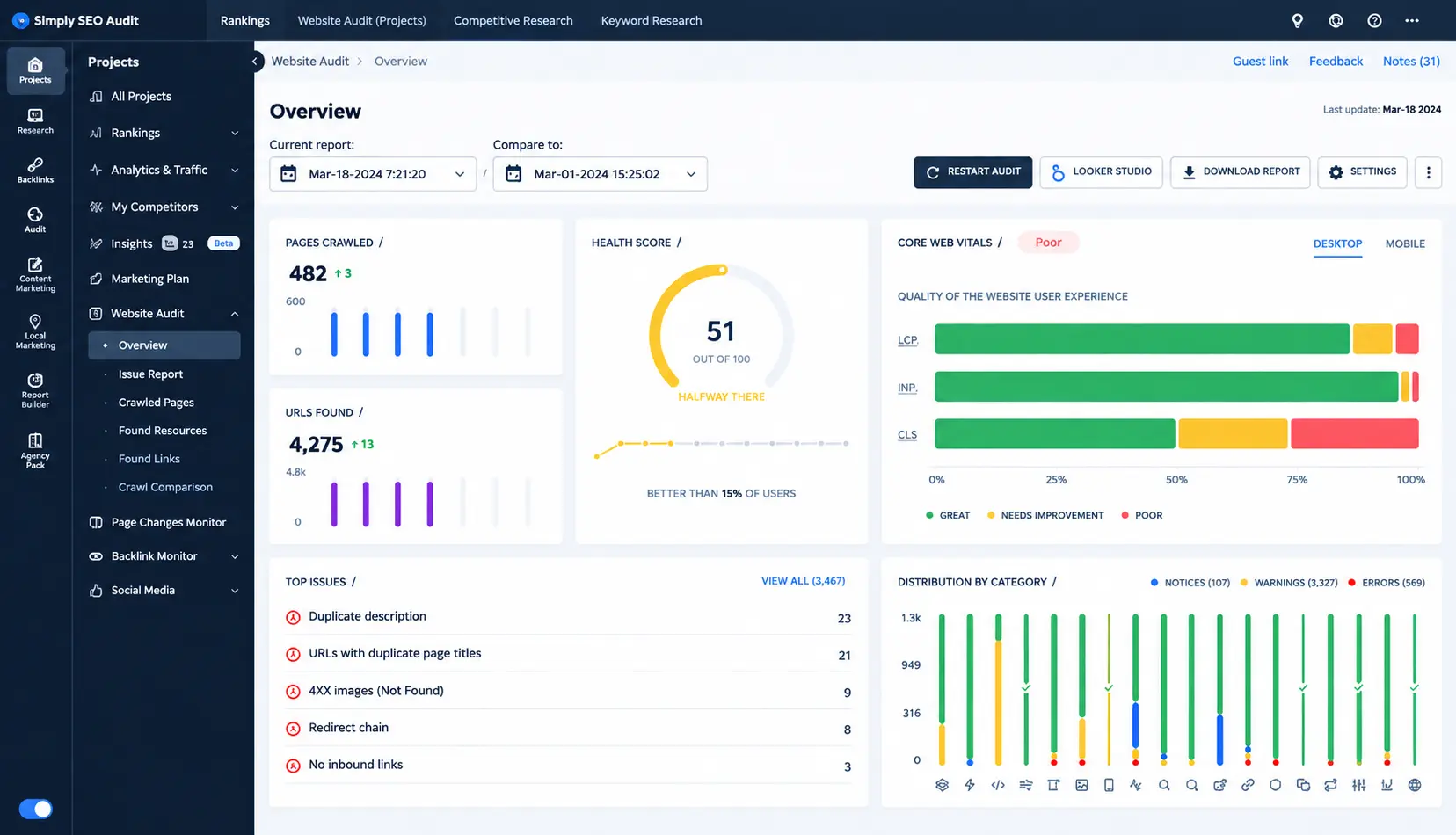
- Page performance and Core Web Vitals
- Collection page structure and content depth
- Product data quality and completeness
- Internal linking patterns between products, collections, and blog content
- AI extractability, whether content is structured in a way large language models can parse and cite
A professional agency focuses on issues that directly affect how Google crawls, understands, and displays an ecommerce site. Google recommends good Core Web Vitals, including an LCP of 2.5 seconds or less, INP below 200 milliseconds, and CLS below 0.1. It also recommends using product structured data because it can make product pages eligible for richer search appearances.
Shopify Technical SEO Checklist
- Canonical tags applied correctly on variant and faceted URLs
- XML sitemap reviewed and resubmitted after major structural changes
- Robots.txt checked to ensure it isn’t accidentally blocking important collection or product paths
- Full app-script audit, with dead code from uninstalled apps removed
- Image compression and lazy loading implemented site-wide
- Core Web Vitals benchmarked against thresholds specific to the store’s theme, not generic industry averages
Optimize Collection Pages With Semantic Intent
Collection pages drive a disproportionate share of ecommerce organic traffic because they map directly to how people search, “men’s running shoes,” not a specific SKU. A strong Shopify SEO agency treats these as priority pages rather than an afterthought, typically adding:
- A 120–250 word optimized category introduction that answers the shopper’s core question up front
- Answer-first descriptions rather than keyword-stuffed filler paragraphs
- Semantic modifiers that reflect how real buyers phrase their searches
- Deliberate internal linking to related collections and top-performing products
- Category-level structured data
- Content genuinely aligned with what the searcher is trying to accomplish, not just the keyword they typed
Collection pages are frequently the highest-value real estate on an ecommerce site precisely because they sit at the intersection of high search volume and high purchase intent — someone searching a category term is closer to buying than someone searching a broad, informational query.
Curious what these improvements could look like for your store? [See our ecommerce SEO services].
Strengthen Product Pages for Search and Conversion
On the product side, the work focuses on giving both search engines and shoppers enough substance to act on:
- Unique, benefit-led product descriptions instead of manufacturer boilerplate
- High-quality, properly compressed images with descriptive alt text
- Structured data so rich results and AI systems can pull accurate product details
- Review integration to build trust signals and fresh content
- Product-specific FAQs that answer the objections shoppers actually have before purchase
- Comparison blocks for stores with multiple similar SKUs
- Cross-sells and internal linking that keep visitors moving through the catalog
Build AEO and AI Search Visibility for Shopify Stores
Answer Engine Optimization (AEO) has become a core part of Shopify SEO work rather than a niche add-on. AI-powered search tools prioritize content that is structured, factually consistent, and easy to extract, which means the same fundamentals that help traditional SEO (clear structure, specific claims, complete product attributes) also determine whether a store gets surfaced by:
- Google AI Overviews
- Bing Copilot
- ChatGPT Search
- Perplexity
Structured data plays an important role in helping search engines understand what an ecommerce page is about and which details matter most. Pages with schema markup have been reported to achieve 40% higher click-through rates, while rich results featuring information such as ratings, prices, and availability can generate around 82% higher CTR than standard listings.
For Shopify stores, implementing accurate Product, Offer, and Review schema can improve how product information is presented in search. It can also give search engines and AI Overviews clearer, machine-readable information to use when understanding and summarizing products. This makes structured data an important part of both traditional Shopify SEO and AI search visibility.
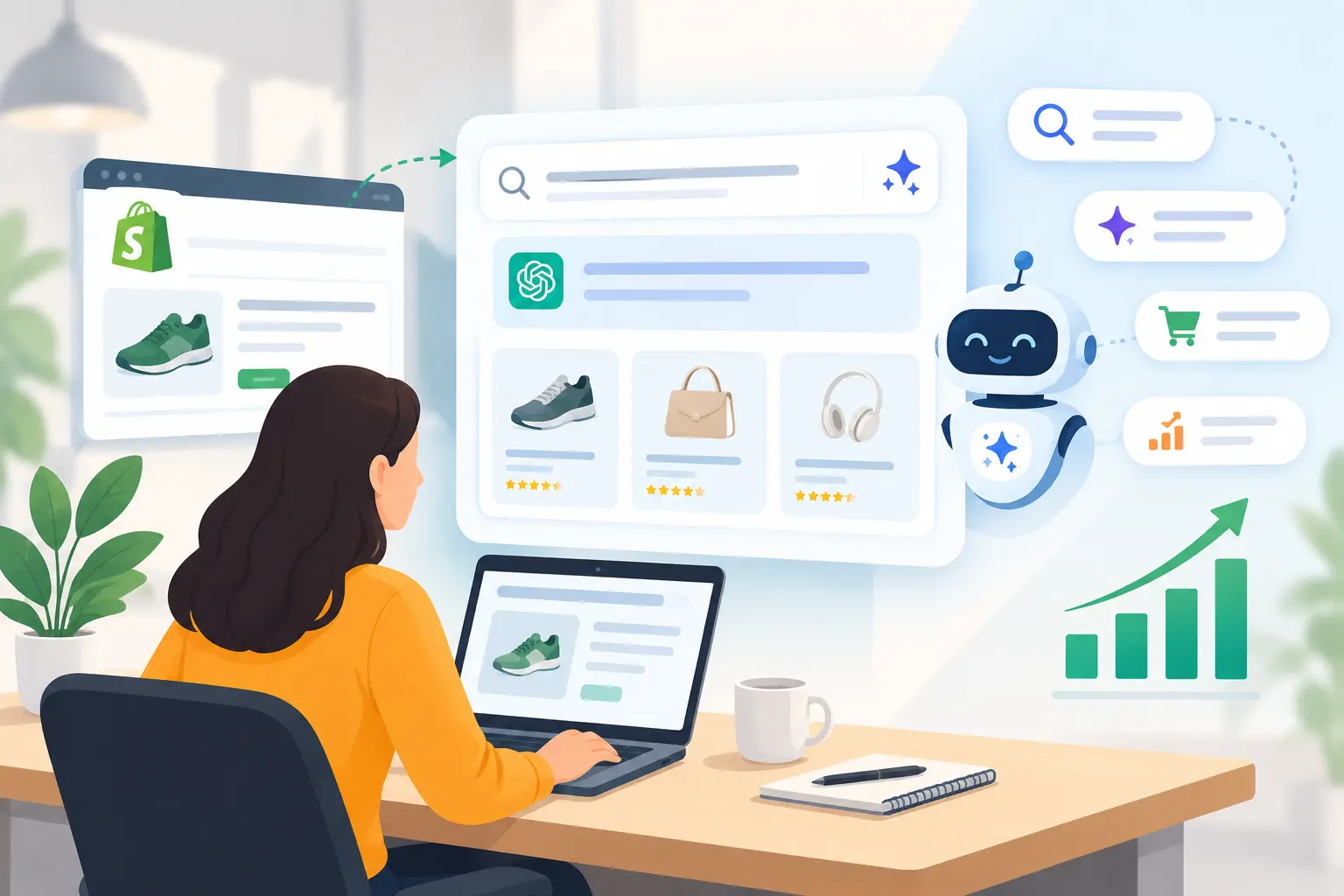
A Shopify SEO agency builds toward this by tightening product attribute completeness, writing content in clear, extractable formats (short answer-first paragraphs, structured FAQs, well-labeled specifications), and making sure structured data accurately reflects what’s actually on the page.
The GROWTH Framework: A Simplified Shopify SEO Methodology
A 13-step acronym is hard for anyone to actually remember or use in a client conversation. In practice, the work above collapses into six sequential steps, easy enough to recall as GROWTH:
| Step | Purpose |
| S — Structure Optimization | Fix URLs, collections, and site architecture |
| H — High-Intent Keyword Strategy | Map keywords to Product Detail Pages (PDPs) and Collection Landing Pages (CLPs) |
| O — On-Page Enhancement | Improve content, schema, and user experience |
| P — Performance Improvements | Improve page speed and Core Web Vitals |
| I — Internal Linking System | Strengthen navigation and contextual linking paths |
| F — Facet and Filter Control | Prevent duplicate URLs and improve crawl efficiency |
| Y — Yield Optimization | Apply conversion rate optimization (CRO) to increase revenue |
| G — Growth Data Mapping | Improve analytics, tracking, and attribution |
| R — Review and Social Proof Integration | Use reviews and social proof to increase conversions |
| O — Ongoing AI Optimization | Improve Answer Engine Optimization (AEO) and AI Overview visibility |
| W — Workflow Automation | Scale SEO processes across large product catalogs |
| T — Technical QA | Conduct regular crawling, monitoring, and technical fixes |
| H — Holistic Strategy | Combine SEO, UX, and CRO into one growth strategy |
What Core Results Can Shopify Stores Expect From a Specialized SEO Agency?
Results vary by starting point, catalog size, and competitive niche, but stores that commit to a sustained Shopify SEO program typically see improvement across a consistent set of metrics:
- Category-level keyword rankings
- Product page visibility for long-tail, high-intent terms
- Inclusion in Google AI Overviews and other AI-generated answers
- Organic revenue as a share of total site revenue
- Add-to-cart rate on optimized collection and product pages
- Overall conversion rate
- Average order value, often through improved cross-sell and comparison content
- Site speed and Core Web Vitals scores
- Reduction in duplicate or thin indexed pages
- Clearer, more navigable user experience
It’s worth being direct about timelines: Shopify SEO is not a paid-media-style lever that produces results within days. Technical fixes can show measurable impact within weeks, but meaningful ranking and revenue gains from content and authority-building work typically take a few months to compound. Agencies that promise overnight results on organic search are usually not being straight with merchants about how search algorithms actually work.
Conclusion
Choosing a Shopify SEO partner means finding a team that understands both Shopify’s technical setup and ecommerce SEO. The right Shopify SEO agency should go beyond increasing traffic by fixing technical issues, improving content and UX, and turning organic search into sustainable revenue growth. The right partner won’t just resolve technical barriers. They’ll strengthen category relevance, deepen product discoverability, and build the kind of AI search readiness that’s quickly becoming table stakes rather than a nice-to-have.
ResultFirst helps Shopify brands implement strategic optimization that supports both search performance and revenue impact. Our ecommerce SEO services are built to help your store rank higher, convert more visitors, and compete confidently as search continues to evolve around AI.
Sources Referenced:
- https://www.get-ryze.ai/blog/best-shopify-seo-audit-tools-compared-in-2026
- https://ahrefs.com/blog/duplicate-content/
- https://developers.google.com/search/docs/appearance/core-web-vitals/
- https://searchatlas.com/blog/schema-for-aeo/
FAQs:
WHAT TO READ NEXT
READY TO BUILD PREDICTABLE ORGANIC GROWTH?
We are the only TOP SEO services agency providing Real Results in a Real Performance model. We help growth hungry companies outperform their competition and achieve 300%+ growth in their digital marketing initiatives.
- San Jose, CA, 95120

- +1-888-512-1890

- sales@resultfirst.com

300K+
KEYWORDS RANKED
546M+
REVENUE GENERATED
18 Years
SOLVING COMPLEX SEO
150+
TEAM MEMBERS