


 sales@resultfirst.com
 +1-888-512-1890

SEO for Personal Injury Lawyers: How to Win High-Value Local Cases

SEO for personal injury lawyers helps law firms appear when people search for legal representation after accidents, injuries, and other incidents. A strong strategy improves local visibility, builds trust, and attracts potential clients who need legal help.
Search visibility matters because people often compare several firms before deciding whom to contact. The need for online visibility continues to grow.
However, ranking on Google is only one part of the process. In 2026, people also use Google AI Overviews, AI Mode, ChatGPT Search, Perplexity, Gemini, and Microsoft Copilot to research legal services. Personal injury firms need useful content, strong local signals, and clear information that these platforms can understand.
Nearly one in four U.S. adults has used AI to answer a legal question, while 46% say they would consult AI before contacting a lawyer. This shows why law firms need more than referrals to reach potential clients.
This guide shows personal injury lawyers how to win those moments. You will learn how local search works, how to build trust, and how to write pages that Google and AI tools can quote.
What is SEO for Personal Injury Lawyers?

Source: Digital Logic
SEO for personal injury lawyers makes a firm visible, credible, and easy to contact when injured people search Google, Google Maps, and AI assistants. It combines local SEO (Map Pack and Google Business Profile), practice-area content, trust signals such as reviews and attorney credentials, technical performance, and AI search optimization, and measures success by signed cases rather than clicks.
It differs from general legal SEO in three ways: searches are urgent and often made on a phone, the legal and financial stakes classify the topic as YMYL (Your Money or Your Life), and a single signed case can be worth many times the monthly marketing budget.
Why Is SEO Important for Personal Injury Lawyers?
SEO helps personal injury law firms connect with people who are looking for legal representation. These searches often happen after car accidents, workplace injuries, medical negligence, or other unexpected events
Personal injury searches carry heavy weight. People search after accidents, hospital visits, and money stress. Google calls this type of search “Your Money or Your Life.” It sets a higher bar before it shows a firm.
Urgent Searches Need Fast Trust
Someone in a hospital waiting room wants help now. They will not read a long essay on tort law. They want proof that your firm is real, local, and ready. Clear signals win these moments.
Weak Signals Do Not Last
Thin pages and messy contact details may rank in easy niches. They struggle here. Google wants proof of real experience before it sends injured people to your door. Strong, steady trust signals build lasting visibility.
A focused SEO strategy helps your firm:
- Appear for relevant injury-related searches.
- Reach potential clients in your service areas.
- Build trust through helpful legal information.
- Improve visibility in Google Search and Maps.
- Generate relevant phone calls and consultation requests.
- Reduce long-term dependence on paid advertising.
The goal is not to attract every website visitor. It is to reach people whose legal needs match your firm’s services and case requirements.
Why Personal Injury Law Is One of the Most Competitive and High-Stakes SEO Categories

Source: SixPL
Search engines and AI systems apply a higher quality bar to injury-law results because users are making legal and financial decisions, often after trauma. Google’s guidance treats legal topics as YMYL and places the most weight on trust, supported by experience, expertise, and authoritativeness (E-E-A-T). AI assistants are cautious for the same reason: they tend to cite sources that look accountable.
Thin pages, anonymous authorship, or inconsistent business data may survive in low-stakes niches. In this one, they quietly lose visibility. Here is what E-E-A-T looks like on a PI site:
| Signal | What to show on the page |
| Experience | Real case types handled, anonymized outcomes (within bar advertising rules), intake process screenshots, photos of the actual team and office |
| Expertise | Named attorney authors with bar admissions, years in practice, jurisdictions, board certifications, CLE teaching, bar association roles |
| Authoritativeness | Editorial mentions, legal directory profiles, local news quotes, bar association links, speaking engagements |
| Trustworthiness | Accurate NAP, real reviews, clear fee disclosures, privacy policy, disclaimer, “last reviewed by” dates, secure and fast site |
Why SEO Drives Case Acquisition
Most high-value cases start with a search. People rarely find injury lawyers by chance. They look when something goes wrong.
Clients Move Within Days
AttorneySync research shows that 76% of personal injury clients move on if nobody answers within 24 hours. The same study found that 67% contact only one attorney. If you miss the first look, you may never get a second chance.
One Call Decides the Case
Imagine a driver hit on a busy road in your city. She searches on her phone and sees three firms on the map. She calls the one with fresh reviews and a clear phone button. SEO helps your firm be that choice.
How people search after an injury (and what to build for each stage)
Injury searches fall into four intent stages, and each needs a different page. Matching the page to the stage is what turns visibility into consultations.
| Stage | Typical query | Best asset |
| Emergency | “car accident lawyer near me,” “truck accident attorney open now” | Google Business Profile, localized practice page with click-to-call |
| Insurer dispute | “Insurance offered a low settlement. What do I do” | Question-led guide with clear next steps and a consultation prompt |
| Research | “statute of limitations car accident [state],” “how long do injury cases take” | State-specific explainer with a cited statute and attorney review |
| Comparison | “best personal injury lawyer [city],” “[firm name] reviews” | Attorney pages, review profile, case-result and process pages |
Why urgency changes everything
Many injury searches happen within hours or days of an accident or during an active dispute with an insurer. The user wants speed and reassurance. Clear local signals, a visible phone number, and a calm explanation of what happens next beat long academic content.
How Proximity and Availability Influence Attorney Selection
Proximity says you are easy to reach. Availability says you are ready now. Attorney Sluice’s survey found that 63% of people would call the next attorney if no one answered during business hours. SEO earns the call, and your intake team must answer it.
Local SEO for Personal Injury Lawyers as a Competitive Battleground
Local SEO is the main battleground, not a side task. Cases are won market by market, not across the whole country. One industry report says the local map pack earns about 42 to 46 percent of clicks on legal searches, and it shows only three firms.
So focus on map visibility, local pages, and steady local engagement. Picture a small Houston firm that focuses on truck crashes along its busiest highways. It can beat a national brand because it speaks to that exact place.
Google Business Profile: Your Primary Conversion Layer
For most urgent injury searches, the Google Business Profile is the first thing a prospect sees, so it should be treated as a landing page. Search and AI systems also use it as a structured, verifiable data source about the firm.
For many users, the profile may be their first interaction with a law firm. They can compare nearby attorneys, check directions, read feedback, and visit the firm’s website without searching through multiple pages.
An effective profile should include:
- The correct business name and primary category.
- Accurate office address and phone number.
- Updated business hours.
- Relevant services and business descriptions.
- High-quality photographs of the office and team.
- A direct link to the firm’s website.
- Genuine client reviews and professional responses.
Google identifies three main considerations for local rankings: relevance, distance, and prominence. Complete business information helps Google understand relevance, while distance and prominence influence how local results are displayed.
How Google Evaluates Injury Law Profiles Differently
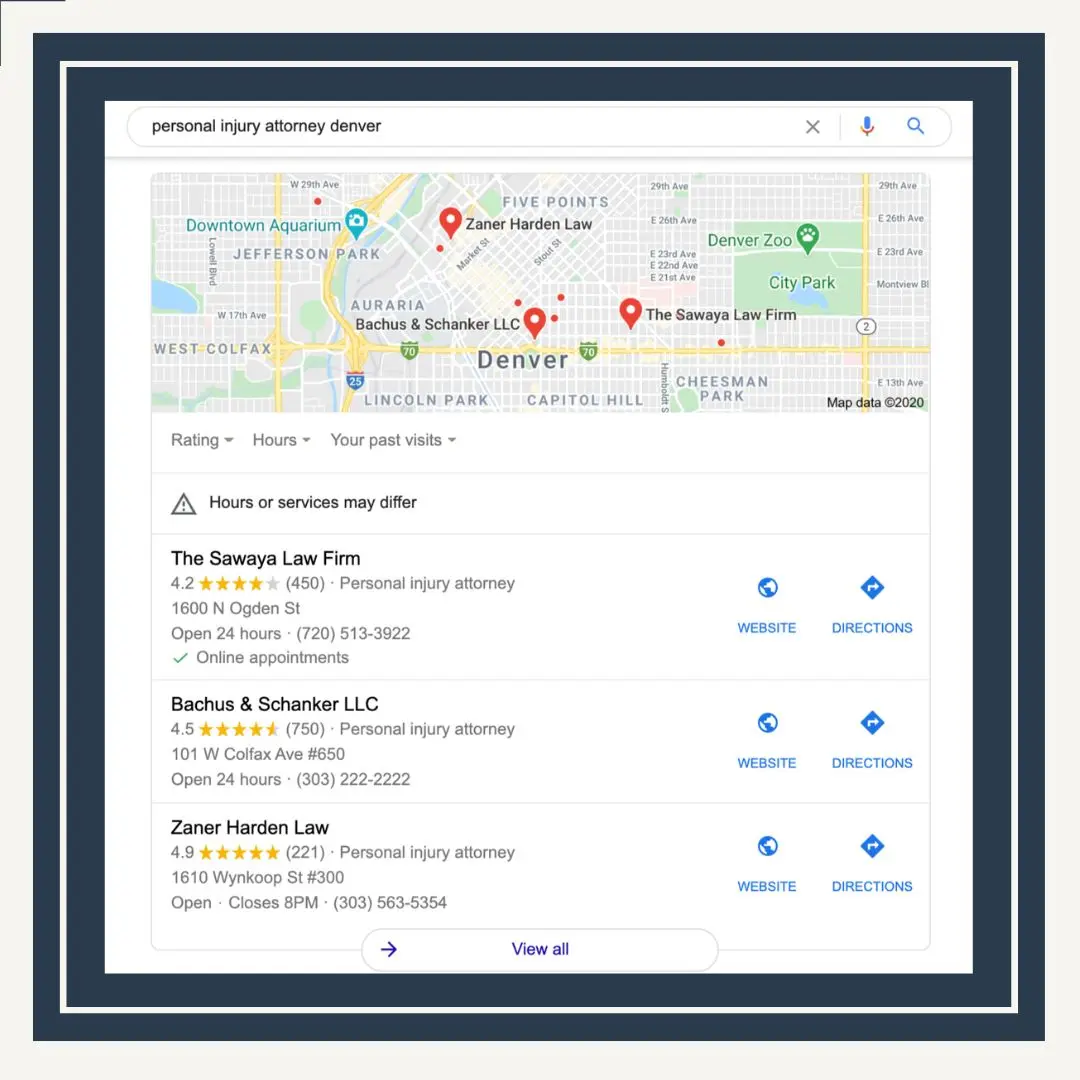
Source: Rankings.io
Google evaluates personal injury law profiles more cautiously than standard local businesses because PI involves high-stakes, sensitive decisions. It applies stricter trust standards through specific mechanics:
- Quiet suppression: Low-trust or inconsistent profiles are silently removed from the local map pack rather than penalized.
- Rigid categories: Services must map to specific legal taxonomies, not generic terms.
- Review weight: Review quantity, recency, and responses carry outsized ranking influence.
- E-E-A-T & AI Overviews: Content must show real legal experience and an answer-first structure.
Category Selection for Personal Injury Practices
Choose the most precise primary category that matches your core work (for most firms, Personal Injury Attorney) and add secondary categories only where you genuinely practice. Mismatched categories weaken relevance.
- Core case categories: motor vehicle accidents (high volume), premises/product liability, medical malpractice (specialized), workplace injuries, catastrophic injury/wrongful death (maximum value).
- Google Business Profile: use “Personal Injury Attorney” as the primary category; add secondary categories like “Legal Services” and “Trial Attorney.”
Location Signals that Influence Map-Pack Visibility
Location information helps Google connect a law firm with relevant nearby searches. Use a real, staffed address. Define service areas honestly.
Important details include:
- Correct office addresses.
- Consistent phone numbers.
- Accurate opening hours.
- Location-specific contact information.
- Relevant service-area descriptions.
- Dedicated location pages where appropriate.
A firm should not create fake office addresses or claim to operate from locations where it has no legitimate presence. Accurate location information supports both local visibility and user trust.
Which Authority Signals Matter in SEO for Personal Injury Law Firms?
Authority helps establish why a potential client should trust a law firm. In personal injury SEO, it comes from more than publishing articles or collecting backlinks.
Search engines and AI-powered discovery platforms need reliable information to understand who operates a website, what the firm specializes in, and whether its content provides useful answers.
Firms can reinforce authority through attorney biographies, legal insights, original research, reputable mentions, and consistent practice-area coverage.
Topical Authority Outweighs Content Volume
Publishing more articles does not automatically make a personal injury firm an authority. A website with dozens of shallow articles about unrelated legal topics may provide less value than one with a focused collection of useful resources about personal injury law.
For example, a firm specializing in vehicle accidents could develop a content cluster covering:
- Car accident claims and liability.
- Truck accident investigations.
- Motorcycle accident injuries.
- Pedestrian accident cases.
- Insurance company disputes.
- Evidence collection after an accident.
- Personal injury claim timelines.
Each article should answer a distinct question and link naturally to relevant practice-area pages.
Firm Identity, Expertise, and Credibility Reinforcement
A credible legal website should make it easy to identify the people and professionals behind its content.
Include attorney profiles with relevant details such as:
- Education and professional qualifications.
- Bar admissions and licensing information.
- Areas of legal practice.
- Professional memberships.
- Relevant experience.
- Published legal commentary or speaking engagements.
Legal articles should also identify their authors and, where appropriate, the attorneys who reviewed them. Use reliable legal references, including government resources, court websites, and relevant state bar information. Update articles when laws or procedures change.
SEO for Personal Injury Law Firms vs. Individual Attorneys
Search engines and AI models treat the firm and each attorney as separate entities, and both need clear, consistent profiles. The firm entity carries practice authority and local presence. The attorney entity carries personal expertise for name searches and E-E-A-T.
| SEO Area | Law Firm SEO | Individual Attorney SEO |
| Primary focus | Firm services and practice areas | Attorney expertise and reputation |
| Main pages | Practice-area and location pages | Attorney biography and professional profile |
| Authority signals | Firm history, legal resources, local mentions | Credentials, publications, and professional recognition |
| Search intent | Personal injury law firm or accident lawyer | Attorney name or specialist expertise |
| Conversion goal | Firm inquiries and consultations | Direct inquiries or attorney-specific consultations |
Both approaches should work together.
For example, a firm can publish a detailed car accident guide reviewed by an attorney who regularly handles these cases. The article supports the firm’s practice-area authority while strengthening the attorney’s professional visibility.
How Do Practice Area Pages Attract High-Value Injury Cases?
Practice-area pages are key conversion assets. They should explain services, case types, and when representation is needed, using focused pages per case category:
- One intent per page: separate car, truck, motorcycle, wrongful death, and premises liability pages to avoid keyword overlap.
- Page content: causes, injuries, legal considerations, evidence, challenges, firm approach, and consultation options.
- Localization: add genuinely local value, offices, courts, state procedures, and regional data, not just city-name swaps.
- Trust elements: credentials, testimonials, case results with disclaimers, and secure forms, while complying with ABA Rule 7.1 and state advertising rules.
Local ranking signals: validation, citations, and behavior
Local signals work as a validation system: they let Google and AI engines confirm that the firm is real and operates in a specific market.
NAP consistency
Name, address, and phone must match across the site, business profile, bar directories, legal directories, and major data aggregators. Inconsistent data is a common reason AI assistants name a different or outdated firm.
Local links, citations, and community authority
Bar association profiles, legal aid partnerships, local news, charities, and scholarships signal real local prominence. Prioritize relevance over volume.
Behavioral signals
Calls, direction requests, and website clicks from nearby users show the profile is useful. These are outcomes of a strong profile and fast response, more than levers to pull directly.
How Do Reviews Multiply Trust and Conversions for Injury Lawyers?
Reviews affect both which firm gets chosen and how confidently local and AI systems recommend it. For injury cases, human trust is the bigger prize: prospects read reviews before they call.
Do you know that 97% of consumers now read online reviews for local businesses?
Why recency and velocity matter
A steady flow of recent reviews shows the firm is active and reliable. A high rating built years ago can look stale. Ask every satisfied client at the right moment (after resolution) and make it easy.
How to respond to reviews
Reply to positive and negative reviews calmly and without disclosing confidential information; bar rules on client confidentiality apply in public replies. Responses are a trust signal for readers, and some local ranking commentary points to engagement as a factor, but treat that as secondary to the human effect.
Compliance with review rules
Never gate, incentivize, or fake reviews. Follow Google’s review policies and your state bar’s rules on testimonials.
Content strategy: question-led clusters that prove expertise
Fewer, stronger, attorney-reviewed pages beat frequent generic posts, and the best ones answer the exact questions injured people ask. Build clusters around each core practice page.
Priority questions to cover:
- What should I do after a car accident, step by step?
- How long do I have to file a personal injury claim in [state]? (state-by-state, cited, reviewed)
- How much is my injury case worth, and what factors change it?
- Do I need a lawyer for a minor accident?
- How do contingency fees work, and what costs come out of a settlement?
- Should I give a recorded statement to the other driver’s insurer?
- What if the insurer offers a quick settlement?
- How long do injury cases take to resolve?
- What if I was partly at fault? (comparative negligence rules by state)
For each page, lead with the direct answer, cite primary sources (statutes, court sites, and government data), show the reviewing attorney and date, and link to the related practice page. Add original information AI engines cannot find elsewhere: your intake patterns, typical timeline ranges from your own files, local venue notes, and anonymized case lessons.
How to Optimize for AI search (AEO and GEO)
To be cited in AI answers, write extractable answers, make the firm an unambiguous entity, and earn mentions on sources AI systems already trust. Traditional SEO remains the foundation, since most AI search features retrieve from the same web index. The additions below make pages easier to quote.
Google now says AI Overviews reach 2.5 billion+ monthly users, available in more than 200 countries and territories and 40+ languages.
How each surface finds and cites sources
| Surface | What matters most |
| Google AI Overviews / AI Mode | Standard Google indexing and ranking, helpful and well-structured pages, and strong local and entity data. No special markup is required beyond eligibility for search. Average AI Mode searches are three times longer than traditional searches |
| ChatGPT / ChatGPT Search | Pages that its search crawler can access, clear answers, authoritative mentions; Bing-index visibility also helps. |
| Perplexity | Fresh, well-cited pages and direct answers; it shows its sources prominently. |
| Gemini | Google ecosystem signals: Search index, Business Profile, YouTube, entity consistency. |
| Claude | Web-search results from crawlable, authoritative pages; clear, quotable passages. |
| Microsoft Copilot / Bing | Bing indexing (use Bing Webmaster Tools and IndexNow), Bing Places, structured and consistent data. |
AI-extractable writing checklist
- Put a 40–60 word answer directly under each question-style heading.
- Use descriptive headings that mirror real queries.
- Keep paragraphs short; use tables for comparisons and numbered lists for steps.
- Define terms in one sentence (“A statute of limitations is…”).
- Cite named sources for facts, and avoid unsourced statistics.
- Show author, reviewer, credentials, and updated date on every page.
- Update high-value pages when laws change and say what changed.
Make the firm an entity machines can verify
Use the same name, address, phone, attorney names, and descriptions everywhere. Add schema markup and link to your business profile, bar profiles, directories, LinkedIn, and media mentions. Ambiguity is the main reason AI assistants misattribute or skip a firm.
Earn mentions where AI models look
AI answers frequently draw on legal directories, local news, bar associations, review platforms, and community discussions. Build real presence there: expert quotes, directory profiles with complete data, helpful participation in relevant forums within bar rules, and original research that journalists reference.
Crawler access
Do not accidentally block the crawlers behind AI search. Review your robots.txt and CDN or security settings for search-related bots from OpenAI, Anthropic, Perplexity, Google, and Microsoft. Blocking training crawlers and allowing search crawlers are separate decisions, so have the firm choose deliberately.
Track AI visibility
Test a fixed list of 25–50 prompts monthly (for example, “best personal injury lawyer in [city],” “how long do I have to sue after a car accident in [state]”) across each platform. Record whether the firm is mentioned, cited, described correctly, and recommended. Add AI referral sources to analytics, and add “How did you hear about us?” to intake with an AI option.
Technical SEO foundations
Technical SEO for injury firms means removing friction between a person in crisis and your intake team.
Mobile speed and usability
Most urgent searches happen on phones. Aim to pass Core Web Vitals, use a sticky click-to-call button, and use large tap targets and short forms. Test on mid-range phones over mobile networks.
Internal linking
Link cluster content to the relevant practice page with descriptive anchors, and link practice pages to attorney bios and local pages. Remove self-referencing links (the current page links to itself in one place).
Avoiding thin content
Merge or remove shallow pages and consolidate overlapping city pages. Redirect retired URLs to the closest relevant page.
Structured data
| Schema Type | Where |
| Article / BlogPosting with author, reviewedBy, dateModified | Guides and blog posts |
| Person (with credentials, sameAs links) | Attorney pages |
| LegalService or Attorney (with address, phone, hours, areaServed) | Firm and location pages |
| FAQPage | Pages with visible FAQs (supports non-Google engines; Google limits FAQ rich results for most sites) |
| BreadcrumbList | All pages |
Schema must match visible content. Never mark up reviews you display for yourself in a way that violates Google’s review snippet policies.
Link acquisition without risk
One relevant local link from a bar association or regional news outlet outweighs dozens of purchased guest posts.
Links that reinforce credibility
Editorial mentions, expert commentary, bar and legal association profiles, sponsorships, scholarships, and community partnerships.
Tactics that quietly damage trust
Paid link networks, low-quality directories, and mass guest posts risk spam policy action. Google ran several spam updates in 2026, so treat any link you wouldn’t show a bar reviewer as a liability.
Measure signed cases, not traffic
The right KPIs connect search activity to revenue.
Metrics that indicate high-value case acquisition
- Calls and form fills from local organic and Map Pack, by practice area
- Qualified leads, signed cases, and cost per signed case
- Average case value by source (where tracking allows)
- Branded search growth in the service area
- AI visibility: prompts where the firm is cited or recommended
- Review count, recency, and rating
Why rankings alone mislead
A position-one ranking for a low-intent phrase can generate calls you cannot sign. Judge SEO by the cases it produces.
Real Results: Improving Organic Visibility for Law Firms
Rankings are only one part of SEO performance. Search clicks and organic sessions help show whether more people are actually reaching a firm’s website. At ResultFirst, we’ve tracked these improvements across four U.S. law firm campaigns, with positive growth in both organic sessions and search clicks for every client.
A few results stand out:
-
McNeill Law Office: Organic sessions increased by 278%, while search clicks grew by 228%.
-
HarrisLaw P.A.: Organic sessions increased by 48%, with search clicks up 46%.
-
Kia Law Firm: Search clicks grew by 57%, while CTR improved from 0.7% to 1.2%.
-
Pimentel Law, P.C.: Search clicks increased by 48%, and nine keywords reached Google’s organic Top 10.
Across the four engagements, combined organic sessions increased by 93%, from 14,894 to 28,807, while search clicks grew by 77%, from 13.49K to 23.90K.
For personal injury firms, these metrics are useful starting points. The next step is to connect them with call tracking, consultation requests, and intake records to understand which search improvements are attracting suitable cases.
Scaling SEO for Multi-location Injury Firms
Multi-location firms need central standards with local ownership.
Normalizing performance across markets
Benchmark each market against its own competition and demand, not the firm average. Track signed cases per market.
Governance
Centralize naming, templates, schema, review process, and reporting. Let local attorneys supply the unique jurisdiction content. Audit every business profile quarterly.
Why Strategies Plateau (and a 90-day plan)
Plateaus happen when trust signals stop being reinforced: review velocity slows, content ages, and competitors invest more.
90-day plan
- Days 1–30: Audit business profile, NAP, robots.txt and crawler access, practice pages, intake response time, and tracking. Fix inconsistencies and add attorney bios.
- Days 31–60: Rewrite top practice pages with answer-first blocks, local detail, fee explanations, and schema. Launch the review process.
- Days 61–90: Publish the first question-led cluster, pursue 3–5 relevant local links or media mentions, and start the monthly AI prompt test..
Conclusion
SEO for personal injury lawyers is a precision system: local visibility, verified expertise, answer-ready content, and fast intake working together. Firms that show real attorneys, real local proof, and clear answers are the ones Google and AI assistants are most comfortable recommending.
As search expands across Google and AI-powered platforms, original expertise and reliable information will remain essential. ResultFirst is a performance-driven law firm SEO agency focused on signed cases rather than surface metrics. It helps law firms develop SEO strategies that strengthen online visibility, attract relevant prospects, and support measurable business growth.
Explore More:
- SEO for Divorce Attorneys to Increase Consultations.
- SEO for Family Law Firms
- SEO for Criminal Lawyers
- SEO for Employment Law Attorneys
- SEO for Bankruptcy Law Firms
Sources Referenced:
- https://www.clio.com/about/press/2026-legal-trends-report/
- https://thelawfirmseoagency.com/research/
- https://attorneysluice.com/legal-marketing-statistics-law-firms-need-to-know/
- https://backlinko.com/google-user-behavior/
- https://support.google.com/business/answer/7091/
- https://www.americanbar.org/groups/professional_responsibility/publications/model_rules_of_professional_conduct/rule_7_1_communication_concerning_a_lawyer_s_services/
- https://www.brightlocal.com/research/87-of-consumers-aged-18-34-have-reviewed-a-local-business-on-social-media/
- https://www.searchenginejournal.com/google-search-behavior-shifts-2027-ads-strategy/594971/
FAQ’s:
WHAT TO READ NEXT
READY TO BUILD PREDICTABLE ORGANIC GROWTH?
We are the only TOP SEO services agency providing Real Results in a Real Performance model. We help growth hungry companies outperform their competition and achieve 300%+ growth in their digital marketing initiatives.
- San Jose, CA, 95120

- +1-888-512-1890

- sales@resultfirst.com

300K+
KEYWORDS RANKED
546M+
REVENUE GENERATED
18 Years
SOLVING COMPLEX SEO
150+
TEAM MEMBERS