


 sales@resultfirst.com
 +1-888-512-1890

Local SEO vs. National SEO: Which Strategy Is Right for Your Business?

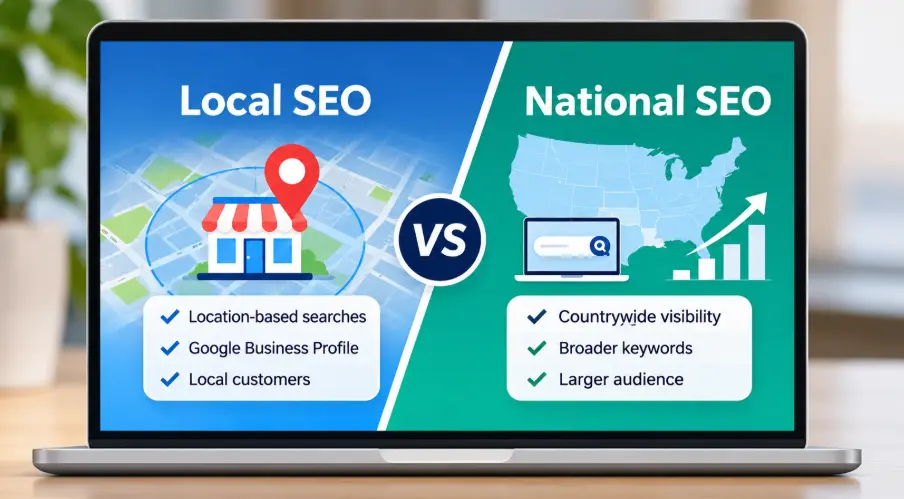
Local SEO is ideal for businesses targeting customers in specific geographic areas, while national SEO helps businesses attract customers across an entire country. The right strategy depends on your business model, target audience, competition, and growth objectives.
For example, a dental clinic needs local visibility to attract nearby patients, whereas an e-commerce company needs broader visibility to sell products nationwide. Both approaches improve organic search performance, but their keyword targeting, content requirements, and optimization priorities differ. Businesses operating across multiple locations may also benefit from combining both strategies.
Understanding these differences helps businesses allocate their SEO budgets effectively, attract qualified visitors, and turn search visibility into measurable leads, sales, and long-term growth.
What Is Local SEO?
Local SEO is the process of optimizing a business’s online presence to improve its visibility in geographically relevant search results. It helps businesses connect with potential customers searching for nearby products, services, or physical locations.
For example, when someone searches for “best dentist in Chicago,” “plumber near me,” or “restaurants in Los Angeles,” Google may display local business listings, Google Maps results, and relevant webpages.
These searches indicate that users are looking for businesses within a particular geographic area. Local SEO helps businesses appear in these results through website optimization, Google Business Profile management, customer reviews, local citations, and location-specific content.
What Are the Main Components of Local SEO?
The main elements of a local SEO strategy include:
- Google Business Profile optimization: Maintain accurate business information, including your business name, address, phone number, operating hours, services, and categories.
- Local keyword optimization: Target location-specific searches such as “accounting services in Mumbai” or “best bakery in Srinagar.”
- Local citations: Maintain consistent business information across relevant online directories and business listing platforms.
- Customer review management: Encourage genuine customer reviews and respond to feedback to build trust and strengthen your online reputation.
- Location-specific landing pages: Create dedicated pages for different business locations and service areas.
- Local link building: Earn relevant backlinks from local publications, community organizations, business associations, and industry websites.
Which Businesses Should Prioritize Local SEO?
Local SEO is particularly valuable for businesses that depend on customers within a defined geographic area.
These include:
- Restaurants, cafes, and retail stores.
- Hospitals, dental clinics, and healthcare practices.
- Law firms and accounting businesses.
- Plumbers, electricians, and home service providers.
- Gyms, salons, and fitness centers.
- Hotels and location-based hospitality businesses.
- Multi-location businesses serving different cities.
For example, a plumbing company operating in Chicago should prioritize searches such as “emergency plumber in Chicago” instead of spending most of its resources targeting broad plumbing keywords across the entire country.
Its primary objective is to connect with customers who need plumbing services within its actual service area.
Read More: Local SEO Best Practices for Local Search Growth
What Is National SEO?
National SEO focuses on improving a website’s organic search visibility across an entire country. Instead of concentrating on one city or neighborhood, it targets broader industry, product, and service-related keywords.
For example, an e-commerce company selling skincare products nationwide might target searches such as “best skincare products,” “organic face moisturizer,” and “sunscreen for oily skin.”
These keywords can attract customers from different regions without requiring them to search for a specific location.
National SEO focuses on building website authority, publishing valuable content, improving technical performance, and targeting relevant keywords with broader search demand.
What Are the Main Components of National SEO?
National SEO requires a comprehensive approach to website optimization. Businesses must compete with established websites, industry publications, and brands targeting similar keywords.
The main elements of a national SEO strategy include:
- Broad keyword research: Identify industry-specific, product-related, and commercial keywords with relevant national search demand.
- Content development: Publish informative articles, product comparisons, buying guides, and comprehensive industry resources.
- Authority building: Earn backlinks from reputable industry publications, relevant websites, and authoritative sources.
- Technical SEO: Improve website speed, mobile usability, crawlability, indexing, and site architecture.
- Search intent optimization: Create pages that address informational, commercial, and transactional search queries.
- Brand development: Build industry recognition through original research, expert insights, and consistent content marketing.
Which Businesses Should Prioritize National SEO?
National SEO is suitable for businesses that can sell products or deliver services to customers across multiple geographic markets.
Examples include:
- E-commerce businesses.
- SaaS companies and software providers.
- Online education platforms.
- Nationwide B2B service providers.
- Financial technology companies.
- Online marketplaces.
- Media publications and content-driven businesses.
For example, a SaaS company offering customer relationship management software can attract customers from different states. Its SEO strategy should focus on software-related keywords, solution pages, product comparisons, and industry-specific resources rather than location-based searches alone.
What Are the Differences Between Local SEO and National SEO?
Local SEO and national SEO share the same fundamental objective: improving organic search visibility. However, they use different targeting methods, optimization techniques, and performance indicators
| Comparison factor | Local SEO | National SEO |
| Target audience | Customers in a specific city, region, or service area | Customers across the country |
| Keyword targeting | Location-based keywords and near-me searches | Broad industry, product, and service keywords |
| Search intent | Primarily local and transactional | Informational, commercial, and transactional |
| Competition | Local businesses and service providers | Established national brands and industry competitors |
| Main optimization focus | Google Business Profile, local pages, citations, and reviews | Website content, technical SEO, backlinks, and topical authority |
| Link-building strategy | Local publications, directories, and community websites | Industry publications and authoritative websites |
| Content strategy | Location pages, local guides, and service-area content | Comprehensive guides, product pages, and industry resources |
| Geographic reach | Limited to targeted locations | Nationwide |
| Primary business goals | Calls, appointments, store visits, and local leads | Organic traffic, online sales, and nationwide lead generation |
| Success metrics | Local rankings, Maps visibility, calls, and directions | Organic traffic, keyword visibility, conversions, and revenue |
Both approaches require keyword research, quality content, technical optimization, and ongoing performance monitoring. The difference is how businesses prioritize these activities to achieve their objectives.
How Does Google Determine Local Search Rankings?
Google uses three primary factors to determine local search rankings: relevance, distance, and prominence. These factors help Google identify businesses that best match a user’s query and location.
According to Google’s official Business Profile documentation:
1. Relevance
Relevance measures how closely a business profile matches what someone is searching for.
For example, a person searching for an Italian restaurant is more likely to see businesses categorized and described as Italian restaurants than unrelated food establishments.
Businesses can improve relevance by providing complete and accurate information, selecting appropriate categories, and describing their services clearly.
2. Distance
Distance refers to how far a business is from the searcher’s location or the location included in the search query.
For example, someone searching for “coffee shops near me” may see different results depending on where they are searching.
Businesses cannot simply add more location keywords to overcome geographic distance. Google considers the searcher’s location when determining relevant local results.
3. Prominence
Prominence refers to how well-known a business is. Google considers information such as website links and customer reviews when evaluating how prominent a business may be.
Businesses can strengthen their online reputation through genuine customer reviews, relevant backlinks, and consistent business information.
Google also confirms that businesses cannot pay for better organic local rankings.
How Do You Choose Between Local SEO and National SEO?
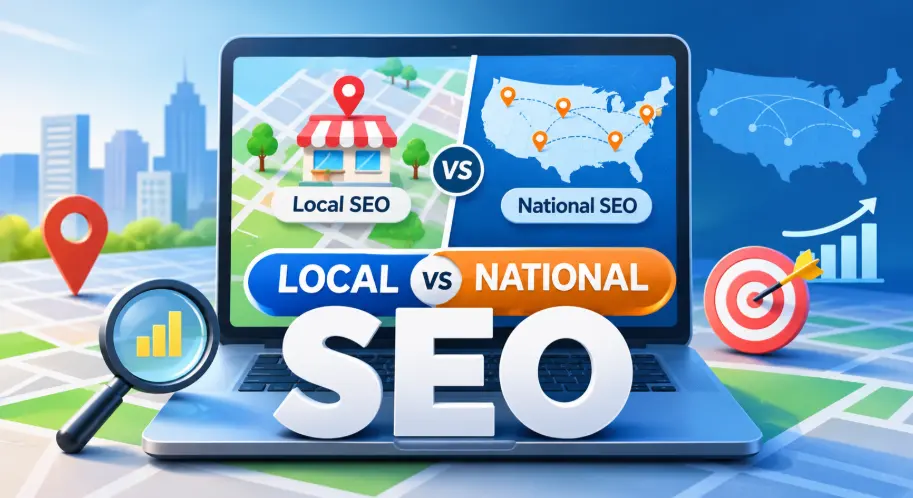
Choosing the right SEO strategy requires understanding your business model, customer behavior, competition, and long-term growth plans. Instead of selecting a strategy based only on keyword search volume, evaluate where your customers are and how they purchase your products or services.
1. Evaluate Your Business Model
Your business model is one of the strongest indicators of which SEO approach you need.
Choose local SEO if:
- Customers visit your physical business location.
- You provide services within specific cities or regions.
- Your business depends on local appointments and inquiries.
- You compete with other businesses in a defined service area.
- Your products or services have geographic restrictions.
Choose national SEO if:
- You sell products to customers across the country.
- Your services are available nationwide.
- You operate an online platform or SaaS business.
- You want to build visibility for broader industry-related searches.
- Your business can manage customers from multiple regions.
For example, a dental clinic in Chicago should prioritize local searches such as “dentist in Chicago” and “dental clinic near me.” An online dental product retailer selling nationwide should focus on broader product searches and category keywords.
2. Understand Your Target Audience’s Search Behavior
Customer search behavior determines whether local or national SEO will attract more relevant opportunities.
People looking for nearby services often include location names or phrases such as “near me” in their searches. They may also use Google Maps to compare businesses, check operating hours, and read customer reviews.
A recent report found that one in five US consumers conduct local searches directly within mapping applications. This demonstrates why businesses should optimize their Google Business Profiles and maintain accurate information across relevant discovery platforms.
On the other hand, people researching products, software, or professional solutions may search using broader terms without specifying a location.
For national SEO, businesses should examine broader search intent. A software buyer, for example, may compare product features, pricing, integrations, and alternatives before choosing a provider. The content strategy should address these requirements rather than focus on geographic keywords.
3. Assess Your Competition and Available Budget
Local and national SEO involve different competitive environments.
A local business competes with other relevant businesses in its target area. Its SEO campaign may focus on improving Google Business Profile visibility, building local citations, earning genuine reviews, and optimizing service pages.
A national business competes with websites targeting similar keywords across the country. It may need more extensive content production, technical improvements, digital PR, and authority-building activities.
Your budget should reflect these requirements.
For example, a local accounting firm targeting one city may not need an extensive national content campaign. Similarly, an e-commerce company with nationwide ambitions may not achieve its objectives through Google Business Profile optimization alone.
The important consideration is to invest in activities that support your actual business requirements.
4. Align Your SEO Strategy With Long-Term Growth Goals
Your immediate business requirements should not be the only consideration. Think about where you want your company to operate over the next two to three years.
For example:
- A local restaurant may want to increase reservations within its current city.
- A regional healthcare provider may plan to open clinics in additional cities.
- An e-commerce company may want to expand its product categories and customer base.
- A B2B technology company may want to attract enterprise clients across different industries.
Your SEO strategy should support these objectives. If your business plans to enter new markets, you may need to gradually expand from local optimization into regional or national SEO.
Can Local SEO and National SEO Work Together?
Yes. Local SEO and national SEO can work together as part of a unified search strategy. This approach is particularly useful for multi-location businesses, national service providers, and brands expanding into new geographic markets.
Consider a home improvement company operating in multiple cities.
Its national SEO campaign can target broad searches such as “home renovation services” and “interior design ideas.” Meanwhile, its local SEO campaign can target searches such as “home renovation services in Dallas” and “interior designers in Chicago.”
The company can implement this strategy through:
1. Dedicated Location Pages: Create useful pages for each city or business location, including relevant services, contact information, and location-specific details.
2. Individual Google Business Profiles: Maintain accurate profiles for eligible physical business locations.
3. National Content Marketing: Publish industry guides, service comparisons, educational articles, and informational resources.
4. Localized Content: Address market-specific requirements, customer questions, and service availability.
5. Relevant Link Building: Earn links from local organizations, regional publications, and authoritative industry websites.
6. Consistent Technical Optimization: Maintain a clear website structure that helps search engines discover and understand important pages.
A hybrid strategy allows businesses to build broader brand authority while capturing geographically relevant search demand.
How Do You Measure the Success of Local SEO and National SEO?
The success of an SEO campaign should be measured through qualified traffic, customer engagement, leads, and revenue. Rankings are useful indicators, but they do not independently demonstrate business growth.
Which Metrics Should You Track for Local SEO?
Businesses investing in local SEO should monitor:
- Google Business Profile interactions: Track calls, website clicks, and direction requests.
- Local keyword rankings: Measure visibility for city-specific and service-based searches.
- Google Maps performance: Monitor visibility for relevant local queries.
- Customer reviews: Evaluate review volume, ratings, and customer feedback.
- Local organic traffic: Measure visits from target geographic markets.
- Lead conversions: Track calls, appointment bookings, quote requests, and contact form submissions.
For example, a dental clinic should measure how many qualified appointment requests originate from organic search rather than evaluating success through website traffic alone.
Which Metrics Should You Track for National SEO?
National SEO requires a broader performance measurement approach.
Businesses should monitor:
- Organic traffic: Measure growth in non-paid search visits.
- Keyword visibility: Track rankings for important industry and product keywords.
- Click-through rate: Understand how often search impressions generate website clicks.
- Content performance: Identify pages attracting qualified visitors and generating conversions.
- Backlink profile: Monitor relevant referring domains and link quality.
- Organic revenue: Measure sales and qualified leads generated through organic search.
Google Analytics 4 helps businesses analyze website traffic and conversions, while Google Search Console provides information about search impressions, clicks, CTR, and search queries.
Businesses can also use SEO platforms such as Semrush and Ahrefs to monitor keyword rankings, competitor performance, and backlink profiles.
The most important step is connecting SEO performance to business outcomes. Increasing organic traffic is valuable only when it attracts the right audience and creates meaningful opportunities.
How Much Should You Invest in Local SEO vs. National SEO?
The investment depends on your industry, competition, website condition, target keywords, and campaign objectives. Neither strategy has a fixed cost.
Local SEO investment generally focuses on:
- Google Business Profile optimization.
- Local keyword research.
- Location-specific landing pages.
- Citation management and review monitoring.
- Local link building.
- Website and technical improvements.
A dental clinic targeting one city may need a smaller campaign than a healthcare group managing several clinics across different regions.
National SEO investment generally involves:
- Comprehensive keyword and competitor research.
- Ongoing content development.
- Product and service page optimization.
- Technical SEO improvements.
- Digital PR and authority building.
- Conversion optimization and performance monitoring.
An e-commerce company competing for high-demand product keywords may require substantial resources to compete with established national retailers.
National SEO generally requires a broader investment, but local SEO costs can also increase significantly in competitive markets or multi-location campaigns.
How Long Does Each SEO Strategy Take to Show Results?
SEO does not produce guaranteed results within a fixed period. The timeline depends on website authority, competition, technical health, content quality, and optimization consistency.
A practical planning estimate includes:
- Months 1–2: Keyword research, technical audits, competitor analysis, and website improvements.
- Months 3–4: Content development, landing page optimization, and link-building activities.
- Months 5–6: Evaluate ranking changes, organic traffic, local visibility, and early conversion trends.
- Months 7–12: Expand successful campaigns, strengthen content authority, and improve conversion performance.
Local SEO may show improvements earlier when competition is limited, and business information is already established. National SEO can require a longer investment because of broader keyword competition.
These are indicative planning stages, not guaranteed ranking timelines.
Conclusion: Which SEO Strategy Should Your Business Choose?
Local SEO and national SEO serve different business objectives, but both can contribute to sustainable growth. Local SEO is suitable for businesses targeting customers in specific geographic areas, while national SEO helps companies build visibility across broader markets.
If your business operates in multiple locations or plans to expand, combining both strategies can create additional opportunities for customer acquisition.
The right approach starts with understanding your audience, evaluating your competition, and identifying opportunities through a comprehensive SEO audit. Focus on qualified traffic, relevant rankings, and conversions rather than visibility alone.
Want to build an SEO strategy that delivers measurable results? ResultFirst helps businesses identify keyword opportunities, resolve technical SEO issues, strengthen website authority, and improve organic visibility. Whether you need local SEO, national SEO, or both, ResultFirst can help develop a strategy aligned with your business goals.
Explore our local search optimization services to improve your business visibility and reach customers in your target locations.
FAQs:
WHAT TO READ NEXT
READY TO BUILD PREDICTABLE ORGANIC GROWTH?
We are the only TOP SEO services agency providing Real Results in a Real Performance model. We help growth hungry companies outperform their competition and achieve 300%+ growth in their digital marketing initiatives.
- San Jose, CA, 95120

- +1-888-512-1890

- sales@resultfirst.com

300K+
KEYWORDS RANKED
546M+
REVENUE GENERATED
18 Years
SOLVING COMPLEX SEO
150+
TEAM MEMBERS