

 sales@resultfirst.com
 +1-888-512-1890

Google Confirms November 2026 Core Update Is Complete

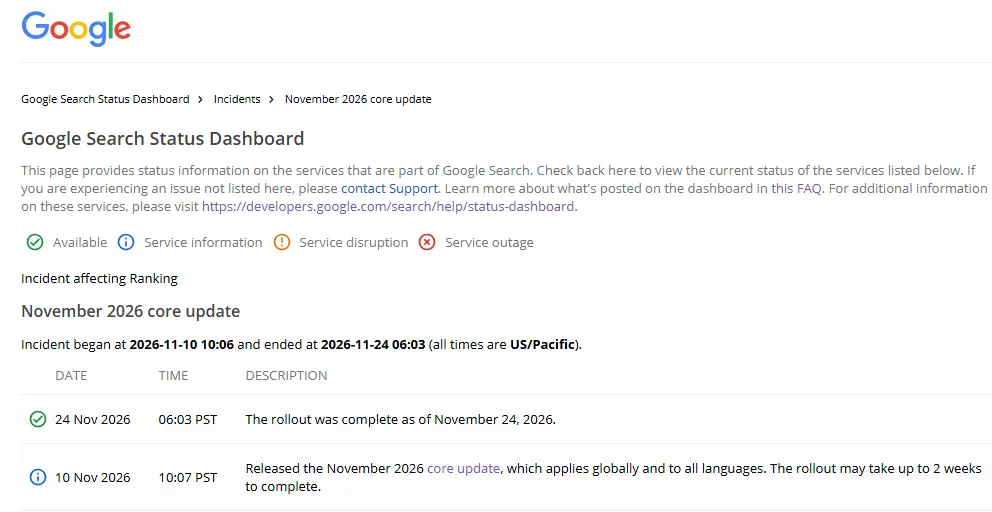
Google has officially closed the book on its November 2026 core update, confirming the rollout finished on November 24 after nearly two weeks of global turbulence. According to the Google Search Status Dashboard, the update began at 10:06 a.m. PT on November 10 and concluded at 6:03 a.m. PT on November 24, landing squarely inside the two-week window Google initially promised. The update applied globally and to all languages.
Source: Google
The confirmation appeared on Google’s Search Status Dashboard, which tracks updates and incidents affecting Google Search. Although the rollout has ended, website owners should avoid making rushed decisions based on short-term ranking movements. A closer look at search performance and page-level data can help businesses understand what changed and where improvements may be needed.
What Website Owners Should Review After the Update
A completed rollout gives website owners a better opportunity to assess ranking and traffic changes. However, Google recommends waiting at least one full week after a core update finishes before analyzing its impact.
For this update, the first full week after completion runs from November 25 to December 1. Website owners can compare this period with November 3–9, which provides a pre-update reference period.
Google Search Console can help businesses review changes in clicks, impressions, average position, and search queries. Instead of looking only at overall website traffic, examine individual pages and content sections to identify where the biggest changes occurred.
What the Industry Spotted
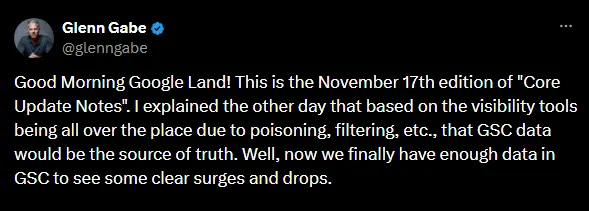
Consultant Glenn Gabe, writing on X, traced the real impact to November 13, three days into the rollout. He relied on Search Console because third-party tools initially looked unreliable. By November 20, he said their trend lines matched what he saw in Search Console.
Source: X
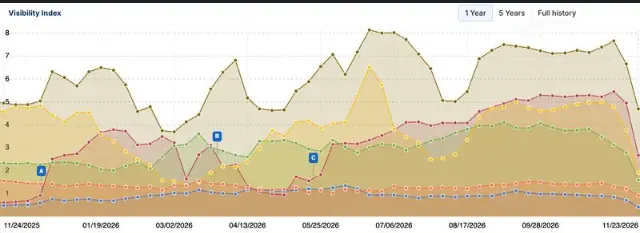
Lily Ray shared a chart on LinkedIn covering six sites. On each, one folder repeated a single template thousands of times, such as pages per word or “X vs Y” pairings. These folders were sliding fast. According to Ray, the blog and resource sections were falling hard while core product and brand pages held steady. She also saw similar declines in AI Overview and AI Mode citations for those folders.
Source: LinkedIn
Reading Your Data Without Misleading Yourself
Google’s core update guidance advises waiting at least a full week after completion. You then compare that week with a week before the rollout began. On this update’s dates, that means November 25 to December 1 against a baseline such as November 3-9.
The calendar adds complications:
- Holiday traffic. The post-update week contains Thanksgiving, Black Friday, and Cyber Monday. A retailer comparing it with a normal pre-update week is measuring two things at once. As a cross-check, SEJ suggests laying the same holiday period from last year beside Google’s suggested comparison.
- Bot-driven clicks. Marie Haynes reported that the click spike some owners saw from October 31 to November 2 was not human. Starting the baseline on November 3 sidesteps it.
- A logging gap. Google’s data anomalies page lists a logging issue that lowered impression counts in the generative AI performance report for November 9-11. That overlaps the end of the baseline week.
A page-path filter in the performance report lets you separate product pages from a templated content folder like those in Ray’s examples. Google’s guidance also cautions against editing content that is already performing well.
The Road Ahead
Google’s November 2026 Core Update officially ended on November 24 after nearly two weeks. Website owners should now focus on understanding their performance data, identifying affected content, and improving pages that do not fully meet searchers’ needs.
Rather than reacting to every ranking movement, businesses should use this period to strengthen their content and build a more reliable search presence.
Need Help Reading the Results?
If your numbers moved and you can’t tell whether the cause is the update, the holidays, or bot traffic, ResultFirst can help. Contact ResultFirst to explore our SEO services for a clear, data-driven review of your post-update performance and a plan built around what Google’s guidance actually recommends. Contact us Now!
WHAT TO READ NEXT
READY TO BUILD PREDICTABLE ORGANIC GROWTH?
We are the only TOP SEO services agency providing Real Results in a Real Performance model. We help growth hungry companies outperform their competition and achieve 300%+ growth in their digital marketing initiatives.
- San Jose, CA, 95120

- +1-888-512-1890

- sales@resultfirst.com

300K+
KEYWORDS RANKED
546M+
REVENUE GENERATED
18 Years
SOLVING COMPLEX SEO
150+
TEAM MEMBERS